
What the Engagement Looks Like
A Science-Based Audit — Start to Finish in Under Four Hours
The Execution Audit applies principles from systems science, constraint theory, and decision research to a specific business problem your organization can’t resolve. These are the same fields that explain why bridges hold, why circuits stabilize, and why engines produce power instead of waste heat. Organizations are subject to the same physics — structure and constraints govern outcomes, not effort or intent.
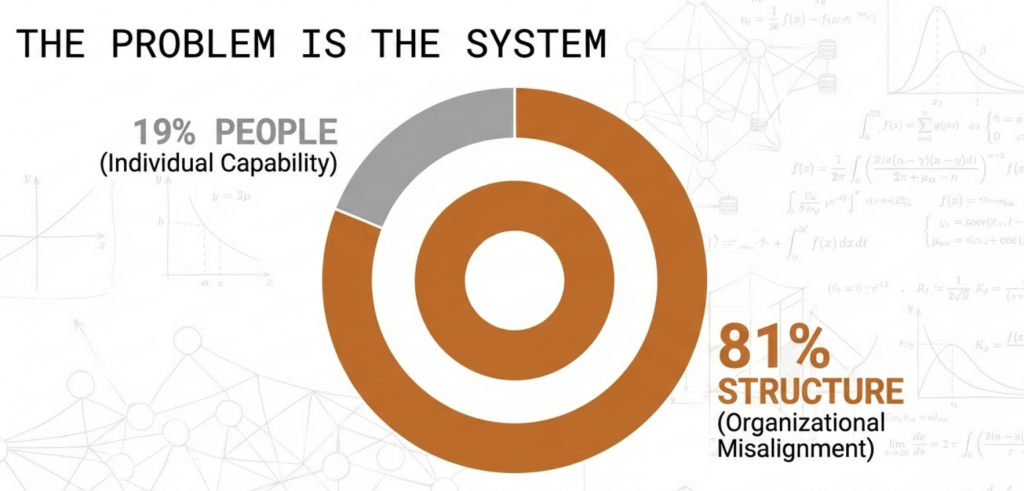
You bring the problem. Through a structured intake and one facilitated session, we identify the specific structural reason it’s unresolved and deliver a written brief with the finding, the evidence, and the fix.
Here’s exactly how it works.
STEP 1 — MAP THE PROBLEM
Structured Intake (completed before the session)
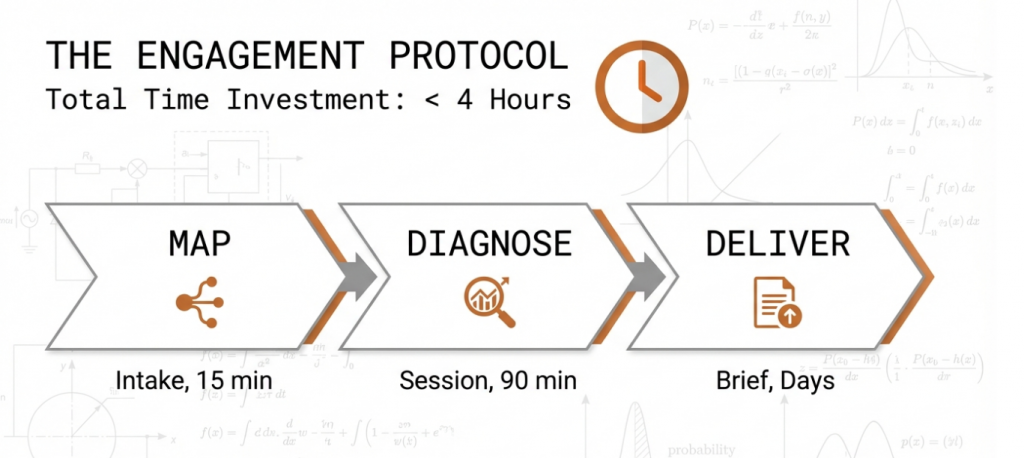
You select 3–7 people closest to the problem — typically a mix of leadership and execution roles. Each person completes a short structured online survey independently. It takes about 15 minutes.
What the intake captures:
- How each person sees the problem — where it recurs, what triggers it, why past fixes didn’t hold
- Who has authority over the problem versus who is accountable for outcomes
- What constraints are shaping the situation — budget, policy, timelines, incentives
- Where definitions of “success” differ across roles
Why it matters: The intake gives me the problem from multiple angles before the session starts. Patterns — especially disagreements between roles — become visible in the data before anyone is in the room. This means the session doesn’t start with “so tell me about the problem.” It starts with what the data already shows.
STEP 2 — DIAGNOSE THE STRUCTURE
What happens in the session:
- We present the intake patterns — where responses align, where they diverge, and what that reveals about the structure underneath the problem
- Using classification methods from decision science, we identify what type of problem this actually is versus how it’s being treated — this is where most structural mismatches live
- We apply constraint analysis to map where authority, incentives, and constraints are working against each other
- We separate what’s a structural issue from what’s a people issue — with evidence from the intake data, not opinion
STEP 3 — DELIVER THE FIX
Written Clarity Brief (delivered within one week)
You receive a 7–10 page written brief. It is designed to be acted on — not filed.
What the brief contains:
- The structural finding — the specific mismatch causing the problem to cycle, stated plainly
- The evidence — drawn from intake data, session observations, and cross-validation between them
- 1–3 corrections — each with an owner (role, not name), a sequence (what to do first), and an expected effect
- A 30-day check — what to watch for to confirm the correction is working
What the brief does not contain:
- Jargon, theory, or frameworks to “implement”
- Broad strategy recommendations
- A proposal for further engagement
The corrections are designed to be actionable by your team independently. If you want follow-on support, it’s available — but the brief is built to stand alone.
AFTER THE AUDIT
What Happens Next Is Up to You
Some organizations implement the corrections independently and the problem resolves. Some use the brief to scope a larger initiative with clarity they didn’t have before. Some bring me back for a follow-on engagement on a deeper or related issue.
There is no automatic phase two. No retainer. No obligation. The diagnostic is a complete engagement — you get a finding and a fix, and what you do with it is your call.
If the problem is deeper or more interconnected than a single diagnostic can address, I’ll tell you that directly — along with what a deeper engagement would look like and what it would cost.
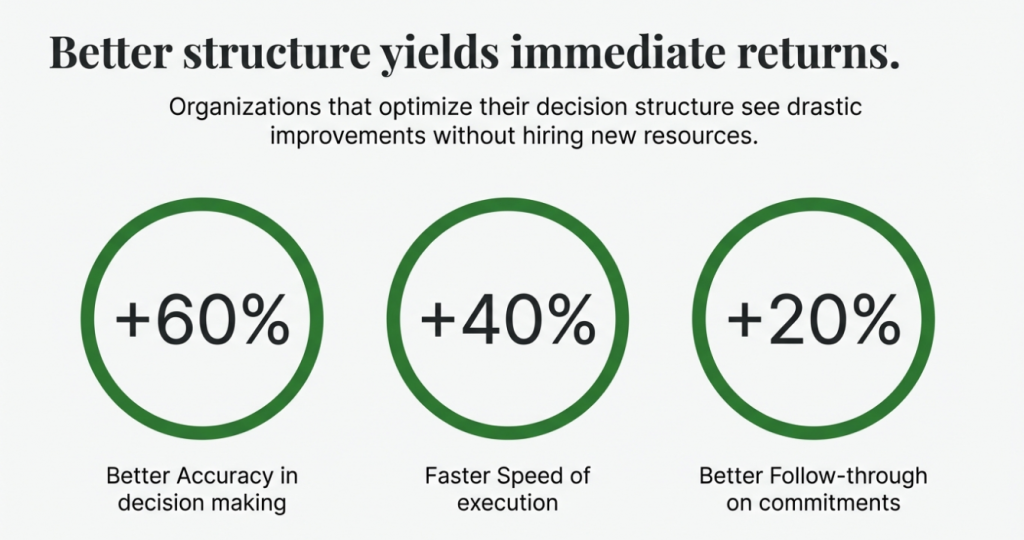
The analysis behind the brief draws on validated principles from systems science and constraint theory. The delivery is plain operational language — no equations, no jargon, no frameworks to learn.
Time: Under four hours total (15-minute intakes + 90-minute session)
Deliverable: Written Clarity Brief, delivered within one week
Commitment: None beyond the engagement itself.