
Structured Probability Modeling for Time-Framed Strategic Outcomes
Clarity Under Pressure. Decisions Under Constraint.
Outcome Modeling is a structured strategic analysis service that determines the most probable time-framed outcomes given defined operational, financial, regulatory, and market constraints.
Rather than projecting broad “best case / worst case” futures, this service evaluates what is structurally possible, what is improbable, and what is time-bound under current conditions. The output is not a narrative scenario. It is a constraint-anchored probability map.
Using Archion mapping methodology, we assess how interacting constraints shape outcome trajectories over defined time horizons. The result is a disciplined view of what is likely to happen — and when — if current structural pressures persist.
What This Service Does
Most scenario planning asks, “What could happen?”
Outcome Modeling asks:
- Given capital constraints, what expansion velocity is realistically achievable?
- Given regulatory friction, how long will deployment actually take?
- Given labor tightness, what revenue scaling rate is structurally feasible?
- Given liquidity posture, when does stress probability materially increase?
Instead of imagination-based futures, we model constraint-bound trajectories.
How It Works
1. Constraint Identification
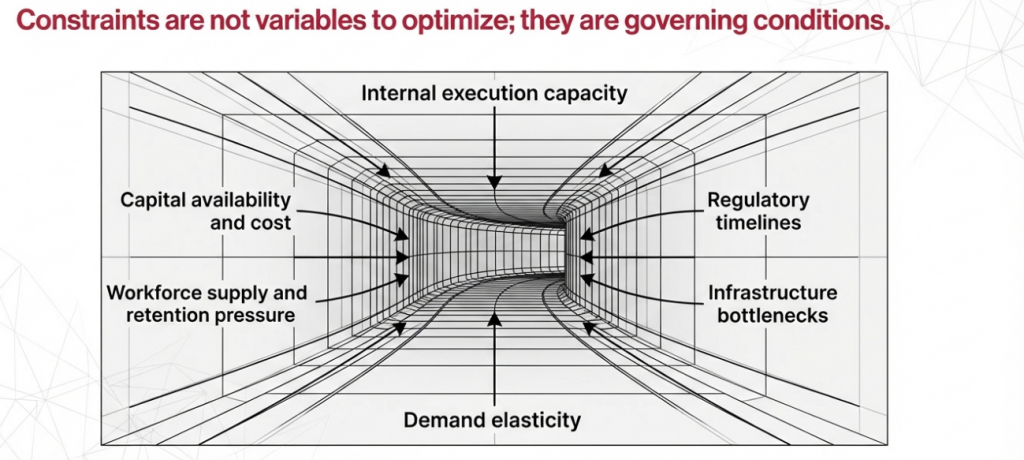
We begin by mapping the structural constraints shaping the situation. These typically include:
- Capital availability and cost
- Workforce supply and retention pressure
- Regulatory timelines and compliance friction
- Infrastructure bottlenecks
- Demand elasticity and macro exposure
- Internal execution capacity
Constraints are not treated as variables to optimize; they are treated as governing conditions.
2. Interaction Mapping
Using proprietary mapping logic, we evaluate how constraints interact rather than operate independently.
For example:
- Capital × Regulatory → Deployment delay risk
- Workforce × Demand → Margin compression probability
- Infrastructure × Velocity → Revenue realization lag
- Liquidity × Time → Stress threshold window
This interaction layer identifies pressure accumulation points and sequencing effects across time.
3. Time-Framed Probability Assessment
We then model probable outcomes across defined horizons:
- 0–6 months
- 6–18 months
- 18–36 months
For each horizon, we evaluate:
- Most probable operating condition
- Threshold events that alter trajectory
- Constraint shifts required for deviation
- Estimated timing of structural inflection points
The objective is disciplined forward clarity — not prediction theater.
What You Receive
Each engagement delivers a structured Scenario Constraint Brief (8–15 pages) containing:
- Identified structural constraints
- Interaction map visualization
- Time-framed outcome probabilities
- Inflection triggers and stress thresholds
- Strategic leverage points
The brief is written in operational language and designed for executive or board-level review.
What This Is Not
Outcome Modeling is not:
- Traditional scenario planning workshops
- Visioning exercises
- Monte Carlo simulation outputs without structural logic
- A macroeconomic forecast
It does not generate speculative narratives. It does not assume infinite adaptability. It defines what is structurally probable under real-world constraint conditions.
Who Uses It
This service is designed for organizations facing material uncertainty where timing matters. Typical users include:
- Regional banks evaluating credit cycle exposure
- Private equity firms modeling deployment pacing
- Growth-stage operators stress-testing expansion assumptions
- Infrastructure developers sequencing capital deployment
- Economic development entities assessing policy impact timing
If the question is “What happens if conditions hold?” or “When does this break?” — this service exists to answer it.
Use Cases
Structured Outcome Modeling is most valuable when leadership faces consequential decisions under structural pressure.
It is designed for moments when timing, sequencing, and probability matter more than optimism.
Common applications include:
- Credit Stress Window Analysis
Determining when borrower portfolios are most likely to experience performance deterioration given interest rates, liquidity tightening, and sector exposure. - Capital Deployment Sequencing
Modeling the most probable pacing of expansion given regulatory timelines, workforce availability, and infrastructure constraints. - Liquidity Runway Assessment
Identifying when operational cash flow constraints are likely to trigger strategic inflection points under current burn and demand conditions. - Market Entry Timing
Evaluating whether a region’s regulatory, labor, and capital conditions support near-term entry or warrant delay. - Policy Impact Modeling
Assessing how anticipated regulatory changes alter deployment velocity and cost structure over defined horizons. - Growth Assumption Stress Testing
Determining whether projected revenue scaling aligns with actual labor, capital, and demand constraints. - Infrastructure Deployment Risk Mapping
Identifying where permitting timelines, capital cost, and demand absorption create structural delay risk. - Board-Level Risk Framing
Converting ambiguous uncertainty into time-framed structural probability to support governance decisions.
These are not hypothetical futures. They are constraint-bound trajectories evaluated against real operating conditions.
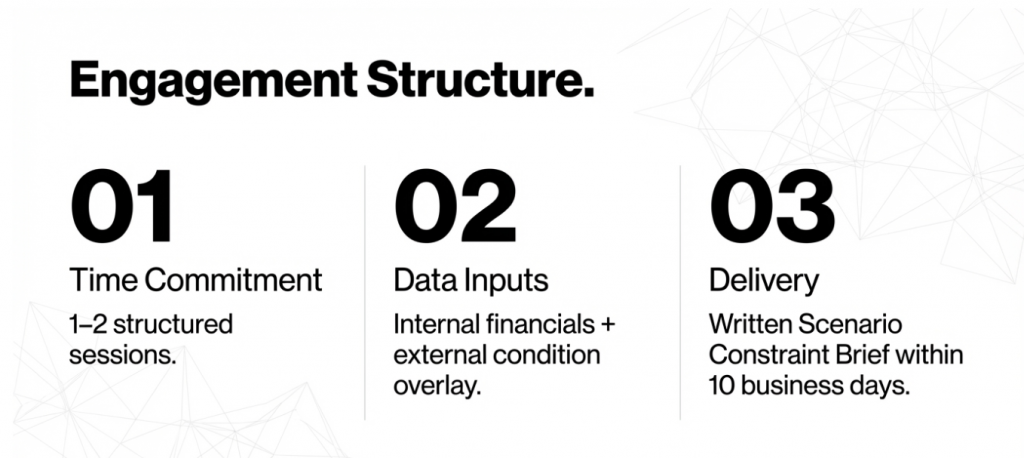
Engagement Structure
Time commitment: 1–2 structured sessions
Data inputs: Internal financials + external condition overlay
Delivery: Written Scenario Constraint Brief within 10 business days
There is no required follow-on engagement. The brief stands independently as a strategic reference document.
The Objective
The objective is not prediction.
The objective is structural probability under constraint.