
When Decisions Don’t Translate Into Execution within Organizations
Consulting Overview
A Decision Structure Diagnostic is a unique consultative service specifically designed for organizations and leadership teams that are capable, committed, but not executing to their own standards.
Decision Structure Diagnostic
When progress slows, decisions repeat, or alignment feels harder than it should, the cause is rarely a lack of effort, intelligence, or goodwill. Research across organizational science, systems engineering, and decision theory consistently shows that such breakdowns arise from structural misalignment—not personal failure.
This Decision Structure Diagnostic helps organizations see and correct those structural conditions, so movement resumes.
Why Smart Organizations Don’t Execute
The Problem The Decision Structure Diagnostic Addresses
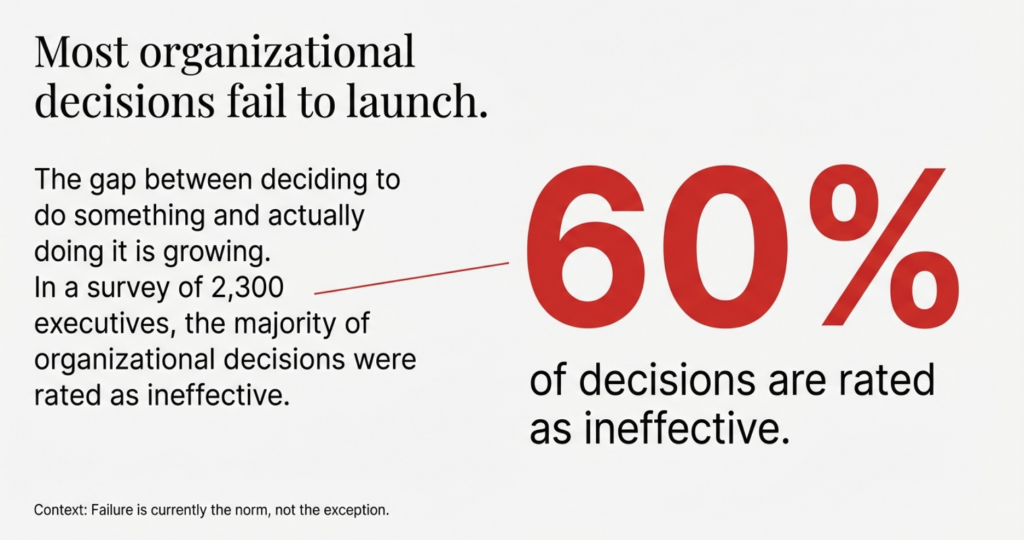
Organizations rarely stall because people are unmotivated or incompetent.
They stall because decision systems break down under complexity.
This is not speculative — it is measurable.
- A McKinsey Global Survey of 1,200+ executives and managers found that 52% reported most organizational decisions were ineffective, defined as slow, poorly executed, or failing to achieve intended outcomes.
- The same research estimated that ineffective decision-making consumes over 500,000 management days per year in large organizations — a significant hidden cost in time, morale, and opportunity.
- Independent organizational research consistently shows that decision clarity and structural alignment are among the strongest predictors of execution quality, outperforming motivation, incentives, or individual capability alone.
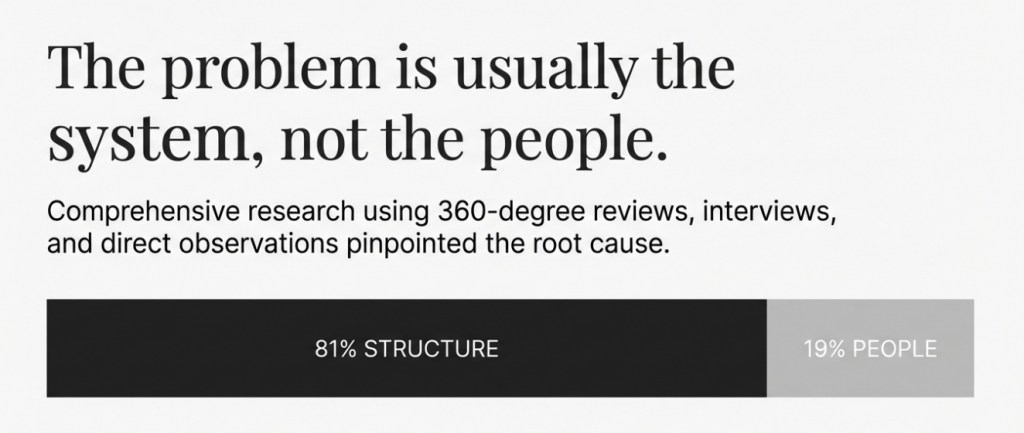
Implication: When capable organizations don’t execute, the dominant failure mode is structural, not personal.
Why Traditional Approaches Often Fail
When organizations face stalled decisions or recurring friction, they typically try one or more of the following:
1. Strategy Refreshes
- Research shows that 60–90% of strategic plans fail to be fully implemented, often because decision authority and incentives are not aligned with the strategy itself.
- Strategy documents do not correct how decisions are actually made day-to-day.
2. Culture or Motivation Initiatives
- Studies in organizational behavior show that culture initiatives without structural change have limited and short-lived impact.
- Motivation cannot overcome misaligned incentives or unclear authority.
3. Training and Skill Development
- Training improves individual capability, but research shows it has minimal impact on systemic decision bottlenecks unless structural constraints are addressed.
- Skilled people still fail inside incoherent systems.
4. Long-Term Consulting Engagements
- Extended consulting can work, but it is expensive, slow to show value, and often over-scoped relative to the actual problem.
- Many organizations need clarity before transformation, not transformation first.
Conclusion supported by data:
Most interventions fail because they address symptoms (behavior, motivation, plans) rather than decision structure and constraint alignment, which research shows are the primary drivers of execution failure.
What This Approach Does Differently – And Why It Works
A Decision Structure Diagnostic applies diagnostic principles drawn from systems science and decision theory, which originate in physics and engineering and are now widely used in economics, operations research, and organizational science.
Across these disciplines, one principle is consistent:
System behavior is governed by constraints and feedback, not intent.
In complex systems:
- Adding effort does not fix misalignment
- Intelligence does not compensate for incoherent structure
- Only structural clarity restores stable performance
This approach focuses exclusively on:
- how decisions actually flow,
- where authority and responsibility diverge,
- which constraints dominate outcomes,
- and where small, precise changes have outsized effect.
This is not belief-based, motivational, or ideological. It is constraint-based physics analysis, applied to organizations.
How this compares to common alternatives
| Approach | What It Focuses On | What Research Shows |
|---|---|---|
| Strategy Planning | Goals, priorities, plans | 60–90% of strategic plans are not fully implemented when decision authority and incentives are misaligned |
| Culture & Motivation Initiatives | Attitudes, engagement, values | Motivation alone has limited impact without structural alignment; incentives dominate behavior |
| Training & Skill Development | Individual capability | Improves skills, but has minimal effect on systemic decision bottlenecks |
| Long-Term Consulting | Broad transformation | Can work, but is slow, costly, and often over-scoped when clarity is the real need |
| Organizational Clarity & Decision Mapping (This Work) | Decision structure, constraints, alignment | Research shows making constraints and decision pathways explicit is a high-leverage intervention |
Most organizations don’t need more effort, motivation, or planning — they need clarity about how decisions and constraints are actually shaping outcomes.
How the Decision Structure Diagnostic works
Each engagement uses a diagnostic-first model, consistent with best practices.
1. Structured Data Collection
Participants complete a structured intake designed to surface:
- recurring decision bottlenecks,
- unclear ownership or authority,
- conflicting definitions of success,
- binding constraints (policy, funding, time, incentives).
This step ensures the analysis is grounded in operational reality, not opinion.
2. Facilitated Working Session (60–90 Minutes)
During the session, we:
- map actual decision pathways,
- identify misalignment between goals, incentives, and authority,
- separate people issues from system issues.
Research shows that making structural constraints explicit is often sufficient to change outcomes without further intervention.
3. Written Clarity Brief
We will take your input to diagnose all issues found. You receive a 7-10 page concise written brief that includes:
- a specific diagnosis of the core structural issue,
- evidence-based explanation of why it persists,
- identification of high-leverage correction points,
- realistic next steps aligned with capacity and risk.
This deliverable is designed to be used, not admired.
Outcomes Typically Observed
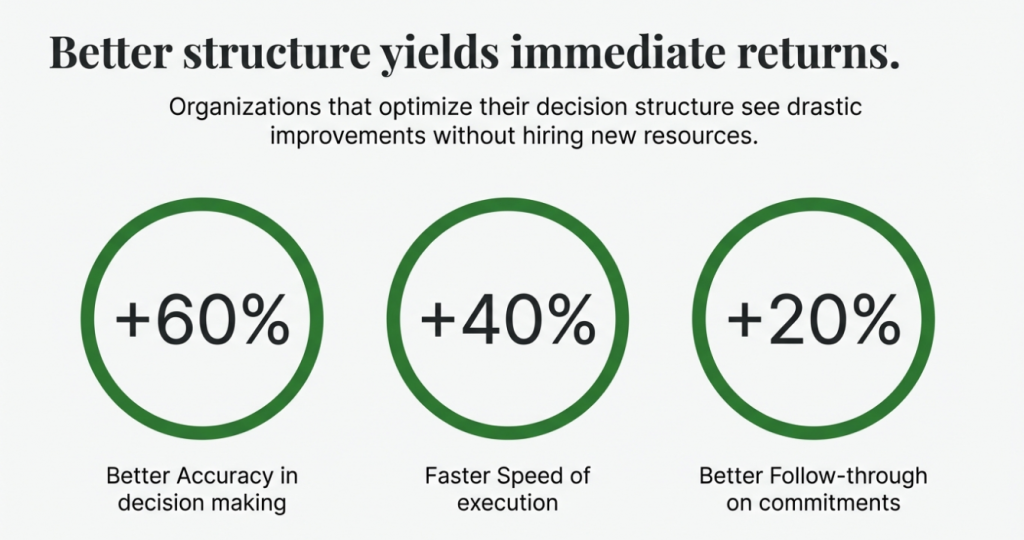
While outcomes depend on context, organizational research predicts — and clients commonly report — improvements in:
- decision speed
- decision quality
- reduction in recurring conflict
- clearer accountability
- lower coordination overhead
These outcomes are consistent with decades of findings showing that decision clarity and structural alignment are leading indicators of execution success.
About the Analytical Basis
This diagnostic is informed by:
- systems science principles originating in physics and engineering,
- constraint-based reasoning used in operations and control systems,
- organizational and decision-science research.
The analytical foundation is documented in Kevin Brown’s published work, Triune Harmonic Dynamics (Amazon), which explores coherence and alignment in complex systems.
Importantly:
- No theory, equations, or physics knowledge is required of participants.
- All sessions are conducted in plain, operational language.
Social Proof
During pilot engagements, client permission is requested to use brief, factual testimonials such as:
“The session made it clear why decisions were stalling and what needed to change. The clarity alone justified the engagement.”
These statements will be used only with explicit sign-off.
Who This Is For
A Decision Structure Diagnostic is most effective for:
- public and civic organizations
- libraries and educational institutions
- nonprofits and foundations
- small to mid-sized professional organizations
It is especially appropriate when:
- issues recur despite effort,
- meetings produce discussion but not resolution,
- leadership senses misalignment but cannot locate it.
What This Is Not
- Not motivational speaking
- Not culture change programming
- Not personality assessment
- Not a long-term consulting contract by default
This is an objective diagnostic engagement, designed to reduce uncertainty and restore movement.
The Rational Next Step
Given the evidence:
- decision failure is common,
- structural misalignment is the dominant cause,
- and diagnostic clarity is a proven leverage point,
the rational next step is not more effort or planning, but structural diagnosis.
A short exploratory conversation can determine whether this approach — or one like it — is appropriate for your situation.