An Informational Physics Account of the Universe’s Missing Components
Abstract
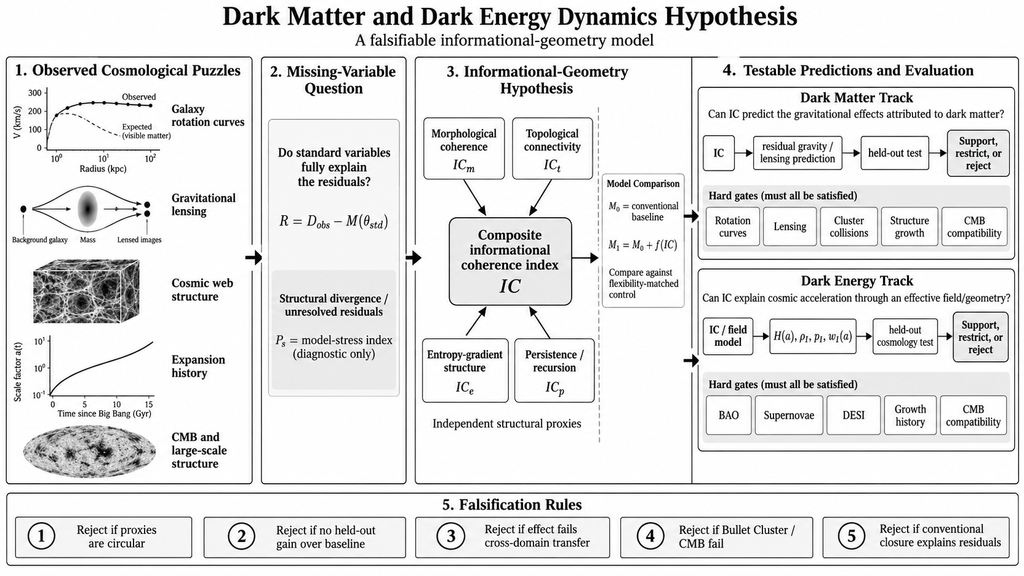
Dark matter and dark energy together account for approximately 95% of the inferred energy–mass content of the universe, yet their physical nature remains unknown. Despite decades of experimental effort, no direct detection of dark matter particles has occurred, and dark energy remains a phenomenological parameter rather than a mechanistic explanation. This article presents an alternative interpretation grounded in informational physics, in which the anomalies attributed to dark matter and dark energy arise not from missing substances, but from an incomplete ontology. We propose that information is a physical field with geometric and dynamical consequences, and that gravitational and cosmological discrepancies emerge naturally when this informational component is neglected. We outline the framework, show how it reproduces key observations, and present falsifiable predictions that distinguish it from particle-based models.
1. The Crisis Beneath the Crisis
Modern cosmology is remarkably successful at fitting observational data, yet it does so by introducing entities that remain empirically elusive. Dark matter is invoked to explain galaxy rotation curves, gravitational lensing, and structure formation, while dark energy is introduced to account for the observed acceleration of cosmic expansion.
The problem is not merely that these components are unseen — science has accepted unseen entities before — but that they resist every direct attempt at detection. Decades of increasingly sensitive detectors have failed to observe dark matter particles. Likewise, dark energy has no known microphysical basis and is treated as a cosmological constant or scalar field whose origin is unexplained.
This persistent failure suggests that the issue may not lie in experimental sensitivity, but in the underlying assumptions about what constitutes “physical” reality.
2. Information as a Physical Component
Informational physics begins with a minimal but radical shift: information is not abstract. It is not merely a bookkeeping tool or emergent description. It is a physical component of the universe, with measurable effects.
In this view, the universe is composed of three coupled aspects:
- Matter–Energy (fields and particles)
- Spacetime (geometric memory and causal structure)
- Information (scalar instruction field governing organization and constraint)
Standard physics accounts for the first two. Informational physics argues that the third has been systematically neglected or treated as mathematically disposable.
As articulated in the attached work , informational density and gradients can curve spacetime and influence dynamics without emitting radiation, making them observationally “dark” by construction.
3. Dark Matter as Informational Geometry
3.1 The Rotation Curve Problem
Galaxies rotate in a way that cannot be explained by visible mass alone. The standard response is to postulate a halo of invisible matter whose gravitational influence stabilizes rotation curves.
Informational physics offers a different interpretation:
the gravitational effect arises from scalar informational gradients embedded in spacetime.
In this model, galaxies are not merely collections of mass embedded in spacetime; they are coherent informational structures. The informational field associated with a galaxy has a non-uniform geometry, producing additional curvature that mimics the effect of extra mass.
Crucially:
- No particles are required
- No new forces are introduced
- The effect is geometric, not particulate
This directly explains why dark matter behaves as if it is smoothly distributed and collisionless — because it is not matter at all.
3.2 Gravitational Lensing Without Particles
Gravitational lensing maps often show mass distributions that do not correspond cleanly to visible matter. Informational physics predicts that lensing traces total spacetime curvature, which includes curvature induced by informational density.
Thus, lensing maps should correspond to regions of high informational coherence, not necessarily baryonic mass concentrations.
This explains why lensing halos appear diffuse, stable, and resistant to collapse — properties difficult to reconcile with particulate dark matter but natural for a scalar informational field.
4. Dark Energy as Informational Convergence
4.1 The Acceleration Problem
The universe appears to be expanding at an accelerating rate. The standard explanation invokes dark energy — a uniform negative pressure permeating space.
Informational physics reframes this observation entirely.
Rather than the universe being “pushed apart,” the model proposes that the universe is evolving toward a stable informational configuration, an attractor state sometimes described as asymptotic convergence .
From within the system, this convergence appears as acceleration. From outside the system, it is relaxation toward maximal informational stability.
4.2 No Heat Death, No Runaway Expansion
Standard cosmology predicts either heat death or runaway expansion. Informational physics predicts neither.
Instead, it predicts:
- Finite entropy
- Stable large-scale structure
- A final state characterized by maximal informational coherence rather than maximal disorder
This is not a metaphysical claim — it is a consequence of treating information as a conserved, structuring quantity rather than an epiphenomenon.
5. Why Particles Are Never Found
A critical strength of this framework is that it predicts the continued failure of dark matter particle searches.
If dark matter effects arise from informational geometry:
- No detector will ever see a particle
- No annihilation signals will appear
- No direct interaction cross-sections exist
The absence of evidence is not anomalous — it is expected.
This turns a long-standing failure mode of the standard model into a confirmatory signal.
6. Falsifiable Predictions
Informational physics is scientific only if it can be wrong. It makes several clear predictions:
Prediction 1: Gravitational Lensing Deviations
High-resolution lensing should reveal systematic deviations from General Relativity predictions that correlate with informational structure, not baryonic mass. These deviations should be consistent across galaxies of similar morphology, independent of environment.
Prediction 2: Early Structure Formation
The model predicts faster formation of large-scale structure in the early universe than ΛCDM allows, because informational scaffolding precedes matter aggregation. This aligns with recent observations of unexpectedly massive early galaxies.
Prediction 3: Persistent Hubble Tension
Discrepancies between early- and late-universe measurements of expansion should persist, because the informational contribution is not captured by standard cosmological parameters.
Prediction 4: No Dark Matter Detection
Continued null results in direct detection experiments are not anomalous but decisive. A confirmed detection of a viable dark matter particle would falsify the informational model.
7. What Changes — and What Doesn’t
Informational physics does not discard General Relativity or Quantum Field Theory. It reframes their domain of applicability.
- GR remains correct for matter-energy curvature
- QFT remains correct for particle interactions
- What changes is the ontology: information becomes causal
This is not a replacement of physics, but a completion of it.
8. Conclusion
Dark matter and dark energy may not be substances waiting to be discovered, but signatures of a missing layer of physical description.
By treating information as a real, geometric component of the universe, informational physics explains:
- why gravity appears stronger than visible mass allows
- why the universe accelerates without a force
- why decades of particle searches fail
- why large-scale structure appears earlier than expected
Most importantly, it does so in a way that is testable, falsifiable, and conservative with assumptions.
If these predictions fail, the framework should be discarded.
If they continue to hold, the mystery may not be what the universe is hiding — but what we have been ignoring.