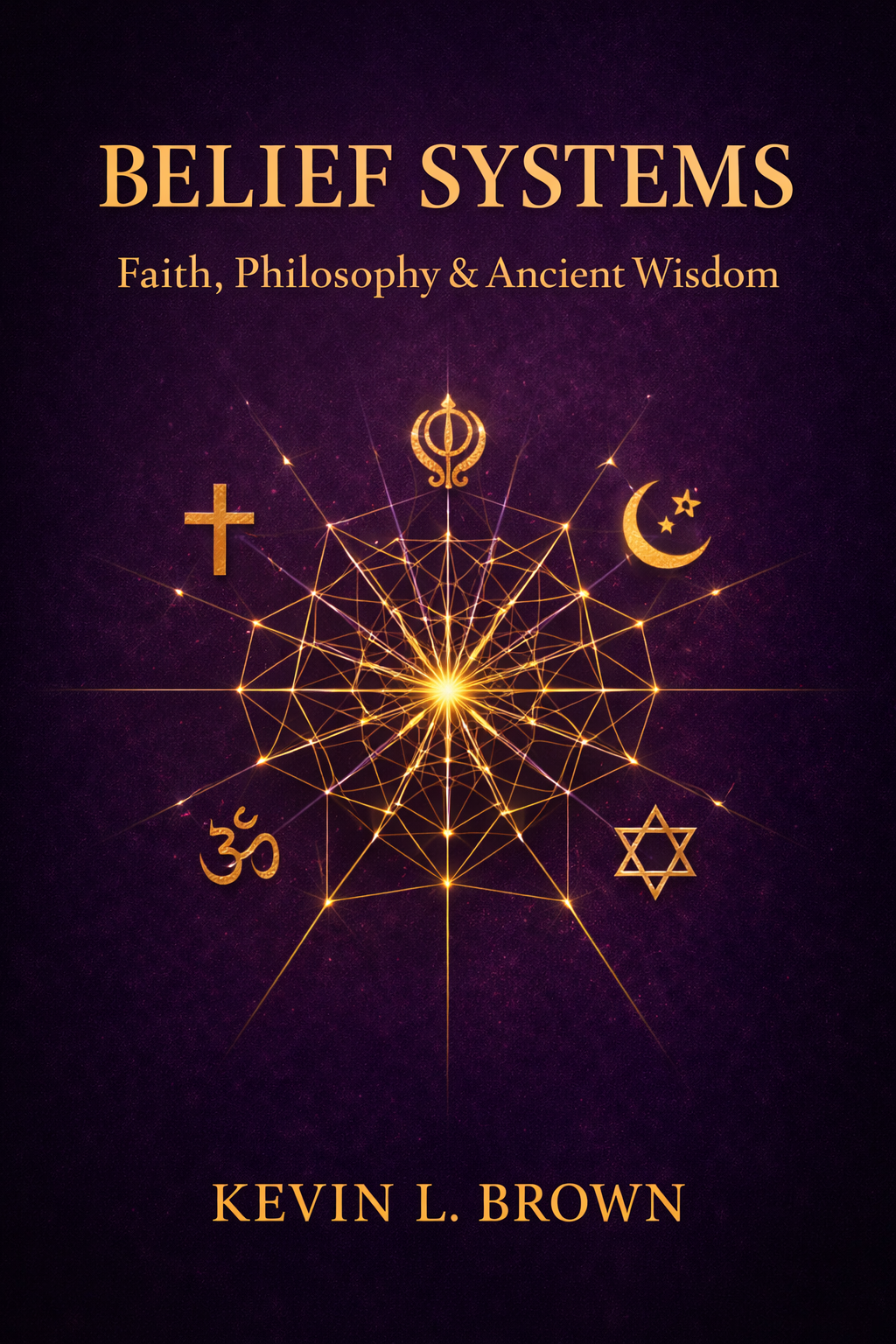
Faith, Philosophy & Ancient Wisdom
Belief Systems
Faith, Philosophy & Ancient Wisdom
Humanity has developed thousands of symbolic languages for answering the same fundamental questions about reality, meaning, morality, life, death, and our place within the universe. Belief Systems asks whether apparently conflicting traditions may sometimes be describing similar underlying structural patterns in different languages.
Planned Amazon release: 2028.
Translation, Not Reduction
Compares traditions without claiming they are identical.
Global Traditions
Religion, philosophy, myth, and ancient wisdom across cultures.
Recurring Patterns
Unity, polarity, causation, cycles, and emergence.
About the Book
For thousands of years, civilizations have asked the same basic questions: Why are we here? What is reality? What happens after death? How should we live?
Their answers often appear radically different because they are expressed through different gods, cosmologies, myths, rituals, moral systems, sacred texts, and philosophical vocabularies.
Belief Systems explores whether some of those differences are partly a problem of translation. The book uses physics and systems theory as a comparative descriptive language for examining recurring structures without claiming that all traditions are equivalent or that sacred traditions can be reduced to equations.
The Shared Structural Grammar
Similar Ideas. Different Symbolic Languages.
Across cultures separated by geography, language, and centuries, several structural ideas appear repeatedly. The book asks whether these similarities are merely cultural coincidences or reflections of deeper recurring patterns.
Unity
The idea of an underlying wholeness beneath apparent diversity or separation.
Polarity
Complementary or opposing forces whose interaction produces dynamic balance.
Causation
The principle that actions, choices, or conditions produce consequences across time.
Cycles
Birth, death, renewal, recurrence, and transformation appearing as repeating structures.
Emergence
Order, complexity, or form arising from simpler underlying principles or conditions.
Inside the Book
Humanity’s Search for Meaning Across Traditions
Each tradition is examined on its own terms before structural comparisons are made across philosophy, religion, science, and systems thinking.
The cultural and historical environment in which each belief or philosophical system developed.
The central teachings, metaphors, stories, symbols, and concepts used by each tradition.
How each tradition organizes ideas about reality, causation, morality, identity, and transformation.
Structural comparisons using concepts from physics and systems theory as a shared descriptive language.
Similar structural ideas examined across traditions without erasing theological or philosophical differences.
What humanity’s many symbolic systems may reveal about the recurring ways people understand reality and their place within it.
And More Inside
Traditions Explored
The book examines major religious, spiritual, and philosophical traditions from different cultures and historical periods.
- Hinduism
- Buddhism
- Daoism
- Confucianism
- Judaism
- Christianity
- Islam
- Zoroastrianism
- Sikhism
- Jainism
- Shinto
- Platonism
- Aristotelianism
- Stoicism
- Neoplatonism
- Pythagoreanism
- Hermeticism
The Tower of Babel Syndrome
Belief systems can appear incompatible because similar ideas may be encoded through very different stories, rituals, symbols, metaphors, and sacred vocabularies.
The book treats this as a translation problem worth testing rather than assuming that either total equivalence or total incompatibility must be true.
The question is not whether all traditions say the same thing. The question is whether some of their different symbolic languages describe overlapping structural patterns.
What This Book Is — and Is Not
This Book Is
- A comparative exploration of belief systems
- A bridge between philosophy, religion, and science
- A translation framework for symbolic language
- A structural analysis of recurring ideas across traditions
This Book Is Not
- A defense of any single religion
- An attempt to merge religions into one
- A claim that all traditions mean the same thing
- A replacement for faith or philosophy
What You’ll Gain
Translation Before Argument
See Overlapping Patterns
Recognize structural similarities without assuming that different traditions are identical.
Translate Symbolic Language
Examine how myths, metaphors, and sacred concepts may encode recurring structural ideas.
Compare Global Traditions
Explore religious and philosophical systems across different cultures and historical periods.
Bridge Different Conversations
Create a more useful dialogue between religion, philosophy, physics, systems thinking, and rational inquiry.
About the Author

Kevin L. Brown
Researcher, Inventor, Author
“Structure is visible if you know where to look. Once you see it, the answer is usually simpler than anyone expected.”
— Kevin L. Brown