
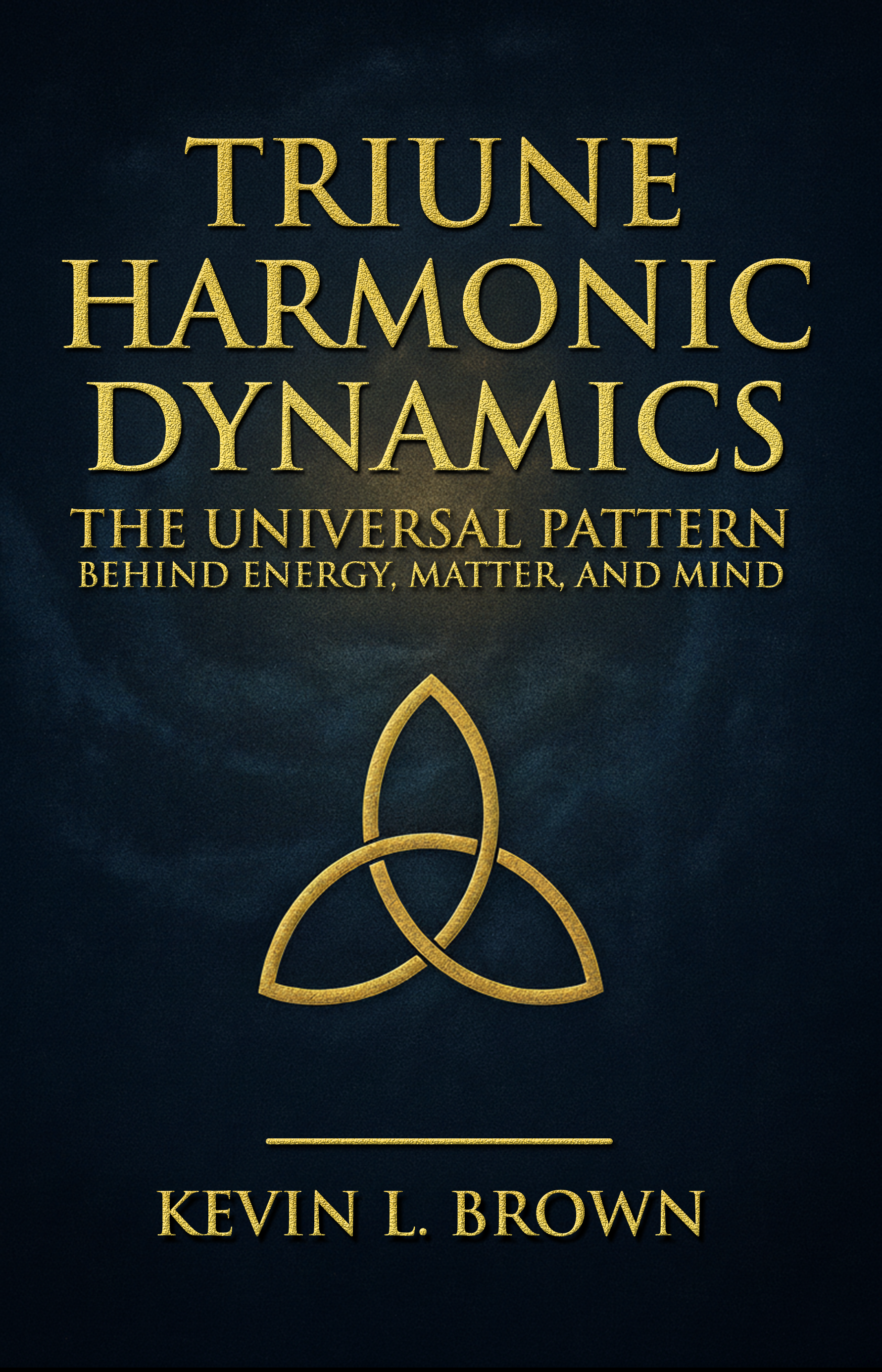
A Mathematical Framework for Transformation
Triune Harmonic Dynamics
The Universal Pattern Behind Energy, Matter, and Mind
A proposed mathematical framework for testing whether transformation repeatedly follows the same three-stage structure: Emergence, Contrast, and Integration. The book explores this proposed 3–6–9 pattern across 28 domains, from physical and biological systems to computation, human systems, and consciousness.
Get the Book on AmazonView available formats and current pricing on Amazon.
Three-Phase Pattern
Emergence → Contrast → Integration
28 Domains
From cosmology to human systems.
Framework + Tools
For measurable comparison, testing, and extension.
About the Book
Triune Harmonic Dynamics proposes that transformation can be examined through a repeating three-phase cycle: Emergence (3), Contrast (6), and Integration (9).
The book develops the mathematical structure behind this proposal and then carries the same testing logic across 28 domains—from cosmology, waves, and field dynamics to biology, computation, markets, organizations, dream states, and synthesis.
Rather than presenting THD only as a philosophical idea, the book attempts to connect the framework to measurable variables, predictions, comparisons, boundary cases, and falsification conditions.
The Core Pattern
Transformation in Three Phases
THD proposes that organized transformation can be described as a recurring sequence in which something emerges, encounters contrast, and integrates the result.
Emergence
A new state, structure, pattern, or possibility begins to appear. This establishes the initial form that the system will subsequently test.
Contrast
The emerging structure encounters pressure, interaction, opposition, difference, or feedback. Contrast tests what can persist and what must change.
Integration
The system incorporates the results of contrast into a new organized state. Integration can then become the emergence point for another cycle.
Inside the Book
One Pattern. Many Types of Systems.
The book applies the THD testing structure across the following 28 domains, moving from physical systems through biological, informational, computational, social, and experiential systems.
- 01Cosmology
- 02Waves & Harmonics
- 03Field Dynamics
- 04Optics
- 05Acoustics
- 06Lattices & Crystals
- 07Thermodynamics
- 08Fluid Flow
- 09Chemistry
- 10Mathematics
- 11Information Theory
- 12Computation
- 13AI Training
- 14Networks
- 15Biology
- 16Neuroscience
- 17Psychology
- 18Ecology
- 19Earth Systems
- 20Forecasting
- 21Markets
- 22Game Theory
- 23Linguistics
- 24Organizations
- 25Time & Rhythm
- 26Urban Form
- 27Dream States
- 28Synthesis
And More Inside
Understanding the Full THD Equation
The equation expresses the three proposed phases as differently weighted contributions to a cumulative transformation state.
- T(n) — Total Transformation
- The total modeled change after n steps or cycles.
- n — Cycle Count
- The number of steps, iterations, or cycles being evaluated.
- H — Scale Setting
- The harmonic scaling term used to adjust the scale or tempo of the modeled pattern.
- 3n — Emergence
- Something begins, forms, or appears.
- 6n2 — Contrast
- The new state encounters pressure, testing, difference, or feedback.
- 9n3 — Integration
- The system integrates the results of contrast into a newly stabilized state.
THD reads change in three parts: Begin → Test → Integrate.
First something begins. Then it is tested through interaction or contrast. The results are then integrated into a new state, which can become the beginning of another cycle.
How THD Is Tested
The domain chapters use a recurring testing structure so the proposed pattern can be compared with observations, simulations, alternative explanations, and failure cases.
- Map the System Define the system boundaries and identify the processes being studied.
- Define Variables Specify measurable quantities and their proposed relationships.
- Apply THD Map Emergence, Contrast, and Integration to the domain.
- Compare With Data Evaluate the model against observations, datasets, experiments, or simulations.
- Record Failures Document boundaries and circumstances where proposed relationships do not hold.
- Predict the Next Test Identify a future observation or experiment capable of further testing the claim.
Limits & Falsifiability
THD is presented as a framework intended to produce testable claims. A pattern appearing in several systems does not by itself establish that the same physical mechanism governs every domain.
Individual THD claims therefore need to be evaluated against appropriate observations, conventional alternatives, uncertainty, controls, and explicit failure conditions.
The framework should change when the evidence requires it. A domain claim that fails its defined test should be revised or rejected rather than protected from falsification.
What You’ll Gain
A Framework You Can Examine.
Read the 3–6–9 Structure
A clear explanation of the proposed three-phase transformation pattern.
Understand the Equation
An explanation of the THD equation and the role proposed for each term.
Explore 28 Domains
Applications with measurable variables, comparisons, predictions, and failure cases.
Question & Test
A framework readers can question, test, extend, refine, or reject.
About the Author

Kevin L. Brown
Researcher, Inventor, Author
“Structure is visible if you know where to look. Once you see it, the answer is usually simpler than anyone expected.”
— Kevin L. Brown