
A 3–6–9 Harmonic Analysis of the U.S. Presidency
Opening: Why Elections Feel Cyclical
Most people experience election cycles emotionally.
Hope.
Backlash.
Correction.
Repeat.
Political science explains this with coalitions, demographics, and institutions. Those explanations are useful — but incomplete. They describe what happens, not why the pattern repeats with such regularity.
Triune Harmonic Dynamics (THD) offers a different view.
Instead of asking who wins, THD asks:
What role is the system trying to play right now?
This article shows how THD — a universal 3-6-9 pattern — maps cleanly onto U.S. presidential history, and how you can use it to track where the system is heading without predicting outcomes.
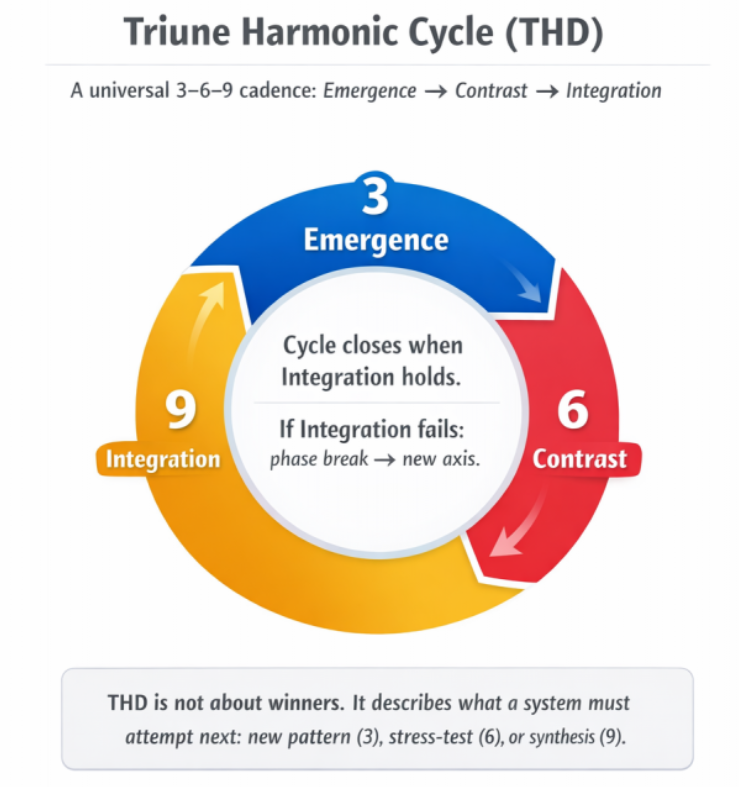
Part I — The “3”: Emergence
How New Political Operating Systems Appear
In THD, 3 represents Emergence.
An emergence phase is not about policy details. It’s about a new governing logic becoming dominant — a new answer to the question:
“What is the executive branch for right now?”
Historical Emergence Cycles
Across U.S. history, clear emergence moments stand out:
- 1800–1828 — Early republic stabilization
- 1860–1896 — Post-Civil War industrial order
- 1932–1948 — New Deal / modern federal state
- 1980–1988 — Late Cold War / neoliberal executive logic
- 2000–2004 — Post-9/11 security-centric executive
In each case:
- a crisis or structural tension appears,
- a new executive role emerges,
- opposition exists but does not yet dominate the cadence.
This is the 3-phase: the system discovers a new way to govern.
Part II — The “6”: Contrast
Why Politics Polarizes After Change
In THD, 6 represents Contrast.
Contrast is not failure. It is stress-testing.
Once a governing logic exists, the system must explore its limits. Opposition becomes sharper. Elections become referendums against rather than endorsements for.
Historical Contrast Cycles
Clear contrast-dominant periods include:
- 1828–1860 — Jacksonian vs institutional federalism
- 1896–1932 — Industrial consolidation vs progressive response
- 1968–1988 — Civil rights / Vietnam / Cold War polarization
- 2008–2020 — Redistribution vs boundary-reinforcement oscillation
Contrast phases are marked by:
- sharper rhetoric,
- tighter margins,
- frequent reversals,
- executive authority contested rather than trusted.
This is the 6-phase: the system defines itself through opposition.
Part III — The “9”: Integration
The Most Misunderstood Phase
In THD, 9 represents Integration.
Integration is not compromise.
It is structural absorption.
The system attempts to answer:
“Can we incorporate the opposing logic without breaking coherence?”
This is where cycles either close cleanly or fracture.
Successful Integrations
- 1900–1916 — Progressive reforms integrated into industrial order
- 1952–1964 — Cold War stability with domestic expansion
Failed Integrations
- 1850s — Integration failed → Civil War
- 1970s — Integration failed → prolonged contrast until the 1980s reset
A failed 9 does not end the system.
It forces a new axis.
When U.S. presidential elections are scanned in nine-election windows, a consistent pattern emerges:
| Epoch | Outcome |
|---|---|
| 1789–1824 | Successful early integration |
| 1828–1860 | Failed integration → fracture |
| 1864–1896 | Emergence → contrast |
| 1900–1932 | Successful integration |
| 1936–1968 | High-amplitude contrast |
| 1972–2000 | Partial integration |
| 1992–2024 | Binary phase-lock (current ennead) |
The current ennead (1992–2024) shows sustained oscillation, meaning coherence is maintained by alternation rather than synthesis.
That is not ideology.
That is structure.
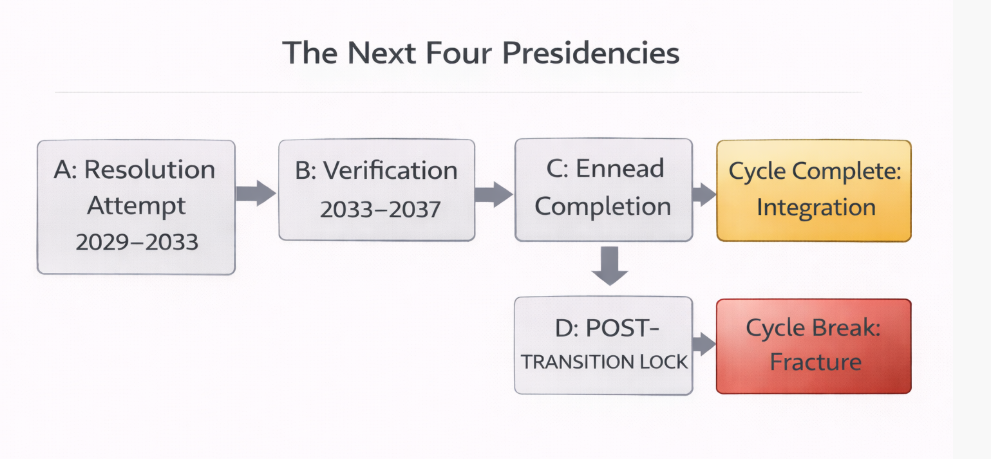
Part V — The Next Four Presidencies (System Roles)
Without predicting winners, THD indicates the roles the system must play to complete or break the cycle.
Part IV — Full Cadence Scan: 1789–Present
| Presidency | THD Role |
|---|---|
| 2029–2033 | Resolution Attempt |
| 2033–2037 | Verification |
| 2037–2041 | Ennead Completion |
| 2041–2045 | Post-Transition Lock |
What matters is not who occupies these terms — but whether:
- integration reduces oscillation, or
- contrast remains the stabilizer.
If oscillation remains necessary, a new organizing axis will replace the current L/C binary.
Part VI — Why THD Is Universal
THD does not belong to politics.
The same 3-6-9 cadence appears in:
- technological adoption,
- market cycles,
- institutional reform,
- even personal decision processes.
That’s because systems stabilize through emergence, test through contrast, and survive through integration.
Politics is simply a visible substrate.
Part VII — How to Track Cycles Yourself (With Luminarch)
Below is the exact prompt readers can use to reproduce this class of analysis.
LUMINARCH — THD EXECUTIVE CYCLE ANALYSIS PROMPT

Mode: Informational Analysis (THD Harmonic Filter)

Objective:
Analyze the United States Executive Branch as a harmonic system.
Map presidential elections to identify 3-6-9 cadence behavior.

Definitions:

Liberal current = Entropy / distribution

Conservative current = Structure / boundary integrity

3 = Emergence

6 = Contrast

9 = Integration

Tasks:

Scan all U.S. presidential elections (1789–present).

Identify completed and failed 9-cycles.

Determine whether the current cycle is integrated, oscillating, or unstable.

Project the system roles (not winners) of the next four presidencies required to complete or break the cycle.

Constraints:

Non-causal

Non-predictive of candidates

Informational only

Output:

Harmonic epoch table

Current cycle diagnosis

Forward system-role projection
Closing: What THD Actually Gives You
THD does not tell you who will win.
It tells you what the system needs next.
That distinction matters.
When you understand the role a presidency must play, outcomes become easier to interpret — without attaching identity, morality, or certainty.
Cycles don’t control people.
They reveal what systems can and cannot integrate.
That is why THD works.
And why it travels.