
From Intention to Geometric Circuits
Design, analyze, scale, and test purpose-built geometric circuits across visual, material, human, geographic, and computational forms.
The Geometric Circuit Generator begins with what you are trying to create, understand, change, stabilize, connect, or express. It translates that purpose into a structured geometric circuit, explains why the relationships were selected, and shows how the same circuit can be expressed across different scales and media.
Open Geometric Circuit GeneratorDefine Purpose
Start with one clear intention, problem, transition, or desired function.
Generate
Translate purpose into geometry, boundaries, nodes, pathways, and proportions.
Analyze
Understand what each component is doing and how the circuit carries its function.
Explore Variations
Adjust scale, medium, complexity, materials, orientation, and expression.
Apply
Use the circuit as a visual, physical, human, geographic, or computational experiment.
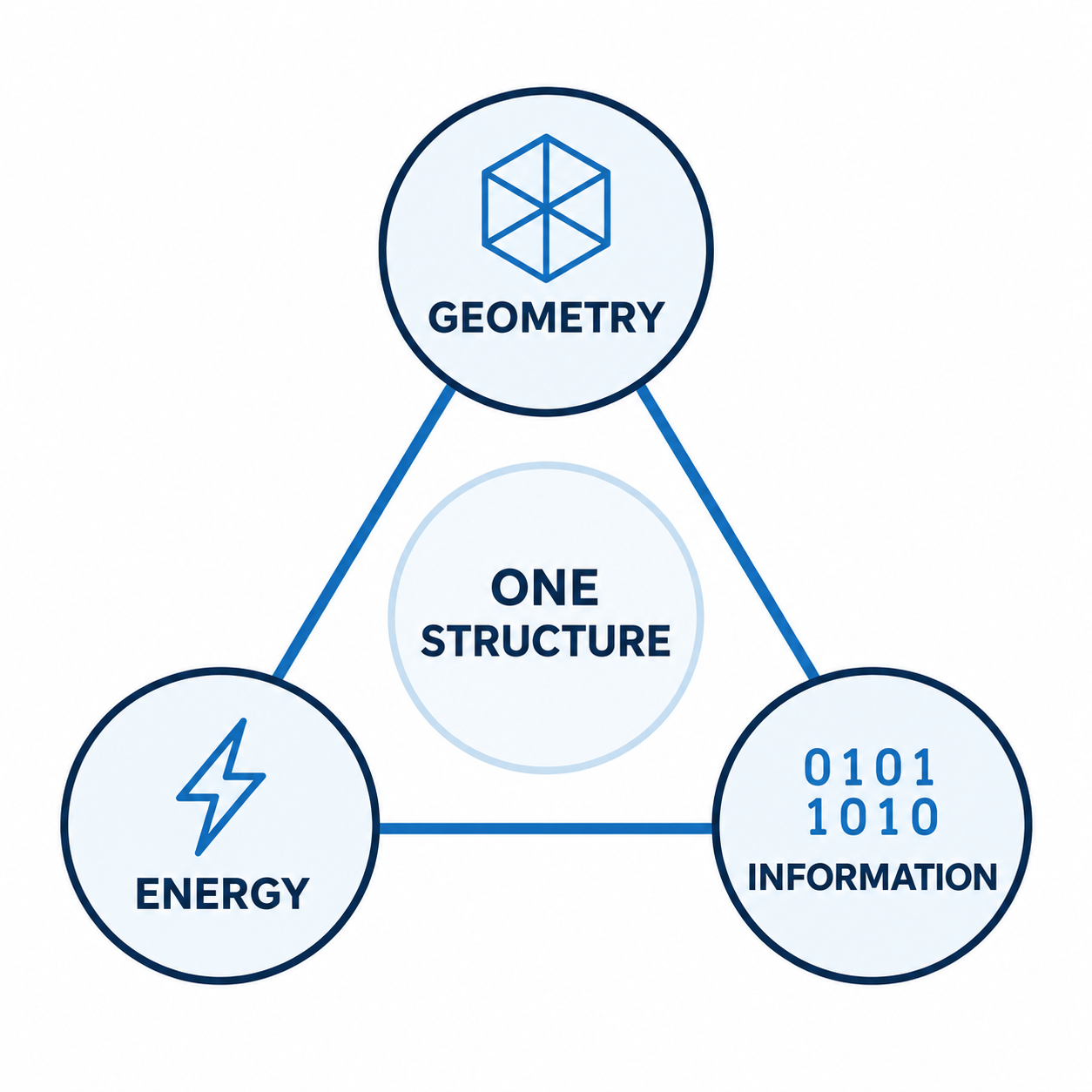
Geometry = Energy = Information
In the Informational Geometric Circuitry framework, geometry, energy, and information are treated as connected expressions of one structured system. Geometry defines arrangement, boundary, proportion, connection, and path. Those relationships constrain how a system can move, interact, transmit, stabilize, or change.
This equation is used here as framework shorthand for structural equivalence, not as a claim that geometry, joules, and bits are numerically interchangeable units.
When geometry is introduced into a system, the arrangement of that system changes. Boundaries move. Paths open or close. Distances, orientations, coupling relationships, symmetry, and constraints can change. That means the system’s informational configuration changes immediately.
In ordinary physics and engineering, geometry can also change energy behavior: antenna shape changes radiation patterns, resonant cavities select modes, waveguides constrain propagation, material lattices alter allowed states, and mechanical geometry determines load paths.
A circuit begins with a reason for existing
A circuit for containment should not be structured the same way as a circuit for expansion. A circuit for communication should not be organized like one for separation. The purpose determines which relationships must be emphasized.
Examples include stabilization, protection, focus, restoration, communication, transition, expansion, coordination, identity, manifestation, environmental balance, or research and discovery.
Without purpose, geometry is simply form. With a defined purpose, the geometry becomes a circuit that can be applied and tested.
From Intention to Observable Effect
The generator is designed to make the dependency chain visible. Purpose comes first; the circuit is then built to carry that purpose into a form that can be used and observed.
Purpose
Define the intention, question, transition, identity, project, or desired outcome.
Why are you creating this circuit?
Geometry
Select the topology, shapes, boundaries, ratios, nodes, symmetry, and pathways that express the purpose.
What form best carries the function?
Informational Structure
The relationships become the circuit’s repeatable pattern: what connects, what contains, what anchors, and what moves.
What relationship is being encoded?
Expression
Translate the pattern into a drawing, material grid, human formation, geographic network, or computational graph.
How does the pattern enter the target system?
Observation
Use the circuit consistently and compare what changes, what remains stable, and what does not respond.
What would count as an observable effect?
One Circuit. Many Forms.
The first output may be a drawing, but the drawing is only one expression. The defining object is the underlying relationship pattern.
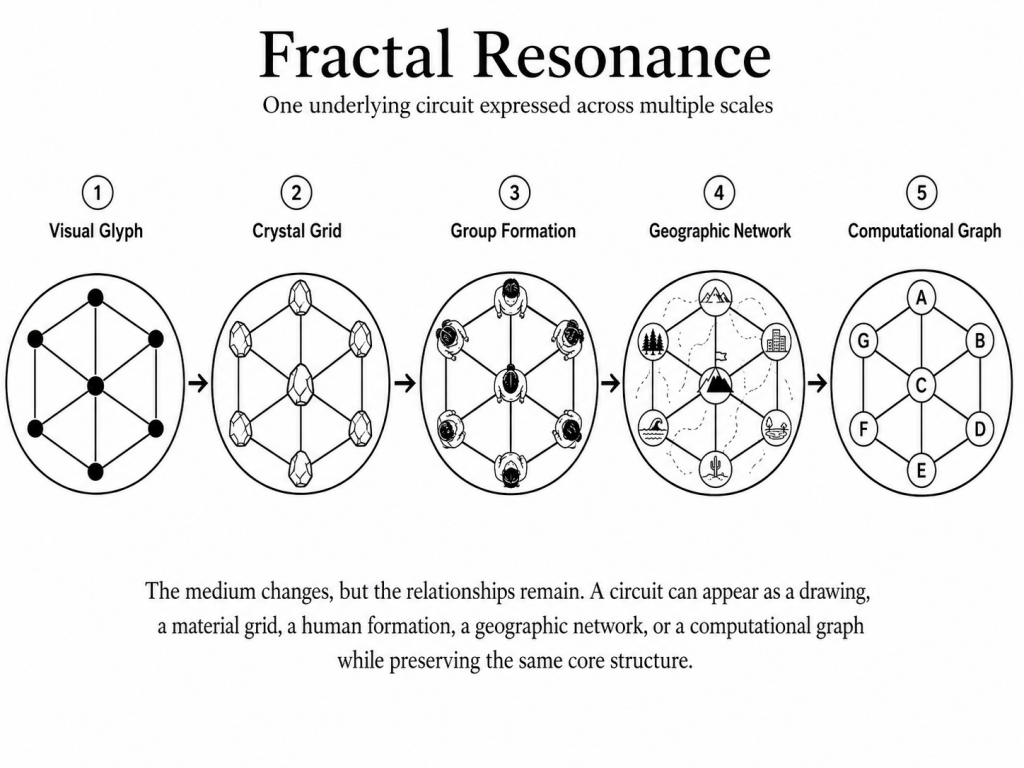
“The form changes. The relationships remain.”
In the IGC framework, Fractal Resonance means preserving the circuit’s core topology while changing its medium or physical scale.
A center remains a center. A boundary remains a boundary. A six-node ring remains a six-node ring. Pathways, proportions, angles, ordering, and role relationships are preserved as closely as the new medium allows.
This is what allows one circuit to move from visual form to matter, people, geography, or computation without being treated as five unrelated designs.
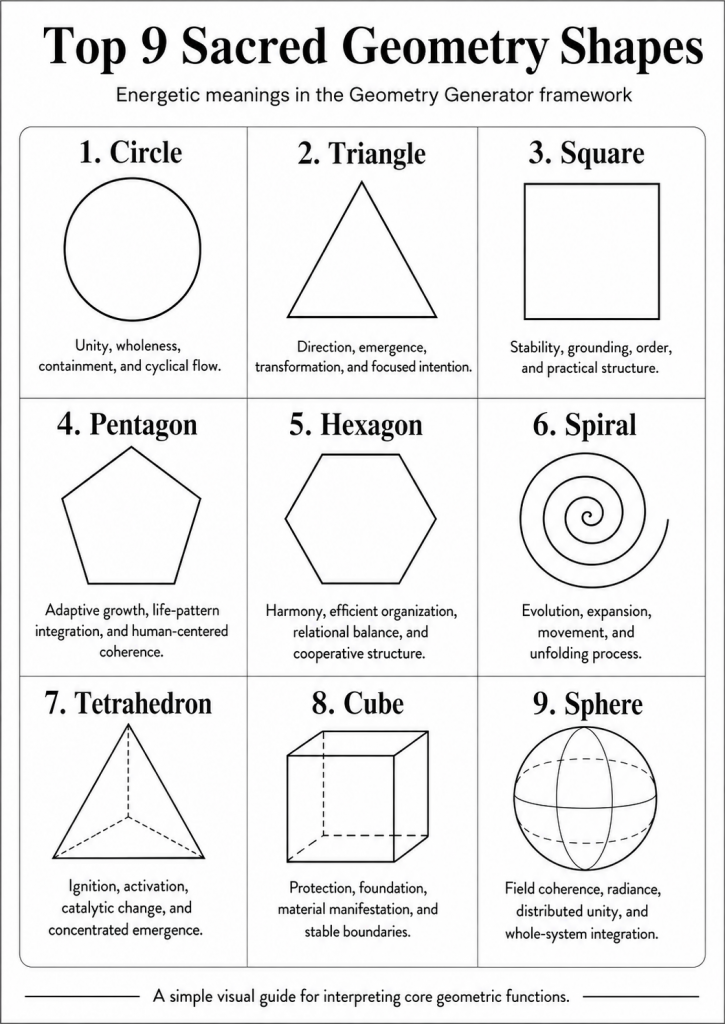
Shapes Carry Different Structural Roles
The generator does not select shapes because they look attractive. Each shape is assigned a functional role inside the circuit, then combined with other elements according to the purpose of the design.
Examples of structural roles
- Circle: containment, wholeness, cyclical flow, boundary.
- Triangle: direction, emergence, activation, transformation.
- Square: structure, stability, grounding, foundation.
- Pentagon: organic growth and adaptive organization.
- Hexagon: equilibrium, efficient organization, relational balance.
- Spiral: expansion, movement, release, unfolding.
- Center point: anchor, focus, origin, reference.
- Nested boundaries: layered containment or filtering.
- Radial nodes: distribution around a common center.
Geometry Can Encode Meaning, Not Just Shape
Circles, triangles, boundaries, nodes, pathways, spirals, symmetry, and proportion are the vocabulary. Meaning emerges from how those elements are positioned, connected, bounded, oriented, and combined into a purpose-built circuit.
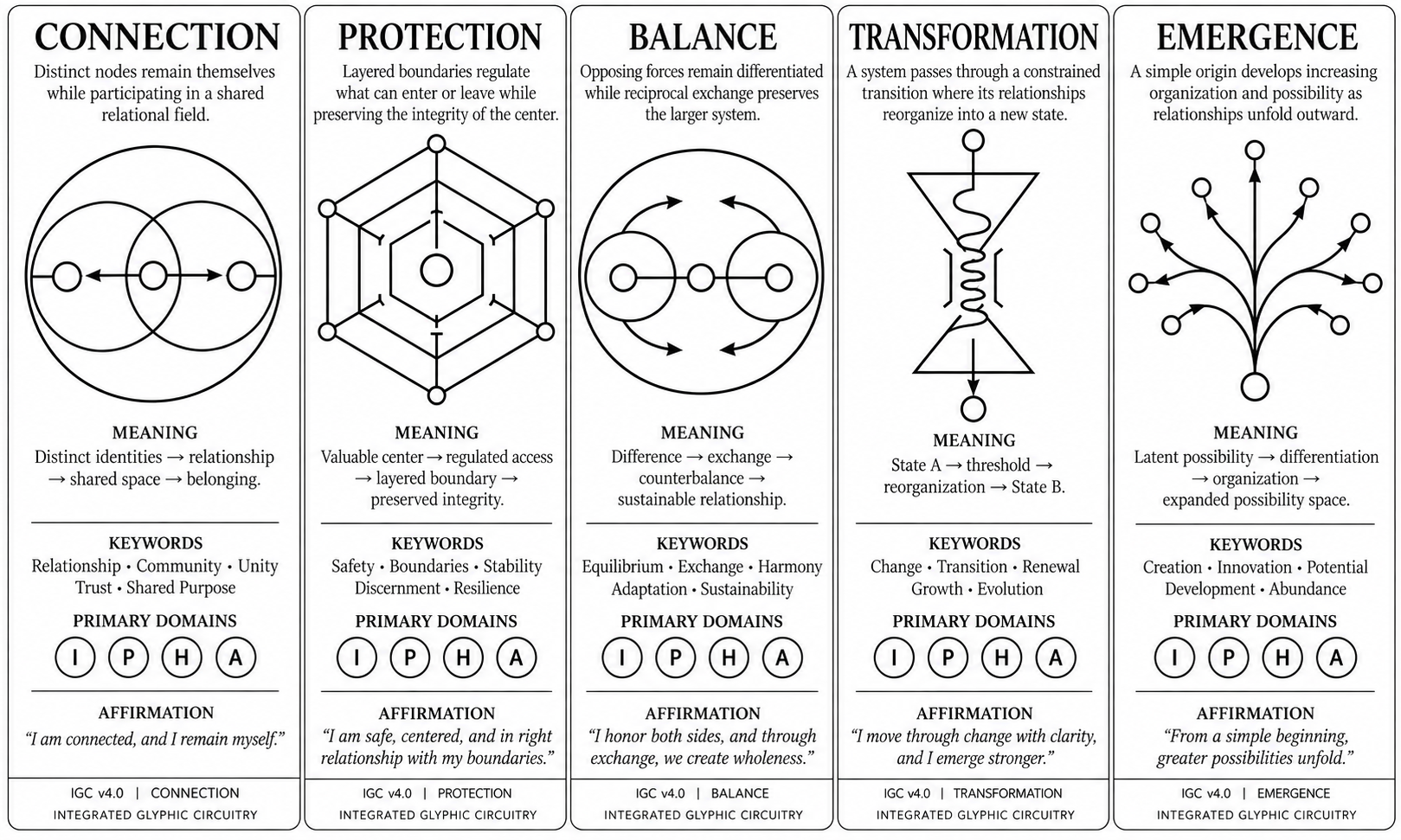
A Circuit Can Be Built Around Almost Any Defined Function
You can begin with a feeling, intention, identity, relationship, project, group objective, or existing symbol. The important requirement is that the purpose is clear enough to be translated into relationships.
A visual circuit
A two-dimensional geometric expression for screen, print, drawing, engraving, artwork, reflection, attention, or use as a blueprint for other forms.
A crystal or material grid
Translate the same circuit into stones, crystals, metals, wire, wood, light, ordinary objects, or other materials while preserving the original relationships.
A group circuit
People become active nodes. The generator can map positions, roles, orientation, movement, communication, and timing for a group-scale expression.
A circuit for a feeling or transition
Describe the state you are in, the state you want to move toward, and the quality that needs to be preserved or changed.
A project, organization, or group goal
Map a project’s center, boundaries, dependencies, pathways, pressure points, coordination relationships, and intended direction.
Conflicting thoughts or relationships
Give two valid but opposing states a visible place within one larger structure so the tension can be examined without forcing either side to disappear.
A personal or project identity circuit
Convert a fixed input such as a name, phrase, date, cryptographic hash, project identifier, or other stable key into a repeatable geometric pattern.
Analyze an existing circuit or symbol
Upload a glyph, logo, tattoo, crystal grid, floor pattern, group formation, emblem, diagram, sacred-geometry design, or hand-drawn symbol for structural analysis and scale translation.
Describe the Function. Let the Geometry Follow.
You do not need to know which shapes, ratios, materials, or topologies to request. Begin in ordinary language.
Describe
Explain what you want to explore, create, change, balance, organize, or understand.
Generate
The tool selects circles, lines, arcs, spirals, polygons, anchors, boundaries, pathways, and nodes.
Review
Read why each element was selected and decide whether the structure actually matches your intended function.
Scale & Test
Choose an expression, use it consistently, observe what happens, compare alternatives, and revise when needed.
One Circuit, Several Ways to Test It
The intended approach is not to require belief. Preserve one underlying circuit, vary the medium, and observe whether the intended function remains recognizable.
Compare expressions
- Begin with the visual circuit and use it consistently.
- Record attention, recall, decisions, behavior, or another variable relevant to the purpose.
- Rebuild the same topology using ordinary objects, stones, crystals, or another material.
- Where appropriate, translate the circuit into a group formation or computational graph.
- Keep the core relationships as constant as possible while changing the medium.
- Compare the result with a baseline, alternative design, or period without the circuit.
- Document null results as well as apparent effects.
A simple seven-day visual test
- Choose one clear purpose. “Remain calm and clear during difficult conversations” is easier to evaluate than “improve my entire life.”
- Generate the circuit. Review why each element was selected before using it.
- Define what you will observe. For example: recall of the intention, self-rated focus, completion rate, error rate, decision time, or another purpose-relevant outcome.
- Use it consistently. Keep the visual circuit in the same general context each day.
- Record rather than reinterpret. Note what happened before deciding what it means.
- Review after seven days. Ask what changed, what did not, and whether any effect was large enough to matter.
- Keep, revise, or scale. A null result is still useful information. You can change the circuit or move to another medium for a second test.
Informational Geometric Circuitry
The Geometric Circuit Generator is based on Informational Geometric Circuitry (IGC), a Creation Unified framework for representing purpose and function through geometric relationships.
IGC treats the circuit as more than a picture. Shapes serve roles; lines establish connections; boundaries regulate containment and release; spacing changes relationships; symmetry changes distribution; direction establishes flow; and nodes provide anchors, interfaces, or points of exchange.
The IGC protocol formalizes this idea through scale-preserving features such as topology, dimensionless ratios, angles, and functional roles. It also defines computational analogs—circuits as nodes, edges, weights, nested structures, radial networks, and other graph forms—so the geometry can be represented algorithmically as well as visually or physically.
The broader physical claim remains testable: if a purpose-specific circuit is proposed to produce an effect beyond ordinary visual, behavioral, spatial, mechanical, electromagnetic, or organizational mechanisms, that effect should be defined in advance, measured, compared with controls, and allowed to fail.
Frequently Asked Questions
Is a geometric circuit the same thing as a drawing?
No. A drawing is one visual expression. The full circuit is the underlying pattern of relationships—centers, boundaries, nodes, pathways, proportions, orientation, and connection rules—which can also be expressed through matter, people, locations, or computation.
Why does a circuit need a purpose?
Purpose determines function. A circuit intended to contain, stabilize, connect, separate, expand, restore, or coordinate should not use exactly the same relationship architecture. The generator starts from the intended function and lets that requirement guide the geometry.
What does “Geometry = Energy = Information” mean?
Within UIPO/IGC, it is shorthand for the proposition that structure, energetic behavior, and informational relationships are deeply linked. It is not a claim that geometric units, joules, and bits are numerically identical. Geometry specifies arrangement and constraint; changing that arrangement changes the system’s information, and in many physical systems it also changes how energy can be distributed or transmitted.
Can geometry impact reality?
Geometry already affects physical systems through ordinary mechanisms: it changes load paths, boundaries, resonant modes, propagation paths, spatial relationships, and coupling. IGC extends this into a broader hypothesis that purpose-specific circuit structure may preserve functional informational effects across different media. Any additional claimed effect should be measured rather than assumed.
Do I have to use crystals?
No. A physical circuit can use stones, metal, wood, wire, paper, lights, everyday objects, floor markers, or other materials. Crystals are one possible medium, not a requirement.
Can the tool create a group formation?
Yes. Ask the generator to scale the circuit for a specific number of people. It can assign positions, roles, orientation, movement, timing, and an observation process while preserving the base topology.
Can one circuit be used in several forms?
Yes. That is the central Fractal Resonance idea. A visual circuit can be translated into a material grid, group formation, geographic network, or computational graph while preserving the circuit’s defining relationships.
Will all versions produce the same result?
Not necessarily. The circuit may preserve the same intended structural function, but every medium introduces different conditions. A drawing, physical grid, group formation, and computational model should be treated as related experiments rather than assumed to produce identical outcomes.
Do I need to believe that the circuit will work?
No. Define the purpose, generate the circuit, choose the form, specify what you will observe, use it consistently, and compare the result. The purpose is to make the experiment visible and repeatable.
Can I ask for a simple circuit?
Yes. Request the simplest possible circuit, a printable black-and-white version, a small material grid, a formation for a specific number of people, or a more technical multi-layer circuit.
Create One Circuit and Explore How Far It Can Scale
Begin with one feeling, intention, question, identity, project, relationship, or system. Let the generator translate its purpose into geometry, then decide how you want to express and test it.
Suggested starting prompt: “Create a geometric circuit for…”