
Understand How You Naturally Think, Work, Recover, Relate, and Move Through Change
The Personal Energetic Profile (PEP), is a deterministic identity model designed to make your recurring patterns easier to understand.
It examines how you tend to:
- recognize and organize information;
- begin, adjust, and complete change;
- make decisions and communicate;
- respond to pressure;
- regain emotional and physical balance;
- connect with other people;
- and turn your natural strengths into practical action.
PEP does not ask you to describe yourself.
It uses fixed birth information to generate a reproducible profile within the Informational Physics framework.
No questionnaire. No mood-based answers. The same verified inputs produce the same profile.
The Question Beneath Every Personality Test
Most personality tools begin by asking what you do, what you prefer, or how you see yourself. Those questions can be useful, but behavior changes. You may be decisive in one environment and cautious in another. You may work intensely for several days and then need quiet recovery. You may communicate clearly at work but struggle to explain yourself during emotional conflict.
The deeper question is not simply:
“What type of person am I?”
It is:
“What underlying pattern keeps producing the way I think, work, recover, relate, and respond to change?”
PEP is designed to examine that deeper pattern.
What the Personal Energetic Profile Is
PEP is an ontology-grounded computational profile. It uses your fixed birth information to calculate a structured identity position and then translates that result into clear, contemporary language.
A complete profile uses:
- your full birth name;
- birth date;
- exact local birth time;
- birthplace;
- and historical timezone.
Those inputs are processed through:
- the 364-day Turtle Calendar;
- Triune Harmonic Dynamics;
- your local birth-time position;
- your Energy Processing Mode;
- your Core Tone;
- and Numerical Fractal Resonance.
The result is not a single personality label. It is an integrated reading of how several parts of your pattern work together.
Why Birth Information Is Used
Within the Informational Physics Ontology, identity begins from constraints.
Every organized being develops from a particular starting condition:
- a specific position;
- a specific moment;
- a specific environment;
- and a defined set of relationships.
PEP treats your birth information as an origin coordinate within the model. That coordinate does not dictate your choices, determine your future, or reduce you to a fixed personality type. It establishes the fixed input from which the profile is calculated.
- Your experiences still matter.
- Your choices still matter.
- Your environment still matters.
PEP is intended to describe the recurring pattern through which you tend to process those experiences—not to claim that every action is predetermined.
The 3,276 Harmonic Positions
The standard PEP identity space contains:
364 Turtle Calendar days
× 3 change phases
× 3 processing modes
= 3,276 harmonic positions
Each position combines three primary layers.
Your Turtle Calendar Pattern
Your position within the 364-day natural-time cycle provides the broad functional pattern used by the profile.
How Change Becomes Clear to You
PEP describes change through three repeating movements:
- something begins and takes form (Emergence);
- it meets real conditions and is tested (Contrast);
- and the experience is brought together into a usable result (Integration).
Your profile identifies which part of that process most naturally holds your attention.
How You Make Sense of Experience
People often process experience in three broad ways:
- by doing and engaging directly (Action);
- by thinking, comparing, and observing (Reflection);
- or by stepping back so the body and mind can settle and absorb what happened (Restoration).
Your profile identifies which mode most naturally supports your clarity.
The Archetype Is the Center of the Profile
The archetype is the primary organizing pattern within PEP. It describes the recurring contribution you are most naturally inclined to make: the kind of information you notice, the problems that attract your attention, the way you respond when something is missing, and the role you tend to assume when change is needed.
Your archetype is not your entire personality. It is modified by your:
- change phase;
- Energy Processing Mode;
- Core Tone;
- cognitive pattern;
- Numerical Fractal Resonance;
- emotional and relational patterns;
- and lived experience.
Two people may share the same archetype while expressing it in very different ways:
A Builder in Action Mode may construct through direct experimentation.
- A Builder in Reflection Mode may plan and test internally before acting.
- A Builder in Restoration Mode may work in concentrated periods and reach the clearest solution after stepping away.
- The archetype establishes the primary function.
- The complete PEP explains the person expressing it.
The 13 Primary PEP Archetypes
Visionary — Future Pattern Mapper
Recognizes emerging possibilities and gives direction before the complete structure is visible. Visionaries often notice weak signals, long-range consequences, and relationships that have not yet fully formed. They are naturally drawn toward what could exist next.
Builder — Structure Creator
Turns disorder, pressure, or incomplete ideas into durable plans, processes, and structures. Builders naturally look for foundations, missing supports, load-bearing relationships, and practical ways to make something stable. They tend to ask, “What would make this work reliably?”
Explorer — Boundary Expander
Moves beyond established limits to gather information from unfamiliar places, experiences, and possibilities. Explorers learn through direct exposure, movement, experimentation, and comparison across different environments. They expand what is known by entering what is not yet familiar.
Sage — Knowledge Integrator
Preserves, compares, and organizes information so experience becomes dependable understanding. Sages naturally seek context, evidence, definitions, history, and the larger principles that connect separate events. They help convert information into usable knowledge.
Nurturer — Capacity Supporter
Maintains the conditions that allow people, relationships, and communities to remain supported and continue developing. Nurturers notice unmet needs, uneven demands, and changes in emotional or physical capacity. They strengthen the conditions through which growth can continue.
Rebel — Constraint Challenger
Recognizes when a rule, assumption, or structure has become obstructive and introduces the disruption required for change. Rebels often see pressure, hypocrisy, blocked movement, or outdated limitations that others have learned to accept. Their function is not disruption for its own sake. It is the release of structure that no longer serves its purpose.
Leader — Direction Coordinator
Organizes people, resources, and decisions around a shared direction. Leaders tend to clarify responsibility, maintain momentum, and help groups move from intention into coordinated action. They help separate activity from actual progress.
Artist — Experience Translator
Converts internal experience, complexity, and perception into forms that other people can see, hear, feel, or understand. Artists make invisible experience communicable through image, sound, language, design, movement, or form. They translate what is difficult to explain directly.
Alchemist — Transformation Designer
Works with unstable, mixed, or contradictory material until it reorganizes into a different functional state. Alchemists are often drawn to transition, recombination, reinvention, and the integration of apparently opposing elements. They tend to see usable potential inside conditions that appear confused or incomplete.
Guardian — Boundary Protector
Preserves safety, identity, continuity, and essential resources by monitoring boundaries and controlling exposure. Guardians notice risks, weak limits, concentrated dependencies, and conditions that could compromise stability. Their strength lies in recognizing what must be protected for the larger structure to endure.
Seeker — Question-Driven Investigator
Follows unresolved questions until hidden structure, missing information, or a deeper direction becomes visible. Seekers are naturally drawn toward gaps, contradictions, anomalies, and answers that have been accepted too quickly. They continue looking when the surface explanation does not fully account for what is happening.
Healer — Restoration Facilitator
Recognizes loss of balance or capacity and supports the conditions through which function can return. Healers notice strain, disconnection, overload, and where people or groups are no longer able to recover effectively. Their role is not limited to physical healing. It can appear through emotional, relational, organizational, environmental, or informational restoration.
Mystic — Whole-Picture Perceiver
Recognizes relationships among layers that are usually treated as separate and searches for the larger identity connecting them. Mystics naturally perceive cross-scale recurrence, Fractal Resonance, and patterns that become visible only when the whole is considered. They tend to ask how separate experiences may be expressions of one deeper structure.
More Than a Type
PEP does not stop after identifying your archetype. It examines how the archetype changes when it interacts with the rest of your profile. For example, the archetype may tell you what contribution repeatedly emerges through you.
The other profile layers explain:
- how you express that contribution;
- how you make sense of experience;
- how change becomes clear;
- how you respond under pressure;
- what helps you regain balance;
- how you communicate;
- how you relate to other people;
- and where your strengths can become overextended.
This is why two people with the same archetype can have noticeably different profiles.
Your Core Node ID
Every current PEP generates a Core Node ID.
- The Core Node ID is a reproducible profile key.
- It stores the information needed to reopen the user-facing profile without entering the complete birth form again.
- It is not a personality label.
- It is not a public identity number.
- It is not a prediction.
- It is the profile’s computational reference.
- Save it after generating your report.
Your Core Tone
Your Core Tone is the verbal expression of your core vibrational pattern translated into sound and language. It is not a traditional personal name.
Its four parts describe how you tend to:
- maintain your direction and sense of self;
- turn what you notice into action;
- connect people, information, timing, and surroundings;
- and recognize the larger meaning of what is happening.
Each part combines a structural function with a way that function moves or expresses itself. The report explains every part in ordinary language and then shows what the full tone suggests when the four parts are read together.
Numerical Fractal Resonance
Your profile also includes three number-based readings calculated from your birth date and full birth name. These do not replace your primary archetype or the other PEP layers. They provide a secondary view of the same person.
The report examines whether each numerical result:
Reinforces
It repeats and strengthens a function already prominent in the main profile.
Complements
It contributes a useful ability or perspective that expands the main pattern.
Creates Productive Tension
It introduces a different need or direction that must be consciously balanced with the rest of the profile. This prevents the numerical layer from becoming a second, competing personality system. Its purpose is to show where a different calculation detects the same function—or reveals an additional part of the person.
What Your Profile Includes
Your PEP is organized into 12 connected sections.
Each section answers a different human question.
1. Core Node ID
Your reproducible profile key and harmonic position within the PEP model.
2. Your Turtle Calendar Pattern
The broad contribution or recurring function associated with your position in the natural-time cycle.
3. How Change Becomes Clear to You
Whether your attention most naturally centers on beginning and shaping, testing and adjusting, or bringing experience together into a usable result.
4. How You Make Sense of Experience
Whether clarity tends to develop through action, reflection, or restoration.
5. Core Tone and Pattern Signature
How your core vibrational pattern is translated into sound, language, and practical meaning.
6. Your Consistent Strengths
Your primary archetype, supporting abilities, Numerical Fractal Resonance, work preferences, and natural areas of contribution.
7. How You Take In and Use Information
What attracts your attention, how you organize information, how you decide, and how you communicate conclusions.
8. How You Regain Emotional Balance
How strain tends to appear in your body and emotions, what helps you settle, and what signals that you are ready to re-engage.
9. Relationships and Working With Others
What creates trust, how you express commitment, how misunderstandings develop, and what helps repair connection.
10. When Your Strength Becomes a Strain
How a healthy ability can become overextended, what the deeper protective pattern may be, and how flexibility can be restored.
11. Fractal Resonance Across Layers
How the same underlying function may appear through geometry, sound, materials, plants, animals, colors, and other layers of reality.
12. Putting Your Whole Profile Into Practice
A combined interpretation of your work rhythm, decision process, relationship needs, recovery pattern, likely risks, and practical next steps.
What Fractal Resonance Means
The Informational Physics Ontology describes reality as fractal. This means that the same underlying function can appear through very different forms and scales.
A function expressed psychologically in a person may also appear:
- geometrically through shape and proportion;
- materially through physical properties;
- biologically through the behavior of a plant or animal;
- sonically through rhythm and organization;
- environmentally through the way a larger living structure regulates flow;
- or planetarily through boundaries, circulation, memory, regeneration, and persistence.
These are not treated as arbitrary symbols.
They are presented as Fractal Resonance expressions: different forms carrying a related structural function.
For example, a person whose profile centers on constructing stable order may resonate with:
- a geometry that distributes load evenly;
- a material known for structural endurance;
- an animal that reorganizes environmental flow through building;
- or music in which many independent parts are coordinated into a coherent whole.
The report explains the shared function behind each correspondence. These expressions are offered as cross-layer references for reflection and environmental alignment. They are not presented as medical treatments or guaranteed causal effects.
Why the Profile Is Detailed
A useful profile should do more than say that you are creative, analytical, sensitive, organized, or independent. Those descriptions are too broad.
PEP is designed to show:
- where a strength comes from;
- how that strength operates;
- what conditions help it function well;
- how it changes under pressure;
- where it creates tension with another part of the profile;
- what restores balance;
- and how the different components work together.
For example, the report does not stop at saying that a person needs rest.
It asks:
- Does rest support clearer thinking or emotional recovery?
- Does the person work best in long, steady periods or concentrated bursts?
- What happens when recovery becomes withdrawal?
- What indicates that the body and mind are ready to return?
- How does the recovery pattern interact with work, relationships, and decision-making?
The depth comes from the interaction among the components—not from adding more labels.
Designed for Human Understanding
PEP uses concepts from Informational Physics and Triune Harmonic Dynamics, but the report is written for people who have never studied either framework.
Technical terms are translated into ordinary language.
Instead of expecting you to understand a term such as “scalar modulation,” the report explains whether you tend to make sense of experience:
- by doing;
- by thinking it through;
- or by allowing the body and mind to settle and absorb it.
Instead of simply stating a phase name, the report explains whether change becomes clearest to you while:
- something is beginning and taking shape;
- it is being tested and adjusted;
- or the experience is being brought together into a usable result.
The framework remains underneath the profile.
The human meaning comes first.
How PEP Compares With Other Profile Systems
PEP shares some features with personality assessments, birth-based systems, and developmental frameworks, but it is not identical to any of them.
Each system begins from different information and answers a different question.
| System | Primary input | Main focus | Timing and change | Processing and recovery | Cross-layer interpretation |
|---|---|---|---|---|---|
| PEP | Full birth name, date, exact time, birthplace, and timezone | Archetype, cognition, relationships, friction, recovery, Core Tone, and integrated identity | Central to the model | Central to the model | Fractal Resonance across human, biological, material, geometric, sonic, environmental, and planetary layers |
| Human Design | Birth date, time, and place | Type, strategy, authority, centers, gates, and channels | Included through chart mechanics and cycles | Addressed indirectly | Interpreted within its own energetic framework |
| Astrology | Birth date, time, and place | Planetary positions, houses, aspects, and archetypal themes | Strong emphasis on cycles and transits | Interpreted through chart factors | Traditional correspondences across planets, elements, signs, and life domains |
| MBTI | Self-report questionnaire | Four preference pairs and a resulting personality type | Not a primary focus | Addressed through preference descriptions | Not a primary feature |
| Big Five | Self-report questionnaire | Five measurable personality-trait dimensions | Not a primary focus | Reflected indirectly through trait scores | Not a primary feature |
| Enneagram | Questionnaire, self-identification, or guided interpretation | Core motivations, defenses, fears, and developmental patterns | Included through growth and stress patterns | Addressed through type dynamics | Limited archetypal correspondence |
PEP differs most clearly in the number of calculated layers it brings together.
It combines:
- a primary archetype;
- a natural-time coordinate;
- a birth-time change phase;
- an Energy Processing Mode;
- a verbal Core Tone;
- cognitive and decision patterns;
- emotional recovery;
- relationship dynamics;
- Numerical Fractal Resonance;
- friction and integration patterns;
- and Fractal Resonance across different layers of reality.
The purpose of this comparison is not to claim that every other system is wrong.
It is to clarify what PEP is designed to examine that other systems may not address in the same way.
PEP Compared With Other Profile Systems
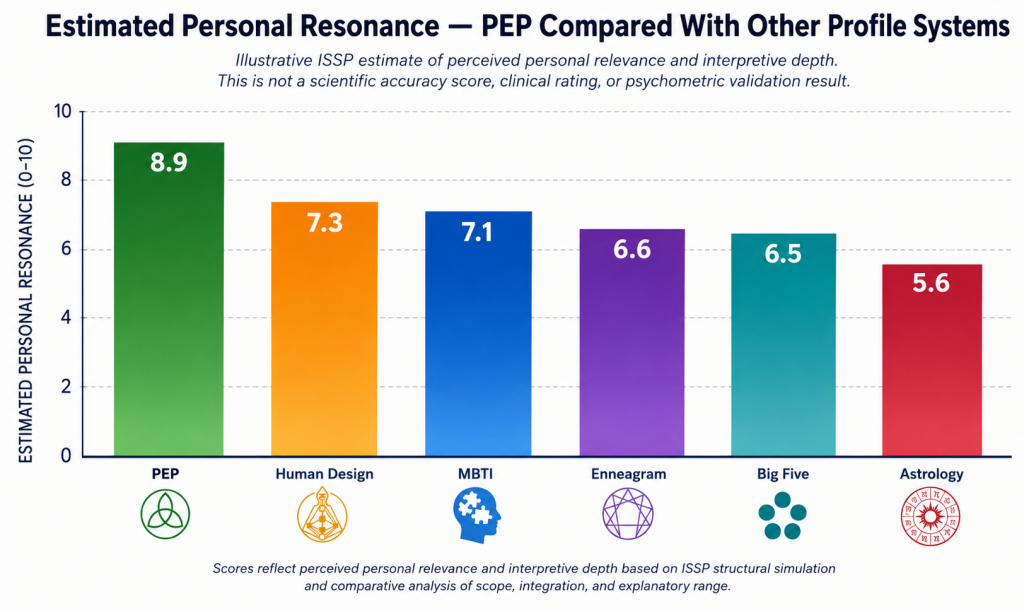
This chart represents an illustrative estimate of perceived personal relevance and interpretive depth. It is not a scientific accuracy score, clinical rating, or psychometric validation result.
The comparison separates MBTI and Big Five because they use different models and have different research foundations.
Deterministic Generation and Reproducibility
PEP is generated through a fixed, versioned calculation. The same standardized inputs processed through the same engine version produce the same profile.
The calculation uses:
- normalized birth information;
- historical timezone conversion;
- the 364-day Turtle Calendar;
- local birth-time position;
- one of three change phases;
- one of three Energy Processing Modes;
- the 3,276-position harmonic model;
- Core Tone construction;
- Numerical Fractal Resonance;
- and the current PEP interpretation library.
The generated Core Node ID stores the information required to reopen the user-facing profile without completing the birth form again. Deterministic generation means that the engine follows repeatable rules. It does not mean that every interpretation has already been independently proven as a psychological measurement. PEP is an ontology-grounded computational model.
External research would still be required to determine:
- how accurately users distinguish their own profile from controlled alternatives;
- how consistently profile findings correspond with measurable behavior;
- how results compare with established psychological instruments;
- and which interpretations are most predictive across a larger population.
PEP therefore separates two different claims.
Reproducibility
The engine can reproduce the same calculated result from the same standardized inputs.
External Validation
Independent testing is still required to establish the model’s measurable accuracy, predictive value, and population-level reliability. That distinction keeps the profile testable without overstating what has already been demonstrated.
What PEP Is Not
PEP is not:
- a medical or psychological diagnosis;
- a prediction of future events;
- a measure of personal worth;
- a statement that you cannot change;
- a replacement for professional advice;
- or a guarantee that every sentence will describe every moment of your life.
It does not tell you what you must become. It is intended to provide a structured model you can compare against your own lived experience.
What PEP Is Designed to Help You Understand
Your profile is designed to clarify:
- what you consistently contribute;
- which archetype most strongly organizes your profile;
- how you naturally process information;
- what makes decisions easier or harder;
- how your body and mind respond to pressure;
- what helps you recover;
- how you connect and communicate;
- where your strengths become overextended;
- what work rhythms may be more sustainable;
- and how different parts of your identity interact.
The goal is not to place you inside another box. The goal is to make your recurring pattern easier to recognize and use.
Who PEP May Be Useful For
PEP may be useful when you are:
- trying to understand why your energy and productivity are cyclical;
- repeatedly encountering the same type of friction;
- reconsidering your work role or environment;
- trying to communicate your needs more clearly;
- recovering from sustained overload;
- comparing several conflicting views of yourself;
- trying to understand the role you naturally assume in groups;
- or looking for a structured language for patterns you already sense but have difficulty explaining.
Frequently Asked Questions
Is PEP a personality test?
No. It does not ask questions or score self-reported preferences. It is a deterministic profile generated from fixed birth information within the PEP model.
Is the archetype my entire identity?
No. The archetype is the primary organizing function in the profile, but it is modified by your change phase, Energy Processing Mo de, Core Tone, cognitive pattern, Numerical Fractal Resonance, relationships, and lived experience.
Will my profile change?
The underlying coordinate is intended to remain fixed when the same canonical inputs and protocol version are used. The software and written interpretations may be refined over time as errors are corrected, terminology improves, or the model is expanded. The engine version is included so results can be audited and reproduced.
Why is an exact birth time required?
Birth time determines your position within the local daily cycle and is used to calculate how your change phase and Energy Processing Mode are assigned. The timezone is also required so the local birth moment can be converted accurately into a canonical universal timestamp.
What if I do not know my exact birth time?
Without a reliable birth time, the profile cannot confirm the exact daily phase, Energy Processing Mode, harmonic position, or complete Core Node ID. Use the best documented birth record available rather than guessing.
What is the Core Node ID used for?
It allows you to reopen the user-facing profile without entering the full birth form again. Keep the complete ID in a secure place after generating your report.
Is the Core Tone a name?
No. It is the verbal expression of the core vibrational pattern calculated by the PEP engine. Its components are translated into practical language within the report.
What is Numerical Fractal Resonance?
It is a secondary number-based reading calculated from your birth date and birth name. It is used to identify whether a numerical pattern reinforces, complements, or creates productive tension with the main PEP profile.
What does Fractal Resonance mean?
Fractal Resonance describes the recurrence of the same underlying function through different forms and layers of reality. For example, a stabilizing function may appear through a human behavior, a geometric form, a material property, an animal’s environmental role, or a musical structure.
Is PEP scientifically validated?
PEP uses deterministic, versioned calculations, which means the same standardized inputs can reproduce the same profile. It has not yet been independently established as a validated psychological or psychometric instrument. The profile should be treated as an ontology-grounded model that users can compare with their lived experience and that can be tested through future controlled research.
Does PEP tell me what career to choose?
No. It can identify working conditions, contributions, decision patterns, and stress risks that may help you evaluate a role. Career decisions still depend on skills, experience, opportunities, responsibilities, and personal choice.
Does PEP predict compatibility?
It describes relationship and collaboration patterns, including what tends to create trust, friction, or repair. It does not determine whether a specific relationship will succeed or fail.
Your Patterns Are Not Random
- You may not be inconsistent.
- You may be operating through a rhythm you have never been taught to recognize.
- You may not lack discipline.
- Your body and mind may process effort, stress, insight, and recovery differently from the schedule you have been trying to follow.
- You may not need another label.
- You may need a clearer map of how your patterns work together.
- The Personal Energetic Profile is designed to provide that map.
Fixed inputs. Reproducible calculation. Human-readable interpretation.