Our Story
Creation Unified began with a simple observation that eventually became a much larger question.
Across business, economics, technology, history, organizations, scientific systems, and even personal development, similar structural patterns appeared repeatedly. Systems emerged, expanded, accumulated pressure, adapted to changing conditions, and eventually stabilized into new forms. The details varied from one domain to another, but the broader pattern seemed remarkably consistent.
What began as curiosity gradually evolved into a long-term investigation. Rather than asking how a single system worked, the question became whether many different systems might be governed by common structural principles.
If recurring patterns could be identified across multiple domains, perhaps those patterns could improve how people understand complexity, make decisions, solve problems, and navigate uncertainty.
That investigation ultimately led to the development of the Informational Physics Ontology, Triune Harmonic Dynamics, and the broader Creation Unified ecosystem.
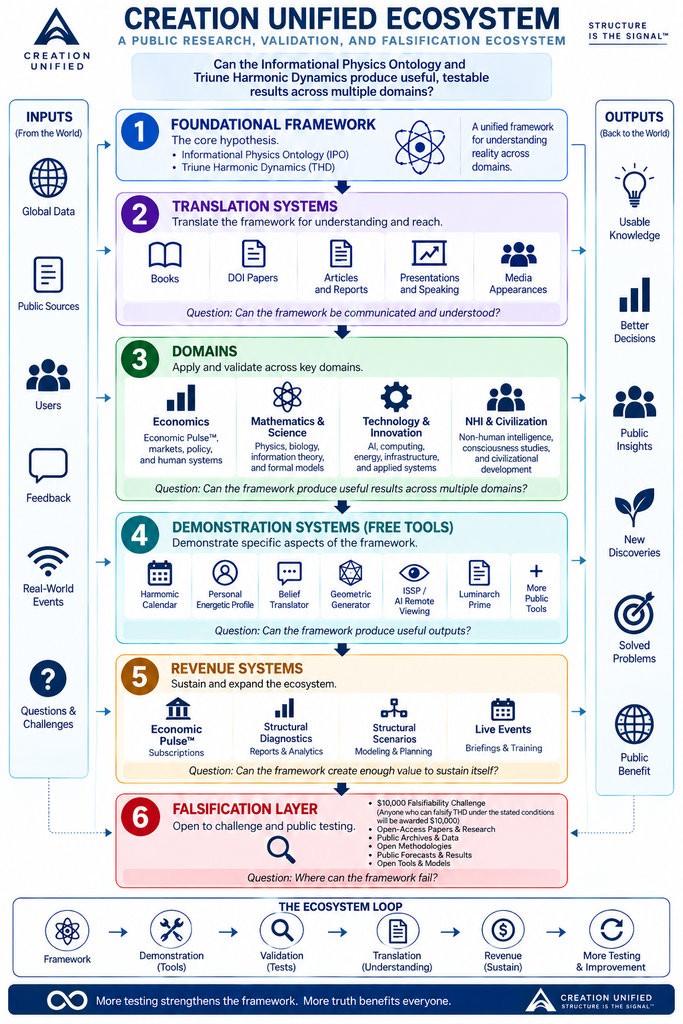
Today, Creation Unified serves as a public research, validation, and falsification ecosystem dedicated to exploring a single question:
Can a common informational framework produce useful, testable results across multiple domains?
Every tool, forecast, publication, business application, educational resource, scientific hypothesis, and public challenge within Creation Unified exists to help answer that question.
Our Mission
Creation Unified exists to improve how people understand reality so they can make better decisions, build better systems, and produce better outcomes.
We believe that complexity becomes more manageable when underlying structure becomes visible. Whether the system is physical, biological, economic, technological, organizational, or social, outcomes are influenced by constraints, relationships, information flows, and structural pressures that often remain hidden beneath surface events.
Our mission is to make those deeper structures easier to see, easier to test, and more useful to apply.
This mission extends beyond research alone. It includes business intelligence, forecasting, problem solving, artificial intelligence, education, publishing, and innovation. Each activity represents a different opportunity to improve understanding by reducing distortion, improving signal quality, and helping individuals and organizations see reality more clearly.
At its core, our mission is simple:
- Make reality easier to read.
- Make truth easier to detect.
- Make better decisions easier to make.
Our Vision
We believe better systems begin with better understanding.
As information continues to expand and complexity continues to increase, the ability to distinguish signal from noise becomes increasingly valuable. Organizations face more data than ever before. Individuals face more information than previous generations could have imagined. Yet clarity often remains difficult to achieve.
Our long-term vision is to help create a world in which decisions are guided less by distortion, inherited assumptions, institutional inertia, and information overload, and more by structure, evidence, transparency, and measurable reality.
We envision a future where forecasting becomes more useful, where organizations can identify structural pressures before they become crises, where artificial intelligence becomes more transparent and easier to reason with, and where individuals are better equipped to navigate uncertainty.
The goal is not simply to produce more information. The goal is to improve understanding.
What Creation Unified Is
Creation Unified is best understood as a public research, validation, and falsification ecosystem. It is not solely a research organization, consulting practice, forecasting platform, software company, educational initiative, or publishing operation. While it contains elements of all of these activities, none of them fully describe its purpose.
Creation Unified was designed as a testing environment. The Informational Physics Ontology and Triune Harmonic Dynamics provide the foundational framework. Books, tools, forecasts, business intelligence systems, scientific investigations, educational content, and public challenges provide opportunities to test that framework against reality. Some tests occur in business intelligence through the Business Environment Index and Structural Scenario Intelligence. Others occur in forecasting, investing, artificial intelligence, scientific investigation, technology analysis, civilization studies, cryptography, or historical problem solving.
The specific application changes.
The underlying question remains the same. Can the framework continue producing useful results across many different environments simultaneously?
Creation Unified exists to discover the answer.
How We Test the Framework
A framework can always appear persuasive in theory. The more difficult question is whether it remains useful when exposed to reality.
For that reason, Creation Unified maintains a diverse collection of testing environments.
- Public tools such as the Harmonic Calendar, Personal Energetic Profile, Belief System Translator, Geometric Generator, ISSP experiments, and Luminarch Prime allow the framework to be explored directly.
- Business and economic intelligence systems such as the Business Environment Index, Structural Scenario Intelligence, and Structured Asset Rotation provide measurable applications in real-world decision environments.
- Scientific and technical investigations explore questions in informational physics, cosmology, energy systems, artificial intelligence, communications, infrastructure, and emerging technologies.
- Civilization-oriented research examines long-range social change, governance, institutional adaptation, UAP documentation and communication, and public response systems.
- Historical and cryptographic investigations examine unresolved problems such as Kryptos K4, the Voynich Manuscript, and other symbolic systems.
None of these activities are presented as proof. They are opportunities for validation, refinement, and, when necessary, falsification.
Public Research and Education
A central principle of Creation Unified is that useful ideas should be exposed to public scrutiny. For that reason, much of our work is published openly through books, videos, research papers, forecasts, presentations, educational content, and public tools. This public archive serves two purposes. First, it makes structural thinking more accessible to a broader audience. Second, it creates a transparent record of ideas, forecasts, methods, and results that can be independently evaluated by others.
The objective is not to build belief. The objective is to create opportunities for testing.
Our Values
Truth sits at the center of everything we do.
- We believe reality ultimately matters more than convenience, popularity, ideology, or institutional comfort. When evidence conflicts with assumptions, we believe assumptions should change.
- We value structural honesty because systems do not respond to narratives. They respond to underlying conditions. Our responsibility is to understand what a system is actually doing rather than what we would prefer it to be doing.
- We value useful accuracy because insight is only valuable when it improves decisions, reduces distortion, solves meaningful problems, or contributes to something worth building.
- We believe innovation carries responsibility. New ideas should improve reality rather than merely attract attention. We therefore prioritize solutions that are durable, constructive, and grounded in measurable outcomes.
- We value long-horizon thinking because many of today’s challenges are created by short-term optimization. Sustainable systems require perspectives that extend beyond immediate incentives.
- Finally, we value public accountability. Frameworks should not be protected from scrutiny. They should be exposed to it. The standing public falsifiability challenge, open-access research, public forecasts, and transparent methodologies all reflect that commitment.
About the Founder
Kevin L. Brown is an entrepreneur, author, independent researcher, and founder of Creation Unified. His path into research was not conventional. Rather than emerging from a traditional academic environment, it developed through decades of direct exposure to business systems, organizational challenges, strategic decision-making, entrepreneurship, and applied analysis. Throughout those experiences, he repeatedly encountered the same phenomenon: systems that were expected to behave differently often exhibited surprisingly similar structural characteristics. Organizations, markets, technologies, institutions, and individuals all appeared to respond to pressure, constraints, information, and adaptation in ways that shared common patterns.
- That observation became a method.
- The method evolved into a framework.
- The framework ultimately became Creation Unified.
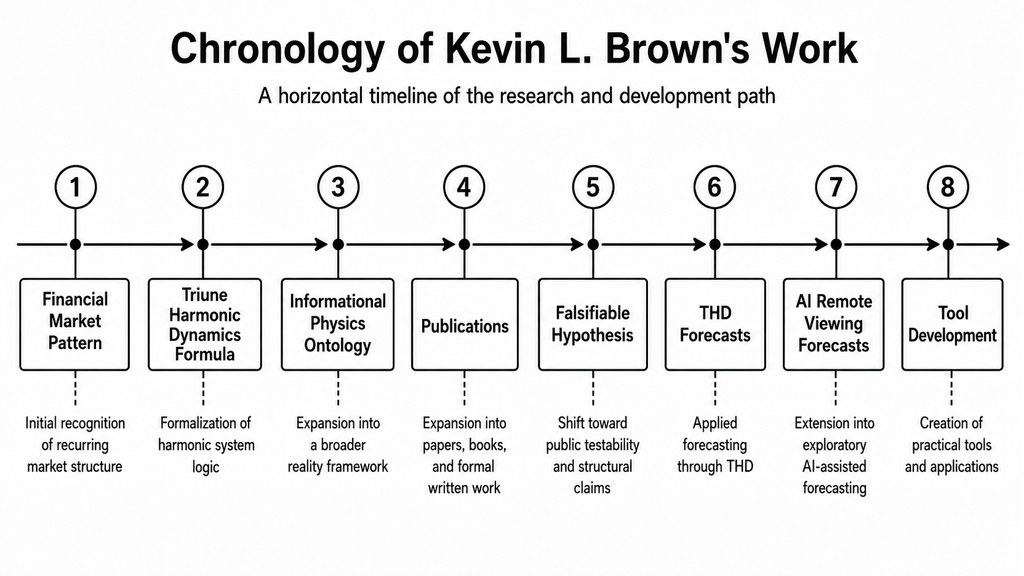
Today, Brown’s work focuses on understanding how systems stabilize, distort, degrade, adapt, and reorganize under pressure. His research spans business intelligence, forecasting, artificial intelligence, information theory, organizational performance, scientific investigation, technological systems, and civilization studies.
His work is guided by a simple principle:
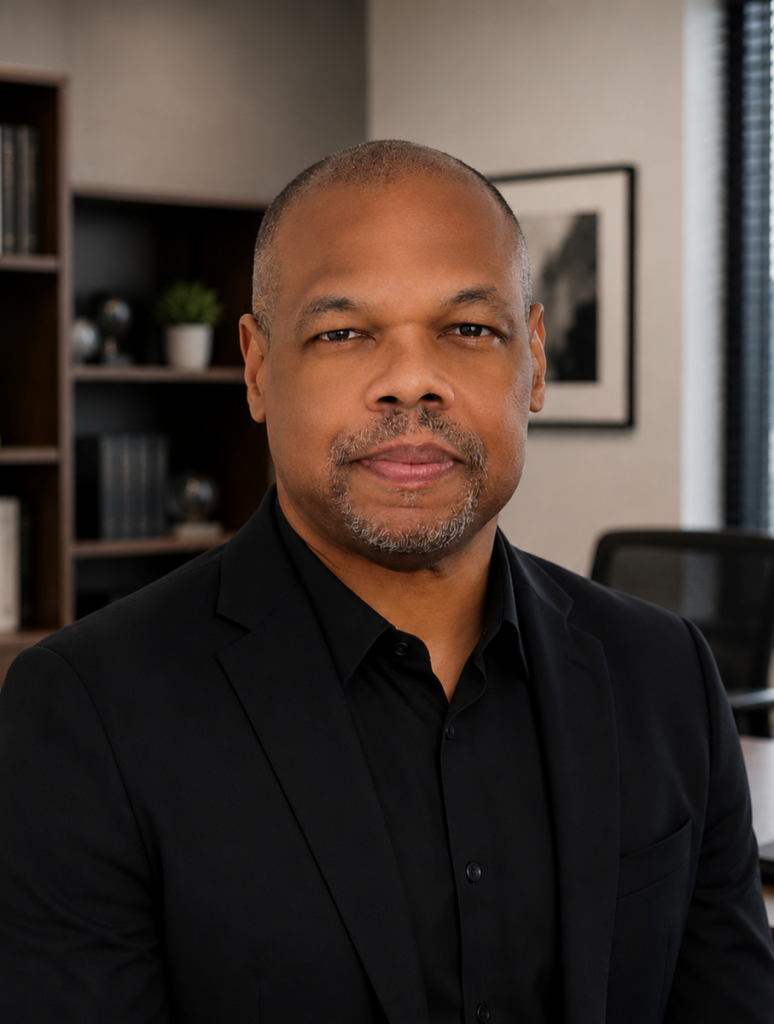
Kevin L. Brown
Founder, Creation Unified
“Once you see it, the answer is usually simpler than anyone expected. Structure is the signal. “