
A Systems Map of the Nodes We Encounter Across an Incarnation
Human life is usually described from the perspective of the individual. We ask who a person is, what they believe, what they are trying to accomplish, what happened to them, what relationships shaped them, and what they eventually become. That perspective is useful, but it begins too late in the structure. Before there is an individual life story, there is already a system.
A system is not simply a collection of things. It is an organized set of relationships with enough boundary, identity, exchange, and persistence to remain recognizable through time. A human being is a system in this sense, but so is a family, an organization, a city, a government, a nation, a university, a research institution, a media network, or an economic sector. Each of these can function as a distinguishable unit inside a larger field of interaction. In that sense, each can also be understood as a node.
A node is therefore not defined by being human. A node is defined by having a functional position inside a larger system. It can receive information, process information, transmit information, respond to pressure, form relationships, maintain boundaries, and influence the larger network. A person is one kind of node inside the broader system of human civilization. A corporation is another. A government can be another. A country can be another. The scale changes, but the basic relationship remains similar: bounded systems interact with other bounded systems through flows of information, resources, authority, energy, attention, trust, and influence.
This systems perspective is consistent with the broader architecture in The Geometry of Systems, where systems are understood through boundary, identity, exchange, persistence, load, capacity, and feedback rather than merely through isolated components. Network thinking adds another layer: nodes only reveal their full function through their links and flows. A node may possess internal capability, but the way it behaves in a larger network depends on what reaches it, what leaves it, and what kinds of relationships connect it to other nodes.
That provides the foundation for the Identity Systems model.
The model proposes that a person can be understood in two different but related ways. First, a person may embody a dominant functional archetype. Second, that person may repeatedly interact with a set of relational node functions across an incarnation. These are not the same thing.
The archetype you embody answers the question, “What kind of function do I naturally contribute to the larger system?”
The relational nodes answer a different question: “What kinds of interactions must I encounter in order for that function to be tested, expanded, balanced, and integrated?”
That distinction is essential. The embodied archetype describes the node’s persistent orientation. The interaction nodes describe the relational field through which that orientation develops.
The working hypothesis is that the purpose of the 12 interaction nodes is to maximize learning by exposing the embodied node to sufficiently different kinds of relational information. The point is not simply to accumulate more experiences. The point is to encounter different forms of experience that exercise different dimensions of identity.
A system that only receives one kind of input learns poorly. A Builder surrounded only by agreement may become productive but rigid. A Healer surrounded only by people who need help may never learn limits. A Visionary surrounded only by encouragement may never learn the difference between foresight and projection. A Leader surrounded only by obedience may never discover whether the direction is actually coherent. Differentiated interaction creates correction.
That is the deeper function of the relational field.
The Node You Embody
The Personal Energetic Profile currently uses thirteen primary archetypes. The archetype is the center of the profile rather than the entirety of the person; other layers affect how the archetype expresses itself, including timing, processing mode, relational dynamics, friction patterns, and other profile elements.
The thirteen archetypes are not best treated as personalities in the ordinary sense. They are better understood as recurring system functions.
The Visionary, or Future Pattern Mapper, notices emerging possibilities before the complete structure is visible. It is oriented toward weak signals, long-range implications, and future configurations. The Visionary contributes direction before others can yet see the full path, but its risk is living too far ahead of the available evidence.
The Builder, or Structure Creator, converts disorder, pressure, or incomplete ideas into durable plans, systems, and structures. Builders notice foundations, missing supports, load pathways, and the minimum architecture required for stability. Their strength is turning possibility into form; their weakness is confusing rigidity with strength.
The Explorer, or Boundary Expander, moves outside existing limits to gather information that cannot be acquired from within the current map. Explorers learn through direct exposure, movement, experimentation, and comparison across contexts. Their challenge is learning to stop long enough to integrate what they have discovered.
The Sage, or Knowledge Integrator, preserves, compares, and organizes information so that experience becomes dependable understanding. The Sage contributes context and continuity, but can become trapped in analysis if understanding is never converted into action.
The Nurturer, or Capacity Supporter, maintains the conditions that allow people and relationships to continue functioning. The Nurturer detects unmet needs and uneven support. Its strength is sustaining life and relationship; its risk is over-functioning or confusing being needed with being connected.
The Rebel, or Constraint Challenger, detects where a rule, structure, or assumption has become obstructive. Its contribution is to reopen pathways that have become blocked. The Rebel’s danger is destroying structures without creating something capable of replacing them.
The Leader, or Direction Coordinator, organizes people, resources, responsibility, and decisions around a shared direction. The Leader converts distributed effort into coordinated movement, but can over-centralize authority or mistake speed for alignment.
The Artist, or Experience Translator, converts internal complexity, perception, emotion, and subtle meaning into forms that others can encounter. That may happen through language, visual art, music, design, performance, or storytelling. Its challenge is accepting enough structure to complete and release what it creates.
The Alchemist, or Transformation Designer, works with unstable or contradictory conditions until a new functional state emerges. The Alchemist seeks change at the underlying level rather than surface management. Its risk is transforming things unnecessarily when stabilization alone would be enough.
The Guardian, or Boundary Protector, preserves identity, continuity, safety, memory, and essential resources. It monitors threats and regulates exposure. Its strength is preserving what matters; its danger is protecting something long after its purpose has ended.
The Seeker, or Question-Driven Investigator, follows unresolved questions until the hidden structure or missing information becomes visible. The Seeker protects against false closure, but can remain identified with searching after enough information has already been gathered.
The Healer, or Restoration Facilitator, detects loss of function, alignment, or capacity and works to create the conditions under which repair can occur. Its contribution is restoration; its challenge is recognizing when responsibility for recovery must return to the other node.
The Mystic, or Whole-Picture Perceiver, notices relationships among layers that are normally treated as separate. It seeks the larger identity or shared structure that connects them. Its value is synthesis; its risk is dissolving distinctions that remain functionally necessary.
These archetypes represent the function a node tends to embody. They do not determine every behavior or every choice. A Builder can nurture. A Healer can lead. A Visionary can build. The archetype is a center of gravity, not a cage.
The Personal Energetic Profile also contains an Intercalary boundary coordinate outside the standard 364-day archetypal sequence, emphasizing transition and recalibration between cycles rather than a standard archetypal function. Once the embodied function is understood, the second half of the model becomes more meaningful.
The 12 Interaction Nodes
The 12 relational nodes do not describe what kind of person someone is. They describe what a relationship or interaction is doing.
This is a major distinction. A person should not be permanently labeled “my Adversary” or “my Teacher.” Relationships change. One individual may occupy several functions at different times, and the same function may be supplied by entirely different people, institutions, or events across a lifetime.
The most reliable way to identify an interaction node is therefore to ask, “What does this interaction repeatedly cause me to encounter, develop, or integrate?”
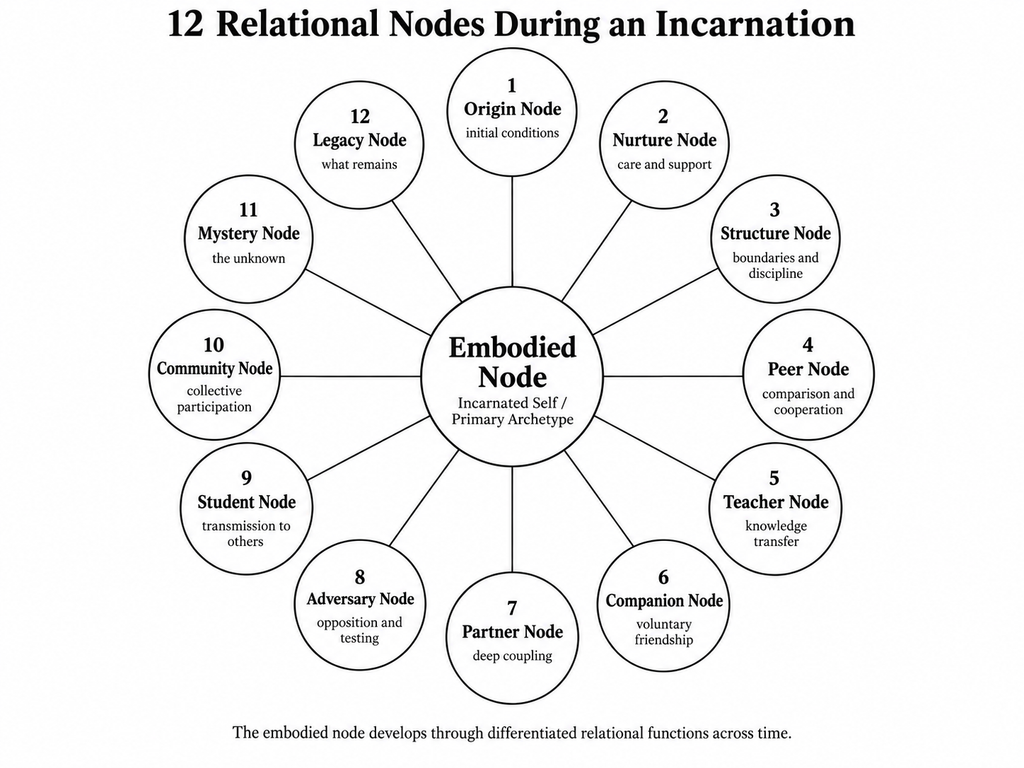
1. The Origin Node
The Origin Node establishes initial conditions.
It includes the family, culture, geography, socioeconomic environment, historical period, and other conditions present before the individual has meaningful control. Its purpose is initialization rather than instruction. Every system begins somewhere, and initial conditions shape which pathways become easy, difficult, available, or invisible.
You identify an Origin Node by asking whether the condition existed before meaningful personal choice and whether later development repeatedly had to respond to that initial configuration.
A family of birth is an obvious Origin Node, but a nation, cultural system, historical era, or inherited institutional condition can also operate in this role.
2. The Nurture Node
The Nurture Node teaches the receiving side of existence. It concerns care, support, safety, belonging, emotional regulation, and the capacity to receive what is needed to remain functional.
A biological mother may occupy this role, but the role is not equivalent to motherhood. A father, grandparent, sibling, foster parent, mentor, institution, or community can perform the same function.
You identify the Nurture Node by asking where you learned whether it was safe to have needs, whether support could be trusted, and whether receiving care strengthened or weakened autonomy.
Its developmental purpose is to establish the difference between support, dependence, deprivation, and healthy capacity.
3. The Structure Node
The Structure Node introduces boundaries, rules, consequences, expectations, standards, and authority.
It often appears through parents, teachers, employers, legal systems, governments, religions, professional institutions, or organizational hierarchies.
The Structure Node asks what happens when personal desire meets an external limit.
You identify it through repeated patterns involving permission, discipline, standards, responsibility, rules, or consequences. Healthy Structure teaches self-regulation. Distorted Structure may teach fear, arbitrary control, or distrust of authority.
Its purpose is not obedience for its own sake. Its deeper function is learning how identity behaves inside constraint.
4. The Peer Node
The Peer Node introduces lateral relationship.
Unlike Nurture or Structure, it operates among nodes of roughly comparable agency or status. Siblings, friends, classmates, professional peers, competitors, neighboring organizations, and even nations may perform this function.
The Peer Node teaches comparison, cooperation, fairness, competition, negotiation, jealousy, loyalty, and shared responsibility.
You identify it by asking whether the central issue is, “How do I exist beside another node that has comparable freedom and capability?”
Its function is learning neither submission nor dominance, but coexistence.
5. The Teacher Node
The Teacher Node introduces consequential information that the receiving node did not already possess.
A Teacher Node may be an actual teacher or mentor, but it may also be a book, failure, experiment, conversation, institution, or unexpected event.
The defining question is whether the interaction changed the internal model.
You identify it by asking, “After this encounter, did I know something important that I could not have learned simply by remaining as I was?”
Its purpose is informational expansion.
6. The Companion Node
The Companion Node introduces voluntary connection.
Family relationships are often inherited. Friendships are usually chosen. That makes companionship a distinct learning environment because the relationship persists without biological obligation, legal authority, or required hierarchy.
You identify a Companion Node through mutual enjoyment, loyalty, shared experience, reciprocal trust, and continued presence where neither party is compelled to remain.
Its question is simple: “Who stays because both nodes choose the relationship?”
Its purpose is learning voluntary reciprocity.
7. The Partner Node
The Partner Node creates deeper coupling.
Romantic relationships are the clearest expression, but long-term collaborative partnerships can also exhibit part of the same structure.
Partnership involves vulnerability, shared decision-making, negotiated boundaries, mutual dependence, intimacy, and often construction of a shared future.
You identify the Partner Node by the degree of coupling. Does the relationship require both nodes to coordinate identity, resources, decisions, risk, or future direction without either node disappearing into the other?
The Partner Node therefore tests one of the most difficult relational questions: can two identities become deeply connected while remaining distinct?
8. The Adversary Node
The Adversary Node introduces counterforce.
It may be an opponent, critic, competitor, gatekeeper, rejecting institution, hostile person, or resistant system.
The purpose of the adversarial function is not necessarily hostility. Its deeper value is stress testing.
You identify the Adversary Node when the interaction repeatedly exposes weakness in your reasoning, boundaries, evidence, resilience, strategy, or self-understanding.
The question is, “What remains true when another node pushes back?”
This does not mean abuse, cruelty, or harm should be spiritualized or justified. Harm remains harm. The relevant systems question concerns what information the receiving node later extracts from the encounter, not whether the harmful act was somehow necessary.
9. The Student Node
The Student Node reverses the direction of informational flow.
At some point, the node that once received must transmit.
Children, students, employees, clients, readers, apprentices, or adopting organizations can occupy this role.
You identify a Student Node when another node depends upon you to convert something you understand into something they can independently use.
The deeper purpose is verification through transmission.
Teaching reveals whether knowledge has actually become integrated. If something cannot be explained, transferred, or reproduced, understanding may be less complete than assumed.
10. The Community Node
The Community Node introduces scale.
Some functions work well between two people but break down in groups. Community tests whether an embodied function remains coherent when many nodes interact simultaneously.
Neighborhoods, organizations, industries, religions, professional communities, online networks, governments, and societies can all occupy this role.
You identify the Community Node when the primary issues involve collective norms, belonging, reputation, coordination, shared identity, public consequences, or distributed responsibility.
Its purpose is to test whether the individual’s function can scale beyond one-to-one relationships.
11. The Mystery Node
The Mystery Node appears when the current explanatory model stops being sufficient.
It may arrive through anomaly, coincidence, unexpected loss, unusual experience, surprising discovery, abrupt opportunity, or observations that resist classification.
Its function is not to demand a supernatural explanation. Its purpose is to expose the edge of the existing map.
You identify the Mystery Node by asking whether the central effect of the interaction is that what you believed was complete no longer appears complete.
The mature response to Mystery is neither denial nor premature certainty. It is investigation.
12. The Legacy Node
The Legacy Node concerns persistence beyond direct presence.
A child, student, book, invention, organization, policy, work of art, research program, cultural practice, or institution can carry information beyond the active participation of the originating node.
You identify the Legacy Node by asking, “What continues functioning when I am no longer present to sustain it?”
This closes the interaction loop. The learner eventually becomes part of another node’s environment.
The output of one incarnation becomes the input of later systems.
Why the 12 Nodes May Exist
The most interesting question is not merely what the twelve functions are, but why an interaction architecture like this would exist at all.
If life is understood as a learning system, then repeated exposure to the same type of relationship would eventually produce diminishing informational value. Learning requires variation.
The twelve functions appear to provide that variation.
An individual learns to receive through Nurture, to operate under limits through Structure, to coexist through Peer relationships, to expand knowledge through Teacher interactions, to connect voluntarily through Companion, to tolerate deep coupling through Partner, to withstand opposition through Adversary, to transmit through Student, to operate at scale through Community, to remain open to uncertainty through Mystery, and to preserve learning through Legacy.
Origin establishes the starting state within which all of those later interactions occur.
Taken together, the twelve nodes create a kind of experiential curriculum.
The curriculum is not organized around academic subjects. It is organized around different forms of relational pressure.
The purpose is therefore not simply to maximize the quantity of learning. It is to maximize dimensionality of learning.
That may be the most important distinction in the model.
A Builder who only builds never learns enough. The Builder must eventually encounter people who resist structure, people who need support rather than structure, people who challenge the assumptions behind the structure, people who carry the structure forward, and systems large enough to reveal whether the structure scales.
The same is true of every archetype.
The Interaction Matrix
The real unit of analysis is not the archetype alone or the interaction node alone.
It is the intersection between them.
A Builder encountering an Adversary receives a different lesson than a Healer encountering an Adversary.
For the Builder, opposition may test whether the structure can carry pressure.
For the Healer, opposition may reveal whether repair is still appropriate or whether a boundary is required.
For the Visionary, an Adversary may force future-oriented intuition into present-day evidence.
For the Rebel, opposition may reveal whether disruption has become identity rather than function.
For the Leader, resistance may expose whether authority is coherent or merely centralized.
For the Mystic, opposition may force large-scale synthesis back into concrete, falsifiable claims.
The same external function therefore produces different developmental pressure depending upon the receiving archetype.
That gives the Identity Systems model a matrix rather than a list:
| Layer | Core Question |
|---|---|
| Embodied Archetype | What function does this node naturally contribute? |
| Interaction Node | What kind of relational pressure or information is entering? |
| Temporal Phase | Where is the interaction in its development? |
| Scale | Is this occurring between people, organizations, institutions, or larger systems? |
That is the more complete model.
The Temporal Layer
Relationships do not remain static.
A Companion may become a Partner. A Partner may temporarily function as an Adversary. A parent may begin as Nurture and Structure, later become Companion, and eventually become Student when the adult child acquires knowledge the parent lacks.
A government may function as Structure during one period, Adversary during another, and Community at another scale.
This is why it is inaccurate to say, “That person is my Adversary Node.”
A better statement is, “That relationship is currently performing an adversarial function.”
The function can change because relationships move through time.
This is also where the Emergence, Contrast, and Integration structure becomes useful. An interaction may begin by forming, move into testing, and eventually integrate, reorganize, or terminate. The same interaction-node function can mean something very different depending upon its phase.
A Partner relationship in Emergence is establishing trust and boundaries. The same relationship in Contrast may be exposing differences. During Integration, the pair either incorporates those differences into a stronger shared structure or recognizes that the relationship cannot preserve both identities coherently.
Time therefore changes interpretation.
A complete analysis must ask not only which node is active, but what phase it is in.
How to Identify an Interaction Node
In practice, identification should be based on function rather than intuition alone.
Five questions are especially useful.
- What repeatedly flows through this relationship: care, knowledge, opposition, authority, intimacy, comparison, uncertainty, or responsibility?
- What changes in me because of the relationship?
- What would disappear from my development if this interaction vanished?
- Is the function stable, or has the relationship shifted roles over time?
- What capacity is this relationship requiring me to develop that I would not develop as efficiently alone?
The last question is particularly useful because it returns to the hypothesized purpose of the system.
The interaction node is not merely describing who someone is. It describes what the relationship is asking the embodied node to become capable of handling.
Verification and Falsification
Although this framework is not presented as a scientific paper, it should not be protected from testing.
The first test concerns completeness. If the twelve interaction nodes genuinely describe a closed functional set, major life relationships should repeatedly fit the categories without requiring arbitrary reinterpretation. If a recurring thirteenth function repeatedly appears, the closed-set claim weakens.
The second test is independent classification. Different trained observers should be able to examine the same relationship history and assign similar node functions. If one observer consistently identifies Teacher while another sees Adversary and another sees Mystery, with no reliable agreement, the categories may be too subjective.
The third test is parsimony. Twelve categories must add explanatory value. If six categories explain the same relational data just as well, the twelve-node model may contain unnecessary complexity.
The fourth test concerns archetype interaction. If the thirteen embodied archetypes are genuinely different functional orientations, then the same relational node should produce different but patterned responses across those archetypes. Builders and Healers, for example, should not respond identically to the same form of structural resistance if the archetypal distinction is meaningful.
The fifth test concerns scale. Because this framework assumes that relational geometry can recur across systems, similar functions should be identifiable between organizations, institutions, governments, and nations. That does not mean those systems are psychologically equivalent to people. It means the underlying relationship should remain recognizable without stretching the categories into metaphor.
This distinction matters. The Unified Informational Mathematics work explicitly separates faithful representation from loose analogy and emphasizes that representation alone does not establish physical truth. The same discipline should apply here.
Finally, the model should eventually demonstrate prospective value. A useful interaction framework should help identify what type of pressure or transition is likely to appear next once the active node and temporal phase are known. If it can only explain events retrospectively, its explanatory power remains limited.
What the Model Does Not Yet Establish
Even if the interaction taxonomy proves useful and reproducible, that would not by itself prove reincarnation, predestination, pre-life agreements, or intentional design.
Those are additional claims.
A more modest observable claim would be that major human relationships may cluster into a stable set of recurring interaction functions, and that those functions may improve learning by exposing identity to different forms of pressure and information.
The reincarnational interpretation belongs to the broader ontology. It may be consistent with the model, but it should not be treated as empirically established merely because the relational structure proves useful.
That separation strengthens the framework rather than weakening it.
Incarnation as a Networked Learning Process
The broader implication is that an incarnation cannot be understood completely by studying the individual alone.
A node develops through its connections.
Some relationships supply what the node lacks. Others resist what it is trying to become. Some give knowledge. Some reveal boundaries. Some permit intimacy. Some create comparison. Some introduce uncertainty. Some receive what the individual has learned. Some preserve that learning after the individual is gone.
The relational field therefore functions less like a random collection of people and more like a distributed learning environment.
The embodied archetype supplies the persistent orientation.
The interaction nodes supply differentiated experience.
The temporal layer determines where the interaction is in its cycle.
Scale determines whether the same relational geometry is appearing between individuals, organizations, nations, or other systems.
That produces a more complete model of identity:
Embodied function + relational function + temporal phase + scale.
Seen this way, identity is neither completely internal nor completely imposed by the outside world. It is relational.
The node changes the network, and the network changes the node.
A Teacher influences the Student, but the Student changes the Teacher. A Partner exposes the self, but is also exposed. An Adversary applies pressure but is also changed by resistance. A Community shapes the individual while individuals reshape the Community. Legacy eventually carries one node’s outputs into lives and systems the original node may never directly encounter.
The loop therefore does not end with the individual.
It continues through transmission.
Conclusion
The distinction between the node a person embodies and the nodes that person interacts with provides a more complete way to model an incarnation.
The thirteen embodied archetypes describe different functional contributions: Visionary, Builder, Explorer, Sage, Nurturer, Rebel, Leader, Artist, Alchemist, Guardian, Seeker, Healer, and Mystic.
The twelve relational nodes describe the differentiated interaction field through which those functions develop: Origin, Nurture, Structure, Peer, Teacher, Companion, Partner, Adversary, Student, Community, Mystery, and Legacy.
The archetype tells us what the node tends to contribute.
The relational node tells us what kind of information or pressure the system is currently delivering.
The temporal layer tells us where that interaction is in its development.
Scale tells us how broadly the same structure is being expressed.
The central hypothesis is that this architecture maximizes learning not through repetition, but through difference. Each relational node exposes an aspect of identity that the others cannot completely reveal.
In that sense, the purpose of the system may not be to make every incarnation comfortable or even orderly. Its deeper function may be to ensure that identity cannot develop in only one direction.
A persistent node must learn to receive and give, to connect and separate, to cooperate and resist, to know and question, to build and release, to act individually and function collectively.
The incarnation is therefore not simply a personal story.
It is a networked process of differentiation, testing, integration, and transmission.
And if the 12-node model is correct, then the people, institutions, and systems encountered along the way are not merely background characters in that process.
They are part of the architecture through which identity learns what it is capable of becoming.