
Voynich Manuscript Translator
A Reproducible Decoding Framework for Beinecke MS 408
The Mechanical Key proposes that the Voynich Manuscript is better approached as a structured technical notation than as ordinary prose. The goal is not to force a translation, but to make the decoding process explicit enough for humans and AI systems to reproduce, compare, challenge, and falsify.
Test the Mechanical Key Yourself
Use the Voynich Manuscript Translator to classify sections, parse tokens, apply the working tables, generate procedural translations, and expose confidence and uncertainty.
Mechanical Key
Procedural decoding model rather than universal substitution cipher.
Triple-Dial Grammar
Subject / Action / Outcome positional structure.
Four-Layer Stack
Section → Position → Token → Offset.
Four Semantic Domains
Botanical, astronomical, balneological/engineering, pharmaceutical.
Why the Voynich Manuscript Has Not Yielded
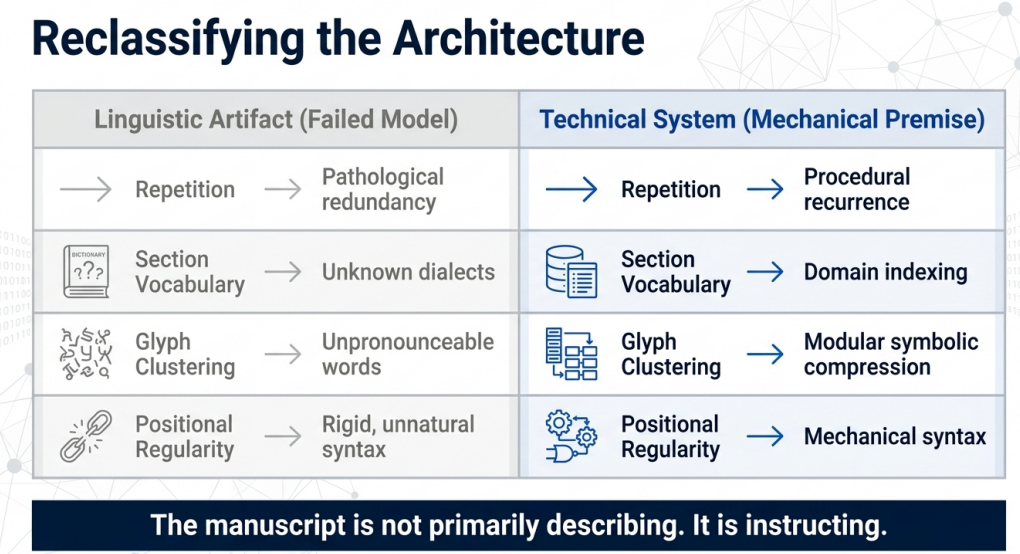
Most attempts have approached the manuscript as concealed natural language: substitution, phonetic reconstruction, linguistic comparison, or synthetic alphabet. The Mechanical Key asks whether the persistent failure of those approaches may point to a classification problem rather than meaningless text.
The Mechanical Premise
The central claim is that Voynich glyph clusters are better modeled as operational tokens than as ordinary words. Their value depends on structural role, section context, and local offset.
Under this premise, several otherwise difficult features become interpretable:
- repetition becomes procedural recurrence;
- section-specific vocabulary becomes domain indexing;
- glyph clustering becomes modular symbolic compression;
- positional regularity becomes mechanical syntax.
The manuscript is therefore treated less like prose and more like technical shorthand, procedural notation, laboratory indexing, or a compressed instructional system.
Four Principles Define the Framework
The model is built around four dependencies that must work together. Removing one of them makes translation more ambiguous and less reproducible.
Triple-Dial Grammar
Text is parsed into recurring functional cycles of Subject / Action / Outcome rather than read as ordinary sentence syntax.
Section-Governed Domains
Illustrations act as semantic headers that determine which domain-specific lookup rules govern the text.
Token Root Modularity
Recurring roots preserve related semantic structure while variants and positions modify the local value.
Header Offset Control
Paragraph-level controller tokens are hypothesized to narrow or rotate local semantic interpretation within bounded spans.
Subject → Action → Outcome
The core operational unit is a repeating three-position cell. The same token root can carry a different functional value depending on where it appears in the cell.
Subject / Part
Defines the object, component, substrate, apparatus, ingredient, celestial field, or other thing being acted upon.
Action / Process
Defines what happens to the subject: cut, heat, compress, expose, rise, steep, or another procedural action.
Outcome / State
Defines the intended result, measured state, interval, potency, delivery state, or terminal condition.
The Four-Layer Decoding Stack
A stable translation requires all four layers. Section alone is too broad; tokens alone drift; position alone cannot resolve domain meaning; offsets provide local control.
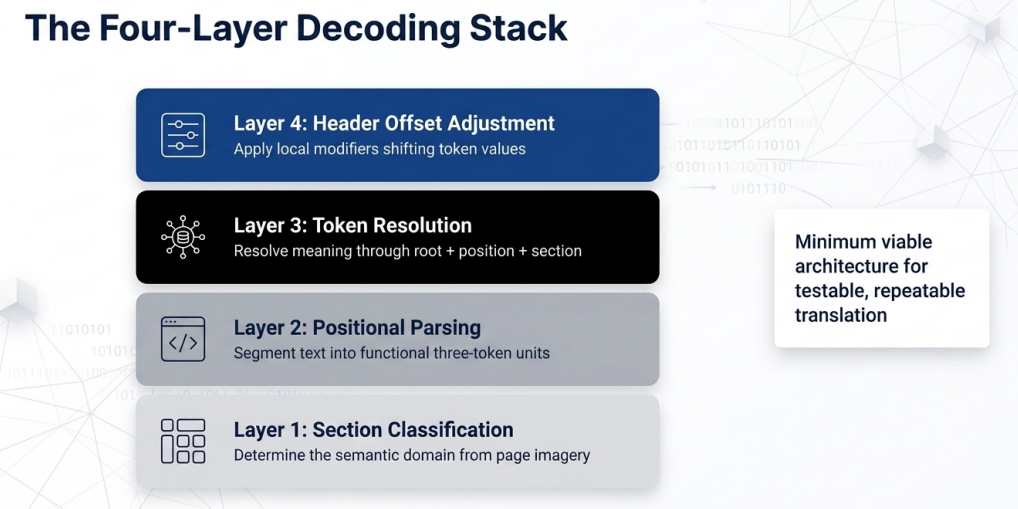
Layer 1 identifies the semantic domain. Layer 2 identifies grammatical function. Layer 3 resolves root + position + section. Layer 4 applies local header adjustments.
Section-Governed Semantic Domains
The manuscript’s imagery functions as a semantic index. A token root can preserve structural continuity while resolving differently in different sections.
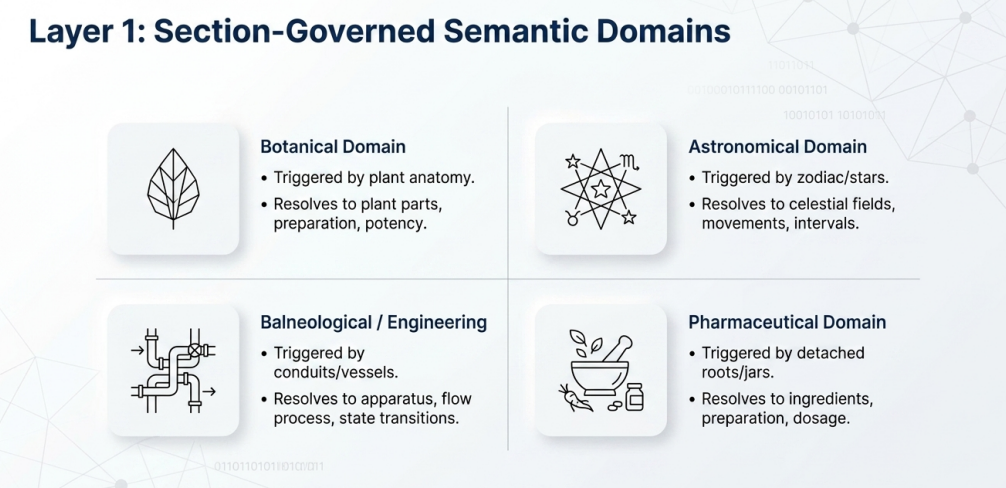
Botanical
- Position 1: plant anatomy
- Position 2: preparation process
- Position 3: medicinal state or potency
Astronomical
- Position 1: celestial field
- Position 2: movement or event
- Position 3: temporal interval
Balneological / Engineering
- Position 1: apparatus or vessel
- Position 2: flow or heat process
- Position 3: state transition
Pharmaceutical
- Position 1: ingredient class
- Position 2: preparation method
- Position 3: dosage, delivery, or implied result
Root + Variant + Positional Function
The Mechanical Key treats token meaning as compositional. A recurring semantic root is modified by visible variants and then resolved through position and domain.
Token Root
The recurring semantic core, such as chol, dar, cth, ar, or shol.
Variant Marker
Prefixes or suffixes indicate subtype, intensity, direction, phase, or another local modification—for example cth-on, cth-or, cth-ot.
Positional Function
The final working value depends on whether the token appears as Subject, Action, or Outcome inside the current semantic domain.
Core Token Table — Base Dial Table
This is the minimum seed table presently used by the framework. It is a decoding scaffold, not a final Voynich dictionary.
| Token Root | Position 1 — Subject | Position 2 — Action | Position 3 — Outcome |
|---|---|---|---|
| chol | taproot | compress / press | primary extract |
| dar | main stem | cut / sever | hand-width measure |
| siyen | petal cluster | expose / dry | brittle / pale state |
| cth | conduit / pipe | heat / fire | boil / third degree |
| ar | north horizon | rise / appear | first watch |
| shol | bitter jagged leaf | steep / infuse | oil tincture |
The Same Root Can Resolve Differently by Domain
The framework does not assume a globally fixed substitution. Instead, the active section constrains the local semantic range.
Example Override — chol
| Section | Position 1 | Position 2 | Position 3 |
|---|---|---|---|
| Botanical | taproot | compress | base extract |
| Pharmaceutical | bitter base | grind | tincture |
| Balneological | intake pipe | compress flow | sediment base |
Header Offset Rules
The current working hypothesis is that paragraph-level header tokens function as local controllers that narrow or shift semantic resolution for the block that follows.
Working offset hypothesis
- the first token in a paragraph acts as an offset controller;
- the offset persists for one paragraph block;
- the offset changes subclass or local semantic resolution rather than replacing the root entirely;
- the base table provides broad meaning while the local offset reduces drift.
Why offsets are needed
Many partial Voynich decodes appear directionally coherent for a short span and then drift. The Mechanical Key predicts that section and position are necessary but not sufficient for long-form stability.
The offset layer is therefore not decorative. It is a proposed control mechanism that should measurably improve consistency if the framework is correct.
Six Initial Cross-Section Validation Cases
These examples are not presented as proof of complete translation. They are examples of the kind of coherent procedural output the model is expected to produce across different semantic domains.
Eight-Step Translation Protocol
The Mechanical Key is intended to be operational rather than intuitive. The same sequence should be usable by a human researcher, a scripted system, or an AI model constrained to the same lookup architecture.
Classify the Section
Use the page imagery to determine the active semantic domain.
Segment the Tokens
Split the line into three-token cells or marked two-token abbreviated forms.
Resolve the Root
Identify the recurring token root and any visible variant markers.
Assign Position
Map each token to Subject, Action, or Outcome.
Apply the Section Table
Resolve the working semantic value from the active domain.
Apply Header Offset
Adjust local values according to the paragraph-level control hypothesis.
Render the Instruction
Convert the resolved semantic cell into procedural English.
Score Confidence
Report the strength of recurrence and structural fit instead of hiding uncertainty.
Strong recurrence and structural fit across the active rules.
Plausible resolution with partial recurrence or unresolved local ambiguity.
Inferred reading with insufficient recurrence or unresolved control structure.
Why the Manual Key and GPT Both Matter
A useful decoding framework should not depend on one person’s intuition. The underlying tables and rules should remain inspectable even when the GPT is used to accelerate analysis.
Human use
A researcher can classify the folio, segment a line, identify roots, assign positions, consult the section table, apply a declared offset, render the instruction, and score confidence manually.
AI-assisted use
The GPT can apply the same sequence more quickly, compare repeated structures across pages, expose alternate resolutions, and preserve an explicit confidence boundary. The AI output should remain subordinate to the published rules rather than silently inventing a new key.
The Mechanical Key Must Be Able to Fail
The framework is only useful if its core claims can lose under repeatable testing.
- Contradictory stable outputs: identical token structures repeatedly produce incompatible outputs under the same declared conditions.
- Position failure: Position 2 tokens do not behave like actions across repeated contexts.
- Reproduction failure: independent decoders using the same tables cannot obtain comparable outputs.
- Section-header failure: section classification does not improve semantic consistency.
- Offset failure: paragraph-level offset modeling does not reduce semantic drift.
These conditions are designed to distinguish a mechanical decoding framework from unconstrained interpretive projection.
From Unsolved Mystery to Testable Decoding System
The Mechanical Key argues that the Voynich Manuscript may have resisted decipherment because its symbols have been classified incorrectly. Under this model, repetition behaves like procedural recurrence, illustrations behave like semantic indexing, and token clusters behave like modular operational units.
The next scientific question is therefore not whether one translation sounds plausible. It is whether the frozen rules continue to generate coherent, comparable, cross-section outputs under independent use—and whether competing models explain the same structure better.
Frequently Asked Questions
Is the Voynich Manuscript solved?
No complete decipherment is claimed here. The Mechanical Key is a proposed reproducible framework for testing a procedural interpretation of the manuscript.
What does the Voynich Manuscript Translator GPT actually do?
It applies the Mechanical Key workflow: section classification, positional parsing, root and variant resolution, section lookup, local offset handling, procedural rendering, and confidence scoring.
Why not use a normal substitution cipher?
The framework predicts that one-to-one substitution is too rigid because token values depend on position, semantic domain, variant markers, and local offsets. A universal substitution model therefore discards information the Mechanical Key treats as essential.
Can I upload or analyze a specific Voynich folio?
Yes. A clear folio image or line transcription gives the translator a concrete object to classify and parse. The output should state which parts are directly resolved and which remain ambiguous.
How is confidence scored?
High confidence requires strong recurrence and structural fit. Medium confidence indicates a plausible but partly unresolved mapping. Low confidence marks an inferred reading that should not be treated as stable translation.
What would falsify the Mechanical Key?
The framework weakens if stable conditions produce contradictory outputs, Position 2 fails to function as an action class, independent users cannot reproduce similar results, section indexing provides no benefit, or offset modeling fails to reduce semantic drift.
Why keep a manual key if there is a GPT?
The manual rules make the method inspectable and reproducible outside the AI. The GPT is useful for speed and comparison, but it should not become the sole authority for what the key means.
Test the Mechanical Key Yourself
Use the GPT for rapid analysis, or open the Manual Key tab to work through the same decoding procedure manually. The goal is to make every step explicit enough to reproduce or challenge.
How to Use the Mechanical Key to Decode a Voynich Folio Page
These instructions define the Mechanical Key as a reproducible decoding framework based on four dependencies: section type, token position, token roots, and local header offsets.
What the Mechanical Key Means
The Mechanical Key does not treat the Voynich Manuscript like normal writing. It treats each page like a technical instruction sheet. The symbols are therefore not assumed to behave like ordinary words in a sentence.
The basic grammar is:
Subject → Action → Outcome
In plain English: What is being used → What is done to it → What result should happen.
Look at the Picture First
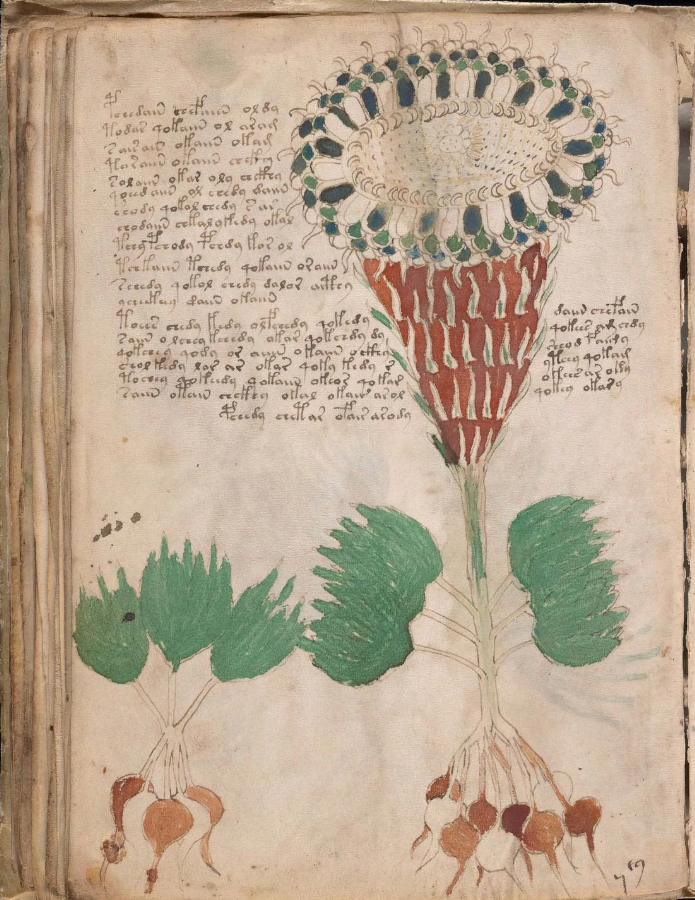
Before reading the symbols, look at the page image and ask: What kind of page is this? The illustrations determine which semantic table should govern the text.
| Page Image Type | Section Type | What It Is About |
|---|---|---|
| Plants, roots, leaves, flowers | Botanical | Plant parts and preparation |
| Stars, zodiac, circles, sky images | Astronomical | Sky position, movement, timing |
| Pipes, tubs, water, vessels, figures bathing | Balneological / Engineering | Flow, heat, water, vessels, transition |
| Jars, roots, detached leaves, recipe-like layout | Pharmaceutical | Ingredients, preparation, dosage, result |
Why it matters: the same Voynich token may resolve differently in different sections. A token on a plant page may refer to a root; the structurally related token on a water-system page may refer to a pipe or flow channel.
Find the Text Line You Want to Decode
Choose one line of Voynich text. Do not try to decode the whole page at once. Start with one short line or one paragraph.
Write the Voynich tokens in order. A token means one visible glyph group or word-like cluster.
Break the Line into Groups of Three
The Mechanical Key uses a three-part grammar. Divide the text into groups of three tokens. Each group is treated as one instruction.
| Position | Meaning |
|---|---|
| Position 1 | Subject or part |
| Position 2 | Action or process |
| Position 3 | Outcome or state |
Read the cell as: What thing? → Do what to it? → What result?
Example: chol / chol / chol is not treated as one word repeated three times. The same root occupies three different functional positions:
taproot → compress → primary extract
Plain English: Compress the taproot to extract the primary juice.
Identify the Token Root
Look at each token and identify its main repeating root. Extra marks or variants may matter later; begin by isolating the stable root.
| Token Root | Basic Use |
|---|---|
| chol | root / compression / extract |
| dar | stem / cutting / measure |
| siyen | petal cluster / drying / brittle state |
| cth | pipe / heating / boiling |
| ar | horizon / rising / first watch |
| shol | bitter leaf / steeping / oil tincture |
Check the Token’s Position
A token does not have one fixed meaning. Its working value depends on whether it appears in Position 1, Position 2, or Position 3.
| Token Root | Position 1: Subject | Position 2: Action | Position 3: Outcome |
|---|---|---|---|
| chol | taproot | compress / press | primary extract |
| dar | main stem | cut / sever | hand-width measure |
| siyen | petal cluster | expose / dry | brittle / pale state |
| cth | conduit / pipe | heat / fire | boil / third degree |
| ar | north horizon | rise / appear | first watch |
| shol | bitter jagged leaf | steep / infuse | oil tincture |
If dar appears in Position 1, it may mean main stem. In Position 2, it may mean cut. In Position 3, it may mean hand-width measure.
dar / dar / dar → main stem → cut → hand-width measure
Plain English: Cut the central stem at one hand-width.
Apply the Section Meaning
Now adjust the root’s meaning based on the page type. The image constrains the semantic range.
Example using chol
| Section | Position 1 | Position 2 | Position 3 |
|---|---|---|---|
| Botanical | taproot | compress | base extract |
| Pharmaceutical | bitter base | grind | tincture |
| Balneological | intake pipe | compress flow | sediment base |
On a plant page, chol may point to a root or extract. On a water-system page, the same root may point to a pipe or flow process.
Watch for Header Tokens
A header is a token or short group at the start of a paragraph or page section. The Mechanical Key proposes that headers may act like local settings or “dials.”
A header may narrow the following passage toward a process such as drying, boiling, measuring, or another local operation.
Before translating a paragraph, check whether the first token appears to control the semantic reading of the tokens that follow. Do not ignore the beginning of the paragraph.
Turn the Tokens into Plain English
After identifying the section type, token roots, positions, section meanings, and any header adjustment, convert the three-token group into a simple technical instruction.
Useful sentence pattern: Apply / cut / heat / observe / dry / steep [subject] until [outcome].
| Token Pattern | Plain English Translation |
|---|---|
| chol / chol / chol | Apply weight to the central taproot to extract the primary juices. |
| siyen / oiyen / eyen | Dry the petal clusters in direct sunlight until pale and brittle. |
| cth-on / cth-or / cth-ot | Heat the delivery pipes until the water reaches a vigorous boil. |
| ar-al / ar-am / ar-ad | Observe the northern horizon for the rising stars during the first watch. |
| dar / dar / dar | Cut the central stem at one hand-width. |
| shol-es / shol-em | Infuse the bitter jagged leaves in oil. |
Score Your Confidence
Do not treat every translation as equally strong.
| Score | Meaning |
|---|---|
| High | The section, token roots, and instruction all fit clearly. |
| Medium | The translation mostly fits, but some tokens are uncertain. |
| Low | The meaning is guessed or the structure does not fully fit. |
A stronger decoding should produce a clear technical instruction. A weak decoding will tend to feel vague, poetic, or forced.
Test the Result Against the Page
After translating one line, ask whether the result fits the page image and section type.
- Botanical: plant handling, cutting, drying, pressing, preparation, extracting.
- Astronomical: timing, watching, rising, movement, sky position.
- Balneological / Engineering: flow, heating, pipes, pressure, vessels, transition.
- Pharmaceutical: ingredients, grinding, steeping, dosage, oil, tincture, delivery.
If the translation does not fit the page type, the decoding may be wrong and should be revised rather than forced.
Use This Checklist Every Time
- Look at the picture. Decide the section type.
- Pick one line. Do not decode the whole page at once.
- Split the line into groups of three tokens.
- Mark each token as Position 1, Position 2, or Position 3.
- Find the root of each token.
- Use the root table to get the basic meaning.
- Adjust the meaning based on the section type.
- Check whether a header token changes the meaning.
- Write the result as a plain instruction.
- Score confidence: High, Medium, or Low.
- Compare the instruction to the page image.
- Repeat on the next three-token group.
The Mechanical Key treats each Voynich folio as a technical instruction sheet in which:
- the image sets the topic;
- the symbols are read in three-part groups; and
- each token’s working meaning depends on its position, section context, and any local header setting.