
A Falsifiable Triadic Hypothesis for Emergence, Contrast, and Integration in Dynamical Systems
This deposit contains the manuscript and reproducibility materials for “Triune Harmonic Dynamics: A Falsifiable Triadic Hypothesis for Emergence, Contrast, and Integration in Dynamical Systems,” by Kevin L. Brown. The work presents Triune Harmonic Dynamics (THD) as a theoretical, methodological, and experimentally testable framework rather than as an empirically established physical law.
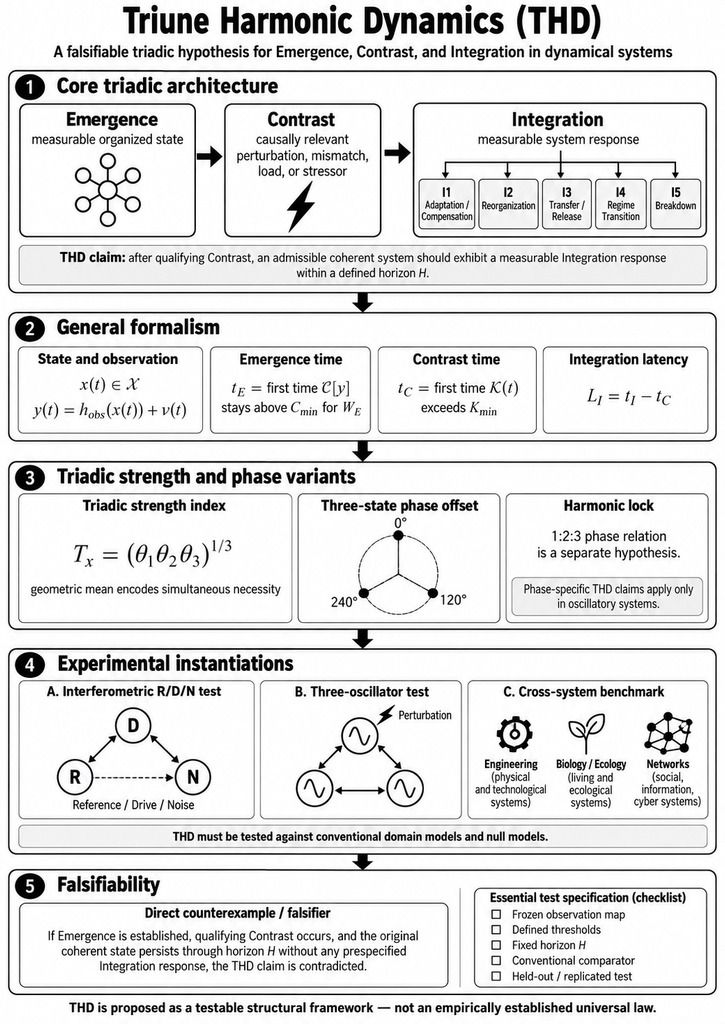
THD proposes that an admissible coherent dynamical system can be analyzed through three operational stages. Emergence identifies the establishment of a measurable organized state. Contrast identifies a causally relevant perturbation, mismatch, load, error, stressor, or competing constraint acting on that state. Integration identifies the measurable system response, including adaptation, reorganization, transfer or release, regime transition, or breakdown. The paper requires each stage, threshold, observation horizon, and failure condition to be defined prospectively so that the framework cannot be rescued by retrospective relabeling.
The manuscript develops THD at three levels. First, it states the general Emergence-Contrast-Integration hypothesis and a direct counterexample condition. Second, it supplies a mathematical and measurement formalism using state and observation spaces, coherence and contrast functionals, response classes, event times, latency, magnitude, triadic composite statistics, and optional phase-coupling rules. Third, it defines three experimental programs: an interferometric Reference-Drive-Noise phase experiment, a controlled three-oscillator synchronization study, and a cross-system perturbation and resilience benchmark.
The reproducibility package includes the complete manuscript, a synthetic three-oscillator simulation, the generated summary table, the recovery figure, a machine-readable toy-model configuration, a minimal THD hypothesis record, a future-experiment freeze checklist, reproduction instructions, scientific interpretation boundaries, citation metadata, and SHA-256 file hashes.
The numerical simulation is deliberately classified as a computational sanity check rather than evidence for THD. Three noisy phase oscillators are tested under uncoupled, pairwise target, all-to-all zero-lag, and all-to-all target coupling conditions. A fixed phase perturbation is introduced and recovery is evaluated with a frozen five-degree phase-error threshold, half-second dwell requirement, and ten-second horizon. Because the target phase offsets are encoded in the target-coupled models, successful recovery in those conditions is expected by construction. The simulation therefore verifies implementation of the phase-error and event-detection machinery only.
No empirical dataset is analyzed in this deposit, and no claim of universal THD validity is made. Future empirical support would require prospectively frozen observation maps, conventional comparators, held-out testing, uncertainty analysis, and independent replication. A positive result in one domain would support only that tested THD instantiation. A pattern fully explained by a stronger conventional model would not constitute distinct evidence for THD. The deposit is intended to make the theory, falsifiers, computational implementation, and future experimental requirements transparent enough for independent criticism, reproduction, direct testing, comparison against conventional models, and future preregistered replication across multiple dynamical domains under clearly bounded scientific claims and reproducible decision rules established before confirmatory outcomes are examined by investigators or external reviewers.
The package is structured so that implementation artifacts, model assumptions, prospective decision rules, and empirical evidence remain explicitly separated. This distinction is central to the manuscript’s falsifiability standard and allows future investigators to test THD without treating computational consistency, framework maturity, or retrospective descriptive fit as confirmation.