An Information-Controlled Scalar-Electromagnetic Precursor and Constraints
Abstract
Wormholes are hypothetical shortcuts through spacetime. General relativity allows mathematical geometries that resemble wormholes, but keeping one open appears to require physical conditions that have never been demonstrated experimentally.
This research does not claim to create a wormhole.
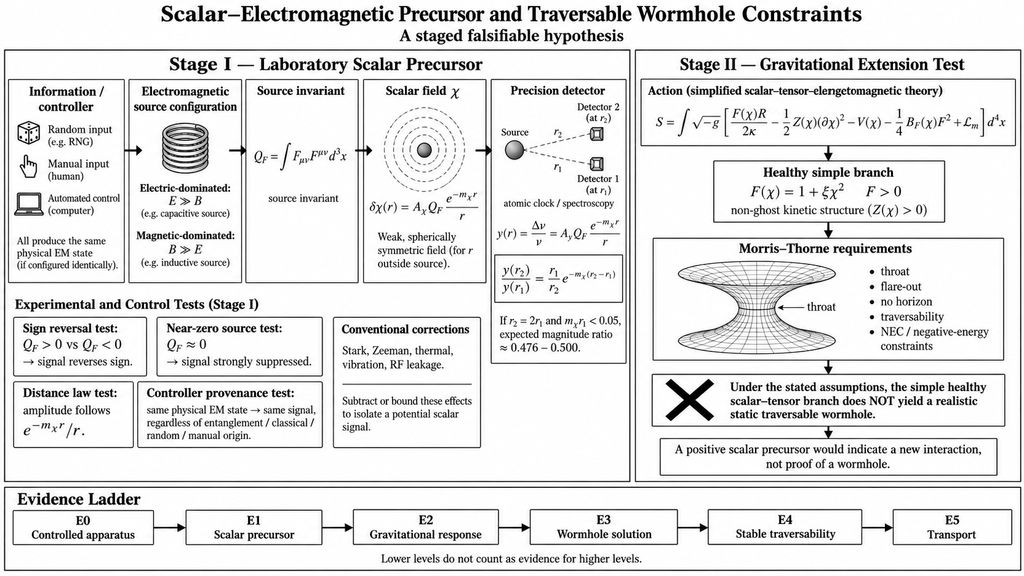
Instead, it proposes a smaller and more testable question: can an information-controlled electromagnetic experiment produce evidence of a new scalar field, and if such a field exists, could it eventually have measurable gravitational consequences?
The experiment uses information to control an electromagnetic apparatus. The information itself is not treated as a physical source. The actual source is the electromagnetic field produced by the apparatus.
The proposed scalar field should create a measurable frequency shift that decreases with distance in a specific mathematical way. The experiment also includes several strong control tests designed to distinguish the predicted effect from heating, ordinary electric or magnetic interference, instrument drift, and other conventional explanations.
The paper then asks whether the simplest gravitational version of this scalar-field model could support a traversable wormhole. Applying established scalar-tensor no-go results shows that it cannot under the stated assumptions.
The research therefore establishes a falsifiable experimental path toward testing new scalar-field physics while sharply separating that question from the much stronger claim of creating a wormhole.
1. Research Question
The central research question is:
Can an information-controlled physical apparatus produce a reproducible scalar-field effect that cannot be explained by established electromagnetic or experimental physics?
A second, later question is:
If such a scalar field exists, can it contribute to a physically acceptable spacetime geometry capable of supporting a traversable wormhole?
These questions are deliberately separated.
Detecting a new scalar interaction would not mean that a wormhole exists.
Even detecting a gravitational effect would not automatically demonstrate a wormhole.
Each stage requires its own evidence.
2. Scientific Background
A wormhole can be visualized as a shortcut between two distant locations in spacetime.
Instead of traveling through the normal space between two points, a hypothetical wormhole would connect them through a much shorter path.
Physics allows mathematical wormhole solutions, but there is a major problem: ordinary matter and energy do not appear capable of holding a traversable wormhole open.
Many models require unusual negative-energy conditions near the throat of the wormhole.
Quantum physics does allow limited negative-energy effects, but established quantum-energy inequalities strongly restrict how large and how long-lasting those effects can be.
There are also mathematical no-go results showing that many apparently attractive scalar-field theories cannot produce stable, physically acceptable traversable wormholes.
This paper therefore does not assume that adding a new scalar field solves the wormhole problem.
It tests that possibility directly.
3. Proposed Hypothesis
The experiment introduces a hypothetical scalar field represented by χ.
A scalar field is simply a physical quantity that has a value at every point in space.
The proposed interaction allows ordinary electromagnetic fields to source this scalar field.
The interaction is written as BF(χ)=1+gγχ,
where gγ describes the strength of the proposed interaction.
The important electromagnetic quantity is FμνFμν.
Under a common sign convention, this behaves approximately like 2(B2−E2).
This is useful because electric-dominated and magnetic-dominated systems can produce opposite signs even when their total stored energy is similar.
That creates a strong experimental test.
4. How Information Enters the Experiment
The word “information” must be used carefully.
The model does not say that information itself becomes a force or energy source.
Instead, information is used to choose the physical state of the apparatus.
The sequence is: measured information→controller→electromagnetic apparatus→scalar-field source→detector.
A reconstructed information statistic may determine how an experimental controller configures the electromagnetic system.
But once the actual electromagnetic fields are fixed, the theory predicts the same result regardless of how those settings were chosen.
The setting could come from:
- quantum entanglement,
- classical correlation,
- a random-number generator,
- or a person manually adjusting the equipment.
If all four methods create the same local electromagnetic field, this model predicts the same scalar response.
Therefore:
The experiment tests an information-controlled electromagnetic source, not a direct physical force produced by abstract information.
5. What Is Actually Measured
A hypothetical field must ultimately produce a real instrument reading.
The proposed detector is a precision frequency comparison.
Certain atomic or molecular frequencies depend sensitively on the strength of electromagnetic interactions.
If the scalar field slightly changes that interaction, the measured fractional frequency shift is y=νδν.
The model predicts y(r,t)=−Kαgγδχ(r,t)+n(r,t),
where:
- Kα is a known or independently calibrated detector sensitivity,
- gγ is the scalar-electromagnetic coupling,
- δχ is the scalar-field disturbance,
- and n represents experimental noise and systematic error.
This makes the hypothesis measurable rather than purely conceptual.
6. Quantitative Prediction
In the simplified weak-field, static regime, the scalar field is predicted to fall with distance approximately as δχ(r)∝re−mχr,
where mχ controls how quickly the field decays.
Combining the source and detector equations gives ysig(r)=16πZχKαgγ2[∫d3x⟨FμνFμν⟩]re−mχr.
For the experiment, the most important point is the predicted distance relationship: ysig(r1)ysig(r2)=r2r1e−mχ(r2−r1).
For example, if r2=2r1
and independent calibration establishes mχr1<0.05,
then the model predicts approximately 0.476≤ysig(r1)ysig(2r1)≤0.500.
In plain language:
Doubling the detector distance should reduce the signal to roughly 48–50 percent of its original strength under those test conditions.
If the measured result falls outside the predicted range after experimental uncertainty is included, that version of the model fails.
7. Parameter Identifiability
The experiment cannot independently determine every theoretical parameter.
The main signal depends on the combination Zχgγ2.
This means the experiment primarily measures the overall observable coupling strength rather than determining gγ and Zχ separately.
The scalar mass mχ, however, can be constrained through how rapidly the signal changes with distance.
Therefore the primary experiment can potentially determine:
- whether the predicted interaction exists,
- the strength of the measurable combined coupling,
- and the approximate range of the field.
Separating the underlying parameters would require an additional independent measurement.
8. Critical Control Experiments
A claimed new field is only convincing if ordinary explanations can be excluded.
Several strong controls are therefore built into the proposal.
Electric-versus-magnetic reversal
Because the source depends on approximately B2−E2,
an electric-dominated source and a magnetic-dominated source should produce opposite scalar signals.
The ordinary stored electromagnetic energy can remain similar.
Therefore: FμνFμν→−FμνFμν
should produce ysig→−ysig.
A sign reversal while power and heating remain similar would be significantly harder to explain as ordinary thermal drift.
Zero-source control
A configuration can be constructed where FμνFμν≈0
while electromagnetic energy is still present.
The proposed scalar signal should then become very small.
Thermal and power controls
Experiments must independently monitor:
- heating,
- electrical power,
- magnetic leakage,
- vibration,
- detector electronics,
- and environmental drift.
Stark and Zeeman controls
Ordinary electric and magnetic fields can directly shift atomic frequencies.
Those standard Stark and Zeeman effects must be measured and removed before any residual signal can be attributed to new physics.
Controller-provenance control
Identical electromagnetic configurations must produce identical results regardless of whether the configuration was chosen by entanglement, classical correlation, random choice, or manual control.
If the outcome changes solely because the information source changes while the physical apparatus remains identical, the proposed model is wrong.
9. Falsification Conditions
The hypothesis is designed to fail clearly if nature does not behave as predicted.
The precursor model is falsified or substantially weakened if any of the following occur:
- The electromagnetic apparatus does not produce the predicted detector response after the coupling parameters are fixed.
- The measured signal does not follow the predicted Yukawa-type distance dependence.
- Doubling the distance fails the preregistered signal-ratio test.
- Reversing the sign of the electromagnetic source does not produce the predicted signal reversal.
- A near-zero FμνFμν configuration produces the same signal as a strong-source configuration.
- The apparent effect is explained by heating, electromagnetic leakage, Stark shifts, Zeeman shifts, vibration, electronics, statistical bias, or another known physical mechanism.
- The theory requires an unknown source or detector parameter to be introduced only after the experiment fails.
- Identical electromagnetic configurations produce different results depending only on how the controller setting was selected.
- The required coupling strength conflicts with existing experimental limits without an independently specified and tested mechanism explaining the discrepancy.
A failed prediction cannot simply be repaired by changing the interaction after the fact.
A changed interaction becomes a new hypothesis requiring new tests.
10. What About Wormholes?
The scalar field can also be coupled mathematically to gravity.
The simplest version studied in the paper uses F(χ)=1+ξχ2,
with parameters chosen so that the scalar field behaves normally and the effective strength of gravity remains positive.
Those are desirable physical properties.
However, established scalar-tensor no-go results show that this healthy class of models does not provide the required static, asymptotically well-behaved traversable wormhole under the assumptions studied.
The paper does not independently prove those theorems.
It applies them to the proposed model and finds that the model lies inside the excluded class.
This is an important negative result.
It tells us that even if the scalar-electromagnetic precursor were experimentally confirmed, the simplest healthy gravitational extension would still not solve the wormhole problem.
11. What Would Be Needed for a Wormhole?
A future wormhole model would need additional physics.
Possible directions could involve:
- physically characterized exotic stress-energy,
- gravitational couplings that behave differently from the healthy branch studied here,
- higher-derivative gravity,
- selected beyond-Horndeski theories,
- or another theory capable of producing a stable throat.
But each new possibility would have to pass its own tests for:
- stability,
- energy conservation,
- negative-energy requirements,
- causality,
- acceptable behavior at large distances,
- and experimental observables.
A theory is not successful merely because a mathematical wormhole can be written down.
12. Evidence Ladder
The research program uses a strict hierarchy of evidence: information-controlled apparatus ↓ local electromagnetic source ↓ scalar-field detection ↓ independent gravitational/curvature effect ↓ physically acceptable wormhole solution ↓ stable traversability ↓ signal transmission ↓ energy and matter transmission.
No lower step is treated as proof of the next one.
13. What This Research Does Not Claim
This paper does not claim that:
- information itself bends spacetime;
- entanglement creates gravity;
- a new scalar field has already been discovered;
- curvature has been experimentally altered;
- a wormhole has been created;
- faster-than-light communication exists;
- matter can be transported through a wormhole;
- or the simplest scalar model solves the exotic-energy problem.
The current claim is much narrower:
An information-controlled electromagnetic experiment can be formulated as a falsifiable test of a specific hypothetical scalar-field interaction, with quantitative predictions, strong control experiments, and explicit rejection conditions. Applying established gravitational no-go results further shows that the simplest healthy extension of that scalar field is not sufficient by itself to create a traversable wormhole.
14. Scientific Significance
The importance of the research is not that it announces a wormhole.
It creates a disciplined way to begin testing physics that might eventually become relevant to much more exotic spacetime questions.
The experiment asks for the smallest measurable effect first.
If no signal appears where the theory predicts one, the hypothesis is constrained or rejected.
If a signal appears but fails the reversal tests, it is probably not the proposed scalar interaction.
If a signal survives those tests but produces no gravitational effect, then the scalar model may still be interesting physics without having anything to do with wormholes.
And if a gravitational effect were eventually established, a completely separate theoretical and experimental burden would still remain before anyone could claim a traversable spacetime shortcut.
That hierarchy is intentional.
Extraordinary conclusions should appear only after the ordinary physical steps beneath them have survived attempts to falsify them.