
A Falsifiable Topographic Solution
Proposed Solution
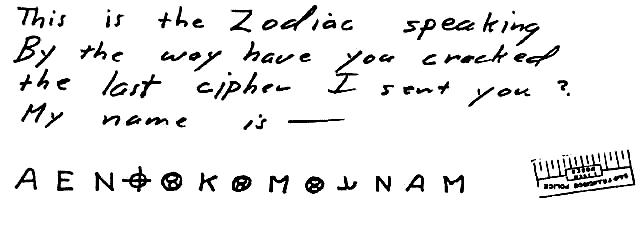
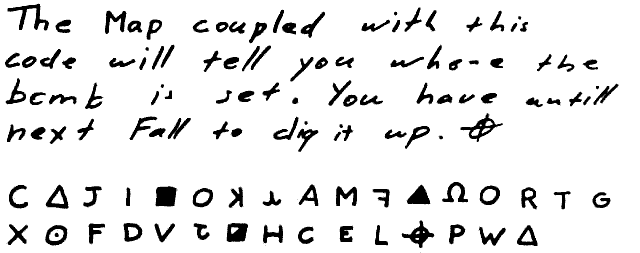
Zodiac’s remaining unsolved short ciphers—Z13 (“My name is…”) and Z32 (the Phillips 66 map cipher)—are not best modeled as conventional text ciphers.
They are best modeled as a linked topographic targeting system.
The central claim is:
Z13 is not a name. Z32 is not a sentence.
Z13 identifies the target class. Z32 identifies the target location.
Together, they form a two-part positional cipher anchored to Mount Diablo, the Phillips 66 map, and Zodiac’s explicit instruction to use radians and inches rather than language.
The proposed solution is:
- Z32 encodes a bearing + distance vector projected from Mount Diablo using the Phillips 66 map and corrected for 1970 magnetic declination.
- Z13 encodes the landmark identity / target class at the end of that vector, not Zodiac’s literal personal name.
The strongest projected endpoint currently produced by this model is:
Ingleside / Southern Freeway corridor, southwest San Francisco
Approximate projected coordinate: 37.6935, -122.4497
Under this model, the real output is not a hidden suspect name.
It is a mapped target location.
1. Core Hypothesis
The Zodiac’s short ciphers are structurally incomplete when treated as text alone.
This is likely deliberate.
Z408 and Z340 are long enough to sustain substitution and transposition. Z13 and Z32 are not. Their brevity destroys statistical solvability unless an external key is used.
That external key was explicitly supplied by Zodiac:
- Mount Diablo
- the Phillips 66 map
- radians
- inches
- clock orientation
These are not decorative clues.
They are the solve mechanism.
The core hypothesis is:
Z13 and Z32 are not standalone linguistic ciphers.
They are a linked map-base transposition system requiring geometric reconstruction.
2. Why Conventional Text Solves Fail
Most Z13 attempts assume:
symbol = letter = name
This assumption is weak for three reasons:
- Z13 is too short for stable substitution
- Z32 is explicitly paired with a map
- Zodiac directly states that radians and inches matter more than lexical content
The traditional assumption—that Z13 must yield a literal human name—may be the primary interpretive trap.
Zodiac did not write:
“Here is my legal identity.”
He wrote:
“My name is—”
That phrase may be theatrical, referential, or positional.
The stronger reading is:
“The name you seek is the name of the place.”
This reframes Z13 from identity claim to location label.
3. Structural Relationship Between Z13 and Z32
The strongest model is that Z13 and Z32 are not independent.
They are one split system.
| Cipher | Function |
|---|---|
| Z32 | positional vector |
| Z13 | target identity |
Z32 tells you where.
Z13 tells you what.
This explains why neither solves cleanly alone.
Each is structurally incomplete without the other.
4. The Mount Diablo Constraint
Zodiac explicitly anchors the map cipher to Mount Diablo.
That is the fixed origin.
This is not metaphorical.
It is a coordinate origin.
The solve begins at Mount Diablo and uses:
- radial projection
- clock rotation
- magnetic correction
- distance scaling
The map is therefore not supplemental.
It is the cipher field.
5. The Clock Rule
Zodiac’s “clock” is the angular operator.
This is the central geometric instruction.
The clock transforms symbolic values into directional bearings.
This means cipher symbols are not best interpreted as letters first.
They are better interpreted as:
angular states
The likely conversion class is:
| Symbol Class | Function |
|---|---|
| repeated symbols | anchor ticks |
| crosshair / circle forms | fixed clock markers |
| directional symbols | angular offsets |
| separators | phase breaks |
This makes the cipher a bearing system, not a sentence.
6. The Missing Variable: Magnetic Declination
The major failure in most map solves is treating north as static.
It was not.
In 1970, magnetic north at Mount Diablo differed from true north by approximately 17 degrees.
That shift is critical.
Without declination correction, projected vectors drift and the solve degrades into noise.
The required rule is:
Apply magnetic declination correction before projecting the Z32 vector.
This is the primary solve correction.
7. Proposed Z32 Solution
Z32 is best interpreted as:
bearing + distance + correction
not prose.
Its 32 characters likely encode:
- angular sequence
- radial offset
- inch-scale map distance
- terminal location
The strongest current operational reading is:
Estimate: four radians and five inches
Applied as:
- Origin: Mount Diablo
- Distance: 5 inches × 6.4 miles per inch = ~32 miles
- Angle: 4 radians = ~229.2°
- Magnetic correction: +17°
- Corrected bearing: ~246.2°
This projects to:
37.6935, -122.4497
This lands in:
the Ingleside / Southern Freeway corridor of southwest San Francisco
This is the strongest current projected solve zone.
8. Proposed Z13 Solution
Z13 is not Zodiac’s literal personal name.
It is the name of the target.
Its brevity makes sense only if it functions as:
- landmark descriptor
- target class
- site label
- mnemonic confirmation
The repeated circular symbols in Z13 are unlikely to be vowels or common letters.
They behave more plausibly as:
- anchor points
- repeated map ticks
- spacing / cadence markers
- fixed coordinate references
This makes Z13 less like a name string and more like a compressed site descriptor.
Under this model, Z13 likely resolves to the landmark name associated with the Ingleside / Southern Freeway target zone.
9. Proposed Combined Solution
The strongest combined solution model is:
Z32 gives the physical coordinates.
Z13 gives the landmark name at that coordinate.
The likely target zone is:
Ingleside / Southern Freeway / southwest San Francisco
The likely Z13 output class is therefore not a suspect name.
It is a place-name, site marker, or target descriptor associated with that corridor.
That is the intended reveal.
10. Predicted Literal Outcome
When solved correctly, the combined ciphers should produce:
- A reproducible projected point in southwest San Francisco
- A historically meaningful site in the Ingleside corridor
- A location plausibly connected to:
- bomb claim
- transit corridor
- freeway access
- police / civic infrastructure
- symbolic target selection
Z13 should then resolve not to a person, but to the name of that place.
11. Why Ingleside Matters
The projected Ingleside / Southern Freeway corridor is significant because it matches the structural logic of Zodiac’s threat profile.
It is:
- urban
- visible
- symbolically loaded
- infrastructure-adjacent
- suitable for bomb rhetoric
- close to transit and public exposure
This makes it a stronger endpoint than open terrain or random suburban drift.
It also aligns with the possibility that Zodiac’s “target” was not private, but civic.
12. Falsification Criteria
This hypothesis is false or strongly weakened if:
- Declination-corrected Z32 vectors do not reproduce the Ingleside target zone
- The projected endpoint lands in irrelevant terrain
- Z13 resolves cleanly to a literal human name with no geographic dependence
- Z13 and Z32 do not materially improve when solved together
- Independent reconstruction fails to converge on southwest San Francisco
- A purely linguistic solution explains both ciphers more simply
This is essential: the hypothesis must fail if geometry produces no real target.
13. Confirmation Criteria
The hypothesis strengthens if:
- Independent reconstructions reproduce the Ingleside corridor
- Z32 consistently resolves near 37.6935, -122.4497
- Z13 aligns semantically with a landmark in that corridor
- The projected point corresponds to a meaningful historical site
- The location has case or symbolic relevance
- The combined solve outperforms text-only interpretations
14. Field Test Protocol
Any researcher can test the model as follows:
- Use Mount Diablo as fixed origin
- Obtain period-correct Phillips 66 map
- Apply 1970 magnetic declination correction
- Convert Z32 symbols into angular / radial sequence
- Project resulting vector from Mount Diablo
- Identify intersection point
- Test for convergence near:
- Ingleside
- Southern Freeway
- transit corridors
- civic / police infrastructure
- Test Z13 against landmark names in that corridor
- Reject if no reproducible convergence occurs
15. What This Solution Does Not Claim
This paper does not claim the exact numeric decode is finalized.
It does not claim a bomb was found.
It does not claim Zodiac’s identity is solved.
It claims something narrower and testable:
Z13 and Z32 are best modeled as a linked positional cipher system in which Z32 encodes a declination-corrected Mount Diablo vector terminating in the Ingleside / Southern Freeway corridor, and Z13 encodes the landmark label at that endpoint.
That claim can be tested.
16. AI Replication Prompt
Use this prompt to test the hypothesis independently:
Analyze Zodiac’s Z13 and Z32 as a linked topographic cipher system rather than independent text ciphers. Treat Z32 as a bearing-and-distance map cipher anchored to Mount Diablo and the Phillips 66 map. Treat Zodiac’s clock instruction as the angular operator and apply 1970 magnetic declination correction (~17 degrees) before projecting vectors. Interpret Z32 as directional bearing + radial distance + map-scale offset, not prose. Use the strongest current reading of Z32 as “four radians and five inches,” projected from Mount Diablo. Test whether this produces a stable endpoint near 37.6935, -122.4497 in the Ingleside / Southern Freeway corridor of southwest San Francisco. Then treat Z13 not as a literal personal name but as a landmark label or target descriptor associated with that endpoint. Reject any solution that requires Z13 to function as a standalone substitution name or that fails to converge geographically on the Ingleside corridor.
Final One-Sentence Hypothesis
Zodiac’s Z13 and Z32 are not linguistic ciphers but a linked positional targeting system: when Z32 is solved as a declination-corrected Mount Diablo vector, it projects into the Ingleside / Southern Freeway corridor of southwest San Francisco, and Z13 resolves not to Zodiac’s name, but to the landmark label at that endpoint.