Informational Collapse and Pop Culture
The Book of Revelation describes a civilization entering terminal instability. The language is symbolic, but the structure beneath the symbolism is remarkably consistent with how complex systems behave when they become overloaded, polarized, and recursively self-reinforcing. The “Mark of the Beast” is often interpreted as a future technology, political identifier, or economic control mechanism. Yet a deeper structural reading suggests something broader and more fundamental: the Mark represents a condition of human synchronization with a collapsing informational system.
Under the framework of Triune Harmonic Dynamics (THD), systems evolve through three recurring phases: Emergence, Contrast, and Integration. These phases are not merely symbolic categories. THD proposes them as measurable structural dynamics governing transformation across physical, informational, biological, and social systems. Reality is modeled not as disconnected domains, but as nested informational structures operating across atomic, electromagnetic, and scalar layers.
Within that framework, the “Mark” can be understood as a phase-lock condition in which human cognition, emotion, and action become trapped in recursive Contrast without successful Integration. Rather than functioning as coherent triadic systems, individuals become structurally polarized. Thought fragments from truth-seeking. Emotion fragments from regulation. Action fragments from long-term survival. The result is not merely moral confusion. It is systemic informational instability expressed through human behavior.
The significance of the forehead and the hand in Revelation becomes clearer under this lens. The forehead represents cognition, orientation, and informational identity. The hand represents physical participation, labor, economic interaction, and executed behavior. The text is describing a civilization in which both thought and action become synchronized with an unstable external architecture.
The issue is not technology itself. The issue is dependency synchronization with a collapsing substrate.
The Human Being as a Triadic System
THD models stable systems as requiring three interacting layers: geometry, dynamics, and information. In biological and human terms, these layers correspond closely to:
- the atomic body
- the electromagnetic regulatory system
- the informational identity layer
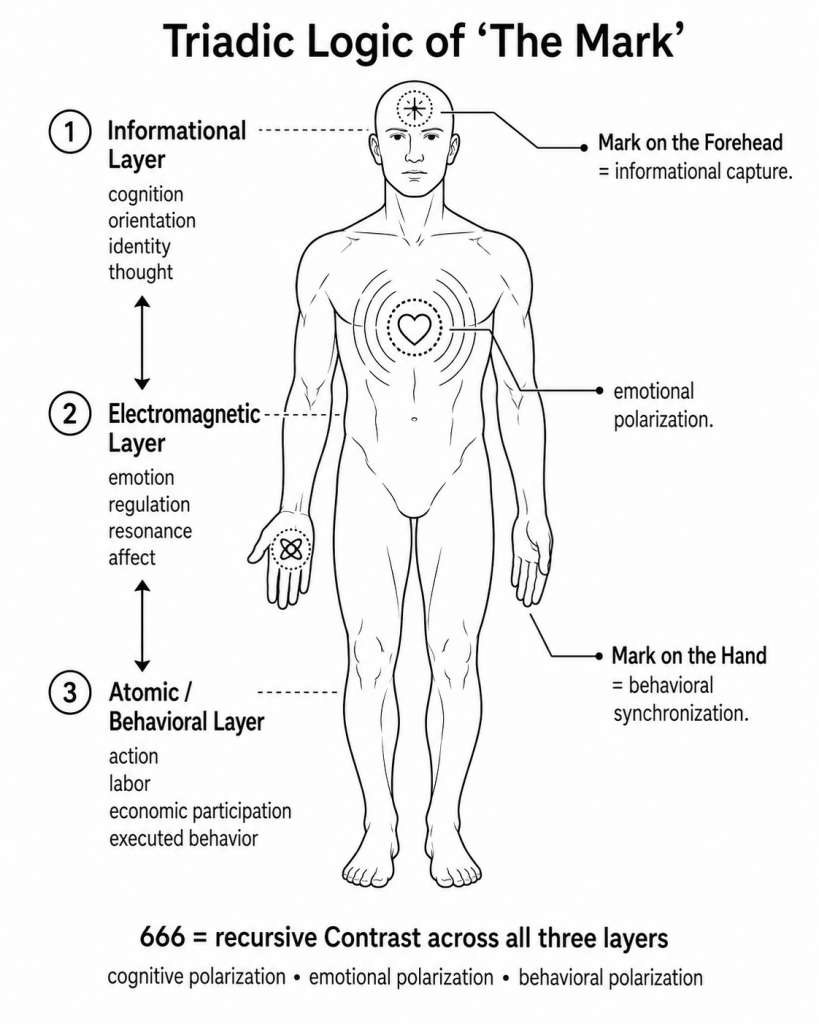
The body is the material structure. It processes environmental constraints, metabolic demand, and physical survival. The electromagnetic layer governs signaling, regulation, affective state, and relational coupling. The informational layer governs identity, interpretation, orientation, memory, and meaning construction.
A stable human system requires alignment across all three.
When cognition believes one thing, emotion reinforces another, and behavior executes a third, internal fragmentation increases. THD would describe this as phase incoherence. The system remains operational, but its internal layers drift out of synchronization.
Modern pop culture and institutional media systems increasingly function as external synchronization engines. They shape attention, emotional cadence, perceived identity, and behavioral expectation at industrial scale. This is not speculative. All large-scale informational systems influence human coordination patterns. Advertising, politics, entertainment, social media algorithms, financial narratives, and ideological tribalism all compete for control over human orientation.
The critical issue is that highly saturated informational environments can override internal coherence mechanisms.
Under overload conditions, humans tend to outsource interpretation to collective narratives. This reduces cognitive burden temporarily, but it also increases synchronization pressure. The individual no longer interprets reality directly. They interpret reality through externally reinforced identity structures.
THD identifies this condition as recursive contrast amplification.
“The Beast” as a Self-Reinforcing Informational System
In this framework, the “Beast” is not one person or institution. It is a civilization-scale informational architecture that survives by amplifying fragmentation while maintaining dependency.
Complex systems under stress often become more centralized, more reactive, and more emotionally volatile. As load increases, systems attempt to preserve stability through tighter coupling and higher control density. However, excessive coupling also increases cascade vulnerability.
Modern civilization exhibits many characteristics of this condition:
- increasing informational saturation
- declining trust convergence
- rising institutional polarization
- emotional amplification cycles
- identity tribalization
- algorithmic attention harvesting
- financial dependency concentration
- centralized digital coordination systems
Under THD, these are not isolated problems. They are expressions of systemic phase drift.
Pop culture functions as one of the dominant synchronization layers of the collective informational field. It establishes emotional norms, identity signaling systems, reward structures, and symbolic orientation. During periods of instability, these systems intensify because institutions require narrative control to maintain continuity.
The result is a civilization increasingly optimized for emotional reactivity rather than informational clarity.
Contrast becomes profitable.
Fear becomes monetized.
Attention becomes extractive infrastructure.
This is structurally important because overloaded systems generate stronger polarization gradients as they approach instability thresholds. In human terms, this produces binary identity sorting:
- left versus right
- believer versus skeptic
- insider versus outsider
- compliant versus dangerous
- approved versus rejected
The informational field narrows until only emotionally reinforced identities remain stable.
At that point, independent cognition becomes socially expensive.
The Mark on the Forehead: Informational Capture
The forehead symbolizes orientation and thought. Under THD, this corresponds to the informational layer of the triad.
The “Mark” on the forehead therefore represents informational synchronization with an external narrative substrate.
This does not require literal implantation technology. Informational systems already shape perception continuously through repetition, emotional reinforcement, algorithmic filtering, symbolic identity signaling, and social reward structures.
Once enough informational pressure accumulates, independent interpretation degrades.
The individual no longer asks: “What is true?” Instead, they ask:
“What maintains synchronization with my tribe, identity group, or survival structure?”
This is a critical distinction.
Truth-seeking requires cognitive flexibility, uncertainty tolerance, and recursive self-correction. Polarized informational systems punish those behaviors because they destabilize group synchronization.
As a result, informational systems increasingly reward certainty performance over accuracy.
The individual begins consuming emotionally compatible narratives instead of structurally grounded analysis. Attention narrows. Complexity tolerance decreases. Opponents become abstractions rather than humans. Contradictory information triggers emotional threat responses rather than curiosity.
This is not merely political behavior. It is measurable informational compression.
THD describes stable systems as requiring successful movement from Contrast into Integration. When systems remain trapped in unresolved contrast, recursive fragmentation increases.
The “Mark” on the forehead therefore represents the stabilization of cognitive fragmentation as identity itself.
The Electromagnetic Layer: Emotional Polarization
Between cognition and physical action sits the regulatory layer: emotion, affect, resonance, and physiological synchronization.
Modern informational systems increasingly target this layer directly.
Outrage cycles, fear amplification, dopamine reward loops, identity reinforcement, and crisis framing all operate by manipulating emotional regulation systems faster than rational analysis can stabilize them.
Emotion is not the enemy. Emotion is necessary for human adaptation and social coordination. The problem emerges when emotional systems become continuously overloaded without recovery.
The Geometry of Systems describes how systems degrade when sustained load exceeds recovery capacity. Human nervous systems behave similarly. Continuous informational saturation reduces adaptive margin.
As adaptive margin disappears:
- attention shortens
- impulsivity rises
- tribal attachment intensifies
- ambiguity tolerance decreases
- fear-based reasoning increases
The individual becomes easier to synchronize through emotional triggers.
At scale, entire populations can become phase-locked into recurring outrage and fear loops. Informational systems learn which emotional patterns maximize engagement and then amplify them algorithmically.
This creates a civilization-scale feedback system optimized for emotional volatility.
THD would classify this as electromagnetic destabilization across the collective field.
The Mark on the Hand: Behavioral Synchronization
The hand symbolizes participation in material systems.
Revelation explicitly links the Mark to economic participation: buying, selling, and access to survival infrastructure.
Structurally, this reflects a civilization in which economic participation becomes conditional upon synchronization with the dominant informational architecture.
This does not necessarily imply a single future event. It describes a recurring systems principle.
As societies centralize digitally, dependency networks tighten:
- banking systems
- employment systems
- communication systems
- identity systems
- payment systems
- reputation systems
- platform access systems
The more centralized and tightly coupled these systems become, the more behavioral conformity can be enforced through access management rather than direct violence.
The hand therefore represents executed synchronization.
The individual acts in alignment with the system because survival dependency requires it.
Under overload conditions, humans often regress toward short-term material stabilization. The body prioritizes immediate survival over long-term coherence. This is why collapsing systems frequently produce:
- hoarding
- tribalism
- scapegoating
- opportunistic behavior
- fear-based compliance
- competitive extraction
The system externalizes instability through human behavior.
THD describes this as unresolved Contrast propagating downward into material execution.
Why “666” Represents Structural Incompletion
Within THD, the number six corresponds to the Contrast phase: tension, testing, instability, and unresolved amplification.
Contrast is necessary. Without it, systems cannot adapt or evolve. However, Contrast is not meant to become permanent equilibrium.
A healthy system moves:
- from Emergence
- through Contrast
- into Integration
The problem with 666 is not the existence of “6.” The problem is recursive entrapment within Contrast across all three human layers simultaneously.
- cognitive polarization
- emotional polarization
- behavioral polarization
At that point, the human system loses upward integration capacity.
The triad stalls.
The individual becomes highly reactive but poorly integrative.
Highly stimulated but structurally fragmented.
Informationally saturated but incapable of coherent synthesis.
THD would interpret this not as supernatural punishment, but as systemic instability emerging from recursive incoherence.
Collapse as a Selection Pressure
Systemic collapse acts as a pressure amplifier.
Under increasing instability, systems either reorganize into higher-order structures or fragment into lower-order competition.
The Geometry of Systems repeatedly emphasizes that collapse is rarely random. It emerges when load, geometry, and limits lose proportional balance.
Human civilization appears increasingly strained by informational overload, institutional saturation, attention fragmentation, and high-coupling dependency systems.
Under THD, this creates selection pressure on consciousness itself.
Can humans maintain internal coherence inside highly distorted informational environments?
That becomes the real test.
The danger is not merely external control. The greater danger is voluntary synchronization with fragmentation because fragmentation feels emotionally rewarding, socially protective, or economically necessary.
The “Mark” therefore functions less like a technological device and more like a systemic resonance condition.
The Structural Alternative
THD proposes that stability emerges when systems successfully integrate pressure rather than endlessly amplifying it.
Applied personally, this means restoring triadic alignment:
- informational clarity
- emotional regulation
- coherent action
The solution is not withdrawal from reality. It is improved structural participation.
This requires:
- reducing dependency on emotionally manipulative informational systems
- strengthening direct observation and critical reasoning
- restoring adaptive margin through recovery and reflection
- building local trust structures
- increasing modularity and decentralization
- aligning action with long-term coherence rather than short-term fear
In systems language, this is movement from recursive contrast toward integrative stability.
The Book of Revelation can therefore be interpreted not simply as prophecy, but as a structural warning about what occurs when civilizations become informationally overloaded while remaining spiritually and psychologically under-integrated.
The “Mark” is not merely something imposed externally.
It is the stabilization of fragmentation within the human system itself.
And the central question is not whether civilization will experience pressure. All systems do. The central question is whether individuals can maintain internal structural coherence while moving through that pressure.
Under THD, that determines whether collapse becomes fragmentation—or transformation.