
What Changes When We Stop Asking Life What It Will Give Us
Most people spend at least part of their lives negotiating with reality. We imagine the relationship we should have, the career that should have worked, the recognition we should have received, the person who should have stayed, the money we should have earned, the health we should possess, or the future that should have arrived by now. When reality produces something different, we often experience not only the pain of the event itself, but also the distress created by the distance between what exists and what we believe should exist.
That distinction is central to understanding suffering. Pain is real. Loss, illness, deprivation, grief, injustice, violence, loneliness, and disappointment cannot be reduced to a failure of perspective. Yet human beings frequently add another layer to painful circumstances by resisting the fact that those circumstances have already occurred. We suffer not only because something hurts, but because some part of us continues to insist that reality should be different from what it presently is.
From an informational-physics perspective, reality can be understood as an interconnected system of relationships, causes, constraints, feedback, and change. No individual participant sees or controls that whole system. We affect reality, participate in it, make decisions within it, and alter local conditions, but we do not command the total pattern. Events emerge through interactions extending far beyond the range of any single person’s knowledge or control.
This means that one of the most common sources of psychological instability is the attempt to exercise authority over a system that was never fully ours to govern.
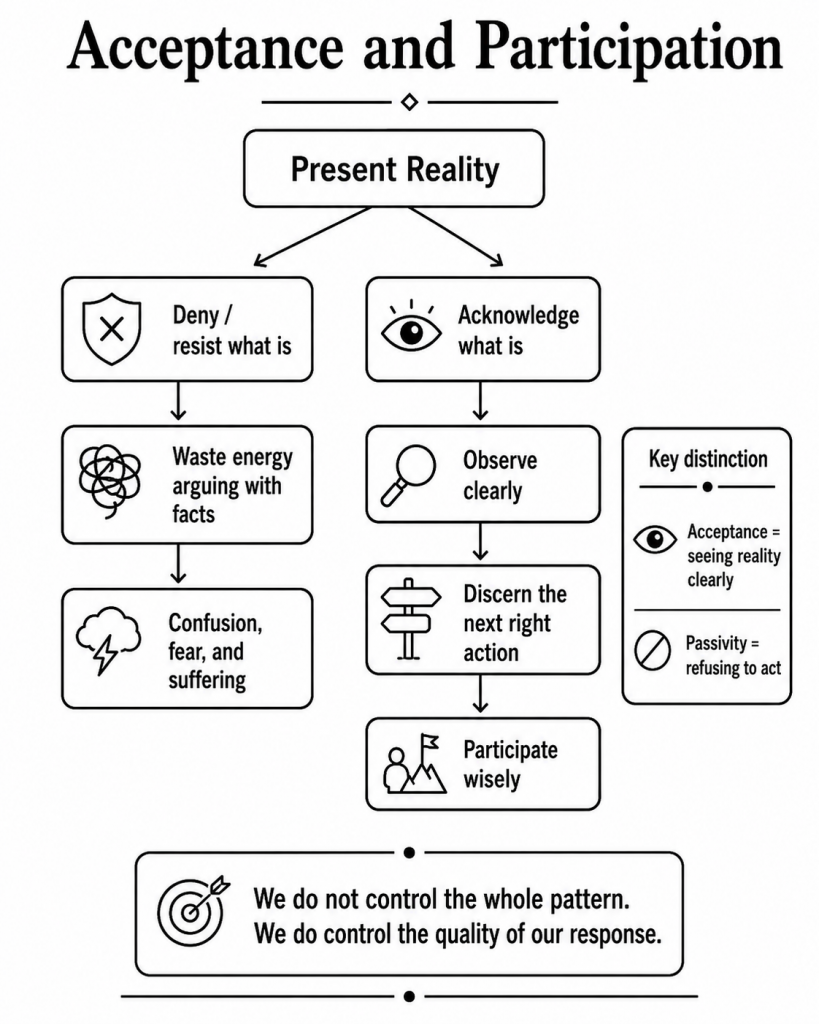
Acceptance begins when that struggle ends.
Acceptance, however, should not be confused with passivity. To accept the existence of a condition is not to approve of it, endorse it, or decide that it should continue. Acceptance simply means recognizing the present state accurately enough to respond to it intelligently. If rain begins while you are walking outside, you may seek shelter, open an umbrella, change your route, or continue walking. Those are meaningful forms of participation. What accomplishes very little is spending the entire walk insisting that it should not be raining.
The same principle applies to far more serious conditions. A relationship can end, a business can fail, a diagnosis can arrive, a person can betray us, or an opportunity can disappear. Our first reaction may naturally be, “This should not be happening.” That statement may even be morally correct. Many events should not happen in a just world. Nevertheless, once an event has occurred, denying its existence does not reverse it. The present state becomes the starting condition from which the next meaningful action must emerge.
This is why acceptance is not the opposite of action. It is often the prerequisite for effective action. The physician must recognize disease before treatment can begin. The reformer must recognize injustice before reform can occur. The investigator must accept the evidence that exists rather than the evidence they hoped to find. Clear participation begins with clear observation.
There is another physical idea that helps illuminate this relationship between resistance and movement: friction.
We normally think of friction as something undesirable because friction slows things down, creates heat, produces wear, and requires energy to overcome. Yet without friction, many ordinary forms of movement would become impossible. A car’s tires depend upon friction with the road in order to accelerate, steer, and brake. If the tires had no meaningful traction against the surface, the engine could spin the wheels without producing useful forward movement, and the brakes would be unable to give the vehicle reliable control over stopping.
The very resistance that appears to oppose motion is also what makes controlled motion possible.
This provides a useful analogy for human life. Resistance is not automatically evidence of failure. Some resistance gives us traction. Some difficulty reveals capacities that would remain undeveloped in a world without challenge. Some disagreement clarifies what we actually believe. Some disappointment exposes expectations we did not realize we were carrying. Some limitations force creativity because the obvious path is unavailable.
In that sense, the familiar phrase “no pain, no gain” contains a partial physical and psychological truth. Growth often requires resistance. A muscle that never encounters meaningful load has little reason to become stronger. A skill that is never tested does not mature. A scientific theory that never meets contradictory evidence does not become more precise. A person who never encounters opposition may never discover the difference between what they casually prefer and what they deeply value.
This does not mean that all pain is useful, that suffering should be deliberately sought, or that destructive conditions should be romanticized. Too much friction can damage a machine just as excessive stress can damage a person. The principle is not that pain is inherently good. It is that resistance can be functional, and therefore its mere presence should not automatically be interpreted as evidence of evil, punishment, or misalignment.
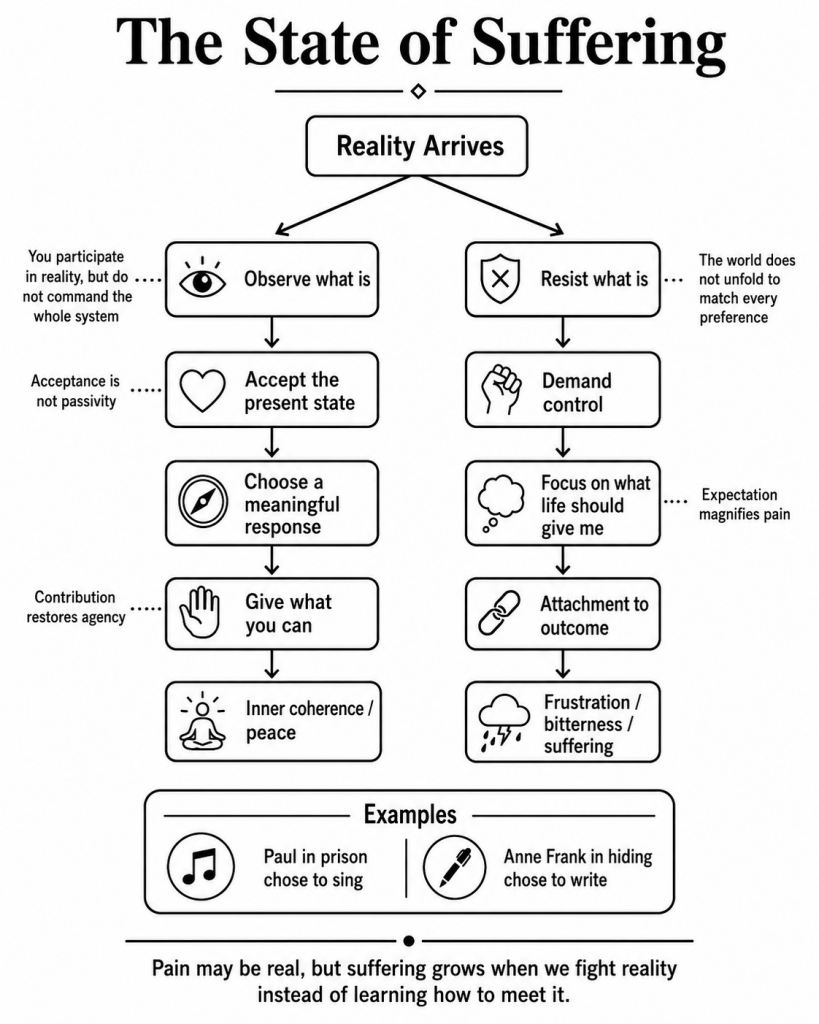
The biblical story of Paul and Silas in prison offers a powerful illustration. According to the Book of Acts, they were beaten, confined, and placed in stocks, yet during the night they prayed and sang hymns. Their prison was not metaphorical. Their suffering was physical and immediate. The important point is not that imprisonment became pleasant because they chose the right attitude. The prison remained a prison. What changed was the degree of authority it held over their internal state.
The walls controlled where Paul could physically stand, but they did not completely determine where he could place his attention. He could not decide whether he would be imprisoned in that moment, but he retained some capacity to determine what he would contribute from within the imprisonment. He could pray, sing, encourage, observe, and bear witness. His freedom was constrained, but it had not disappeared.
Anne Frank presents a much more tragic historical example. Her family went into hiding because Nazi persecution had made ordinary life impossible, and her eventual fate cannot be softened by philosophy. Her circumstances were objectively horrific. Yet within an environment of extreme restriction, she continued to write, think, observe, and document what she experienced.
She could not control the political system surrounding her. She could not determine the actions of the occupying forces, guarantee her survival, or know whether anyone outside the hidden annex would ever read her words. What remained available to her was the act of writing itself. Her diary ultimately became a witness to millions of people who had not yet been born.
The lesson is not that suffering was necessary in order to produce the diary, nor that tragedy becomes acceptable when something meaningful later emerges from it. The more defensible lesson is that even severe external constraint does not always eliminate the human capacity to contribute. The field of available action may become very narrow, but it may not become completely empty.
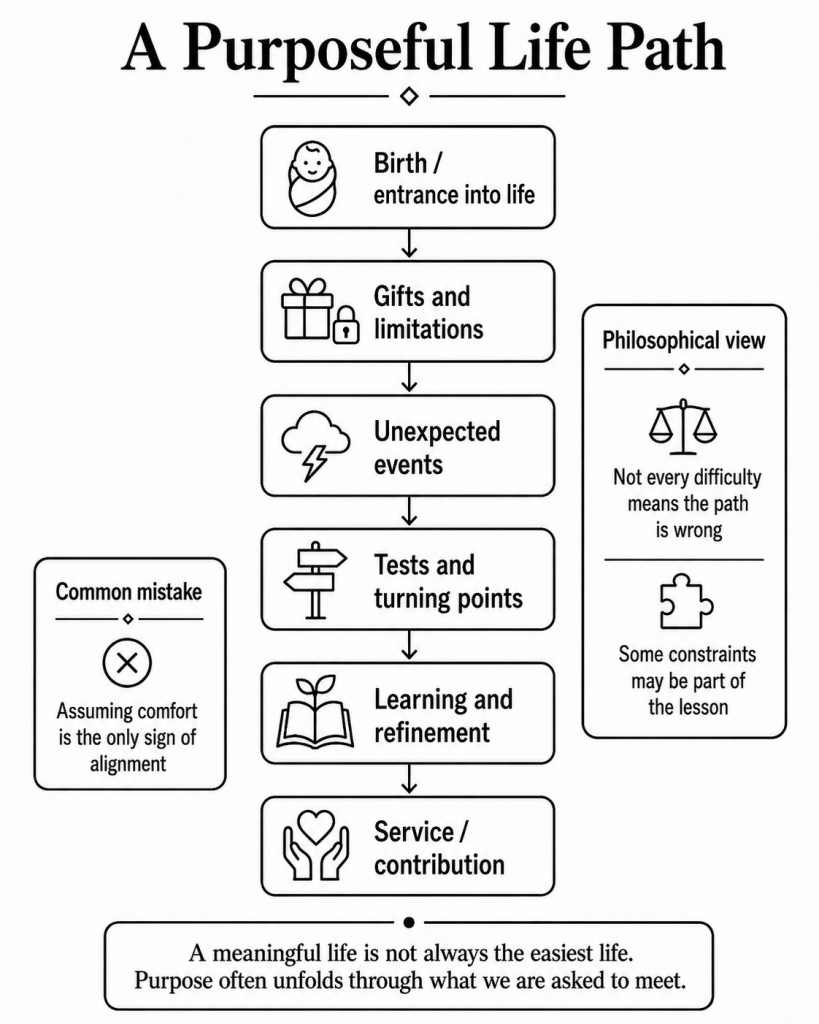
This becomes even more significant when we consider the possibility that human life has purpose before its full meaning becomes visible. Many religious and philosophical traditions have proposed that incarnation is not merely an accidental arrival into existence, but participation in a developmental path. Within an informational-physics-aligned spiritual view, a life could be understood as an entry into a particular configuration of relationships, gifts, limitations, opportunities, pressures, contrasts, and lessons.
That proposition is metaphysical rather than experimentally established, and it should be treated as such. Yet if we entertain it seriously, an important consequence follows: the easiest life would not necessarily be the most purposeful life.
Human beings often assume that alignment should feel like comfort. If circumstances become difficult, we conclude that something has gone wrong. Yet many forms of development depend upon constraint. Muscles strengthen because resistance exists. Skills mature because problems must be solved. Character is revealed because choices become costly. Scientific theories improve because evidence refuses to cooperate with expectation.
If a soul enters life for development, contribution, experience, or refinement, then some limitations may be part of the conditions through which that purpose becomes possible. A failure may redirect a person toward work they otherwise would never have attempted. A period of isolation may produce reflection. A loss may reorder priorities. A constraint may force the development of a capacity that comfort never required.
In this sense, friction can become informational. It tells us something.
A perfectly smooth life gives very little feedback about what matters most because preferences are never tested. We often do not know the strength of a value until something challenges it. We may think we value freedom until freedom is restricted. We may think we value truth until telling the truth becomes costly. We may think we value a relationship until the relationship is threatened. Contrast makes preference visible.
The same principle can operate at the scale of civilization. Societies often do not fully understand what they value until they experience the consequences of alternatives. A population may take civil liberties for granted until those liberties are restricted. Institutions may underestimate the value of transparency until secrecy produces corruption. A civilization may not appreciate peace until war reveals what peace protected.
This resembles the ordinary process through which a person develops preferences. Someone can be told what a particular food tastes like, but description is not identical to experience. Sometimes a person must taste something before knowing whether it belongs among their preferences. Experience turns abstract possibility into information.
Civilizations do something similar through history. They encounter systems, ideologies, technologies, social arrangements, freedoms, restrictions, successes, and failures. Through those encounters, collective preferences become more defined.
However, this idea requires an important boundary. It would be wrong to conclude that atrocities, oppression, or catastrophe are therefore “necessary” because humanity supposedly needed the lesson. We cannot know that. The safer and more useful point is that once an event has occurred, experience produces information. Civilization can either integrate that information or repeat the conditions that produced the harm.
History therefore becomes a kind of collective memory. What was once abstract becomes experienced, and what was experienced can become a constraint on future choices.
The biblical story of Joseph illustrates this relationship between difficulty and later meaning. Joseph is betrayed by his brothers, sold into slavery, falsely accused, and imprisoned. At several points, someone evaluating his life entirely through comfort, reputation, or immediate reward could reasonably conclude that his path had collapsed. Yet the later story presents those events as part of a larger sequence that eventually places Joseph in a position where he can respond to famine and preserve lives.
The point is not that betrayal, slavery, or imprisonment are good. The point is that the meaning of an event may extend beyond the meaning visible from inside the event itself. A chapter cannot always explain the entire book.
This leads to one of the most important distinctions in the state of suffering: whether our attention is primarily directed toward what life is supposed to give us or toward what we are capable of giving to life.
Most people naturally want love, financial security, companionship, recognition, accomplishment, comfort, and belonging. There is nothing inherently wrong with any of these desires. The instability arises when our emotional identity becomes dependent upon receiving them.
If my sense of worth depends upon being loved by a particular person, then part of my psychological stability has been placed in another person’s hands. If my sense of success depends upon fame, then my internal state becomes dependent upon public attention. If my purpose depends upon wealth, then economic circumstances become responsible for validating my existence. If I require other people to understand me before I can feel at peace, then I have made my peace dependent upon something I cannot command.
This orientation creates a fragile relationship with reality because nearly everything we want to receive depends partly upon variables outside our control. We can love another person deeply, but we cannot force that person to return the feeling. We can produce careful work, but we cannot compel society to recognize it. We can behave ethically, but we cannot guarantee fair treatment. We can build a business, but we cannot command the economy. We can care for the body, but we cannot negotiate permanent exemption from aging, illness, or death.
When identity depends on what the world delivers, the world must continually cooperate in order for us to remain psychologically stable. That is an impossible contract.
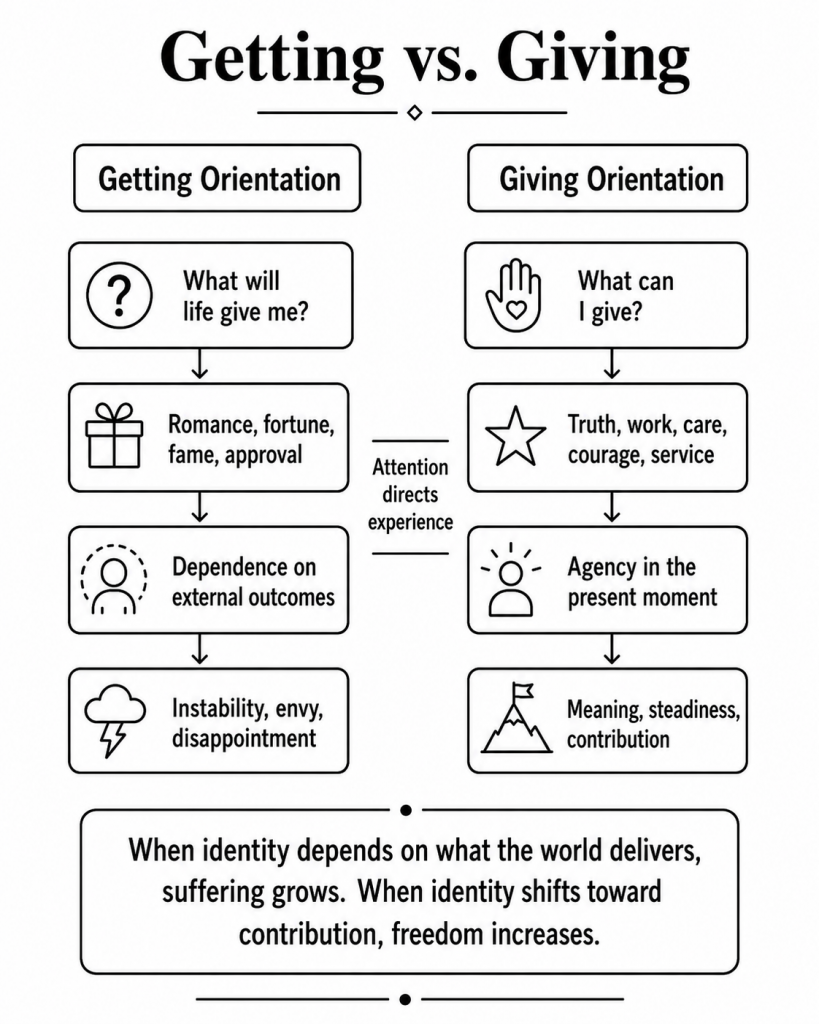
A different orientation begins with a different question. Instead of asking, “What will life give me?” we can ask, “What can I give to the life that has arrived?”
This change does not eliminate hardship, but it moves the center of agency. I may not be able to control whether someone understands me, but I can decide whether I communicate honestly and clearly. I cannot control whether my work becomes famous, but I can determine whether I do the work carefully. I cannot force kindness to be returned, but I can choose whether kindness is mine to offer. I cannot command history to remember me, but I can decide what I place into history.
Even here, the word “control” should be used carefully. We do not possess absolute control over our own lives. Fatigue, illness, trauma, material limitations, other people, and unforeseen events all affect what we are capable of doing. Yet our capacity to choose our orientation and contribution often remains much greater than our capacity to determine external outcomes.
This is the more stable form of agency. We stop demanding sovereignty over the total system and instead become responsible for the quality of our participation within it.
The giving orientation should not be confused with endless self-sacrifice. Boundaries can themselves be a form of contribution. Refusing exploitation may protect both personal integrity and the health of a relationship. Leaving a destructive environment can be an act of responsibility. Speaking against injustice can be a gift to people who have less power to speak for themselves.
The critical distinction is that contribution is not the same as compliance. It is the deliberate placement of something constructive into the system from the position we actually occupy.
Attention plays a major role in determining which orientation becomes dominant. Two people can live through similar external circumstances while experiencing very different inner worlds because attention selects which elements of reality receive psychological emphasis. One person continually measures what is absent, while another asks what remains possible. One asks why life has not provided more; another asks what can be done with what is available. One waits for ideal conditions before beginning meaningful work, while another begins from the imperfect conditions already present.
None of this means that positive thinking can solve structural injustice, cure illness, or eliminate grief. Hunger is not corrected by reframing. Abuse should not be endured in the name of acceptance. Mental illness is not simply a failure to focus on the right thing. The argument is narrower and more useful: attention influences what we do with the reality that exists.
Every present state contains constraints, but most also contain some remaining possibilities. Coherent action does not deny the constraints. It identifies the possibilities that remain inside them.
Perhaps friction is one of the mechanisms through which those possibilities become visible. Without resistance, there is no traction. Without contrast, preference remains vague. Without challenge, capacity may remain dormant. The obstacle is therefore not always merely something standing between us and the path. Sometimes the obstacle becomes part of the surface against which movement is possible.
Viktor Frankl developed a related insight after his experiences in Nazi concentration camps. His later work emphasized the importance of meaning and the possibility that human beings retain some capacity for orientation even under extreme external constraint. That freedom is not unlimited. It is situated and conditional, but it can still be profound.
A prisoner may not be free to leave. A grieving person may not be able to recover what was lost. A scientist cannot force nature to confirm a hypothesis. An artist cannot make an audience care. A parent cannot determine every outcome for a child. Yet each person may still possess some domain of response.
The mistake is to look for sovereignty over the whole pattern. Human freedom appears to be smaller than that, but also more practical. We participate from somewhere inside the pattern, and our responsibility begins there.
Many people quietly postpone meaningful living until reality satisfies a list of conditions. When the right relationship arrives, when there is enough money, when the work is recognized, when uncertainty ends, when the world becomes fair, when the difficult season passes—then life will supposedly begin.
But conditions continue changing because change is one of the basic properties of reality. If meaningful action depends upon perfect circumstances, it can be postponed indefinitely.
History repeatedly shows another pattern. Paul had a prison and gave a song. Anne Frank had a hidden room and gave a diary. Joseph encountered betrayal and confinement before the larger meaning of his path became visible. The circumstances were not ideal, yet contribution remained possible.
Perhaps this is where the state of suffering can be understood most clearly. Pain tells us that something hurts. Suffering often adds another proposition: that this must not be happening, that nothing useful can emerge while it is happening, and that life cannot become meaningful until reality provides something different.
A more coherent relationship with reality does not require pretending that pain is good. It asks us to see the present state clearly, understand its constraints, identify what can responsibly be changed, recognize what cannot presently be changed, and then determine what meaningful response remains available.
From an informational-physics perspective, we are not separate from reality looking down upon it as commanders. We are participants inside an unfolding system whose total pattern exceeds our individual perception. We influence that system through our choices, relationships, work, attention, and contribution, but we do not dictate its entire course.
Friction, constraint, and contrast are therefore not necessarily defects in that system. Sometimes they are the conditions through which movement becomes possible, distinctions become visible, preferences become known, and development acquires direction.
Perhaps we were never meant to eliminate all resistance.
Perhaps part of wisdom is learning which resistance should be overcome, which should be accepted, which should be learned from, and which is providing the very traction we need to move.
The central question of a life may therefore be less about what reality eventually agrees to give us and more about what we choose to place into reality while we are here.
Instead of asking, “What will the world give me?” we can ask a question that returns us to the part of the system where genuine agency still exists:
Given the world that has arrived, what can I give to it?