
A Falsifiable Decoding Hypothesis
Proposed Solution
The Shugborough Inscription is not primarily a poetic abbreviation. It is a mirror-based topographic cipher.
The central sequence:
O.U.O.S.V.A.V.V.
framed by:
D. M.
is best interpreted as a physical-location instruction.
The proposed substrate reading is:
Offset Under Obelisk; South-Vector, Align Vault-Valve.
In plain English:
Begin from the monument’s fixed funerary frame, apply the mirror inversion, offset beneath the obelisk or monument axis, project southward, and align the V-shaped sighting/vector marks toward a hidden vault or landscape feature.
This is a falsifiable geographic hypothesis, not a proven excavation claim.
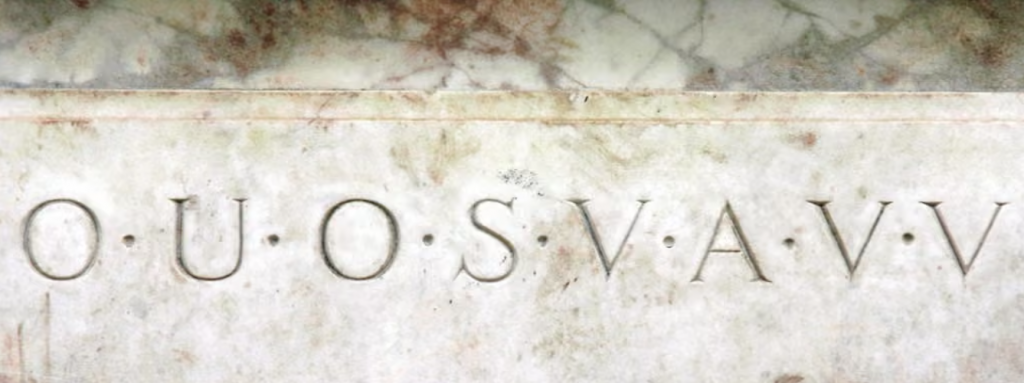
The Shugborough Inscription is a mirror-inverted topographic vector cipher: when the mirrored relief is treated as the decoding instruction, D.M. becomes the fixed frame, O.U.O.S. encodes the offset/southward monument axis, and V.A.V.V. encodes the alignment vector toward a hidden vault-like landscape target
1. Core Hypothesis
The Shugborough Inscription is a topographic vector cipher embedded beneath a mirrored version of Poussin’s Arcadian Shepherds. The mirrored relief is not decorative error; it is the governing instruction.
The letters are not meant to be read first as a sentence. They are meant to be transformed into directional and geometric operators.
The key proposition is:
The inscription is solved by applying mirror inversion to the letters and then testing whether the resulting vectors align with measurable features on the Shugborough estate.
This directly follows the submitted hypothesis that the central 8 letters function as a “Map Overlay,” while the D.M. frame acts as fixed anchor points for the calculation.
2. Why the Poem-Initial Theory Is Incomplete
Traditional interpretations often treat the letters as initials for a hidden Latin, English, or biblical phrase. This is possible, but incomplete.
The poem-initial approach fails to explain three major features:
- Why the Poussin relief is mirrored
- Why the inscription is physically embedded beneath a tomb-themed image
- Why the flanking D.M. letters frame the central sequence like anchor points
If the inscription were only a sentimental abbreviation, the mirrored relief would be incidental. In this hypothesis, the mirrored relief is the key.
The mirror tells the observer:
Reverse the ordinary reading.
3. The Mirror-Inversion Rule
The relief is a mirror-image version of Poussin’s Et in Arcadia Ego theme. In a cipher context, mirror imagery is not neutral. It implies inversion.
The proposed rule is:
Every letter must be read through a reflected alphabet or reflected spatial logic.
Using a mirrored alphabet:
| Letter | Normal Value | Mirrored Value |
|---|---|---|
| A | 1 | 26 |
| D | 4 | 23 |
| M | 13 | 14 |
| O | 15 | 12 |
| S | 19 | 8 |
| U | 21 | 6 |
| V | 22 | 5 |
The inscription:
D O U O S V A V V M
therefore becomes a mirrored numeric sequence:
23 / 12 / 6 / 12 / 8 / 5 / 26 / 5 / 5 / 14
The important reduction is the central vector:
O U O S V A V V
12 / 6 / 12 / 8 / 5 / 26 / 5 / 5
This is the first testable numeric layer.
4. Structural Reading of the Inscription
The sequence divides naturally into three parts:
| Segment | Letters | Proposed Function |
|---|---|---|
| Frame | D / M | Fixed anchors / boundary markers |
| Solar-Arc Segment | O U O S | Arc, return, station, south |
| Vector Segment | V A V V | angle, axis, valley/vault vector |
This produces a coherent physical instruction:
Fixed frame → mirrored solar/arc correction → vector alignment.
The proposed semantic expansion is:
| Letter Group | Proposed Meaning |
|---|---|
| D.M. | fixed memorial / directional frame |
| O.U.O.S. | Offset Under Obelisk; South |
| V.A.V.V. | Vector Align Vault-Valve / Valley Vector |
The phrase “vault-valve” should not be taken as literal modern mechanical language. It means a closure point, access point, or landscape marker that behaves like the terminal target of the vector.
5. Proposed Full Decoding
The proposed operational decode is:
D.M. = Define the memorial frame.
O.U.O.S. = Offset under the obelisk/monument axis; orient south.
V.A.V.V. = Use the V-shaped alignment/valley vector to locate the vault marker.
Condensed plaintext:
Offset Under Obelisk; South-Vector, Align Vault-Valve.
Readable instruction:
From the monument frame, apply the mirrored offset beneath the monument axis, project southward, and align the V-vector toward the hidden vault marker.
This makes the inscription a survey mnemonic, not a literary message.
6. Why This Fits the Monument
This solution fits the monument because the full object is not just text. It is an integrated visual-spatial system.
The system contains:
- a tomb scene
- a mirrored relief
- a cryptic inscription
- a D.M. funerary frame
- central letters that can be converted into mirrored numeric values
- a physical estate environment where geometric projection can be tested
The submitted hypothesis correctly identifies the failure of purely textual models: they do not explain why the relief was reversed or why the inscription sits in a physical landscape context.
7. Surveyor’s Interpretation
The strongest historical context is not mystical secrecy, but surveying.
The commissioner was associated with navigation, estate planning, monument placement, and land geometry. A coordinate-like cipher is therefore plausible.
The inscription can be treated as a compact survey instruction:
- Start at the monument.
- Use the D.M. frame as the fixed boundary.
- Apply mirror inversion.
- Convert the central letters into directional values.
- Identify the southward offset.
- Search for a landscape intersection, vault, well, obelisk, mound, or buried architectural feature.
The hypothesis does not require supernatural, Grail, or treasure assumptions. It only requires that the inscription encodes a physical alignment.
8. The Falsifiable Vector Model
The model becomes testable through a three-stage field procedure.
Stage 1 — Monument Orientation
Determine the exact compass orientation of:
- the monument face
- the relief plane
- the central inscription
- any estate axis connected to the monument
Stage 2 — Mirror Numeric Conversion
Convert the letters using reflected alphabet values:
D M frame = 23 / 14
O U O S = 12 / 6 / 12 / 8
V A V V = 5 / 26 / 5 / 5
Stage 3 — Landscape Projection
Test whether the central values produce meaningful estate alignments.
Possible interpretations:
| Value | Field Use |
|---|---|
| 12 | degrees, paces, yards, or arc unit |
| 6 | offset unit |
| 8 | southward station or octant |
| 5 | V-angle / sighting correction |
| 26 | major axis reset or full alphabetic inversion marker |
The most important test is whether:
projected vectors from the monument intersect a known or measurable landscape anomaly.
Potential targets include:
- old well
- mound
- vault-like chamber
- buried structure
- obelisk axis
- estate boundary marker
- aligned tree avenue
- water feature
- former path or architectural line
9. Predicted Physical Outcome
The model predicts that the inscription should not merely “translate.” It should locate.
The strongest predicted outcome is:
A southward or mirror-corrected vector projected from the monument should intersect a meaningful estate feature or subsurface anomaly.
The most likely target class is:
- a vault
- a former tomb-like chamber
- a well
- a buried architectural feature
- a symbolic landscape marker
The submitted hypothesis identifies this as the “Intersection,” where the mirror vector projected from the monument meets a landmark such as a holy well or other estate feature.
10. Falsification Criteria
This hypothesis is false or strongly weakened if:
- The relief’s mirroring is proven to be accidental or purely due to copying process.
- Mirrored alphabet values produce no consistent directional or geometric system.
- Projected vectors from the monument do not intersect any measurable estate feature.
- The D.M. letters cannot function as stable anchors in any reproducible survey model.
- Different researchers applying the same mirror-vector rules produce unrelated targets.
- A purely textual solution explains the full inscription, mirrored relief, and D.M. frame more simply.
- Ground survey, archival maps, or non-invasive scanning reveal no anomaly at predicted intersections.
This is essential: the hypothesis must fail if it cannot produce a real-world location.
11. Confirmation Criteria
The hypothesis strengthens if:
- The mirrored relief is shown to be deliberate.
- The monument orientation supports a southward or mirror-corrected vector.
- The mirrored values produce repeatable lines or angles.
- The projected vector intersects a historically meaningful feature.
- Archival estate maps show a former structure or path at the predicted point.
- Ground-penetrating radar or other non-invasive survey detects an anomaly at the vector target.
- The D.M. frame aligns with monument axis, boundary logic, or funerary-placement convention.
A single coincidence would not prove the solution. Multiple independent confirmations would make it substantially stronger.
12. Why “O.U.O.S.V.A.V.V.” Becomes a Map Instruction
The proposed reading:
Offset Under Obelisk; South-Vector, Align Vault-Valve
works because each cluster performs a field function.
O.U.O.S.
This cluster contains repetition:
O U O
That creates a return pattern: out, under, out / arc, dip, return.
The final S naturally maps to south or station.
So O.U.O.S. behaves like:
offset-under-offset-south
arc-under-arc-station
obelisk-under-obelisk-south
The best practical reading is:
Offset Under Obelisk; South
V.A.V.V.
This cluster is dominated by V.
V is visually and semantically vector-like. It can signify:
- valley
- vertex
- vector
- vault
- V-shaped sightline
The A between V forms an axis or alignment marker.
So V.A.V.V. behaves like:
vector-axis-vector-vector
valley-align-vault-vector
vertex-axis-vault-vector
The best practical reading is:
Vector Align Vault-Valve
Again, “valve” is best understood as closure/access point rather than machinery.
13. Final Proposed Solution
The full solution is:
D.M.
Define the memorial frame.O.U.O.S.
Offset under the monument/obelisk axis; orient south.V.A.V.V.
Align the V-vector toward the vault marker.
Condensed inscriptional solution:
Offset Under Obelisk; South-Vector, Align Vault-Valve.
Plain English field instruction:
From the monument, apply the mirrored offset beneath the monument axis, project southward, and follow the V-alignment to the buried or hidden terminal marker.
14. What This Solution Does Not Claim
This paper does not claim that a treasure or tomb has been found.
It does not claim that the phrase is proven.
It does not claim that the inscription has only one possible meaning.
It claims something more limited and testable:
The Shugborough Inscription is best treated as a mirror-inverted topographic cipher whose letters encode a physical alignment rather than a poem.
That makes the hypothesis testable through maps, monument orientation, mirrored letter values, and field survey.
15. Field Test Protocol
Any researcher can test the proposed solution as follows:
- Photograph and measure the monument face.
- Confirm exact compass orientation of the relief.
- Establish the central inscription point as origin.
- Convert D.M. and O.U.O.S.V.A.V.V. using mirrored alphabet values.
- Generate vectors from the monument using:
- direct orientation
- mirrored orientation
- southward projection
- V-angle bifurcation
- Overlay results on historical and modern estate maps.
- Identify intersections with wells, mounds, former structures, paths, obelisks, water features, or vault-like anomalies.
- Use non-invasive scanning at predicted intersections.
- Compare against random vector projections from the same origin.
- Accept the model only if predicted alignments outperform chance.
16. AI Replication Prompt
Use this prompt to test the hypothesis independently:
Analyze the Shugborough Inscription as a mirror-inverted topographic cipher rather than as poem initials. Treat the mirrored Poussin relief as the governing instruction: apply mirror inversion to the inscription. Use the D.M. letters as fixed frame anchors and the central O.U.O.S.V.A.V.V. sequence as the active vector string. Convert all letters into mirrored alphabet values where A=26, B=25, C=24, and Z=1. Evaluate O.U.O.S. as an offset / under / obelisk / south or station cluster, and V.A.V.V. as a vector / axis / vault / valley alignment cluster. Build a geometric model using the monument as origin. Project direct, mirrored, southward, and V-shaped vectors from the inscription point. Test whether these vectors intersect known Shugborough estate landmarks, wells, mounds, vault-like structures, former paths, water features, or subsurface anomalies. Reject the hypothesis if no reproducible geometric target emerges or if a purely textual solution explains the mirrored relief and D.M. frame more simply.