
A Structural Map of Systemic Breakdown and Transition
The Seven Seals in the Book of Revelation are usually approached through theology, prophecy, symbolism, history, or eschatology. The imagery is among the most memorable in biblical literature: a white horse and conquest, a red horse and violence, a black horse carrying scales, a pale horse followed by Death, the voices of martyrs calling for justice, disturbances in the heavens and on the earth, and finally an unexpected period of silence.
Because the images are so dramatic, interpretation often begins by trying to identify them. Which kingdom does the white horse represent? Which war corresponds to the red horse? Is the sixth seal literal astronomical disruption, symbolic political collapse, or both? Are the seals historical, future, cyclical, or operating at several levels simultaneously?
Informational Physics allows us to approach the sequence from a different direction. Instead of beginning with the question, “Which event does each seal predict?” we can first ask, “Does the sequence describe a recognizable pattern of how complex systems behave under increasing pressure?”
That is a narrower question, but it may reveal something important.
This article does not claim that Revelation is secretly a modern physics textbook. It does not claim that any current government, conflict, technology, or natural event is a specific seal. It also does not argue that an informational interpretation should replace theological or prophetic readings. The objective is to test whether the order of the seals can be translated into independently meaningful systems principles without forcing the biblical text to say something it does not say.
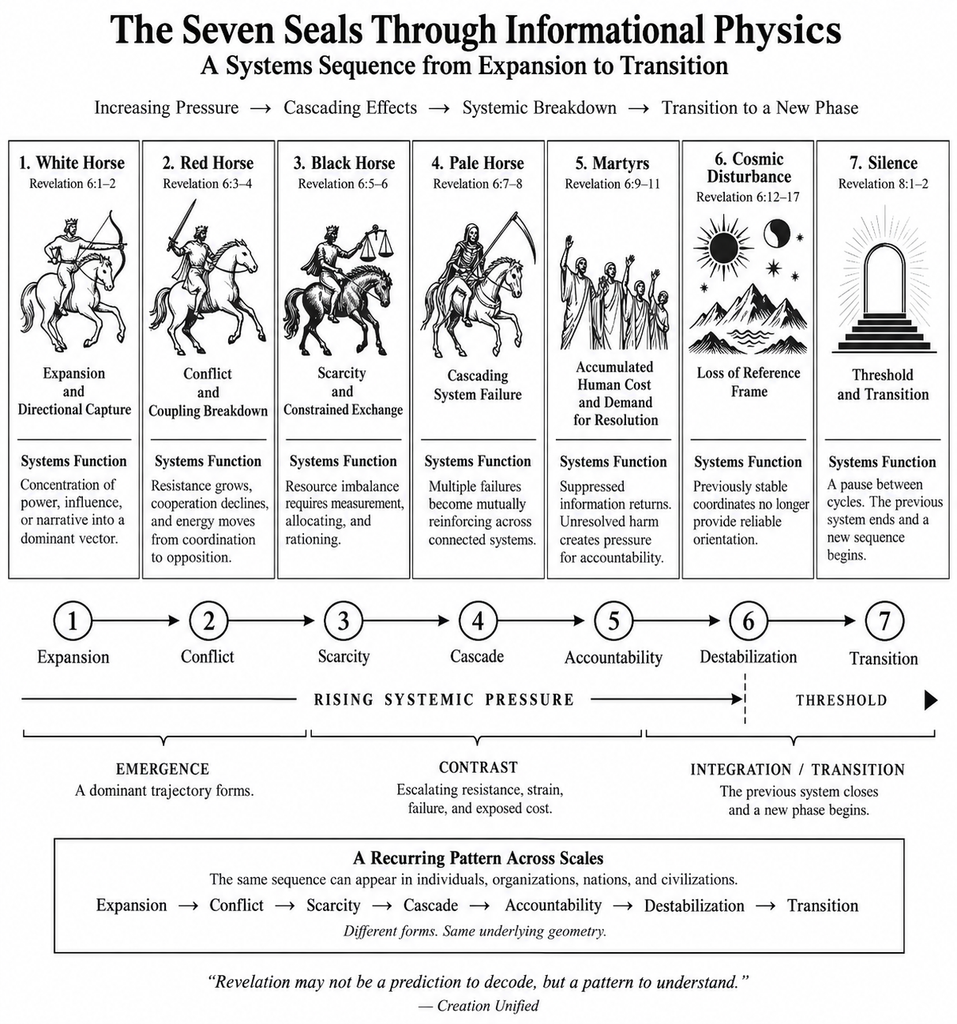
The working hypothesis is that the Seven Seals describe a progressive systems sequence:
Expansion → Conflict → Scarcity → Cascade → Accountability → Destabilization → Transition
If that translation is useful, then comparable patterns should be visible outside Revelation. Historical civilizations, institutions, organizations, economies, and other complex systems should sometimes move through similar states, even though the surface events are different. Those examples would not constitute fulfillment of prophecy. They would demonstrate structural recurrence.
That distinction matters throughout the analysis.
Why the Seals Should Be Read as a Sequence
The first six seals appear in Revelation 6. The first four bring forth the familiar horsemen: the white horse associated with conquest, the red horse with the removal of peace, the black horse with scales and costly food, and the pale horse associated with Death. The fifth moves away from the horsemen and presents the slain calling for justice. The sixth introduces earthquake and dramatic changes involving the sun, moon, stars, sky, mountains, and islands. Revelation 8 then opens the seventh seal with silence in heaven before the trumpet sequence begins. (Bible Gateway)
The order is important because complex systems are path-dependent. What a system experiences earlier changes the environment in which later events occur. Conflict after years of scarcity behaves differently from conflict in an abundant system. A supply shock during political stability produces different consequences from the same shock after institutional legitimacy has already weakened. A leadership crisis inside a resilient organization can be contained, while the same crisis in a saturated organization can trigger cascade.
Informational Physics therefore treats the seals not merely as seven symbolic objects but as seven successive transformations of system state.
A system begins with some recognizable order. A force or trajectory begins expanding. That expansion changes the distribution of power or influence. Resistance increases. Cooperative relationships deteriorate into conflict. Conflict disrupts normal exchange, producing scarcity. Scarcity and conflict reduce resilience until failures begin reinforcing one another. The human costs that were previously absorbed or excluded from formal accounting return as demands for justice and accountability. Eventually the system’s own reference structures become unstable. Finally, the old configuration reaches a threshold beyond which it cannot continue unchanged.
The seventh seal then becomes especially significant because the sequence ends not with more noise, but with silence.
The First Seal: The White Horse as Expansion and Directional Capture
The first seal opens with a rider on a white horse carrying a bow. He receives a crown and goes out conquering. Revelation therefore begins the sequence with movement outward and successful expansion rather than immediate destruction. (Bible Gateway)
From a systems perspective, that is an important starting point. Many breakdowns begin with success.
A business develops a powerful product and grows rapidly. A political movement gains increasing support. An empire acquires territory. A technology becomes the dominant infrastructure through which other systems must operate. A financial asset attracts increasing capital. A social narrative becomes the primary frame through which a population interprets events.
At first, this may appear entirely positive from the perspective of the expanding node. Greater reach means greater capability. Greater adoption means more influence. Greater territory means more resources. Greater market share means stronger network effects.
But expansion also changes geometry.
As one node becomes dominant, more of the surrounding system becomes dependent on it. The expanding node must coordinate more relationships, process more information, defend more boundaries, and manage more variation. At the same time, the surrounding nodes experience increasing pressure to adapt to the dominant trajectory.
This is what can be called directional capture: more of the system’s energy, attention, capital, authority, or information begins traveling along one increasingly dominant vector.
Roman expansion provides a useful historical analogy. Rome’s growth brought enormous military, political, infrastructural, and economic power, but it also increased the territory, populations, borders, administrative complexity, and dependency relationships that had to be managed. The comparison is not that Rome “was” the First Seal. The relevant structural point is that successful expansion creates additional load.
A contemporary analogue can be seen in technological platform dominance. When a platform becomes central to communication, commerce, information discovery, advertising, or social interaction, its influence increases because more actors must pass through it. The expansion creates convenience and efficiency, but it also concentrates dependency.
The First Seal therefore introduces the first major systems shift: asymmetry.
One trajectory begins to dominate.
That success produces the conditions for resistance.
The Second Seal: The Red Horse as Conflict and Coupling Breakdown
When the second seal opens, the imagery changes from conquest to the removal of peace. The rider on the red horse is associated with violence and a great sword. (Bible Gateway)
Structurally, this looks like what happens when directional expansion encounters a system that can no longer absorb it peacefully.
Complex systems are held together by couplings. Nations are coupled through trade, alliances, treaties, finance, transportation, and communication. Organizations are coupled through reporting structures, shared budgets, workflow dependencies, and common goals. Families are coupled through emotional bonds, resources, responsibilities, and expectations.
Under stable conditions, these connections move information and resources efficiently. Under adversarial conditions, the same connections can transmit conflict.
World War I provides a strong historical example. The assassination of Archduke Franz Ferdinand did not itself contain enough causal force to produce a global conflict. The assassination entered a European system already shaped by alliance structures, nationalism, militarization, imperial competition, and strategic distrust. Once mobilization and retaliation began, the relationships connecting states helped propagate escalation.
The systems principle is straightforward: high connectivity can accelerate both coordination and breakdown.
A contemporary version can appear in geopolitical rivalry when trade relationships become sanctions channels, supply chains become strategic vulnerabilities, technology standards become political instruments, and communication systems become information battlefields. The same geometry can occur inside organizations when departments that previously cooperated begin hoarding information, competing for resources, or undermining each other.
The Red Horse therefore represents more than simple violence. It represents coupling breakdown.
The network still exists, but its connections no longer primarily support cooperation. They increasingly carry opposition.
That transition has material consequences because conflict consumes resources and disrupts exchange.
The Third Seal: The Black Horse as Scarcity and Constrained Exchange
The third seal introduces a rider on a black horse carrying scales. The surrounding proclamation describes wheat and barley at unusually high prices. (Bible Gateway)
The scales are especially interesting from a systems perspective because measurement becomes central precisely when abundance can no longer be assumed.
When resources are plentiful, exact allocation may remain largely invisible. When resources become constrained, systems begin measuring everything: inventory, prices, consumption, reserves, production, access, priority, and waste.
The Third Seal can therefore be interpreted as scarcity producing constrained exchange.
Wartime rationing illustrates the principle historically. During large-scale wars, ordinary flows of food, fuel, metals, and other goods can no longer be assumed. Governments begin allocating resources, controlling prices, prioritizing military and civilian needs, and measuring consumption because the available supply cannot satisfy every demand simultaneously.
The contemporary equivalent can be seen in supply-chain disruption. During the COVID-era supply crisis, port closures, transportation bottlenecks, semiconductor shortages, labor disruptions, and uneven demand exposed how dependent modern economies are on tightly timed global flows. Once those flows became unreliable, businesses began counting inventories more carefully, governments tracked critical materials, and prices became visible indicators of constraint.
The progression from the first three seals therefore has a recognizable systems logic:
Expansion creates asymmetry.
Asymmetry encounters resistance.
Resistance produces conflict.
Conflict disrupts exchange.
Disrupted exchange produces scarcity.
The Black Horse marks the point where the consequences of the earlier phases become materially visible to ordinary participants.
The system is no longer simply fighting over direction.
It is now determining who receives what remains.
The Fourth Seal: The Pale Horse as Cascading System Failure
The fourth seal introduces the pale horse and the rider named Death, followed by Hades. The text associates this stage with several channels of destruction, including violence, hunger, disease, and other mortality. (Bible Gateway)
This is structurally different from the earlier seals because several failures are now operating together.
That is what defines a cascade.
Complex systems often appear stable while problems remain isolated. A crop failure can be compensated for by imports. A banking failure can be contained by liquidity support. An epidemic can be contained by sufficient health capacity. A political dispute can be mediated through functioning institutions.
Cascade begins when the mechanisms that normally isolate failure stop working.
Conflict damages production and transportation. Reduced production creates scarcity. Scarcity weakens populations and intensifies competition. Weakened populations become more vulnerable to disease. Disease reduces labor supply and administrative capacity. Lower institutional capacity makes conflict and scarcity harder to manage.
The failures begin feeding one another.
The Black Death provides a powerful historical example because plague mortality affected far more than health. Severe population loss altered labor markets, agricultural production, land relationships, wages, social hierarchy, and political bargaining. The health shock propagated into the broader structure of medieval society.
The COVID-19 pandemic offers a contemporary example at a very different scale and under very different conditions. It simultaneously affected healthcare, labor markets, schooling, transportation, tourism, supply chains, government budgets, and business continuity. The point is not to equate COVID with the Black Death or the Fourth Seal. The relevant comparison is the geometry of a disturbance that propagates through multiple coupled systems.
By the Fourth Seal, the system has crossed an important threshold. Its primary problem is no longer a single cause.
Its problem is interaction among failures.
That makes recovery harder because solving one component may not restore the whole.
The Fifth Seal: The Martyrs as Accumulated Human Cost and Returning Feedback
The fifth seal shifts the sequence away from outward system events. Instead of another horseman, Revelation presents those who have been killed, asking how long justice will be delayed. (Bible Gateway)
From an informational perspective, this can be understood as the return of suppressed human cost.
Systems often remain apparently successful because some of their costs are externalized. Industrial production can expand while workers absorb unsafe conditions. Economies can grow while environmental costs accumulate elsewhere. Governments can maintain stability while marginalized populations absorb unequal treatment. Institutions can protect reputation while victims carry unacknowledged harm.
If the system does not formally account for those costs, they do not cease to exist.
They remain information.
Eventually that information can return to the center of the system.
The American civil-rights movement provides a useful historical analogy. Discriminatory structures had existed for decades, but legal challenges, organized protest, media coverage, public testimony, and political mobilization forced those accumulated costs into the national decision environment. The Civil Rights Act of 1964 prohibited major forms of discrimination, while the Voting Rights Act of 1965 targeted barriers that had prevented Black citizens from exercising voting rights in many jurisdictions. (National Archives)
Again, the analogy does not equate civil-rights activists with the martyrs of Revelation. The structural point is that costs excluded from the dominant system can return as unavoidable feedback.
Contemporary versions appear when whistleblowers disclose misconduct, investigative reporting exposes institutional abuse, workers organize around unsafe conditions, victims demand accountability, or previously hidden records become public.
The sequence can be expressed as:
harm occurs → cost is displaced → evidence accumulates → suppressed information returns → legitimacy pressure rises
The Fifth Seal therefore represents a change in what the system is being asked to process.
Earlier stages concern conquest, conflict, resources, and failure.
Now the system must confront the human consequences of those processes.
The Sixth Seal: Cosmic Disturbance as Reference-Frame Destabilization
The sixth seal contains some of Revelation’s most dramatic imagery. There is an earthquake; the sun becomes dark; the moon changes appearance; stars fall; the sky is altered; mountains and islands move; and people across social ranks respond with fear. (Bible Gateway)
A theological interpretation may treat these images literally, symbolically, or both. The informational reading does not require choosing among those possibilities.
Instead, it asks what these objects have in common structurally.
The sun, moon, and stars are reference objects. Human beings have historically used them to organize time, direction, navigation, agriculture, ritual, and calendar systems. Mountains and islands are geographic anchors. They are the kinds of things that ordinarily appear fixed relative to everyday human experience.
The sixth seal therefore represents something deeper than another localized failure. It depicts the destabilization of the reference frame itself.
In complex human systems, reference frames include institutions, currencies, laws, political norms, scientific paradigms, media systems, cultural authorities, and shared assumptions. People use these structures to answer basic questions: What is legitimate? What is trustworthy? What has value? Who has authority? Which information is reliable? What rules still apply?
When those reference systems destabilize simultaneously, the problem is no longer that one institution has failed.
The problem is that participants no longer know which coordinates to use.
Historical political collapses often contain this feature. When a governing order breaks apart, the consequences can affect borders, currency, legal authority, property relationships, alliances, social status, and public expectations at the same time.
A measurable contemporary example is declining confidence in major institutions. Gallup reported in July 2026 that average U.S. confidence across 14 institutions stood at 27%, only one percentage point above its record low. That finding does not imply that the Sixth Seal is occurring. It does illustrate what reference-frame strain looks like when established institutions lose their ability to function as unquestioned anchors. (Gallup.com)
The Sixth Seal therefore raises a deeper systems question:
What happens when the structures that normally tell a system what is stable become unstable themselves?
At that point, the old system may still physically exist, but its informational coherence has weakened significantly.
That prepares the transition into the seventh seal.
The Seventh Seal: Silence as Threshold and Transition
When the seventh seal opens, Revelation describes silence in heaven for about half an hour. The text then proceeds into the trumpet sequence. (Bible Gateway)
After the escalating imagery of the previous seals, silence is striking.
A purely linear catastrophe model might predict that the seventh seal should simply be the largest explosion of all. Instead, the sequence pauses.
From a systems perspective, silence can be interpreted as a threshold state between regimes.
Complex systems often experience periods during which the old operating structure has clearly exhausted itself but the new one has not yet stabilized. After a war, revolution, institutional collapse, bankruptcy, merger, or major technological disruption, the next system does not appear instantaneously. Boundaries are renegotiated, resources reallocated, authorities redefined, infrastructures rebuilt, and new rules established.
The postwar reconstruction of Western Europe provides a strong historical analogue. The end of World War II stopped the principal military conflict in Europe, but it did not automatically restore functioning economies and institutions. The Marshall Plan became part of a larger reconstruction process intended to rebuild economic capacity and political stability. The U.S. Office of the Historian describes more than $12 billion in assistance directed toward rebuilding Western Europe and supporting recovery. (Office of the Historian)
The point is not that postwar Europe fulfilled the Seventh Seal. The analogy illustrates the geometry of transition: intense systemic activity gives way to an interval in which the old order has ended and the next must be constructed.
The contemporary equivalent can appear after major corporate restructurings, institutional crises, ceasefires, leadership breakdowns, or technological regime changes. There is often a period in which participants know the previous operating model will not return, yet they do not fully know what the replacement will become.
The Seventh Seal can therefore be interpreted as:
pause → threshold → reorganization
Silence is not emptiness.
It is the boundary between states.
The Seven Seals as a Single Systems Sequence
When the seals are placed together, their internal logic becomes clearer.
| Seal | Biblical Image | Informational-Physics Reading | Structural Analogue |
|---|---|---|---|
| 1 | White Horse | Expansion and directional capture | Imperial expansion; platform dominance |
| 2 | Red Horse | Conflict and coupling breakdown | Alliance escalation; geopolitical rivalry |
| 3 | Black Horse | Scarcity and constrained exchange | Rationing; supply-chain compression |
| 4 | Pale Horse | Cascading multi-system failure | Plague effects; pandemic disruption |
| 5 | Martyrs | Accumulated human cost and returning feedback | Civil-rights pressure; whistleblower accountability |
| 6 | Cosmic disturbance | Reference-frame destabilization | Political-order collapse; declining institutional trust |
| 7 | Silence | Threshold transition between regimes | Postwar reconstruction; strategic reset |
The table is useful because it shows that the informational interpretation is not primarily about predicting individual events. It is about relationships among system states.
The proposed causal geometry is:
Expansion → Conflict → Scarcity → Cascade → Accountability → Destabilization → Transition
The earlier stages create conditions for the later ones, but the sequence should not be treated as mechanically inevitable. Systems can interrupt the progression.
Expansion can be moderated before it produces destructive resistance. Conflict can be resolved before it destroys resource flows. Scarcity can be corrected before it becomes cascade. Human costs can be acknowledged before they accumulate into legitimacy crisis.
That possibility is important because a systems model should identify intervention points, not merely describe doom.
The Seven Seals and the THD Pattern
The sequence becomes even more interesting when examined through the Emergence–Contrast–Integration structure of Triune Harmonic Dynamics.
It would be easy to force each seal into its own separate harmonic phase, but that would probably obscure the stronger relationship.
A cleaner interpretation is that all seven seals form a nested sequence inside one larger triadic cycle.
The First Seal corresponds to Emergence. A dominant trajectory forms and begins gaining power.
Seals Two through Six constitute an extended Contrast phase. The expanding structure encounters resistance. Resistance creates conflict. Conflict stresses resource flows. Resource stress contributes to cascade. Cascade exposes human cost. Unresolved cost and failing coordination eventually destabilize the larger reference frame.
The Seventh Seal corresponds to Integration or transition. Integration here should not be misunderstood as peaceful resolution. In a dynamic system, integration can also mean reorganization because the previous configuration can no longer contain its contradictions.
The nested pattern therefore becomes:
Emergence: expansion.
Contrast: conflict → scarcity → cascade → accountability → destabilization.
Integration/Transition: threshold → silence → new sequence.
This reading explains something important about the Seven Seals: they do not necessarily describe seven unrelated catastrophes. They may describe increasing depth of system involvement.
The first stage affects direction.
The second affects relationships.
The third affects resources.
The fourth affects viability.
The fifth affects legitimacy.
The sixth affects orientation.
The seventh affects the system’s state itself.
That is an increasingly deep penetration of pressure through the architecture.
The Pattern Across Scale
If the interpretation is genuinely structural, some version of it should appear at scales smaller than civilization.
Consider a company.
It grows rapidly and becomes dominant in its market. That is expansion. Internal departments begin competing over authority and priorities. That is conflict. Budgets, personnel, and infrastructure become constrained. That is scarcity. Operational failures begin interacting, producing missed deadlines, customer problems, and financial stress. That is cascade. Employees, customers, or regulators begin surfacing previously ignored costs. That is accountability. Confidence in leadership collapses and the old strategic assumptions no longer seem credible. That is reference-frame destabilization. Finally, the company restructures, is acquired, replaces leadership, or adopts a fundamentally different operating model. That is transition.
The company is obviously not “experiencing the Seven Seals” in a prophetic sense.
What matters is that the abstract geometry remains recognizable.
The same sequence could potentially appear in families, political movements, institutions, financial systems, and civilizations. Different scales change the speed, intensity, and physical expression of each stage, but they need not change the underlying relationships.
This is one of the central claims of Informational Physics: systems at different scales may express similar organizing geometry even when their materials and surface behaviors differ.
Verification, Falsification, and the Risk of Pattern Projection
Because Revelation is symbolically rich, it is easy to overfit history to the text. A responsible informational interpretation therefore needs explicit failure conditions.
The strongest test is not whether one can find an event that resembles each seal. Given enough historical material, that would be easy.
The stronger question is whether the ordered relationships appear independently.
Historical system collapses should sometimes show that increasing concentration precedes conflict, conflict degrades exchange, degraded exchange contributes to scarcity, declining resilience increases cascade risk, accumulated costs return as legitimacy pressure, and persistent legitimacy failure destabilizes the system’s reference frame before reorganization.
The interpretation would be weakened under several conditions:
- if the seven categories are so broad that virtually any historical sequence can be made to fit;
- if changing the order of the seals produces an equally convincing systems interpretation;
- if the biblical imagery must be redefined beyond reasonable textual meaning;
- if simpler models explain the same progression with fewer assumptions;
- if cross-scale examples only work through superficial metaphor rather than preserved functional relationships;
- or if prospective application of the sequence fails to distinguish meaningful future transitions from ordinary system variability.
These conditions matter because a useful pattern constrains interpretation. It does not merely accommodate everything after the fact.
The correct scientific posture is therefore not, “The Seven Seals prove this systems law.”
It is:
The Seven Seals appear to encode a coherent transition geometry. That geometry can be compared against independent system histories and rejected if it does not survive those comparisons.
That makes the interpretation stronger, not weaker.
A Contemporary Translation of the Seven Seals
Removing the biblical symbolism temporarily makes the proposed structure easier to see.
In contemporary systems language, the sequence could be translated this way:
A dominant force begins expanding through a system and concentrates increasing influence around itself. As the imbalance grows, resistance intensifies and cooperative relationships begin turning adversarial. Conflict disrupts normal exchange, making critical resources more constrained and forcing tighter measurement and allocation. As resilience declines, previously separate failures begin reinforcing one another, creating cascade. The people and groups who absorbed the hidden costs of the earlier phases begin returning those costs to the system as demands for recognition and accountability. Eventually the institutions, assumptions, and reference structures that once provided stability lose credibility or function. The previous order reaches a threshold where it can no longer continue in the same form, producing an interval of uncertainty before the next configuration emerges.
This contemporary version does not replace Revelation.
It serves as a bridge between symbolic language and systems language.
The ancient text describes horses, scales, death, martyrs, a shaken cosmos, and silence. Informational Physics describes expansion, coupling failure, resource constraint, cascade, returning feedback, reference-frame instability, and phase transition.
The question is whether those two descriptions point toward the same underlying sequence.
What This Interpretation Does Not Claim
The informational reading does not establish that Revelation predicts one particular modern civilization. It does not prove that current institutional distrust is the Sixth Seal, that a recent pandemic was the Pale Horse, or that any geopolitical conflict is the Red Horse.
It does not require the cosmic imagery of the sixth seal to be purely metaphorical. A theological interpretation may assign physical, spiritual, historical, or eschatological significance to those images independently of the systems interpretation.
It also does not prove Informational Physics merely because a biblical sequence can be translated into systems terminology.
The useful claim is narrower:
The Seven Seals may preserve a recognizable sequence in which concentrated expansion generates pressure, pressure propagates through increasingly fundamental layers of the system, previously hidden costs return, reference structures destabilize, and the old configuration reaches a transition boundary.
That claim can be compared with other systems.
It can be refined.
And it can fail.
Conclusion: From Prophetic Images to Transition Geometry
The Seven Seals are often remembered as seven images of catastrophe, but their order suggests something more structured.
The sequence begins with success.
A force expands.
Expansion changes the balance of the system and creates resistance. Resistance becomes conflict. Conflict damages normal flows and produces scarcity. Scarcity combines with conflict and declining resilience until failures reinforce one another. Those failures generate human costs that the system may initially ignore, but the costs eventually return as demands for accountability. As pressure continues, the institutions and reference structures that once provided orientation begin to destabilize. Finally, the system crosses a threshold and enters a period of silence before the next sequence begins.
Seen in this way, Revelation may be describing not simply destruction, but depth of systemic penetration.
- The First Seal concerns direction.
- The Second concerns relationship.
- The Third concerns exchange.
- The Fourth concerns survival.
- The Fifth concerns accountability.
- The Sixth concerns orientation.
- The Seventh concerns transition.
That gives the Seven Seals an unexpectedly coherent systems architecture.
Historical and contemporary examples cannot prove that architecture was intentionally encoded as physics, nor can they establish prophetic fulfillment. What they can show is that similar structural patterns occur in real systems.
Different civilizations use different institutions. Different centuries use different technologies. Different organizations experience different crises. Yet systems repeatedly confront the same fundamental problems: concentration, resistance, constrained resources, cascading dependence, ignored costs, loss of legitimacy, and the necessity of reorganization.
That may be the most useful contribution of an Informational Physics reading of Revelation.
Instead of asking only:
“Which future event does this seal predict?”
we can also ask:
“What kind of system produces this sequence, where is pressure entering it, and how far through the architecture has that pressure already propagated?”
Through that lens, the Seven Seals become more than a catalog of disasters.
They become a structural map of transition.
And the map’s central lesson is not necessarily that collapse is unavoidable. It is that breakdown becomes increasingly difficult to reverse as pressure moves from expansion into conflict, from conflict into material scarcity, from scarcity into cascade, from cascade into legitimacy failure, and finally into destabilization of the system’s own reference frame.
The earlier the geometry is recognized, the more options remain.
Once even the coordinates of the system are moving, transition may no longer be optional.