
A Falsifiable Procedural-Compression Solution
Proposed Solution
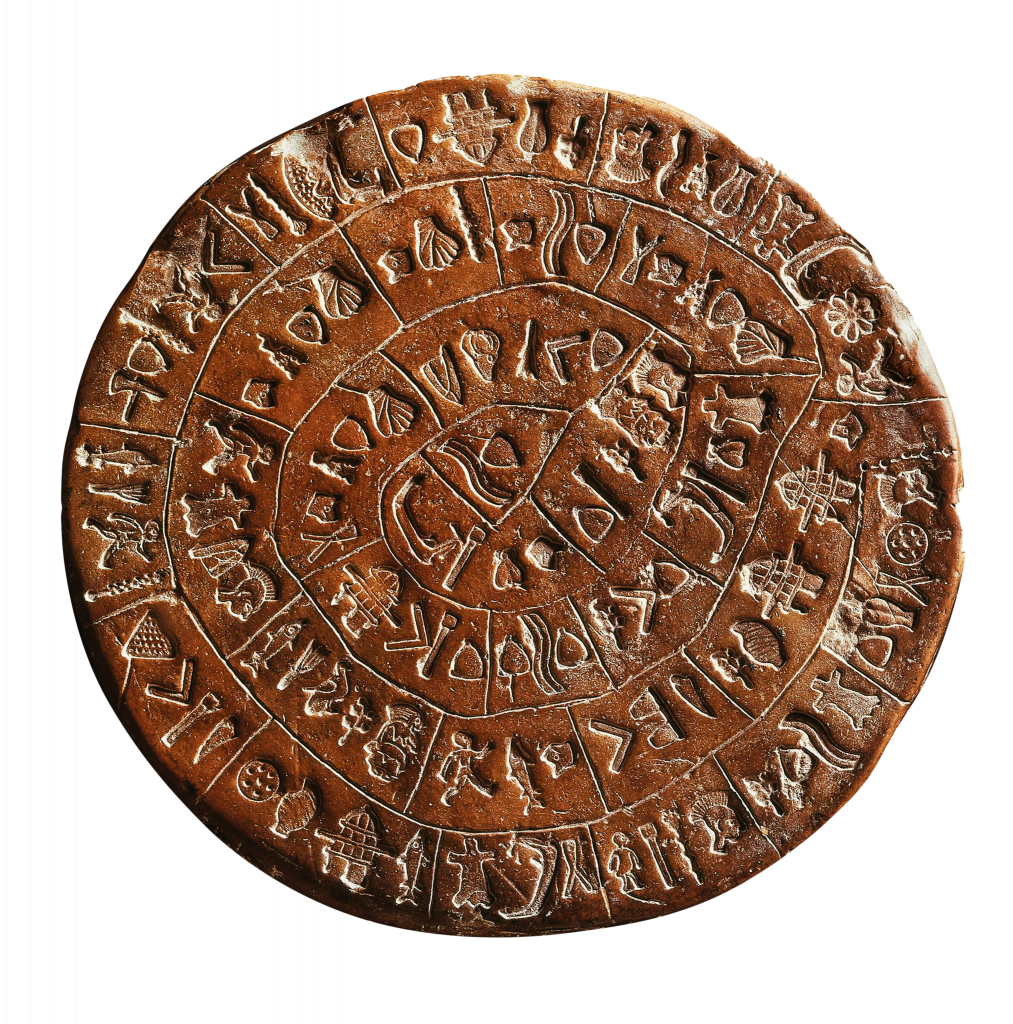
The Phaistos Disk is best understood not as a miniature literary text, but as a structured procedural device. For more than a century, most attempts to decipher it have assumed that the disk should behave like ordinary writing: a hymn, a ritual text, a legal formula, or a compressed narrative rendered in an unknown script. That assumption has never produced stable results, not simply because the underlying language is unknown, but because the object itself does not behave like conventional prose.
The stronger explanation is that the Phaistos Disk was designed to encode ordered operations rather than continuous speech. Its signs are stamped rather than written, its symbols are grouped into discrete cells rather than flowing as sentences, and its content is arranged in a spiral sequence that governs progression through the disk. These are not incidental visual features. They are structural constraints, and they strongly suggest that the disk functions less like a text and more like a procedural register.
The central claim of this hypothesis is straightforward:
The Phaistos Disk is not best modeled as a written sentence. It is best modeled as a stamped procedural spiral used to encode ordered operations.
This reframes the disk not as an undeciphered literary artifact, but as a compact symbolic system built for sequence, repetition, and controlled execution.
1. Core Hypothesis
The Phaistos Disk has resisted decipherment for so long because it has likely been misclassified at the most basic level. Most decipherment attempts begin from the assumption that the disk should resolve into a familiar textual form: alphabetic writing, syllabic prose, ritual liturgy, magical invocation, or some compressed narrative formula. These approaches all share the same premise—that the disk is fundamentally trying to record speech.
That premise is weaker than it appears.
The disk does not behave like ordinary inscriptional text. It behaves like a constrained symbolic sequence in which signs are stamped from a fixed inventory, grouped into bounded cells, and ordered by a spiral progression that appears to structure execution rather than syntax. This makes it far more plausible that the disk was intended to encode a repeatable process than a spoken utterance.
Under this model, the disk is not a literary composition. It is a structured operational artifact.
2. Why Conventional Linguistic Decipherment Fails
The failure of conventional decipherment is not merely a consequence of limited corpus size. It is a consequence of structural mismatch.
The Phaistos Disk does not resemble ordinary prose in the ways that matter most. Its signs were impressed from reusable dies rather than written freely by hand. Its content is segmented into clearly bounded clusters rather than continuous lines. Its layout follows a spiral progression rather than a linear sequence. These features are awkward for conventional literary writing, but highly efficient for procedural encoding.
If the disk were meant to record ordinary prose, stamping each sign from a fixed die set would be cumbersome and unnecessarily rigid. If it were meant to encode a repeatable sequence—ritual, administrative, calendrical, or instructional—then stamping becomes highly efficient. Standardized symbols allow consistent reproduction, bounded cells preserve unit integrity, and spiral order naturally governs progression.
This is not what one expects from narrative writing. It is exactly what one expects from a structured operational system.
3. Structural Model
The most useful way to model the Phaistos Disk is as a three-layer procedural system in which meaning emerges from the interaction of sequence, symbol, and grouping.
| Layer | Function |
|---|---|
| Spiral Layer | Determines sequence and execution order |
| Symbol Layer | Determines unit function |
| Cell Layer | Determines grouped operation |
In this model, the spiral establishes the order in which the disk is traversed. Each stamped sign contributes a functional symbolic value. Each grouped cell acts as a bounded instruction unit. Meaning does not emerge through simple letter-to-sound substitution. It emerges through the interaction of all three layers at once.
The disk is therefore better read as sequence logic than as prose syntax.
4. Functional Roles in the Disk
The strongest operational interpretation is that the signs on the Phaistos Disk fall into recurring functional roles rather than lexical word classes.
| Sign Class | Likely Function |
|---|---|
| Initial Signs | Category, actor, or instruction header |
| Core Signs | Object, action, or operation |
| Modifier Signs | Quantity, state, or conditional change |
| Terminal Signs | Closure, completion, or phase break |
This explains why certain signs recur at the beginnings of clusters, why others appear disproportionately in medial positions, and why some symbols appear preferentially at the ends of grouped cells. These are not typical behaviors for lexical units in ordinary prose. They are much more consistent with instruction logic, where opening signs define context, central signs define action, and terminal signs define closure.
5. The Spiral Constraint
The spiral arrangement is one of the strongest arguments against reading the disk as ordinary prose. Spiral writing is inefficient for narrative reading but highly efficient for ordered execution.
A spiral naturally encodes progression, recurrence, termination, and controlled directional movement. These are useful properties in any system meant to guide a sequence of actions. They are less useful in ordinary narrative composition, where linear readability is usually preferred.
This makes the spiral format functionally meaningful. It is not decorative. It is the organizing logic of the object.
A spiral is an efficient way to encode process. It allows movement through ordered phases while preserving sequence integrity. That makes it well suited to ritual order, procedural recitation, controlled production, or calendrical progression.
6. The Stamp Constraint
The fact that the Phaistos Disk was stamped rather than written is one of its most important and least adequately explained features.
Stamping implies standardization. It implies a controlled inventory of symbols, repeated use of fixed forms, and likely institutional production. These are not the usual characteristics of spontaneous literary writing. They are the characteristics of a system designed for consistency and reproducibility.
This matters because the disk is not merely inscribed. It is assembled.
That suggests intentional symbolic standardization and strongly supports the interpretation that the disk was designed to encode a stable, repeatable sequence rather than a one-time literary composition.
7. Predicted Solution Class
If this model is correct, the Phaistos Disk will not resolve into conventional prose. It will resolve into a structured sequence of operational units.
The most likely output classes include ritual procedure, offering sequence, administrative cycle, calendrical ordering, process mnemonic, or controlled ceremonial instruction. These are all forms of ordered symbolic behavior rather than literary narration.
The likely output is not literature. It is operational language.
This predicts that repeated sign groups should correlate more strongly with phase position and execution role than with lexical syntax.
8. The Single-Artifact Problem
The uniqueness of the Phaistos Disk has often been used to argue against serious structural interpretation. In practice, it may support it.
A single surviving example is difficult to reconcile with ordinary prose transmission. It is much easier to reconcile with a specialized procedural artifact. A ceremonial register, calendrical control device, or institutional instruction disk does not require mass duplication to be useful. A single master copy would be entirely plausible.
Its uniqueness is therefore not evidence against structure. It is evidence of specialization.
9. Falsification Criteria
This hypothesis is weakened or falsified if a conventional linguistic reading explains the disk more simply and more consistently than procedural sequencing.
| Failure Condition | Consequence |
|---|---|
| Sign order resolves cleanly into ordinary phonetic prose | Procedural model weakens |
| Spiral position does not affect sign function | Sequence model weakens |
| Cell grouping is statistically incidental | Instruction model weakens |
| Repeated clusters behave like ordinary lexical repetition | Compression model weakens |
| Conventional linguistic reading explains the full disk more simply | Procedural hypothesis fails |
The hypothesis must fail if the disk behaves more like ordinary text than structured sequence.
10. Confirmation Criteria
The model strengthens if sign position predicts function, if cell boundaries predict operational grouping, if repeated clusters align with phase transitions, and if terminal symbols behave more like closure markers than lexical endings.
| Confirmation Condition | Implication |
|---|---|
| Spiral position predicts sign role | Sequence model strengthens |
| Cell boundaries predict function | Instruction model strengthens |
| Repeated clusters align with phase transitions | Procedural model strengthens |
| Terminal symbols behave like closures | Execution model strengthens |
| Sign recurrence outperforms lexical substitution | Compression model strengthens |
The model gains credibility through repeatable structural prediction rather than speculative translation.
11. Field Test Protocol
This hypothesis can be tested directly. Researchers should begin by segmenting the disk according to spiral cell boundaries rather than assumed words. Signs should then be classified by positional role within each cell—initial, medial, modifier, and terminal. From there, repeated symbols can be tested for positional consistency, and repeated clusters can be evaluated for recurrence by spiral phase.
The critical question is whether sign behavior is better predicted by position and recurrence than by phonetic substitution. If lexical substitution consistently outperforms positional analysis, the model fails. If positional structure consistently outperforms lexical substitution, the procedural model gains strong support.
12. What This Solution Does Not Claim
This hypothesis does not claim that the Phaistos Disk is fully deciphered. It does not claim that phonetic values are irrelevant, nor that the disk contains no spoken language at all.
It makes a narrower claim, and a testable one:
The Phaistos Disk is best modeled first as a structured procedural spiral and only secondarily as a phonetic inscription.
That claim can be tested.
13. AI Replication Prompt
Use this prompt to test the hypothesis independently:
Analyze the Phaistos Disk as a structured procedural spiral rather than ordinary phonetic prose. Do not begin with alphabetic or syllabic substitution. Segment the disk by spiral cell boundaries and classify signs by positional role within each cell: initial, medial, modifier, and terminal. Treat the spiral as the primary sequencing mechanism, the stamped symbols as standardized operational units, and grouped cells as bounded instruction blocks. Test whether repeated sign clusters correlate more strongly with phase position, recurrence, and closure than with phonetic lexical substitution. Evaluate whether terminal symbols behave like completion markers, repeated initial symbols behave like category headers, and recurring clusters behave like procedural transitions. Reject the hypothesis if conventional linguistic substitution explains the disk more coherently than positional procedural analysis.