
How Thought Becomes Reality
The Universal Triadic Structure Connecting Intention, Energy, Geometry, and Matter
1. Are We Already Manifesting Reality Every Day?
Look around at the physical world for a moment. Almost everything humans have deliberately created began as something that did not yet exist. The house you live in, the chair you sit on, the computer you use, and the roads connecting your community all began as possibilities before becoming physical realities. Someone imagined what could exist, decided that the possibility was worth pursuing, organized the necessary resources, and performed the work required to bring it into existence.
We rarely think of this ordinary process as manifestation. We call it building, inventing, planning, working, or creating. Yet beneath these different activities is a recognizable relationship between an imagined possibility and an eventual physical outcome. Something initially represented as information becomes a guide for organizing activity, and that activity changes the material world.
For generations, manifestation teachings have encouraged people to think positively, visualize their goals, and believe that their desires can become reality. Some approaches suggest that concentrated thought attracts corresponding events, while others emphasize intention, emotional alignment, and persistence. These ideas raise an interesting question, but they often leave the most important part unexplained. What actually connects a thought to a physical result?
Imagining a beautiful house does not construct the building, and wanting financial independence does not automatically create wealth. Nevertheless, thoughts clearly influence reality through the decisions, relationships, and physical activities they help organize. A thought can influence what someone notices, which opportunities they pursue, how they allocate resources, and what they are willing to do.
The deeper question is whether this familiar relationship reflects something more fundamental about the structure of creation itself.
Kevin L. Brown’s proprietary Unified Informational Physics Ontology proposes that reality can be understood through a recurring generative architecture involving information, energy, geometry, and matter. Within this proposed framework, physical realization involves more than the existence of information or the expenditure of energy. It depends on how information, available capacity, and structural relationships interact to produce persistent outcomes.
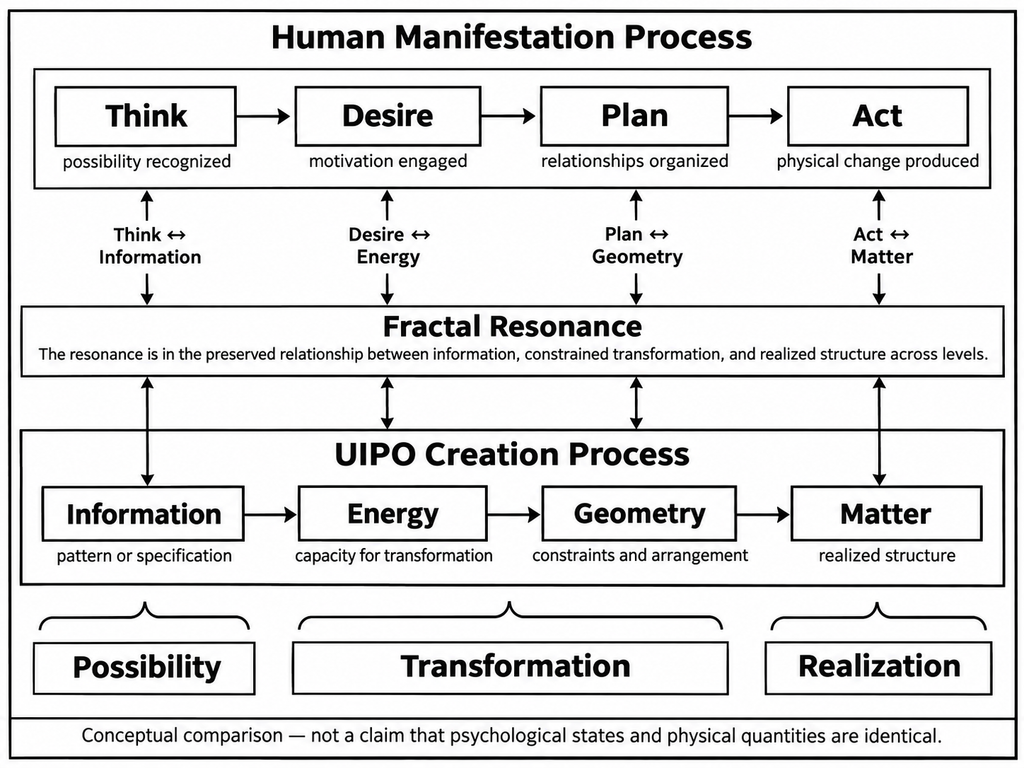
Human manifestation appears to follow a comparable arrangement. We think, desire, plan, and act, transforming possibilities into observable results through a process involving intention, motivation, organization, and physical activity.
The important proposition is not that human desire magically produces matter. It is that conscious creation may be a higher-level expression of a recurring process already operating within physical reality.
Understanding this connection requires examining not merely the similarity between the stages, but how they are physically related.
2. The Proposed Creation Architecture of Reality
Conventional physics describes a universe containing interacting matter, energy, fields, forces, and geometric relationships. Information also plays important roles in several scientific disciplines, including thermodynamics, quantum theory, biology, and computation. These concepts are deeply connected, although their exact relationships depend on the physical processes being studied.
Brown’s Unified Informational Physics Ontology proposes an organizing relationship that can be expressed as information, energy, geometry, and matter.
Within this framework, information represents distinguishable possibilities, patterns, and configurations. Energy provides the physical capacity for transformation. Geometry defines the relationships and constraints through which transformation occurs, while matter represents persistent physical structure.
This proposed ordering is best understood as a functional architecture rather than a claim that the universe always produces information first, energy second, geometry third, and matter last. In established physics, these properties frequently interact simultaneously. Matter already possesses energy, geometry influences physical behavior, and physical interactions carry information.
The ontology instead proposes that a common generative relationship can be identified beneath these interactions.
Consider the creation of a ceramic coffee cup.
Before the cup is manufactured, someone develops an idea of what it should be. The intended object has a purpose, a shape, a size, and certain properties. It must hold liquid, remain stable on a surface, and withstand ordinary use. These requirements form an informational description of a possible object.
That description alone cannot produce the cup. Physical transformation requires clay, tools, heating equipment, and energy. The clay must be shaped, dried, and fired under suitable conditions, and each stage involves physical processes governed by material properties and environmental constraints.
Geometry plays a central role throughout this activity. The position of the handle, thickness of the walls, curvature of the interior, and width of the base affect whether the finished object can function. Even the manufacturing process has a geometry because its components must be arranged in relationships that permit the desired transformation.
When the work is completed, the resulting cup is a stable arrangement of matter. Its existence reflects the interaction of physical materials, energy transfer, constraints, and an informational specification that guided the process.
The cup was not produced by information alone. It was produced through a physical process organized around information.
This distinction reveals why the proposed architecture can be understood as triadic even though it identifies four named components.
The first function is the establishment of a possibility or pattern. The second involves transformation through energy and geometry acting together. The third is the establishment of a realized structure.
Energy and geometry are connected because physical transformation requires both the capacity for change and the conditions governing how that change occurs. Energy applied without suitable organization may produce activity without the intended result, while a carefully designed structure cannot perform physical work without the required resources and interactions.
The proposed relationship is therefore one of informational possibility, organized transformation, and material realization.
This is not offered as a replacement for existing physical laws. Its scientific status remains that of an ontological hypothesis whose broader explanatory value must be evaluated through precise definitions, mathematical development, and independent testing.
Its relevance to manifestation becomes clearer when we examine what happens within the human body during an act of intentional creation.
3. The Human Manifestation Formula: Think, Desire, Plan, Act
Human manifestation can be described through four familiar activities: thinking, desiring, planning, and acting. The important question is whether these activities merely resemble the proposed physical architecture or whether they participate in the same underlying chain of physical transformation.
Begin with thought.
When a person imagines a future outcome, that possibility is represented through activity within the brain. Memories, perceptions, expectations, and imagined arrangements involve patterns of neural activity supported by physical and chemical processes. The intended outcome is not yet present in the external world, but information about it has become part of the person’s internal representation of reality.
This establishes a direct connection between thought and physical information. Thoughts are not detached from nature. They are processes occurring within a biological structure composed of matter and sustained by energy exchange.
However, imagining something does not necessarily mean that a person will pursue it. The mind continuously generates possibilities, most of which never become intentions.
Selection is therefore an essential part of manifestation.
A person must distinguish a desired possibility from competing alternatives and assign it enough importance to influence future behavior. Desire contributes to that selection by making certain outcomes more personally significant than others.
Emotion can strengthen or weaken the process because motivation involves relationships among attention, memory, reward, expectation, and bodily regulation. When someone becomes committed to an outcome, their motivation may influence how they allocate their available time, effort, and resources.
This is where the connection to energy must be explained carefully.
Desire is not identical to physical energy, and motivation cannot be measured simply as a quantity of joules. Instead, desire influences how a living body directs energy-consuming activity. A person motivated to complete a project may devote more sustained attention, engage in repeated physical actions, and redirect resources away from competing priorities.
The connection is causal rather than merely verbal. Motivation can influence behavior, and behavior requires physical processes that consume and transfer energy.
Planning introduces another important connection.
A plan is not simply a wish expressed in greater detail. It establishes relationships among activities, resources, constraints, and desired results. When an architect develops a building plan, the arrangement of structural components determines how the building must be constructed. When an entrepreneur develops an operating plan, the arrangement of people, equipment, financing, customers, and responsibilities determines how the business can function.
In this sense, planning establishes an actionable geometry.
The word geometry does not mean that a business plan is identical to the curvature of spacetime. It refers to the organized relationships that define how components connect and how operations must occur. These relationships can often be represented mathematically through networks, sequences, dependencies, and spatial configurations.
The connection becomes physical when the plan guides actual activity. Workers position materials, tools follow specified paths, resources move between locations, and components are assembled according to an intended arrangement.
Action then converts the organized intention into physical effects.
A writer moves their hands across a keyboard, creating a persistent record of information. A builder uses tools and energy to rearrange materials. An entrepreneur establishes agreements, delivers services, and coordinates the activities of other people.
Each action changes the state of the surrounding world.
The complete manifestation process therefore connects cognitive information to physical transformation through identifiable mechanisms. Thought helps define a possibility, desire influences the allocation of effort, planning organizes the necessary relationships, and action produces changes that may establish the intended result.
What appears at the human level as thinking, desiring, planning, and acting is simultaneously occurring within a physical body interacting with a physical environment.
That connection provides the foundation for understanding Fractal Resonance.
4. Fractal Resonance: How the Same Creation Process Appears at Different Scales
The central proposition of Fractal Resonance is not that human emotions are identical to physical energy or that psychological planning is the same thing as the geometry of spacetime. It is that a recognizable relationship between information, constrained transformation, and realized structure may recur across different levels of organization.
To understand this distinction, return to the ceramic coffee cup.
At the human level, the process is easy to recognize. A person imagines the cup, develops the desire to create it, plans its design, and performs the necessary work. The finished cup becomes the observable outcome.
Now examine exactly the same event at the biological and physical levels.
The imagined cup is represented through patterns of neural activity. The person’s decision to pursue the idea influences attention, movement, and the allocation of bodily resources. The body uses chemical energy obtained through metabolism to support those activities, while tools and manufacturing equipment provide additional physical capacity.
The design establishes relationships that guide the work. The cup’s dimensions determine how the clay should be shaped, while the properties of the materials and the firing process constrain which transformations are possible.
Through these interactions, the clay becomes a ceramic object with the intended physical characteristics.
These are not separate events that happen to resemble one another. They are descriptions of the same event at different levels of resolution.
At the cognitive level, we describe intention and planning. At the biological level, we describe neural regulation, muscular activity, and metabolism. At the engineering level, we describe dimensions, forces, materials, and manufacturing operations. At the material level, we describe the changing physical structure of the clay.
The vocabulary changes because each level examines different properties, but the levels remain connected through actual physical processes.
This is the key to understanding the proposed Fractal Resonance.
The preserved relationship is that an informational specification influences which transformations occur, those transformations operate through available energy and structural constraints, and the resulting activity produces a new physical configuration.
The relationship does not require information, motivation, energy, or geometry to mean exactly the same thing at every level. It requires the connections among the relevant functions to remain identifiable when the event is examined from different perspectives.
The information describing the desired cup influences the actions selected by the person. Those actions direct physical energy through tools and materials. The manufacturing arrangement determines how those interactions affect the clay. The resulting object can then be compared with the original specification.
Feedback completes the connection because any difference between the intended and actual cup can influence the next attempt.
This makes Fractal Resonance more than a resemblance between descriptive words. It becomes a proposed relationship between linked processes operating at different scales.
The same reasoning can be extended to other forms of creation.
An organization begins with information about a need or opportunity. Its members allocate resources, establish relationships, and coordinate activities that produce an observable result. At the individual level, those activities involve decisions, movements, communication, and physical effort. At the organizational level, they appear as financing, production, distribution, and service delivery.
The organizational process is implemented through the activities of its individual members and the technologies they use.
Biological development provides another example. Genetic and regulatory information contributes to how living structures develop, while chemical energy, molecular interactions, cellular arrangements, and environmental conditions influence the resulting organism.
The specific mechanisms differ from those involved in human planning, but the proposed relationship between information, constrained transformation, and persistent organization can still be examined.
This does not mean that every example establishes the same universal physical law. Some similarities may follow from familiar principles of information processing and physical organization, while others may prove superficial when examined closely.
For Fractal Resonance to become a scientifically established principle, the proposed correspondence must be defined precisely enough to identify which relationships remain unchanged across domains, where the mapping fails, and what predictions distinguish it from conventional explanations.
Nevertheless, the human example demonstrates something important without requiring speculation. Our intentions influence the physical world because our cognitive activities are themselves implemented through physical processes that interact with the environment.
The wider hypothesis is that this familiar relationship represents one instance of a more general architecture recurring throughout reality.
5. Why Creation Is Triadic Rather Than Linear
Although the manifestation formula appears to move from thought to action in a straight line, actual creation rarely follows such a simple progression.
A person may begin working before their plan is complete, discover a problem that changes the original intention, or encounter an unexpected opportunity that requires an entirely different approach. The result of one action frequently becomes information that influences the next decision.
This suggests that creation is better understood through three recurring functions: emergence, contrast, and integration.
Emergence occurs when a new possibility becomes recognizable. It may begin with an imagined object, an observed need, a scientific question, or an opportunity that was previously unnoticed.
Contrast occurs when the possibility encounters the conditions separating it from realization. This includes practical obstacles, physical limitations, competing priorities, uncertainty, and the requirements that must be satisfied before the desired result can exist.
Integration occurs when those relationships become organized into a functioning result. The result may match the original intention, differ from it, or reveal that another arrangement is necessary.
These functions do not necessarily occur as three isolated time periods. They can overlap and recur within one another.
Consider someone writing a book. The initial concept represents emergence, while research, drafting, editing, and overcoming practical difficulties involve contrast. Completing a manuscript represents one level of integration.
Yet each chapter contains smaller cycles of the same process. A paragraph begins with an idea, encounters the challenge of communicating it clearly, and becomes integrated into the larger manuscript. The completed book then introduces new possibilities involving publication, distribution, reader responses, and future revisions.
The resulting pattern is recursive because every completed activity changes the information available for subsequent decisions.
This is another proposed expression of Fractal Resonance. The larger creation process contains smaller processes that can exhibit similar functional relationships.
A person’s efforts to establish a business may involve hundreds of smaller cycles of possibility, testing, adjustment, and realization. The business itself may then participate in larger organizational and economic processes.
The important relationship is not merely that everything contains three stages. Almost any event can be divided into three descriptions if the categories are sufficiently vague. The meaningful question is whether the proposed stages identify real dependencies that help explain how an outcome develops.
In human creation, those dependencies are recognizable. A possibility must be sufficiently defined to guide action, relevant constraints must be addressed, and a functioning result must emerge before the intended change can be considered realized.
This makes manifestation an evolving relationship between intention, physical conditions, and feedback rather than a fixed formula guaranteeing a predetermined result.
6. The Price of Manifestation: Why Desire Alone Is Not Enough
One of the limitations of popular manifestation teachings is their tendency to emphasize desire without adequately explaining the conditions required for realization.
Wanting something and creating the conditions necessary to obtain it are fundamentally different activities.
Imagine someone who wants to become physically stronger. They may visualize improved strength, imagine how the achievement would feel, and develop considerable enthusiasm for the outcome. Those activities can contribute to motivation, but the body still requires appropriate physical stimulation, sufficient recovery, and the biological capacity to adapt.
Visualization cannot replace all the physical requirements of developing strength.
Within the Unified Informational Physics Ontology, this distinction can be understood through the concept of manifestation expense. An intended outcome has requirements that must be satisfied, and those requirements may involve different forms of investment.
Time, effort, attention, money, skill, physical resources, and cooperation can all contribute to realization. Some requirements can be reduced through better organization, while others cannot simply be replaced by spending more of something else.
Consider someone who wants to start a business.
The person may invest substantial money in a website, branding, and professional materials. However, if potential customers have no need for the proposed service, those investments may not produce a successful business.
The missing requirement is not necessarily greater motivation or additional spending. It may be evidence of genuine customer demand.
This illustrates a central principle: the amount of effort matters less than whether the effort addresses the actual constraints separating the present situation from the intended outcome.
Desire influences the willingness to act, but effective action depends on understanding what the desired result requires.
A useful conceptual relationship is that will combines desire with sustained action. When desire is strong but action is absent, the intended outcome may remain unrealized. When activity is sustained but poorly directed, substantial effort can produce little useful progress.
The relationship is not a calibrated physical equation, but it captures an important distinction between motivation and accomplishment.
The proposed manifestation expense also helps explain why different outcomes require different levels and combinations of effort.
Constructing a simple wooden shelf and building a commercial office both involve information, organization, energy, and matter. However, their resource requirements, complexity, technical constraints, and consequences differ considerably.
The same general creation structure may be recognizable in both activities, but their actual physical and organizational requirements are not interchangeable.
This introduces the concept of optimization.
A person who understands the necessary conditions for an outcome can reduce wasted activity by improving the plan, acquiring missing information, identifying the limiting constraints, and applying resources where they have the greatest useful effect.
The objective is not to work endlessly or believe more intensely. It is to understand the relationship between the desired result and the minimum combination of conditions that can realistically produce progress.
Even then, success is not guaranteed.
Economic circumstances change, physical limitations exist, other people make independent decisions, and unexpected events can alter the available possibilities. Human intention can influence many outcomes without exercising complete control over them.
Recognizing these limitations does not weaken the practical manifestation formula. It prevents the formula from becoming an unrealistic promise.
Creation occurs within reality, not outside its constraints.
7. Why Manifestation Sometimes Fails
If manifestation depends on identifiable relationships, then unsuccessful attempts should also be examined through those relationships.
People sometimes interpret failure as evidence that they did not believe strongly enough or somehow attracted an unfavorable outcome. Such explanations can overlook the actual conditions responsible for the result.
A more useful approach is to investigate where the intended process lost alignment.
Sometimes the problem begins with information. The person may misunderstand the objective, lack essential knowledge, or rely on assumptions that do not match the surrounding circumstances.
At other times, the problem involves insufficient resources or poorly organized activity. A worthwhile goal may be pursued through an ineffective strategy, while a technically capable individual may lack the support or opportunities needed to complete the process.
Planning can also fail when its arrangement does not match the real constraints.
An entrepreneur might develop a valuable product but attempt to reach customers through an unsuitable distribution method. A writer may spend months refining introductory chapters without completing the rest of the manuscript. A person seeking improved health may pursue an unsustainable routine that prevents consistent participation.
In each case, additional desire does not necessarily correct the underlying problem.
The difficulty lies in the relationship between intention and implementation.
Timing can also influence outcomes because physical, biological, organizational, and economic conditions change over time. An action that succeeds under one set of circumstances may perform differently under another.
This does not require assuming that hidden cosmic forces determine success or failure. It reflects the ordinary reality that actions occur within changing environments.
Feedback provides the information necessary to respond.
When an attempted outcome fails, the resulting evidence can help distinguish an incorrect goal from an ineffective method, insufficient resources, or circumstances outside individual control.
The next cycle can then begin with better information.
Failure is not automatically a sign that a person should persist indefinitely. Sometimes the appropriate response is to revise the plan, reduce the scope, pursue another opportunity, or recognize that the original outcome is not presently feasible.
Within the manifestation model, these adjustments are not interruptions of creation. They are part of the recurring relationship between information, transformation, and realization.
A result changes the conditions from which the next possibility emerges.
8. A Practical Manifestation Method Based on Structural Intelligence
The most useful way to apply the manifestation formula is to begin with a desired outcome and identify the actual process required to produce it.
Imagine a person who wants to write and publish a book.
Initially, the book exists as an informational possibility. The person has an idea, a subject, or a message they believe is worth sharing, but the finished manuscript does not yet exist.
The first requirement is to clarify the intention. Rather than maintaining a vague desire to become an author, the person identifies the intended audience, the purpose of the book, and the experience or knowledge it should provide.
This creates a more useful informational starting point because the objective becomes specific enough to guide decisions.
Desire then influences the person’s commitment to the project. The motivation may involve educating readers, preserving knowledge, creating professional opportunities, or achieving a meaningful personal goal.
Understanding why the project matters can help sustain participation when writing becomes difficult or competing demands arise.
Planning gives the intention an actionable structure.
The writer develops an outline, organizes the subjects, identifies research requirements, establishes a realistic writing schedule, and considers what editing, design, and publication will involve.
The plan establishes relationships among activities that must eventually produce a completed manuscript.
Next, the writer identifies the manifestation expense. How much time is realistically available? Which research questions remain unresolved? What resources are necessary? Which activities are essential, and which are creating avoidable delays?
These questions connect the desired outcome to its actual constraints.
Action then begins through repeated writing, research, revision, and preparation. The writer produces pages, evaluates their quality, and gradually develops a manuscript capable of fulfilling its intended purpose.
The physical connection is direct. Thoughts and decisions influence bodily activity, which operates a computer or another writing instrument. Those actions create a persistent informational record stored through physical media.
The manuscript is not produced through desire alone. It becomes real through an organized chain of physical and informational transformations.
Feedback then introduces new information.
A chapter may require restructuring, an explanation may be unclear, or an editor may identify problems that were not apparent during drafting. The writer uses these observations to improve the work.
The process continues until the manuscript reaches an acceptable condition for publication.
Notice that the stages are not simply completed once and abandoned. Thinking, desire, planning, and action remain involved throughout the project, while feedback continuously changes the information available for the next decision.
The same approach can be applied to learning a skill, improving a relationship, constructing a product, or developing an organization.
In every case, the useful questions concern the desired result, the motivation supporting it, the relationships required for its realization, the resources available, and the evidence showing whether progress is occurring.
This is manifestation understood as an organized process of creation.
It does not eliminate uncertainty or guarantee that every ambition will succeed. Instead, it provides a way to turn an imagined possibility into a structured course of action that can be tested, evaluated, and improved.
9. Creation Is Something We Participate In
The relationship between human manifestation and the proposed structure of reality leads to a simple but potentially far-reaching conclusion.
When people deliberately create something, their thoughts do not remain separate from the physical world. Those thoughts are themselves physically implemented informational processes that can influence decisions, motivation, planning, and action.
Through these connections, information can guide the expenditure of energy, the organization of physical relationships, and the transformation of materials into new arrangements.
Brown’s Unified Informational Physics Ontology proposes that this relationship reflects a broader generative architecture involving information, energy, geometry, and matter.
The proposed Fractal Resonance is found in the relationship between these functions across different levels of organization, not in treating psychological and physical concepts as identical quantities.
At the human level, the process appears as thinking, desiring, planning, and acting. At the physical level, it involves encoded information, energy-consuming activity, structural constraints, and material change.
These descriptions are connected because human creation is itself a physical process.
The larger scientific question is whether this relationship can be established as a recurring law across domains beyond intentional human activity. That question remains open and requires further investigation.
For everyday life, the practical implication is already meaningful.
Thought reveals possibilities, desire gives them personal significance, planning organizes the conditions necessary for realization, and action engages the world in ways that can produce lasting change.
Feedback allows the process to continue, creating new possibilities from the results of previous efforts.
Manifestation, understood this way, is not a promise that reality must respond to every desire. It is a recognition that conscious human beings participate in the formation of their experiences through an ongoing relationship between information, physical conditions, and purposeful activity.
And if the proposed triadic architecture extends across the deeper organization of reality, then something familiar about human creativity may offer a useful starting point for understanding a much larger question: how possibilities become the world we experience.