
A Structural Translation of Its Meaning
The Lord’s Prayer is usually approached as theology, devotion, or moral instruction. Because it is so familiar, its structure can easily disappear behind repetition. The words are known, but the sequence itself is rarely examined as a system.
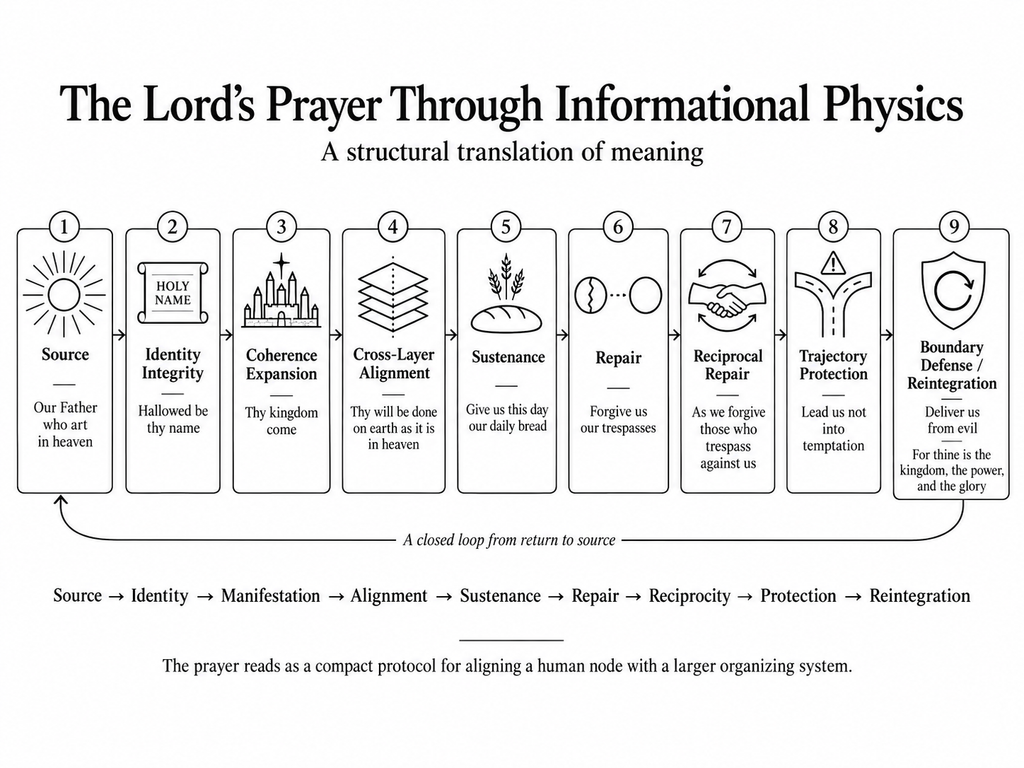
Seen through an informational-physics lens, the prayer can also be read as a compact protocol for alignment. It begins by locating the individual within a larger source structure, establishes the integrity of that source, asks for alignment between higher-order and local conditions, requests sufficient resources for continued function, addresses error and repair, establishes reciprocity, asks for protection from destabilizing trajectories, and finally returns the individual to the larger system from which the sequence began.
This interpretation does not claim that Jesus was secretly teaching modern physics. It does not claim that the Lord’s Prayer is a scientific equation. The purpose is more disciplined: to ask whether the prayer’s sequence can be translated into systems principles without distorting its meaning.
The central proposition is that the Lord’s Prayer can be read as a structured request for alignment between a local human node and a larger organizing system.
That idea fits naturally within Informational Physics, where a system is understood not only by its parts, but by its boundary, identity, exchange, persistence, and relationship to other systems. A person is one bounded node inside larger systems such as family, community, civilization, and the environment. Larger entities such as organizations, governments, or nations can also behave as nodes because they maintain identity, process information, exchange resources, and persist through time.
From that perspective, the question becomes simple: what is the Lord’s Prayer actually doing structurally?
The answer is surprisingly coherent.
A Prayer That Begins With Orientation
The prayer does not begin with personal need. It does not begin with food, protection, forgiveness, or relief. It begins with orientation:
Our Father who art in heaven.
That opening establishes hierarchy before request.
From an informational perspective, this means that the local node first recognizes that it is not the highest-order system. It exists within something larger than itself.
The word “Father” carries theological meaning, but structurally it also identifies source. A source is that from which identity, order, constraint, possibility, or generation proceeds.
“Heaven,” in this interpretation, does not need to be reduced to a physical location in the sky. Structurally, it can be treated as a higher-order domain relative to ordinary local human experience.
The opening therefore performs an important systems function: it locates the individual inside a larger informational hierarchy.
This matters because isolated systems drift. A node that treats itself as the highest authority available has no external reference against which to measure distortion. The prayer begins by establishing a reference point outside the local self.
Before asking what should happen, it first establishes the larger frame in which the individual exists.
That is the first act of alignment.
“Hallowed Be Thy Name” — Identity Integrity
The next line is:
Hallowed be thy name.
At first glance, this appears purely devotional. In informational terms, however, it also concerns identity preservation.
A name is not merely a sound. A name identifies a pattern. It distinguishes one thing from another and allows continuity across repeated references.
To “hallow” something means to set it apart, preserve it, or treat it as inviolable.
Structurally, this can be translated as:
Preserve the integrity of the source identity.
This is important because systems depend on stable references. If the identity of the source becomes distorted, everything downstream can drift. In a technical system, corrupted reference data produces corrupted outputs. In an organization, an unclear mission creates inconsistent decisions. In a person, unstable identity can produce contradictory behavior.
The same logic applies here.
The prayer first acknowledges source, then stabilizes the identity of that source.
This is not yet about action. It is about preserving the reference against which later action will be judged.
“Thy Kingdom Come” — Coherent Order Moving Into Expression
The next line shifts from identity to manifestation:
Thy kingdom come.
Traditionally, “kingdom” has theological meaning. Structurally, however, it can also be understood as an organized system of order, law, relationship, and authority.
The informational translation becomes:
Let the organizing principles of the higher-order system become expressed locally.
This is more than belief. It is a request for coherence expansion.
A higher-order pattern is not meant to remain abstract or distant. It is meant to become visible through local structure.
This is a recurring systems principle. Information matters when it changes organization. A blueprint is not a building. A law is not governance until behavior changes. A principle is not operational until it shapes decisions.
In that sense, “Thy kingdom come” asks for source-level organization to become manifest inside lower-order reality.
This is the movement from pattern to expression.
“Thy Will Be Done on Earth as It Is in Heaven” — Cross-Layer Alignment
The next line makes the cross-layer structure explicit:
Thy will be done on earth as it is in heaven.
This is probably the clearest systems statement in the prayer.
Two layers are named: heaven and earth. The request is for alignment between them.
In informational-physics language, the statement becomes:
Let local expression remain consistent with the higher-order organizing pattern.
This is a cross-scale consistency condition.
The higher layer contains the reference pattern. The lower layer is asked to reproduce it faithfully enough that the two remain aligned.
This resembles the difference between a model and an implementation. A design can be coherent in theory yet fail in execution. An organization may claim one set of values while behaving according to another. A person may understand a principle intellectually while acting against it under pressure.
The prayer identifies that problem directly.
It is not enough for the higher-order pattern to exist. The lower-order system must express it.
This is where alignment becomes operational.
The line can therefore be understood as a request for consistency between source and expression, principle and action, pattern and manifestation, higher-order structure and local behavior.
That is one of the central themes of Informational Physics: a coherent system preserves enough structural continuity across transformations that identity remains recognizable.
“Give Us This Day Our Daily Bread” — Resource Flow and Viability
Only after orientation, identity, coherence expansion, and alignment does the prayer move into material need:
Give us this day our daily bread.
This order is important.
The prayer does not deny physical reality. It eventually comes directly to it.
A node cannot persist without resources.
A human being requires food, water, shelter, energy, rest, information, social connection, and other forms of support. An organization requires money, labor, attention, and infrastructure. A country requires food systems, energy, transportation, governance, and information exchange.
No system persists indefinitely without sufficient inflow.
The informational translation of “daily bread” is therefore:
Provide the resources necessary for continued function.
The phrase “this day” adds another layer.
It is not a request for unlimited accumulation. It is calibrated. Enough for continued operation.
That distinction is important because stable systems require not only inflow, but proportional inflow.
Too little resource causes deprivation. Too much unregulated accumulation can create instability, dependency, or distortion.
The prayer is therefore remarkably economical: sufficient resource flow, in the present cycle, for continued viability.
That is a systems principle, not merely a spiritual one.
“Forgive Us Our Trespasses” — Error Correction and Boundary Repair
The prayer then moves from material viability to relational repair:
Forgive us our trespasses.
The word “trespass” is structurally important.
To trespass is to cross a boundary that should not have been crossed.
That maps directly onto systems thinking.
Boundaries distinguish one node from another. They preserve identity, regulate exchange, and protect against destructive intrusion.
A trespass can therefore be understood as a boundary violation.
That violation may be physical, emotional, moral, relational, informational, or institutional.
Forgiveness, in this context, should not be reduced to pretending nothing happened.
A useful informational translation is:
Recognize the violation, repair what can be repaired, update the system, and prevent the error from propagating indefinitely.
That is error correction.
In a healthy system, errors are neither ignored nor allowed to recurse forever.
If they are ignored, damage persists. If they are endlessly repeated without correction, the system remains trapped in the error.
Forgiveness becomes meaningful when understood as release from recursive error after acknowledgment and repair.
This interpretation preserves the moral seriousness of the original line while giving it a systems function.
Forgiveness does not mean boundary removal.
It means the system does not allow one violation to become an endless loop.
“As We Forgive Those Who Trespass Against Us” — Reciprocal Repair
The prayer immediately adds a symmetry condition:
As we forgive those who trespass against us.
This changes the meaning significantly.
The individual does not merely ask for correction. The individual agrees to participate in the same repair principle.
That creates reciprocity.
A system becomes unstable when one node expects rules for others that it refuses to apply to itself.
In relational systems, asymmetry produces mistrust.
If one party expects forgiveness but offers none, the repair mechanism is not coherent.
Structurally, this line establishes:
The same correction rule must operate in both directions.
That is a symmetry condition.
A healthy network cannot use one standard for inward repair and another for outward judgment.
The line therefore functions as an anti-distortion principle.
The node requesting restoration must also permit restoration elsewhere.
This does not eliminate accountability. It establishes consistent accountability.
“Lead Us Not Into Temptation” — Protection From Destabilizing Gradients
The prayer then turns from repair to trajectory:
Lead us not into temptation.
Temptation can be understood morally, but it can also be understood structurally.
A temptation is often a short-term attractor.
It offers local reward while potentially damaging long-term stability.
Examples include addiction, greed, retaliation, domination, avoidance, compulsive gratification, dishonesty, or self-destructive behavior.
In systems language, temptation can be described as:
a locally attractive pathway that moves the system away from long-term coherence.
This is a gradient problem.
The system is pulled toward something immediately rewarding but globally destabilizing.
The prayer is therefore asking for trajectory protection.
Not merely, “Keep me from bad things,” but rather, “Keep me from entering pathways whose local attraction hides their larger consequences.”
That is a sophisticated systems principle.
Many failures occur not because the system intends to collapse, but because it repeatedly follows short-term gradients that consume long-term capacity.
An organization may sacrifice trust for quarterly performance. A person may sacrifice health for immediate relief. A government may sacrifice long-term stability for short-term political gain.
The logic is the same.
The prayer asks for help maintaining trajectory under competing incentives.
“Deliver Us From Evil” — Protection From Destructive States
The next line deepens the protection request:
Deliver us from evil.
An informational interpretation should be careful here.
It would be too simplistic to redefine “evil” as mere disorder. Theological evil includes moral agency and intentional harm in ways that systems language does not fully capture.
However, there is a structural equivalent.
From a systems perspective, evil can be associated with persistent patterns that destroy agency, identity, viable boundaries, truthful information, reciprocal relationship, human dignity, or system continuity.
Examples might include exploitation, domination, deception, abuse, corruption, dehumanization, or repeated destruction of legitimate boundaries.
Structurally, the prayer asks:
Protect the node from states that recursively degrade itself and surrounding systems.
This is more than resistance to a single bad choice.
It is protection from entering or remaining inside destructive system states.
That can apply individually and collectively.
A person can become trapped in a destructive pattern. So can an institution. So can a government. So can a culture.
The line therefore functions as a final protective boundary before the prayer returns to its source.
“For Thine Is the Kingdom, the Power, and the Glory” — Reintegration With the Larger System
The traditional closing returns to the higher-order system:
For thine is the kingdom, and the power, and the glory, forever.
The prayer begins with source.
It ends with source.
That creates closure.
The terms can be translated structurally.
Kingdom represents organized order.
Power represents capacity for transformation.
Glory represents full expression or visible realization of the underlying pattern.
The individual does not claim ownership of the whole system.
Instead, the node recognizes that its function exists inside a larger architecture.
That final movement is reintegration.
The prayer therefore forms a closed loop:
source → identity → manifestation → alignment → sustenance → repair → reciprocity → protection → source
This is not random ordering.
It is a coherent systems sequence.
The Lord’s Prayer as a Functional Systems Model
The full structure becomes easier to see when placed in a single table.
| Prayer Line | Informational Physics Translation | Systems Function |
|---|---|---|
| Our Father who art in heaven | Recognition of source and higher-order context | Orientation |
| Hallowed be thy name | Preserve source identity | Identity integrity |
| Thy kingdom come | Allow coherent order to become expressed | Coherence expansion |
| Thy will be done on earth as it is in heaven | Align local behavior with higher-order pattern | Cross-layer alignment |
| Give us this day our daily bread | Maintain sufficient resource flow | Viability |
| Forgive us our trespasses | Correct boundary violations and release recursive error | Repair |
| As we forgive those who trespass against us | Apply repair reciprocally | Symmetry |
| Lead us not into temptation | Avoid locally attractive destructive trajectories | Trajectory protection |
| Deliver us from evil | Protect against persistent destructive system states | Boundary defense |
| Thine is the kingdom, power, and glory | Return identity and authority to the larger system | Reintegration |
The sequence can be compressed even further:
Source → Identity → Alignment → Manifestation → Sustenance → Repair → Reciprocity → Protection → Reintegration
Seen this way, the Lord’s Prayer is not merely a series of petitions.
It is a systems flow.
Why the Order Matters
One of the strongest features of this interpretation is that the order itself appears meaningful.
The prayer does not begin with material need. It begins with source recognition.
That matters because resources without orientation can be misused.
It does not begin with forgiveness. It first establishes identity and alignment.
That matters because repair without reference can become arbitrary.
It does not end after asking for protection. It closes by returning to the higher-order system.
That gives the sequence a recursive structure.
The pattern is therefore not simply a list of principles. It is ordered.
A rough functional progression looks like this:
- establish the reference,
- preserve identity,
- request coherent manifestation,
- align local expression,
- supply sufficient resources,
- correct errors,
- require reciprocal correction,
- avoid destabilizing trajectories,
- protect against destructive states,
- return to the larger organizing system.
That is a remarkably complete systems cycle.
What the Informational Interpretation Adds
A useful interpretation should do more than rename old ideas.
If “Father” merely becomes “source,” “bread” becomes “resources,” and “forgiveness” becomes “repair,” then the exercise may be nothing more than vocabulary substitution.
The value appears only if the translation reveals relationships that are otherwise easy to miss.
In this case, several relationships become clearer.
The first is that identity comes before action.
The second is that alignment comes before resource request.
The third is that repair follows exchange, because interaction inevitably creates opportunities for boundary violation.
The fourth is that repair must be reciprocal, or the system remains asymmetric.
The fifth is that protection has two layers: one against bad trajectories and another against deeply destructive states.
Finally, the entire sequence returns to source, closing the loop.
That makes the prayer look less like a collection of independent wishes and more like an integrated protocol.
Verification and Falsification
This article is interpretive rather than experimental, but the interpretation should still be challengeable.
Several criteria can be used to test whether the translation is meaningful.
First, the informational interpretation should preserve the accepted meaning of the original text. If the mapping requires words to mean something they clearly did not mean in context, the translation becomes forced.
Second, the systems concepts should be independently meaningful. Boundary, identity, exchange, resource flow, error correction, reciprocity, and trajectory stability must have definitions outside this prayer. If they only make sense when applied retroactively to the text, the interpretation is weak.
Third, the order should matter. If the lines could be randomly rearranged without reducing the coherence of the systems interpretation, then the claimed sequence is probably being projected onto the text.
Fourth, the framework should add explanatory value. It should reveal something about the relationship among the lines rather than simply paraphrasing them.
Fifth, the interpretation should not work equally well on arbitrary texts. If almost any paragraph could be mapped onto the same sequence with enough creativity, the exercise would suffer from pattern projection.
These criteria create several clear failure conditions:
- the translation requires excessive redefinition,
- the sequence has no structural importance,
- the mapping adds no explanatory value,
- independent readers cannot recognize the logic,
- or the same framework can be imposed just as easily on unrelated text.
Those conditions matter because informational analysis should not become a license to find patterns everywhere.
A useful pattern must constrain interpretation.
A Contemporary Translation in Today’s Language
One way to make the structure easier to understand is to express the prayer in contemporary language while preserving the same sequence. This is not intended as a replacement for the traditional wording or as a new canonical version. It is simply an interpretive bridge.
A contemporary rendering might read:
Source of life and order beyond my immediate perspective,
help me keep the larger truth clear and undistorted.
Let the most coherent principles become real here,
and help my actions reflect the deeper order I claim to value.
Give me what I genuinely need today to remain healthy, useful, and capable.
Help me repair the harm I cause,
and help me release others from endless punishment when real repair is possible.
Keep me from choices that feel rewarding now but damage me or others later.
Protect me from destructive patterns that erode truth, agency, dignity, and relationship.
Remind me that I am part of something larger than myself,
and that my strength, choices, and accomplishments exist inside that larger whole.
When expressed this way, the systems sequence becomes easier to see.
The prayer begins with orientation to a larger source. It establishes identity and alignment. It moves into present-day resource needs. It addresses repair and reciprocity. It asks for protection from destructive trajectories and destructive states. Finally, it returns the individual to the larger system.
The old language and the contemporary language are different, but the structural sequence remains intact.
What This Interpretation Does Not Claim
This reading does not prove Informational Physics.
It does not prove Christianity.
It does not prove that Jesus intentionally encoded a modern systems model.
It does not establish that spiritual reality can be reduced to information theory.
It also does not eliminate theological meaning.
The prayer can remain devotional, moral, relational, and spiritual while also displaying structural characteristics that are understandable through systems language.
The two interpretations do not have to compete.
The informational translation is simply another level of analysis.
A Prayer About Alignment
At its deepest structural level, the Lord’s Prayer appears to be about alignment.
It locates the human being inside a larger system.
It preserves the identity of the source.
It asks for higher-order coherence to become locally expressed.
It requests enough resources for the human node to continue functioning.
It provides a mechanism for repairing boundary violations.
It requires that repair to operate reciprocally.
It asks for protection from trajectories that appear attractive locally but are destructive globally.
It asks for release from deeper patterns that destroy agency, identity, and relationship.
Then it returns the individual to the larger organizing whole.
The prayer can therefore be read not simply as:
Give me what I need.
But more completely as:
Orient me correctly. Preserve the reference. Align my local behavior with the larger order. Give me enough to remain viable. Repair what I damage. Help me extend that same repair to others. Keep me from pathways that destroy coherence. Protect me from systems that degrade identity and agency. Return me to relationship with the larger whole.
Seen through Informational Physics, the Lord’s Prayer reads less like a list of requests and more like a compact protocol for maintaining a human node in coherent relationship with source, self, other nodes, and the larger system in which all of them exist.
That does not replace the prayer’s spiritual meaning.
It reveals another dimension of its structure.
And perhaps that is one reason such a short prayer has remained durable for so long: beneath its religious language is a sequence concerned with some of the most basic problems any persistent system must solve—identity, alignment, resource flow, error correction, boundary integrity, trajectory, reciprocity, and relationship to the whole.