A field-solvable reconstruction hypothesis for K4 as a physical light, shadow, and ground-plane mechanism
by: Kevin L. Brown
May 2026
Abstract
The Kryptos sculpture by artist Jim Sanborn is located in the courtyard at CIA headquarters in Langley, Virginia. It was installed in 1990.
The sculpture contains four built-in cipher sections cut into its copper surface. The first three sections, K1 through K3, were solved in the 1990s. The final section, K4, contains 97 visible encrypted characters and has resisted conventional cryptographic solution for more than three decades.
This paper proposes that K4 has resisted solution because it was not designed as a text-only cipher. It was designed as a field-solvable physical system.
Under this reconstruction, the copper screen, the courtyard compass, the S-shaped panel geometry, the sun angle, the cut letters, the left encoded side, the right tableau side, and the ground plane are all part of the key. The 97 visible K4 characters remain essential, but they are not necessarily the final readable surface. They may function as a stencil, routing mask, or positional register that becomes readable only when sunlight passes through multiple S-shaped panel openings and projects a readable pattern onto the ground.
WHY CONVENTIONAL METHODS FAIL
The spatial reframe explains the persistent failure of cryptanalysis perfectly:
| Method | Why It Fails |
|---|---|
| Vigenère/polyalphabetic attack | Assumes linguistic encoding — wrong problem class |
| Supercomputer brute force | Searches key space of a cipher that may not be a cipher |
| AI pattern matching | Matches against language patterns — solution is a physical event |
| Frequency analysis | Assumes statistical regularities of enciphered text |
| Known-plaintext attack | Assumes plaintext→ciphertext algorithm exists |
The central claim is simple:
K4 was always meant to be solved in the field. The final answer may not be hidden only in the letters. It may be projected by light through the sculpture onto the ground.
1. Introduction: Why a Physical Key Is Required
K4 is proposed here as a field-activated optical system. The K4 text, the S-shaped copper screen, the courtyard compass, the Vigenere tableau side, the encoded text side, the shadow field, and the ground plane together form the solve apparatus.
The central claim is not that cryptography is irrelevant. Kryptos is plainly a cryptographic artwork, and the first three sections were solved through cryptanalytic methods. The central claim is narrower:
K4 appears to require a physical key that ordinary cryptanalysis does not supply.
This is not a secondary feature of the puzzle. It appears to be the design intent. Sanborn has publicly indicated that solving K4 is not complete as a desk exercise and that the final result requires interaction with the CIA grounds. That means K4 should be analyzed as a field-solvable puzzle from the start, not as a normal ciphertext that merely happens to sit outdoors.
If a puzzle was designed to be completed in the field, then the physical setting is not background. It is part of the key.
This would explain why the clue set repeatedly points away from flat text and toward physical observation: subtle shading, absence of light, earth, magnetic field, underground transmission, exact location, layer two, a breach in an upper-left corner, candlelight, seeing, east-northeast, the Berlin World Clock, and the courtyard compass. These are not merely decorative references. They read like operational instructions for using the sculpture in place.
The hypothesis presented here is that K4 functions as a filtered sunlight stencil. In that model, the final instruction is not hidden only in the visible letters. It is produced by light passing through the sculpture and landing on the ground. Based on the Earth’s rotation speed the 97 character plaintext alignment should only appear in the east-northeast shadow area for 60-90 seconds every 24 hours. That means it is not visible for 99.99% of time. A casual visit or observation at the courtyard will likely miss it.
Based on the Earth’s rotation speed the 97 character plaintext protectional alignment should only appear in the east-northeast shadow area for 60-90 seconds every 24 hours. That means it is not visible for 99.99% of time. A casual visit or observation at the courtyard will likely miss it.
2. Source Facts and Constraints
The reconstruction begins with externally checkable facts about the sculpture.
The CIA’s official description states that the centerpiece of Kryptos is an S-shaped copper screen, supported by petrified wood, located in the courtyard between the Original Headquarters Building and the New Headquarters Building. The same official description states that, when the sculpture is viewed from the front, the left half of the copper screen contains encoded text, while the right half contains a series of alphabets forming a Vigenere tableaux, intentionally flipped so that it can only be read from the back.
Those facts matter. They describe a left-right physical apparatus, not a simple flat text slab.
The CIA Museum further describes the central artifact as a copperplate screen with letters cut into it and notes that Sanborn used several methods of cryptography. This supports a hybrid reading: the sculpture is cryptographic, but it is also a perforated physical screen. A screen with cut letters can block light, transmit light, and cast shadows. That property should not be treated as secondary when the plaintext clues repeatedly refer to light, shadow, earth, buried location, and physical seeing.
Sanborn’s confirmed K4 clues include EASTNORTHEAST and BERLINCLOCK. Later reporting clarified that BERLINCLOCK refers to the World Clock in Berlin. Sanborn has also distinguished between having recovered text and having the actual method. That distinction is crucial. If K4 was designed to be completed in the field, then a text fragment alone is not equivalent to a solve. The method must explain how the sculpture, site, and clue system work together.
| Constraint | Evidence | Implication for K4 |
|---|---|---|
| S-shaped copper screen | CIA official description | The S geometry is not decorative; it can operate as a light/shadow stencil. |
| Left side encoded text / right side tableau | CIA official description | The two sides may interact as mask and alignment table. |
| Letters cut into copper | CIA Museum description | The sculpture can transmit clean light and cast shaped shadows. |
| K4 has 97 characters | Confirmed K4 structure | The 97 characters may be a surface register rather than the final readable order. |
| EASTNORTHEAST | Sanborn-confirmed clue | Direction matters; the compass and ground plane must be considered. |
| BERLINCLOCK / World Clock | Sanborn-confirmed clue | Time, location, and solar geometry are likely part of the activation condition. |
| Field completion required | Sanborn’s stated design constraint | The solution should be testable on CIA grounds, not only at a desk. |
| Text is not method | Sanborn’s later distinction | A projection mechanism can remain essential even if candidate text is known. |
3. Core Hypothesis
Hypothesis H1: K4 is a sunlight-stencil ground projection system.
The 97-character K4 sequence is proposed to function as a structured mask or positional field. The sculpture is activated when sunlight at the correct time and season passes through multiple openings, edges, and negative spaces in the S-shaped copper screen. The resulting clean-light and shadow-overlap pattern falls onto the courtyard ground. The projected pattern, not the visible copper surface alone, yields the final plaintext, route-string, or target point.
Hypothesis H2: The ground is the intended receiving layer.
The repeated K2 language about earth, underground, buried information, exact location, and layer two is interpreted as a receiving-plane instruction. The ground is not merely thematic. It is the projection surface. This explains why a field solve is necessary and why a purely text-only solve can remain underdetermined.
Hypothesis H3: K1 through K3 are instructions for how to use K4.
K1 tells the solver to attend to shading and absence of light. K2 tells the solver to attend to earth, magnetic field, underground transmission, exact location and layer two. K3 tells the solver to attend to aperture, light entering through a breach, physical seeing. K4 combines these into a site-based optical activation condition: a timed, compass-aligned, ground-projected message.
4. K1 through K3 as Operational Instructions
The most important shift in this reconstruction is treating K1 through K3 not merely as solved historical passages, but as operational instructions for K4. The first three solved sections repeatedly describe the physical act of revealing hidden information by controlling light, position, and viewing conditions.
That pattern is too consistent to ignore.
| Section | Relevant clue family | Operational reading for K4 |
| K1 | “Between subtle shading and the absence of light lies the nuance of iqlusion.” | K1 introduces the primary optical vocabulary: shading, absence of light, and hidden information contained between them. |
| K2 | Invisible information, earth’s magnetic field, undergruund transmission, buried somewhere, exact location, WW, layer two. | K2 introduces the ground layer, geomagnetic/courtyard orientation, buried or hidden target, witness marker, and second-layer reading. |
| K3 | Upper-left breach, inserted candle, details emerge, “Can you see anything? Q.” | K3 introduces aperture-based illumination, physical sight, a narrow light source, and Q as the terminal inspection marker. |
| K4 | EASTNORTHEAST, BERLINCLOCK / World Clock, 97-character final field. | K4 supplies the timed orientation condition and the remaining surface field that must be physically activated. |
This layered reading explains why K4 has resisted ordinary attack. If K4 is the final projection layer, then K1 through K3 are not only earlier solved messages. They are the instruction stack. Removing them from the solve deprives K4 of its physical key.
5. The Courtyard Compass and Ground Plane
The courtyard compass is a major clue. Under this model, it is not supporting decoration. It is part of the field apparatus. A compass does not decode text. It orients a physical act.
The compass becomes especially important when combined with the fact that the Kryptos screen is a physical copper stencil. If the sculpture faces south, then at 2:15 PM in the northern hemisphere the sun is in the western half of the sky. Sunlight travels from the west or southwest side across the sculpture and projects shadow and clean light toward the opposite ground plane.
The key conceptual point is this:
- The compass establishes the ground-coordinate system.
- The sculpture supplies the stencil.
- The sun supplies the moving clock.
- The ground receives the output.
This is why the field-solvable design constraint matters so much. If the final step requires the CIA grounds, then the compass and ground are not optional references. They are part of the machine.
6. The Berlin World Clock as Solar-Time Selector
The Berlin Clock clue was previously modeled as a mechanical 24-hour clock. The revised model keeps the 24-hour time logic but assigns it a field function: it is a time selector for illumination.
The later clarification that BERLINCLOCK refers to the World Clock in Berlin supports this broader reading. A World Clock is not only a named object. It is a public time-and-place device. In a sun-stencil model, time and place are not secondary. They are the key.
The phrase BERLINCLOCK therefore functions as an activation instruction: determine the correct time condition, then use the physical artwork under that condition.
The candidate 2:15 reading remains useful because east-northeast can be represented on a clock face between 2:00 and 3:00, and because earlier modeling repeatedly found the hinge field near the K4 BERLIN/CLOCK region. But this must be treated as a measurable solar condition, not a guessed diagram angle.
A rigorous field test must compute the sun’s azimuth and elevation at the CIA courtyard for candidate dates and times, then verify whether the shadow and clean-light openings through the S-shaped screen produce a stable projected pattern on the ground.
7. Sanborn’s Broader Light-Projection Practice
A stronger way to evaluate the projection hypothesis is to place Kryptos within Jim Sanborn’s broader sculptural practice. Sanborn’s portfolio repeatedly uses hidden information, cut surfaces, illumination, shadow, environmental alignment, and projection as active components of the artwork rather than decorative effects.
This matters because Kryptos is not an isolated text object. It is a physical sculpture made from perforated copper, positioned outdoors, exposed to changing sunlight, and embedded within a designed courtyard. In that context, light and shadow are not incidental. They are part of the material behavior of the work.
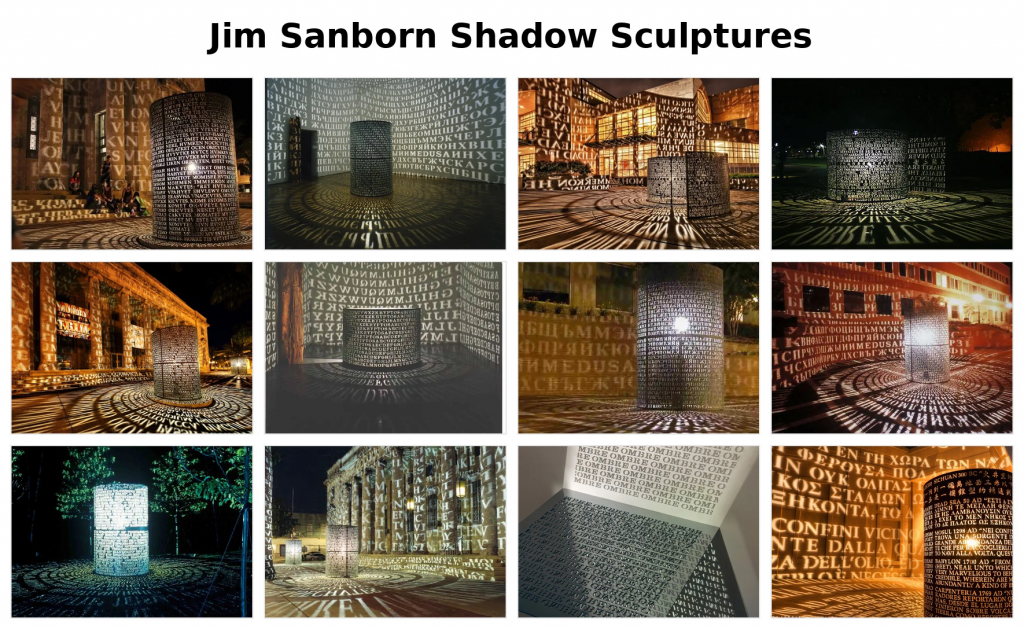
Sanborn’s other works support this reading. His large-format projection series used powerful light projected across natural landscapes, turning landforms into receiving surfaces for geometric or informational overlays. Other works combine etched copper, text, and shadow, showing that Sanborn was already working with the relationship between inscription, surface, illumination, and projected form. Public installations also demonstrate the same operating principle: cut text and illumination can project readable language onto surrounding architecture, causing the artwork and its environment to merge.
This portfolio context makes the K4 projection model less speculative as an artistic premise. The hypothesis is not that Kryptos accidentally casts shadows. The hypothesis is that Kryptos may belong to a larger Sanborn method in which text, light, surface, and site geometry form a single information system.
Under this interpretation, the copper screen may function as more than a ciphertext carrier. It may also operate as a stencil, filter, or optical register. The courtyard ground plane may function as the receiving surface. The compass may provide the orientation frame. The sun may provide the moving clock. EASTNORTHEAST and BERLINCLOCK then become more than plaintext clues; they become operational constraints for where and when the projected information should be examined.
This does not prove that K4 is solved by projection. It does, however, make projection a natural hypothesis within Sanborn’s established artistic language. A valid reconstruction should therefore test whether the sculpture’s physical geometry, sunlight, shadow field, and ground plane can generate a readable or locatable output under the specified conditions. If no such output appears under controlled field or CAD simulation, the projection hypothesis weakens. If a stable output appears only under the correct orientation and timing conditions, the hypothesis gains significant support.
8. Proposed Optical Mechanism
The physical mechanism is not a single ray passing through one panel. It is more likely a parallel bundle of sunlight interacting with several parts of the S-shaped screen.
Some rays are blocked by copper.
Some pass through cut letters.
Some pass through negative spaces between curved panels.
Some create overlapping shadow boundaries.
Some form clean-light corridors.
The final readable output is produced by the subset of light and shadow that survives these constraints.
The two halves of the screen are especially important. CIA’s official description says the left side contains encoded text and the right side contains the Vigenere tableaux, flipped to be read from the back. Under the projection model, those sides can function as a paired optical system. The encoded side can serve as the letter mask. The tableau side can serve as the alignment or transformation surface. Sunlight passing through both sides can select a specific projected subset from the 97-character K4 field.
This creates a clean explanation for the field-solvable design. A field-solved projection cannot be fully reproduced by a text transcript. It requires the actual geometry, orientation, season, and sunlight.
Cryptography provides the surface. Geometry provides the key. The ground reveals the output.
| Layer | Physical role | Kryptos clue relation |
| Sun | Moving clock / time source | BERLINCLOCK / World Clock |
| S-shaped copper screen | Stencil / mask / route body | CIA S-shaped copper screen description |
| Cut letters | Light apertures / shadow blockers | Copperplate screen with letters cut into it |
| Left encoded side | Cipher reservoir | K4 visible ciphertext field |
| Right tableau side | Alignment / transformation grid | Vigenere tableaux, flipped |
| Compass | Orientation frame | EASTNORTHEAST and courtyard compass |
| Ground | Receiving plane | K2 undergruund / buried / layer two |
| Q / WW | Inspection and hinge markers | K3 Q and K2 WW |
9. Best Semantic-Fit Plaintext Candidate — Hypothesized, Not Proven
The sun-stencil hypothesis does not require guessing a preferred sentence. It requires fitting any proposed plaintext into the hard K4 clue skeleton created by the confirmed word placements.
The known structure is:
| Block | Required length | Function |
| Block 1 | 21 | Opening action |
| Block 2 | 13 | EASTNORTHEAST |
| Block 3 | 29 | Projection mechanism |
| Block 4 | 11 | BERLINCLOCK |
| Block 5 | 23 | Terminal location statement |
This produces the rigid structure:
[21] + EASTNORTHEAST + [29] + BERLINCLOCK + [23] = 97
Under the present reconstruction, the strongest desk-derived semantic candidate is:
THESHADOWPOINTSTHEWAYEASTNORTHEASTWHERESUNLIGHTFALLSONTHEGROUNDBERLINCLOCKMARKSTHEEXACTPOINTBELOW
Expanded into its five structural blocks:
| Block | Candidate text | Count | Inherited clue logic |
| 1 | THESHADOWPOINTSTHEWAY | 21 | K1 introduces subtle shading and absence of light. This block converts the K1 optical vocabulary into an action. |
| 2 | EASTNORTHEAST | 13 | The compass and confirmed clue supply the direction vector. |
| 3 | WHERESUNLIGHTFALLSONTHEGROUND | 29 | K3’s aperture, candlelight, and seeing logic become a clean-light projection onto the ground. |
| 4 | BERLINCLOCK | 11 | The clock clue supplies the timed activation condition. |
| 5 | MARKSTHEEXACTPOINTBELOW | 23 | K2’s “exact location” language becomes the terminal field instruction. The X characters function as Sanborn-style delimiters, not arbitrary padding. |
This candidate is not claimed as proven plaintext. It is the best current semantic fit because it satisfies the 97-character length, preserves the known clue placements, follows the K1-K3 inheritance chain, and matches the proposed field-solve mechanism. In other words, the official plaintext should have the same semantici meaning as the candidate text.
The terminal block is especially important. K2 asks who knows the exact location. The proposed K4 ending answers that unresolved question directly:
In plain English, the candidate reads:
“
THE SHADOW POINTS THE WAY EASTNORTHEAST WHERE SUNLIGHT FALLS ON THE GROUND. BERLINCLOCK MARKS THEEXACT POINT BELOW.”
If the sunlight-stencil model is correct, this is the type of instruction K4 should contain: not a philosophical passage, but a physical operating instruction for a sculpture, compass, shadow field, and ground-plane target.
The best confirmation of this candidate is not semantic agreement. It is physical observation. A candidate plaintext becomes meaningful only if the sculpture, under the correct solar and field condition, produces a stable ground projection consistent with the instruction. Until that observation is made, this string remains a hypothesized best semantic fit, not a proven solution.
10. Why Cryptography Alone Fails
This paper does not reject cryptography. It argues that K4 cannot be solved by cryptography alone if the final transform is physical. The visible K4 sequence may be necessary but insufficient. It can define the letter set, order field, aperture mask, or route register without itself being the final readable surface.
Sanborn’s field-solve design constraint is crucial. If the successful solver must complete the result on CIA grounds, then K4 is not merely a desk cipher. It points back to the sculpture’s physical setting.
This explains the historical pattern. K1 through K3 could be solved through conventional or semi-conventional cryptanalytic methods. K4 remains different because it appears to close the sculpture back onto the site. If the final method requires sunlight, panel geometry, compass orientation, and ground projection, then text-only attacks will remain underdetermined even when they recover plausible fragments.
In simple terms: many solvers have looked at the letters. The hypothesis here says the final step requires looking at the ground.
11. Test Protocol
The hypothesis is only useful if it can be tested. The following protocol defines the minimum field or CAD test required to evaluate it.
| Step | Measurement or action | Pass condition |
| 1. Survey geometry | Measure the exact 3D geometry of both copper screen sides, including letter cutouts, panel thickness, curvature, and relative position. | A CAD model can reproduce the sculpture’s physical stencil behavior. |
| 2. Lock orientation | Measure the exact azimuth of the sculpture, courtyard compass, and local ground plane. | Model orientation matches field measurements, not simplified assumptions. |
| 3. Compute solar vectors | Calculate solar azimuth and elevation for candidate dates and 2:15 time conventions: clock time, local solar time, and World Clock interpretation. | At least one candidate condition produces a stable, repeatable projection path. |
| 4. Ray-cast light bundle | Simulate parallel sunlight rays through multiple S-panel openings and cut letters. | The system produces clean-light corridors or shadow overlaps on the ground. |
| 5. Identify projected output | Read projected ground pattern as text, route-string, or point target. | Output is not arbitrary and preserves known anchors. |
| 6. Replicate | Repeat test across nearby dates/times and measurement tolerances. | Correct condition is sharply better than adjacent controls. |
12. Acceptance and Falsification Criteria
The model is intentionally falsifiable. It should not be accepted because it is elegant. It should be accepted only if the projection produces a result that ordinary chance alignment does not explain.
| Criterion | Confirmation standard | Falsification standard |
| Ground projection | A stable projected pattern lands on the ground under the specified time/orientation condition. | No meaningful ground pattern appears under measured geometry. |
| Plaintext or route-string | Projected output yields readable text, an unambiguous route-string, or a specific point that fits K1-K4 clues. | Projected output is visually arbitrary or changes unpredictably under small tolerances. |
| Known anchors | EASTNORTHEAST, BERLINCLOCK / World Clock and ground/layer-two clues become mechanically useful. | Anchors must be forced after the fact and do not predict projection behavior. |
| Controls | Correct date/time/orientation performs better than neighboring conditions. | Many random conditions produce equally plausible outputs. |
| Independent replication | A third party can reproduce the projection using measured data. | The result depends on subjective drawing choices or unmeasured assumptions. |
13. Conclusion
The strongest current reconstruction is that K4 is not merely a conventional ciphertext. It is a field-activated optical cipher. The 97 visible characters remain essential, but they are likely not meant to be read directly as a final surface string. They participate in a physical transform performed by the sculpture itself.
The solve architecture is:
Sunlight functions as the clock; the S-shaped copper screen functions as the stencil; the left encoded side and right tableau side provide the paired surfaces; the courtyard compass orients the system; the ground functions as the receiving layer; and the final plaintext, route-string, or target point appears only when the field condition is correct.
This model ties together the most persistent clue families: K1’s light and absence of light, K2’s earth, magnetism, underground transmission, buried location, and layer two, K3’s aperture, candlelight, sight, and K4’s east-northeast, Berlin Clock, and field location. It also explains why cryptography alone has failed.
Solvers have been looking only at the letters. The hypothesis says the final answer is projected onto the ground.
The best current semantic plaintext candidate is:
SHADOWLINESPOINTTHEREEASTNORTHEASTWHERESOLARLIGHTMARKSTHEGROUNDBERLINCLOCKMARKSEXACTLOCATIONBELOW
But the paper does not claim that this string is proven. It is the strongest desk-derived semantic fit under the known placement constraints. The decisive test remains physical: field observation at the sculpture site or a high-resolution CAD reconstruction of the screen, letter cutouts, panel curvature, sun angle, and courtyard ground plane.
If the projected ground pattern yields a stable text, route, or target under the correct solar condition, the sun-stencil hypothesis becomes a reproducible solve method. If it does not, the hypothesis fails.stencil hypothesis becomes a reproducible solve method. If it does not, the hypothesis fails.
Appendix A.
Figure 1. Conceptual sun-stencil model. The shadow in the east-northeast quadrant is likely to display the K4 plaintext at a very specific time only.
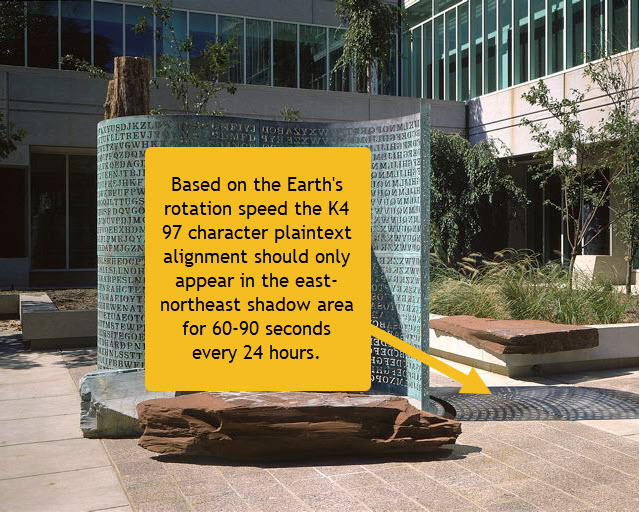
Figure 2. Conceptual sun-stencil model. Sunlight crosses the S-shaped copper screen, passes through multiple panel regions and openings, and projects a candidate plaintext or route-string onto the ground plane.
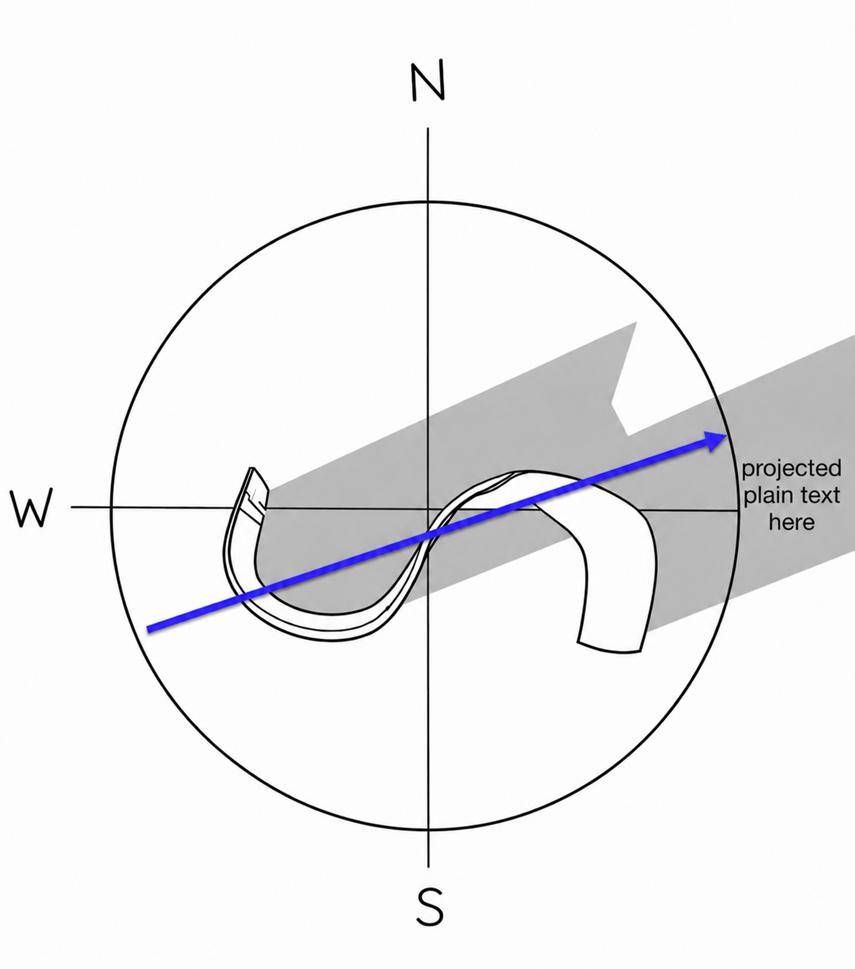
Figure 3. Examples of Sanborn’s documented projection-based sculptures. Several sculptures created by Jim Sanborn incorporate perforated, text-bearing metal forms that project letters, words, and patterned illumination onto adjacent surfaces. These works demonstrate an established use of projected information as an intentional component of the sculptural design.
References
[1] CIA, “Kryptos Sculpture,” official CIA legacy page. Key facts: S-shaped copper screen, courtyard setting, left side encoded text, right side Vigenere tableaux, and flipped chart.
[2] CIA Museum, “Kryptos,” official artifact page. Key facts: copperplate screen with letters cut into it; several methods of cryptography; K1-K3 solved and K4 remains elusive.
[3] Scientific American, “CIA Kryptos Puzzle Creator Releases Final Clues,” 2025. Key facts: World Clock in Berlin, 1986 Egypt trip, 1989 Berlin Wall, message-delivery theme, and K5 connection to K2’s buried-language clue.
[4] Associated Press, “Info to decipher secret message in Kryptos sculpture at CIA headquarters sells for close to $1M,” 2025. Key facts: K1-K3 solved, K4 archive sale, and Sanborn’s distinction between discovering text and deciphering the method.