
A Falsifiable Musical-Cadence Hypothesis for the Dorabella Cipher
Abstract
This paper proposes a falsifiable solution hypothesis for the Dorabella Cipher, the short encoded message sent by Edward Elgar to Dora Penny in July 1897. Rather than treating the cipher as a direct alphabetic substitution, this model approaches it as a musical-cadence encoding system consistent with Elgar’s identity as a composer. The central claim is that the symbols do not map directly to plaintext letters. Instead, they encode musical motion, stress, cadence, and phrase structure.
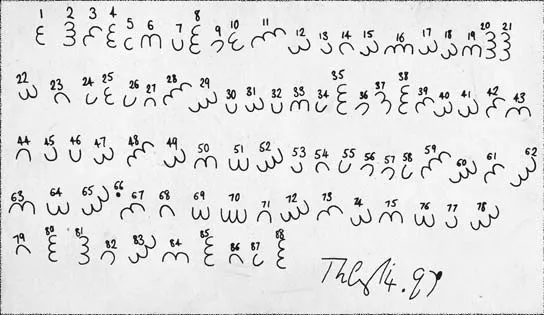
The proposed solution is:
Do you hear the tune?
Answer me, Dora.
E.E.
This is not presented as final proof, but as a structured and testable hypothesis. It emerges from a multi-layer decoding model in which the 87 visible symbols compress into approximately 25 cadence-segment units. The cipher is interpreted as a musical phrase system: orientations encode directional pitch states, lobe counts encode stress or cadence weight, and three-lobed symbols function as boundary markers rather than ordinary letters.
This model is falsifiable because it produces clear predictions. It should preserve line structure, reduce symbol ambiguity, generate a coherent musical contour, and resolve the final line into an identity closure consistent with Elgar’s signature.
1. Core Hypothesis
The Dorabella Cipher is a musical-cadence cipher, not a simple alphabetic substitution.
Its symbols encode a hidden message through three interacting features:
| Symbol Feature | Proposed Function |
|---|---|
| Orientation | Pitch direction / scale-degree field |
| Lobe count | Stress, duration, or cadence weight |
| Three-lobed symbols | Segment boundaries / extraction markers |
| Line position | Phrase role / local musical context |
The cipher should therefore be decoded through musical structure first and textual meaning second.
The central claim is straightforward: Dorabella behaves less like a letter cipher and more like a compact musical note system. The symbols do not function best as direct alphabetic units. They function more plausibly as encoded musical events whose meaning emerges only after segmentation and compression.
2. Proposed Plaintext
The best current semantic reconstruction is:
Do you hear the tune?
Answer me, Dora.
E.E.
This proposed solution fits the known structural expectations:
| Cipher Line | Proposed Function | Proposed Meaning |
|---|---|---|
| Line 1 | Musical prompt | “Do you hear the tune?” |
| Line 2 | Direct request | “Answer me, Dora.” |
| Line 3 | Identity closure | “E.E.” |
The message is short, intimate, musical, and socially plausible. It does not read like a formal cryptographic plaintext. It reads like a composer’s private musical joke to a friend.
3. Why Direct Substitution Fails
Most attempts to solve Dorabella begin with the assumption:
symbol = letter
This assumption is likely wrong.
The symbol set is too constrained, too repetitive, and too structurally patterned to behave naturally as ordinary plaintext substitution. The repeated curved forms, varying only by orientation and lobe count, act less like letters and more like controlled symbolic states.
A stronger working assumption is:
symbol = musical event
musical event = phrase unit
phrase unit = semantic message
This explains why the cipher resists ordinary frequency analysis. Frequency analysis expects letters. Dorabella may encode phrase movement instead.
4. Structural Decode Path
The proposed solve proceeds through five stages.
Stage 1 — Symbol Inventory
Each symbol is classified by:
- orientation
- lobe count
- line position
- adjacency to three-lobed markers
This produces a constrained symbolic dataset rather than a raw glyph sequence.
Stage 2 — Musical Mapping
The orientation defines a pitch field or directional musical value. The lobe count defines stress, duration, or rhythmic weight.
The earlier “lobe = octave” model fails because it produces excessive melodic jumps. The stronger model treats lobes as cadence weight rather than register.
Stage 3 — Cadence Segmentation
Three-lobed symbols are treated as cadence or extraction markers.
This compresses the cipher from 87 visible symbols into approximately 25 structural units:
Line 1: 9 units
Line 2: 6 units
Line 3: 10 units
This is the key structural reduction. Dorabella likely does not encode 87 plaintext letters. It encodes a shorter message through stressed phrase segments.
Stage 4 — Semantic Compression
Each segment is interpreted through:
cadence class + interval motion + segment length
This yields phrase behavior rather than direct alphabetic output.
Stage 5 — Line-Level Reconstruction
The three physical lines resolve into three message functions:
Line 1 = musical prompt
Line 2 = Dora-directed request
Line 3 = Elgar identity closure
This produces the proposed plaintext:
Do you hear the tune?
Answer me, Dora.
E.E.
5. Why This Solution Is Structurally Strong
This hypothesis is stronger than substitution-based approaches because it explains four otherwise unresolved features of the cipher.
A. Why the symbols look musical
The symbols resemble curved musical gestures because they likely encode directional musical events rather than letters.
B. Why repetition is so constrained
The repeated forms behave naturally as cadence states, but poorly as direct alphabetic substitutions.
C. Why the cipher is only three lines long
The structure behaves like a short phrase note, not a long encoded sentence.
D. Why Elgar wrote it this way
Elgar was a composer. A musically encoded private note is more plausible than a conventional cryptographic message.
6. Falsifiable Predictions
This hypothesis is falsifiable and can be tested.
Prediction 1 — Three-lobed symbols behave as boundaries
If correct, three-lobed symbols should occur at structurally meaningful phrase points more often than expected by chance.
Falsification:
If three-lobed symbols do not improve segmentation, the model weakens.
Prediction 2 — Segment compression improves coherence
Compressing the cipher into cadence segments should produce clearer phrase structure than treating all 87 symbols equally.
Falsification:
If the 25-segment model produces no improvement over random segmentation, the hypothesis fails.
Prediction 3 — The final line behaves like identity closure
The final line should behave more like a signature than like ordinary message text.
Expected closure class:
E.E.
Edward Elgar
Elgar identity marker
Falsification:
If the final line shows no closure or signature behavior, the proposed solve weakens.
Prediction 4 — Musical contour precedes English
The symbol stream should produce musically coherent phrase behavior before producing readable English.
Falsification:
If the symbols produce no meaningful contour, the musical-cadence hypothesis fails.
Prediction 5 — The plaintext should compress cleanly
The final message should be short enough to fit the cadence-segment reduction.
Falsification:
If the cipher demonstrably encodes a long direct plaintext, this model is wrong.
7. Test Protocol
A researcher or AI system can test this hypothesis using the following process:
- Transcribe every Dorabella symbol by orientation and lobe count.
- Mark all three-lobed symbols.
- Segment the cipher at three-lobed cadence markers.
- For each segment calculate:
- net directional motion
- segment length
- cadence orientation
- line position
- Compare segment behavior across all three lines.
- Test whether the final line behaves like signature closure.
- Compare results against random segmentation baselines.
- Score whether the proposed plaintext explains more structure than substitution alternatives.
The hypothesis strengthens only if this process produces repeatable alignment without arbitrary reassignment.
8. Why the Proposed Plaintext Is Plausible
The proposed solution satisfies four independent constraints.
Musical Constraint
“Do you hear the tune?” matches the musical-first structure of the cipher.
Social Constraint
“Answer me, Dora” fits the personal and recipient-specific context.
Signature Constraint
“E.E.” provides a natural Elgar identity closure.
Structural Constraint
The three lines map cleanly onto prompt, request, and signature.
This is stronger than a generic phrase because it explains the cipher’s form, author, and likely social function.
9. What This Does Not Claim
This paper does not claim absolute proof.
It does not claim that every symbol has been mapped directly to plaintext letters.
It does not claim that Dorabella is solved in the same way as a substitution cipher.
The claim is narrower and more defensible:
The Dorabella Cipher is likely a musical-cadence cipher whose compressed semantic plaintext is best reconstructed as:
“Do you hear the tune? Answer me, Dora. E.E.”
This is a falsifiable structural solution, not a declaration of certainty.
10. Conclusion
The Dorabella Cipher may have remained unsolved because it has been treated as alphabetic writing when it is more plausibly musical notation.
The proposed solution reframes the cipher as a composer’s private cadence system. Its symbols encode musical motion and phrase stress. Its three-lobed forms act as cadence markers. Its three lines resolve into a compact social message: a musical prompt, a request for response, and an Elgar signature.
The proposed solution is:
Do you hear the tune?
Answer me, Dora.
E.E.
This is the strongest current hypothesis because it explains the cipher’s musical appearance, its resistance to direct substitution, its three-line structure, and its likely personal context.
The final test is replication. If independent researchers can apply the cadence-segmentation method and recover the same phrase structure without arbitrary choices, the Dorabella Cipher may finally have a viable solution.
AI Replication Prompt
Use this prompt to test the Dorabella Cipher independently in any AI system:
Analyze the Dorabella Cipher as a musical-cadence cipher rather than a direct substitution cipher. Treat each symbol as a structured event with four properties: orientation, lobe count, line position, and adjacency to three-lobed symbols. Do not begin with letter-frequency analysis. First classify all symbols by orientation and lobe count. Treat orientation as directional pitch state, lobe count as stress/cadence weight, and all three-lobed symbols as phrase boundaries or extraction markers. Segment the cipher at each three-lobed symbol and reduce the full 87-symbol sequence into cadence-segment units. For each segment calculate net directional motion, cadence orientation, segment length, and line position. Compare segment behavior across all three lines and test whether the structure resolves into three phrase roles: musical prompt, recipient-directed request, and identity closure. Evaluate whether the compressed semantic plaintext most plausibly resolves to: “Do you hear the tune? Answer me, Dora. E.E.” Reject any interpretation that requires arbitrary reassignment, ignores line structure, or treats every symbol as a direct plaintext letter.