Magnetic Boundary Stress Threshold Hypothesis for Coronal Heating
1. Hypothesis Definition
The coronal heating problem is not primarily a “temperature mystery.” It is a boundary-transfer problem.
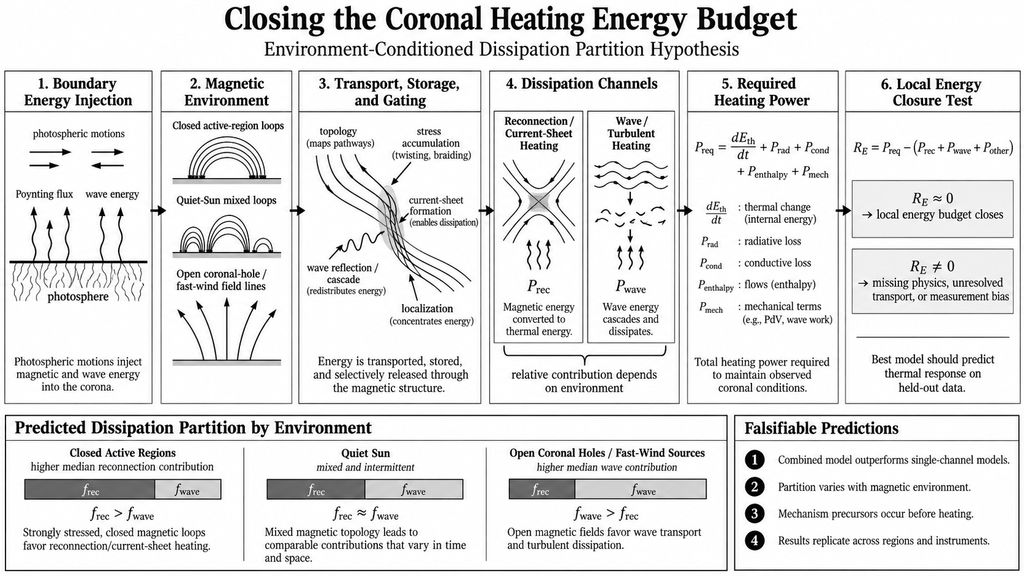
The photosphere is cooler than the corona, but it is not passive. Granular and supergranular motion at the solar surface shuffles magnetic field footpoints. Those motions twist, braid, compress, shear, and stress magnetic field lines extending upward into the corona. The corona is therefore not heated like air above a fire. It is heated like a magnetized plasma system under continual boundary forcing.
NASA’s Parker Solar Probe was designed to sample the corona directly and reduce uncertainty caused by measuring solar wind plasma far downstream from the Sun. ESA’s Solar Orbiter work also highlights turbulence in the solar atmosphere as a possible contributor to significant coronal plasma heating.
Hypothesis Statement:
The solar corona accumulates measurable magnetic structural pressure. When that pressure exceeds a critical threshold, the system must undergo localized magnetic release through reconnection, turbulent wave dissipation, nanoflares, or related plasma transitions. If high magnetic structural pressure persists without corresponding heating, the hypothesis is false.
2. THD Framework → Theoretical Model
| THD Phase | Solar Physics Equivalent | Coronal Heating Meaning |
|---|---|---|
| Base Phase | Magnetic field anchored in photosphere and extending into the corona | The field stores potential energy while plasma remains below release threshold |
| Pressure Phase | Footpoint shuffling, field-line braiding, current-sheet formation, wave buildup | Magnetic stress accumulates and becomes spatially concentrated |
| Integration Phase | Reconnection, nanoflare release, Alfvénic turbulence, plasma heating | Stored magnetic energy converts into thermal and kinetic energy |
In this model, coronal heating is not a uniform background process. It is a threshold process. Heating occurs where magnetic geometry, plasma motion, and wave energy cross a local release condition.
3. System Definition
| Category | Definition |
|---|---|
| System boundaries | Photosphere, chromosphere, transition region, corona, coronal loops, open-field regions, coronal holes |
| Variables | Magnetic field strength, footpoint velocity, current density, wave amplitude, reconnection rate, plasma density, temperature, radiative loss, conductive loss |
| Interactions | Magnetic braiding, reconnection, turbulence, wave propagation, plasma conduction, radiation, particle acceleration |
| Observables | EUV/X-ray brightening, line broadening, Doppler shifts, magnetic field topology, loop temperature, wave power spectra, nanoflare frequency |
| Measurement methods | Parker Solar Probe, Solar Orbiter, SDO/AIA, Hinode, IRIS, DKIST, spectroscopic line diagnostics, magnetograms, EUV and X-ray imaging |
NASA notes that spacecraft including Parker Solar Probe, Solar Orbiter, SOHO, SDO, Hinode, IRIS, and Wind are currently investigating the Sun.
4. Prior Evidence → Historical Structural Transitions
| Prior Transition | Structural Problem | Resolution Pattern |
|---|---|---|
| Solar wind acceleration | Solar wind speeds could not be fully explained by thermal expansion alone | Magnetic waves, reconnection, and field geometry became central |
| Magnetic reconnection in flares | Stored magnetic energy suddenly converts into heat, light, and particle acceleration | Current-sheet formation and reconnection explained abrupt release |
| Parker Solar Probe switchbacks | Magnetic field reversals were observed close to the Sun | Switchbacks suggest localized magnetic disturbances connected to solar wind acceleration and coronal dynamics |
| Solar Orbiter turbulence studies | Single-spacecraft observations were insufficient to isolate heating mechanisms | Coordinated observations improved ability to connect turbulence and coronal heating |
These examples point toward a recurring pattern: plasma systems store magnetic or wave energy until geometry, stress, and instability combine into release.
5. Structural Pressure Measurement
The coronal heating hypothesis requires a measurable pressure index, not just a descriptive claim.
| Indicator | Measurement | Expected Result if Hypothesis Is Correct |
|---|---|---|
| Anomaly frequency | Frequency of small EUV/X-ray brightenings | Increases in regions of high magnetic stress |
| Clustering | Spatial clustering of nanoflares/current sheets | Clusters near stressed loop footpoints and complex magnetic boundaries |
| Volatility | Rapid changes in line widths, Doppler shifts, wave amplitudes | Increases before heating events |
| Model divergence | Difference between predicted and observed temperatures | Shrinks when magnetic stress and wave dissipation are included |
| Instability metric | Current density, field shear, reconnection rate | Peaks before localized heating |
6. Structural Pressure Sources → Independent Variables
Define:
| Variable | Driver | Physical Meaning |
|---|---|---|
| | Magnetic field strength | Stronger fields can store more magnetic energy |
| | Footpoint velocity | Photospheric motion injects stress into coronal fields |
| Field-line braiding | Twisted geometry increases stored magnetic tension | |
| | Current density | Current sheets mark sites of likely reconnection |
| | Alfvén wave amplitude | Wave energy available for turbulent dissipation |
| | Plasma density gradient | Controls heating response and radiative losses |
| | Magnetic topology complexity | Null points, separatrices, and quasi-separatrix layers localize release |
7. Structural Pressure Index → Structural Equation
Where:
- = coronal heating structural pressure index
- = normalized stress variables
- = empirically fitted weights
- = critical magnetic release threshold
Threshold condition:
Expanded form:
Where:
| Symbol | Meaning |
|---|---|
| magnetic field strength | |
| magnetic footpoint velocity | |
| field-line braiding index | |
| current density | |
| | Alfvén wave amplitude |
| plasma density gradient | |
| | magnetic topology complexity |
8. Model Incompleteness — Verification Gap
Current solar physics already includes major candidate mechanisms: nanoflares, magnetic reconnection, wave heating, turbulence, and plasma instabilities. NASA mission planning documents explicitly identify nanoflares and wave heating as physical mechanisms to be determined in the solar corona.
The verification gap is not that these mechanisms are unknown. The gap is that no single observational model has fully demonstrated where, when, and in what proportion these mechanisms produce the required heating across different coronal environments.
Current models fail where:
- heating is spatially intermittent but models smooth it into averages;
- coronal loops show temperature profiles that do not match simple conduction expectations;
- open-field and closed-field regions appear to require different heating balances;
- wave energy is observed but not always shown to dissipate at the required rate;
- nanoflares are plausible but difficult to resolve at required scales.
9. Signal Divergence → Residual Error Model
Where:
- = observed coronal temperature
- = temperature predicted by baseline thermal/conductive/radiative model
- = residual heating divergence
Baseline model:
Magnetic structural model:
The hypothesis gains support only if:
That means the magnetic structural pressure model must predict observed coronal temperatures better than models that omit the stress-release terms.
10. Pre-Transition Indicators
Before localized heating occurs, the model predicts:
- increasing magnetic shear at loop footpoints;
- growing current density in thin layers;
- stronger nonthermal line broadening;
- increased Alfvénic wave power;
- rising intermittency in EUV/X-ray emission;
- localized Doppler shifts;
- clustered microbrightenings near stressed magnetic boundaries.
11. Structural Failure Location Hypothesis
Heating occurs at the locations where magnetic stress can no longer remain stored.
| Failure Location Type | Solar Equivalent |
|---|---|
| Weakest constraint | Thin current sheets and magnetic null points |
| Highest stress concentration | Braided coronal loops and sheared active-region boundaries |
| Bottlenecks | Transition-region interfaces and loop footpoints |
| Resonance points | Alfvén-wave reflection/dissipation zones |
| Boundary discontinuities | Separatrices and quasi-separatrix layers |
12. Predicted Structural Outcomes
If continues to increase, the system resolves through one or more of the following:
| Outcome | Physical Meaning |
|---|---|
| Nanoflare release | Small reconnection events convert magnetic energy into heat |
| Wave dissipation | Alfvénic waves cascade into smaller scales and heat plasma |
| Turbulent cascade | Large-scale motion converts into small-scale heating |
| Loop reconfiguration | Magnetic geometry shifts into lower-energy state |
| Solar wind acceleration | Open-field regions transfer energy outward into flowing plasma |
13. Transition Likelihood Model
More specifically:
Where:
| Symbol | Meaning |
|---|---|
| probability of localized heating event | |
| σ | logistic function |
| current-density heating proxy | |
| | Alfvénic wave energy proxy |
| field-line braiding index | |
| local loss term from radiation and conduction | |
| fitted coefficients |
14. Observable Confirmation Signals
If the hypothesis is correct, observations should show:
- Spatial correlation: hot coronal regions correlate with high magnetic stress, not simply altitude.
- Temporal ordering: footpoint motion and magnetic shear increase before heating signatures.
- Energy closure: magnetic stress plus wave/turbulence terms supply enough power to balance radiative and conductive losses.
- Intermittency: heating occurs in clustered small events rather than as perfectly smooth background heating.
- Spectral signatures: nonthermal broadening and Doppler shifts precede or accompany heating.
- Environment dependence: closed loops and open coronal-hole regions show different heating balances.
- Residual reduction: temperature prediction improves when PCH is included.
Parker Solar Probe’s direct sampling of the corona and Solar Orbiter’s coordinated observations are important because the problem requires connecting local plasma measurements with global magnetic context. NASA states that Parker passed through the Sun’s outer atmosphere and crossed the Alfvén critical surface, where plasma remains connected to the Sun by waves traveling back and forth to the surface.
15. Falsification Criteria
The hypothesis is false if:
- High magnetic stress does not statistically precede or accompany coronal heating.
- Regions with low magnetic stress heat just as strongly as high-stress regions after controlling for density and geometry.
- Current sheets, reconnection signatures, and wave dissipation fail to correlate with local temperature increases.
- Energy supplied by magnetic stress and waves is insufficient to balance observed radiative and conductive losses.
- Heating remains spatially uniform despite highly nonuniform magnetic topology.
- PCH does not improve prediction of coronal temperature, EUV brightness, or X-ray emission.
- Independent observations from Parker Solar Probe, Solar Orbiter, SDO, Hinode, IRIS, and DKIST fail to reproduce the predicted ordering.
16. Final Hypothesis Test Statement
In plain language:
If magnetic boundary stress rises above a measurable threshold, the corona should respond with localized heating through reconnection, wave dissipation, and turbulent cascade. If it does not, then the structural pressure explanation fails.
17. Real-World Implications
A. Domain-Level Impact
If validated, this reframes the coronal heating problem from “why is the outer atmosphere hotter?” to “where does magnetic boundary stress cross release threshold?” The core explanatory variable becomes magnetic stress distribution, not distance from the solar surface.
B. Predictive Capability
The model would allow researchers to predict heating zones from magnetic topology, footpoint motion, and wave power before temperature spikes become visible.
C. Measurement & Instrumentation
The model requires development of a Coronal Heating Structural Pressure Index:
This index would combine magnetogram data, wave signatures, current-density estimates, line broadening, and EUV/X-ray emission.
D. Engineering / Application Layer
The primary application is space-weather forecasting. If coronal heating, solar wind acceleration, and magnetic release are structurally linked, better heating prediction could improve forecasts of solar wind streams and energetic particle events.
E. Cross-Domain Transferability
The same model may apply to:
- magnetospheres
- plasma confinement systems
- fusion devices
- astrophysical jets
- accretion-disk coronae
- magnetic reconnection in planetary environments
F. Decision-Making / Policy Impact
Validated heating prediction would improve satellite-risk forecasting, communications protection, grid preparedness, and human spaceflight planning.
G. Discovery Implications
High plus high implies missing physics, missing resolution, or missing energy-channel accounting. That guides future instruments toward small-scale current sheets, wave dissipation layers, and footpoint stress mapping.
H. Limitation & Boundary Conditions
This hypothesis does not claim:
- that all coronal heating is caused by one mechanism;
- that nanoflares alone solve the problem;
- that wave heating alone solves the problem;
- that THD replaces magnetohydrodynamics;
- that every hot region must have the same heating pathway.
The model applies where magnetic fields dominate plasma behavior and where boundary forcing can inject energy into the coronal field. It may not apply cleanly in regions where observational resolution is too low, where magnetic topology is poorly reconstructed, or where plasma loss terms are underestimated.
Conclusion
The Sun’s coronal heating problem can be framed as a structural pressure problem in a magnetized plasma system. The photosphere injects stress into coronal magnetic fields through continual motion. The corona stores that stress until local thresholds are crossed. At those thresholds, magnetic energy converts into heat through reconnection, nanoflare-scale release, Alfvénic wave dissipation, and turbulent cascade.
The hypothesis is falsifiable because it requires measurable ordering:
Magnetic Stress→Localized Release→Coronal Heating
If the ordering fails, the model fails. If the ordering holds and reduces temperature residuals across independent observations, the coronal heating problem moves from mystery toward structural explanation.