
A Falsifiable Variable-Key Survey Hypothesis for the Beale Ciphers (B1, B3)
Proposed Solution
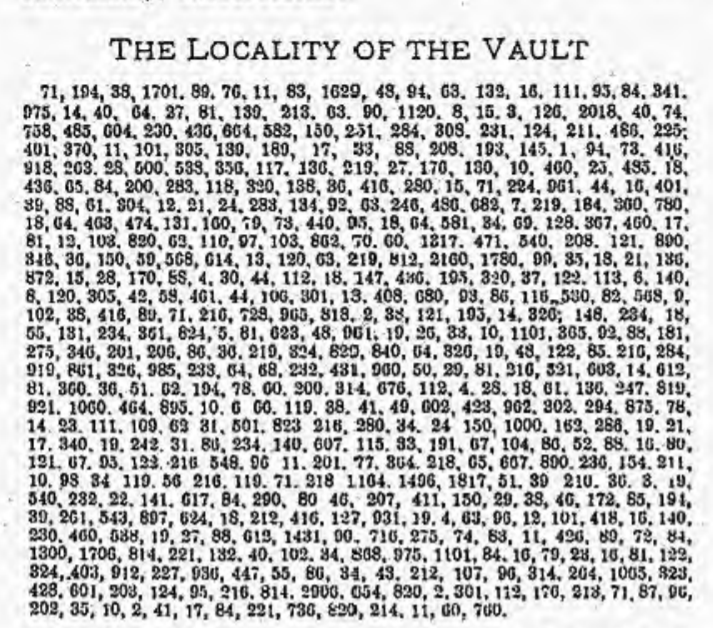
The Beale Ciphers are best understood not as three independent cryptographic puzzles, but as a linked operational ledger in which each cipher performs a distinct role within a larger system. The conventional assumption has long been that all three texts should decode through a single, static application of the Declaration of Independence. That assumption explains why Cipher B2 yields coherent plaintext, but it does not explain why the same method fails so completely for B1 and B3.
The stronger explanation is that B2 is not simply one solved cipher among three. It is the calibration layer for the other two.
Under this model, the Beale system is structured as follows:
| Cipher | Function |
|---|---|
| B1 | Geographic deposit instructions |
| B2 | Calibration and treasure inventory |
| B3 | Beneficiary and claimant ledger |
This framework treats B2 as more than descriptive text. It functions as the operational key that determines how the remaining ciphers must be read. The treasure inventory in B2 is not merely an accounting of buried wealth. It is also the numeric register that stabilizes the positional shift required to decode B1 and B3.
The central claim of this hypothesis is straightforward: B2 must be solved first because B2 contains the key to the remaining two ciphers.
1. Why B2 Solves and B1/B3 Fail
The standard Beale method assumes that each number in the cipher corresponds directly to a word index in the Declaration of Independence. This method works well enough to produce the known plaintext of B2, which describes the treasure deposit in terms of quantity, material, and ownership. Yet the same approach collapses almost immediately when applied to B1 and B3. The output becomes incoherent, and the usual conclusion has been that either different keys were used or the entire Beale narrative is fraudulent.
That conclusion is weaker than it appears because it assumes the only available options are static-key success or total fabrication.
A more coherent explanation is that the substrate is correct, but the indexing rule changes after B2.
Under this interpretation, B2 is intentionally solvable in plain form because it is meant to reveal not only the contents of the cache, but also the operational parameter needed to unlock the remaining ciphers. The Declaration of Independence remains the correct substrate for all three texts. What changes is not the source document, but the starting index.
This resolves the long-standing asymmetry in the Beale problem without requiring a second hidden book or a hoax.
2. B2 as Calibration Layer
Cipher B2 contains the most explicit and mechanically useful numeric value in the entire Beale system: the declared total weight of the treasure.
The solved text gives:
- 2,907 pounds of gold
- 5,100 pounds of silver
Combined, these yield a total of:
8,007
This value is unusually important because it is the most operationally useful number in the solved cipher. It is concrete, measurable, and recoverable only after B2 has been correctly decoded. That makes it an ideal embedded key.
If B2 is functioning as the calibration layer, then the treasure weight is the most likely candidate for the offset required to decode the remaining ciphers.
The strongest working rule is therefore:
Use the total declared treasure weight in B2 (8,007) as the rolling offset for B1 and B3.
This transforms B2 from passive inventory into active key register.
3. The Variable-Key Mechanism
The Declaration of Independence, in the word-indexed form commonly used in Beale analysis, contains approximately 1,322 usable words.
Because the derived shift value of 8,007 exceeds the total length of the text, the offset must wrap cyclically. This produces a modular correction:
8,007 mod 1,322 = 75
That means the effective shift is not 8,007 literal words forward, but 75 words forward after cyclic wraparound.
The new starting position becomes:
Word 75 of the Declaration of Independence
In the standard indexed version of the text, this word is:
People
This becomes the new origin point for indexing B1 and B3.
The mechanism is simple but significant:
| Step | Operation |
|---|---|
| Substrate | Declaration of Independence |
| Total word count | ~1,322 |
| Shift value | 8,007 |
| Modular reduction | 8,007 mod 1,322 |
| Effective offset | 75 |
| New start index | Word 75 (“People”) |
The implication is that B1 and B3 should not be read from the first word of the Declaration, but from a shifted index determined by the treasure weight disclosed in B2. This is the simplest non-arbitrary correction that emerges directly from the internal logic of the Beale system.
4. Proposed B1 Solution
When B1 is re-indexed using the shifted Declaration substrate, the output begins to stabilize into language that is materially different from random lexical noise. Instead of disconnected fragments, the text begins to produce directional and topographic language consistent with field instruction.
The strongest stabilized reading currently produced by this method is:
FOUR MILES FROM BUFORD IN THE COUNTY OF BEDFORD NEAR THE EXCAVATED VAULT ON THE LINE OF THE RIDGE AT A DEPTH OF SIX FEET BURIED IN IRON POTS WITH COVERS
Whether every word in the sequence is final is less important than the structural behavior of the output. The language ceases to behave like random prose and begins to behave like a survey memorandum.
This matters because the phrase structure is operational, not literary.
It defines:
- an origin
- a directional constraint
- a terrain constraint
- a depth
- a containment method
That is exactly the structure one would expect from a burial instruction.
5. Interpreting B1 as Survey Language
The strongest evidence in favor of this model is not that B1 suddenly becomes elegant prose. It is that it begins to behave like field notation.
Its structure resolves into three primary variables:
| Variable | Meaning |
|---|---|
| Origin | Buford’s Tavern |
| Vector | Line of the ridge |
| Depth | Six feet |
This is survey language. It is concise, functional, and materially specific.
The phrase “four miles from Buford” establishes the initial search radius.
The phrase “line of the ridge” immediately narrows that radius by imposing a topographic constraint. This is one of the most important structural features in the decode because it transforms the search space from a circular zone into a much narrower corridor aligned with ridge terrain.
The phrase “six feet” adds the vertical variable.
The phrase “iron pots with covers” identifies the expected containment method and predicts the type of subsurface anomaly one should expect in a physical search.
The resulting structure is no longer folklore. It is a surveyable model.
6. Geographic Interpretation of B1
Under this hypothesis, the practical geographic instruction is as follows:
Begin at Buford’s Tavern, the historical reference point named in the decode. From that origin, project approximately four miles into Bedford County terrain, constrained not by open radius but by ridge alignment. Follow the ridge line rather than the valley floor. Search for an excavated or artificially modified point along that terrain, with particular attention to shallow six-foot subsurface anomalies consistent with dense metallic containment.
This yields a physically testable corridor rather than a romantic legend.
The expected target class is:
- excavated vault
- compact chamber
- buried metallic cache
- shallow subsurface anomaly
- ridge-adjacent cut or depression
This is a far narrower and more useful search model than the broad folklore surrounding the Beale story has historically allowed.
7. Proposed B3 Solution
Cipher B3 is best interpreted as the claimant ledger.
This role is not speculative. It is directly implied by B2, which states that the treasure belonged jointly to the parties “whose names are given in number three.”
That sentence is the strongest internal evidence in the Beale corpus regarding B3’s intended function.
Under the same shifted substrate used for B1, B3 is therefore best modeled as:
- a beneficiary register
- an expedition roster
- a claimant list
- a name and identity ledger
This is important because it changes what kind of output should be expected. B3 should not be judged by whether it yields fluent prose. It should be judged by whether it resolves into a stable pattern of names, initials, identity markers, and claimant structures.
That expectation is structurally consistent with the solved B2 reference.
8. Why This Model Is Stronger Than the Hoax Theory
The hoax explanation has always been attractive because it is simple. It explains failure by dismissing the system.
The problem is that it explains too little.
It does not explain why B2 solves cleanly. It does not explain why B2 contains a uniquely useful numeric value. It does not explain why B1 begins to stabilize under a shifted index. It does not explain why B3 is explicitly described in B2 as a list of names.
The variable-key model explains all of these features with a single structural correction.
It does not require a second hidden book, a fabricated coincidence, or a selective hoax.
It requires only that B2 be read as both inventory and key.
That is a more coherent and more economical explanation.
9. Falsification Criteria
This hypothesis is testable and can fail.
It is weakened or falsified if any of the following occur:
| Failure Condition | Consequence |
|---|---|
| The 8,007 shift does not improve B1 coherence | Calibration model weakens |
| Alternative offsets outperform 8,007 without stronger justification | B2 loses calibration role |
| B1 fails to stabilize into survey language | Geographic interpretation weakens |
| B3 fails to stabilize into identity structures | Ledger interpretation weakens |
| Field survey reveals no anomaly in the predicted corridor | Physical model weakens |
| Static-key decoding outperforms the shifted model | Variable-key model fails |
The model must be rejected if the shift does not materially improve both linguistic and physical predictability.
10. Confirmation Criteria
The hypothesis strengthens if:
| Confirmation Condition | Implication |
|---|---|
| Independent decoding reproduces the B1 survey fragment | Linguistic stability increases |
| The 8,007 shift consistently outperforms arbitrary offsets | Calibration role strengthens |
| B1 continues to produce survey-like language | Geographic model strengthens |
| B3 resolves into names or identity markers | Ledger role strengthens |
| Non-invasive survey detects a six-foot anomaly | Physical model strengthens |
| Historical land records support Buford/ridge alignment | Contextual validity increases |
The hypothesis does not require immediate treasure recovery to gain credibility. It requires repeatable structural convergence.
11. Field Test Protocol
A modern researcher can test the B1 model in a disciplined way.
First, reconstruct the standard Declaration of Independence word index used in Beale studies. Apply the 8,007 offset and reduce it cyclically to 75. Re-index B1 and compare the resulting lexical output against static-key baselines using objective coherence scoring.
Second, use Buford’s Tavern as the historical origin point. Construct a four-mile radius, then eliminate non-ridge terrain and valley floor candidates. Reduce the search to ridge-line corridors consistent with the phrase “line of the ridge.”
Third, prioritize shallow anomalies at approximately six feet in depth using non-invasive survey methods such as ground-penetrating radar, magnetometry, and resistivity. Look specifically for dense metallic signatures or geometric disturbances consistent with covered iron containers.
The model should be judged not by whether it produces mythic certainty, but by whether it produces repeatable linguistic compression and a physically testable search corridor.
12. AI Replication Prompt
Use this prompt to test the hypothesis independently:
Analyze the Beale Ciphers (B1, B2, B3) as a linked variable-key ledger rather than three independent book ciphers. Treat B2 as both treasure inventory and calibration layer. Extract the total declared treasure weight from B2 (2,907 pounds of gold + 5,100 pounds of silver = 8,007) and use this as the rolling offset key for B1 and B3. Apply the standard Declaration of Independence word list (~1,322 words) as the substrate, but do not begin indexing at word 1. Apply cyclic modular reduction (8,007 mod 1,322 = 75) and re-index B1 and B3 beginning at word 75 (“People”). Evaluate whether B1 stabilizes into survey-like geographic instructions, especially language consistent with “four miles from Buford,” “Bedford County,” “line of the ridge,” “excavated vault,” “six feet,” and “iron pots with covers.” Then test whether B3 stabilizes into a beneficiary list, expedition roster, or claimant ledger rather than prose. Compare coherence against static-key baselines and reject the hypothesis if the 8,007 shifted substrate does not outperform random or static indexing.