
A Structural Symbol of Stability, Not a Literal Headcount
Few numbers in the Bible have attracted more speculation than the 144,000 in the Book of Revelation. For generations, the number has often been treated as though its primary purpose were to count people. That has led naturally to questions about who those people are, whether they belong to a particular religion or lineage, whether they are specially chosen, and whether only 144,000 people ultimately qualify for some protected or elevated status.
A structural reading leads somewhere very different.
The hypothesis developed here is that the 144,000 is not primarily a population count at all. Instead, it functions as a symbolic architecture of stability. The number describes a condition in which differentiated parts remain organized, identity remains intact, and the whole structure can withstand pressure without collapsing. Human beings may express that condition, but the number does not need to refer to a fixed number of human beings.
This changes the central question. Instead of asking, “Who are the 144,000?” we can ask, “What does 144,000 describe?”
That question produces a much more coherent relationship between Revelation 7, Revelation 14, and the New Jerusalem described in Revelation 21. It also makes the symbolism relatable beyond religion because the underlying idea—structural integrity under pressure—is something we encounter constantly in nature, engineering, organizations, families, and ordinary human behavior.
The core proposal is simple: 144,000 represents a complete, reinforced, fully expressed structure. Revelation applies that structure to people because people are the living expression of the architecture, not because exactly 144,000 individuals must exist.
Why the Number Matters
The first clue is the construction of the number itself.
That is not a mathematically arbitrary number. It is highly organized.
The number twelve already has a clear role within Revelation and the broader biblical tradition. Israel is represented by twelve tribes. Jesus appoints twelve apostles. The New Jerusalem has twelve gates and twelve foundations. Twelve repeatedly appears wherever a complete organized people or complete structured order is being described.
That does not mean every appearance of twelve has exactly the same theological meaning. It does mean that Revelation has already taught the reader to associate twelve with completed organization.
If twelve represents an organized whole, then twelve multiplied by twelve intensifies that structure.
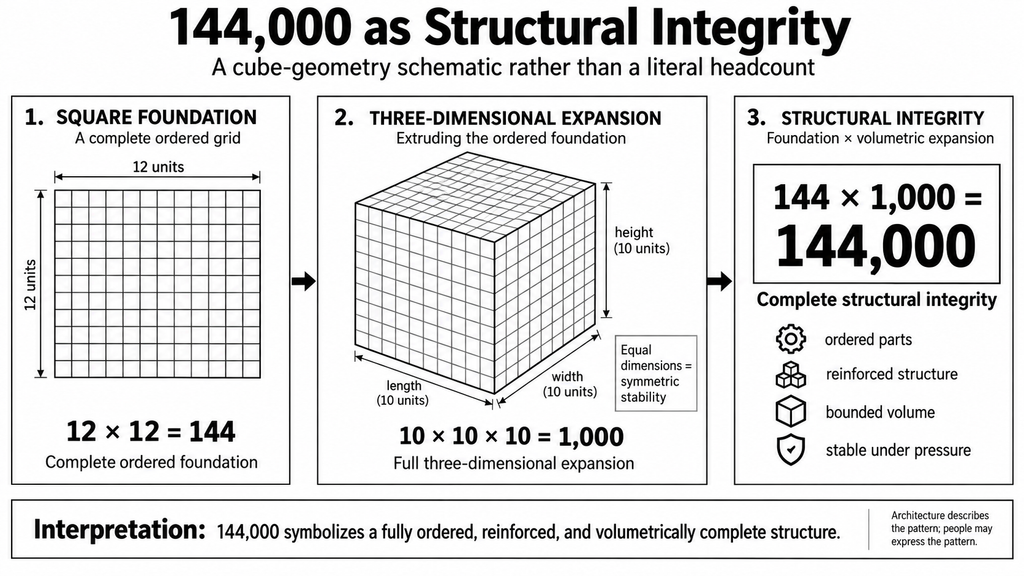
The important idea is not simply that 144 is “more twelve.” Squaring a quantity changes the kind of structure it can symbolize. A single dimension can describe extension. A square describes an ordered plane. In ordinary geometry, squaring moves a relationship from a line-like quantity into an area-like quantity. Structurally, it suggests reinforcement across more than one dimension.
In this interpretation, 144 represents completed order reinforced through itself.
Then comes 1,000.
Mathematically,
and that cubic structure matters. A cube takes a stable two-dimensional base and extends it fully into three dimensions. Length, width, and height are all present. A square is an ordered surface; a cube becomes an ordered volume.
The resulting number can therefore be read symbolically as something much more specific than “a very large amount”:
or, conceptually,
This gives us the missing bridge.
The 144,000 is not merely a “sacred number,” nor is it interchangeable with another numerically interesting value such as 9 or 432. Those numbers may carry other structural or harmonic meanings in other systems, but they do not perform the same job here. Revelation’s own numerical vocabulary repeatedly uses twelve, 144, and 12,000 in connection with completed communal and architectural order.
The number 144,000 therefore makes sense because it belongs to Revelation’s internal architecture.
The New Jerusalem Confirms the Pattern
The strongest support for this interpretation appears later in Revelation.
When the New Jerusalem is described in Revelation 21, the city is not portrayed casually. Its geometry is extraordinarily deliberate. It has twelve gates, twelve foundations, and dimensions of 12,000 stadia. Its wall is measured at 144 cubits. Most importantly, the city is described as having equal length, width, and height.
It is a cube.
That connection is difficult to dismiss as irrelevant.
The same numerical family appears in both places:
12
144
12,000
144,000
The 144,000 appear earlier in connection with people. The same structural numbers later appear in the architecture of the perfected city.
This suggests that Revelation may be expressing the same underlying condition in two different forms.
In one scene, the architecture is represented through people.
In another, it is represented through space.
The people and the city do not need to be numerically identical for the symbolism to work. What matters is that both are organized through the same structural language.
The New Jerusalem is not merely large. It is proportioned. Its dimensions are ordered. Its boundaries are intact. Its parts are differentiated but integrated. Its geometry communicates completeness.
That is precisely the type of condition the 144,000 can represent.
Rather than saying, “There are exactly 144,000 people,” the symbolism may be saying, “Here is humanity expressed in a fully ordered configuration.”
That is a very different claim.
Why the Cube Is Important
The cube is one of the simplest examples of complete three-dimensional balance. Its length, width, and height can be equal. It has six faces, twelve edges, and eight vertices, all arranged in a highly symmetric structure.
The point is not that cubes are magically stable in every physical circumstance. Engineering stability depends on material, loading, orientation, joints, and many other factors. The deeper structural principle is that symmetry and ordered geometry make relationships predictable.
A cube has no arbitrary distortion built into its ideal form. Its axes are orthogonal. Its dimensions can be equal. Its faces correspond to one another. Every part has a defined relationship to every other part.
That makes the cube an effective symbol for complete spatial order.
Revelation’s New Jerusalem uses exactly that imagery. The city is not described as irregular, fragmented, or asymmetrical. Its dimensions are equal.
That matters because the Holy of Holies in the Hebrew temple tradition was also cubical. The symbolism therefore links the idea of complete spatial order with the presence of God.
For a religious reader, that can retain its theological meaning.
For a nonreligious reader, the same image can still be understood structurally: the cube represents a condition in which the dimensions of the system are proportionate and the boundaries hold.
That is the essence of structural integrity.
What Structural Integrity Actually Means
Structural integrity does not mean that nothing changes.
A bridge flexes.
A building expands and contracts with temperature.
A tree bends in wind.
A healthy organization changes roles and processes.
A family adapts when circumstances change.
Stability is not rigidity. It is the ability to change without losing the relationships that make the system what it is.
That distinction appears throughout systems thinking. A system has to preserve enough boundary, identity, exchange, and organization to remain recognizable even while its components change. UIPO likewise distinguishes internal structure and persistence from claims of literal material sameness, and explicitly warns that a coherent symbolic or mathematical model should not automatically be treated as empirical proof.
The same idea is developed in The Geometry of Systems: systems remain stable when load is distributed through viable structure, limits are respected, and enough margin remains to absorb disturbance. Collapse often occurs not because one component is “bad,” but because the geometry of the system can no longer distribute pressure effectively.
This gives us a useful way to understand the 144,000.
It represents not perfection in the sense of flawlessness, but structural completeness in the sense that the necessary relationships remain intact.
Nature Uses Structure, Not Headcounts
This distinction becomes clearer when we look at nature.
A snowflake is recognizable because of its structure, not because it contains a specific number of water molecules. Different snowflakes can contain vastly different numbers of molecules, yet they express the same underlying sixfold symmetry produced by the geometry of water molecules and the conditions under which the crystal grows.
The number of particles is secondary.
The arrangement is primary.
Crystals provide another example. A crystal lattice can grow from a tiny seed into a much larger structure while preserving the same basic organization. The total number of atoms can change dramatically, but the pattern remains recognizable because the relationships repeat.
Biological organisms work similarly. A human body changes material continuously. Cells die and are replaced. Molecules enter and leave. Water is exchanged. Proteins are broken down and rebuilt. Yet the organism remains recognizably itself because identity is preserved through organization, information, boundaries, and coordinated function.
The same is true of ecosystems. A forest does not remain a forest because it contains an exact number of trees, insects, birds, or microorganisms. Its stability depends on relationships: nutrient cycles, predator-prey interactions, reproduction, water flow, soil structure, redundancy, and the ability of the system to recover after disturbance.
The components can change while the architecture persists.
That is exactly why interpreting the 144,000 as a structural number is more coherent than treating it as a literal census.
If the number describes a pattern, then the number of people expressing that pattern can be unlimited.
The Great Multitude Suddenly Makes More Sense
This is where Revelation 7 becomes particularly important.
John first hears the number 144,000. Then he sees a great multitude that no one can count.
Under a literal-count interpretation, this creates an obvious problem that theologians have handled in different ways. Are these two separate groups? Are they the same group viewed differently? Is one Jewish and the other international? Is one privileged above the other?
Those debates will continue.
But structurally, the relationship becomes simpler.
The 144,000 can describe the architecture.
The great multitude can describe the people who express it.
That would explain why one is numerically precise while the other is explicitly beyond counting.
The number is bounded because a structural pattern can be exactly defined.
The population is unbounded because any number of people can embody that pattern.
This is a crucial distinction.
The architecture has a number.
The people do not.
Seen this way, Revelation is not limiting participation to 144,000 individuals. It is giving a mathematical-symbolic picture of what stable human order looks like.
What Does the “Seal” Mean in This Model?
The sealing of the 144,000 also becomes clearer when understood structurally.
A seal preserves integrity.
We use seals everywhere for exactly this reason. A tamper-evident seal tells us whether a product has been altered. A digital signature tells us whether information is authentic. Encryption protects information from unauthorized modification. A legal seal verifies origin and authority.
The underlying principle is always similar: identity remains distinguishable despite outside interference.
Applied to human beings, that becomes a very ordinary question.
Can a person remain recognizably themselves when pressure increases?
Someone may say they believe in honesty until honesty becomes costly. They may value fairness until their own group stands to lose. They may believe in independent thinking until everyone around them disagrees. They may insist that family comes first until work demands become overwhelming.
Pressure exposes the difference between a value that is deeply integrated and one that is merely convenient.
The “seal,” in this structural interpretation, represents preserved identity under pressure.
It does not require the image of a supernatural badge separating special people from ordinary people.
It describes integrity.
Truthfulness Is a Structural Requirement
Revelation 14 also associates the 144,000 with truthfulness.
That becomes much less mysterious when viewed as part of the same architecture.
Any system that loses accurate information eventually loses the ability to correct itself.
A company cannot recover from financial trouble if leaders falsify the numbers. A family cannot repair a relationship if everyone avoids what actually happened. A scientific community cannot self-correct if inconvenient evidence is suppressed. A government cannot function reliably if information becomes indistinguishable from propaganda.
Truth therefore has structural value.
It is not merely a moral decoration.
A stable system requires feedback that corresponds sufficiently well to reality. If the feedback becomes distorted, decisions become increasingly disconnected from conditions.
The 144,000 can therefore symbolize a human condition in which the informational signal remains intact even when the surrounding environment becomes noisy.
This applies equally to religious and nonreligious people.
A scientist refusing to manipulate data expresses it.
A manager telling employees the real situation expresses it.
A parent admitting a financial problem instead of hiding it expresses it.
A citizen checking information before repeating it expresses it.
A friend refusing to participate in a false rumor expresses it.
The structural condition is universal even if Revelation expresses it through religious symbolism.
Twelve Tribes and Differentiated Stability
The twelve tribes introduce another important principle: structural integrity does not require sameness.
Healthy systems are differentiated.
A body has a heart, lungs, kidneys, muscles, and nervous system. Their differences make the whole possible.
A company has accounting, sales, operations, logistics, and leadership.
A community contains teachers, builders, caregivers, technicians, artists, business owners, and countless other functions.
If every part attempted to perform the same role, the system would fail.
The problem in unstable systems is therefore not difference. It is failed coordination.
This gives the twelvefold symbolism an everyday meaning. The stable whole contains differentiated parts without allowing those parts to fragment into unrelated pieces.
That is why a structural interpretation of 144,000 should not imply uniformity.
The pattern is coordinated diversity.
Different people remain different while maintaining enough shared structure to function together.
Firstfruits Without a Chosen Class
The description of the 144,000 as “firstfruits” should also be handled differently under this model.
Earlier versions of this interpretation treated firstfruits as evidence of a special early group of people who stabilize before everyone else. That still assumes the number refers primarily to people.
A cleaner interpretation is that “firstfruits” describes the first visible expression of the stable condition.
A new pattern becomes observable somewhere before it becomes widespread.
That happens in ordinary systems all the time.
A new organizational method may first appear in one department. A new scientific idea may first be demonstrated in one experiment. A new social behavior may begin in a small community. A new technology may initially appear in one application.
The importance of firstfruits is not that the first expression owns the pattern.
It demonstrates that the pattern is possible.
That preserves the agricultural metaphor without creating an elite class.
How Ordinary People Express the Structure
Once the 144,000 is understood as architecture rather than population, the practical meaning becomes much clearer.
A teacher in a chaotic classroom can express the structure by maintaining calm boundaries, accurate information, and fair treatment.
A family under economic strain can express it by confronting the real numbers, redistributing responsibilities, and staying connected instead of turning on one another.
A business can express it when departments remain differentiated but coordinated during a crisis.
A researcher can express it by following evidence even when the results contradict expectations.
A community can express it after a natural disaster when ordinary residents share information, organize resources, and prevent panic from fragmenting the group.
A person can express it simply by remaining capable of thinking clearly when social pressure demands immediate conformity.
None of these people needs to believe they belong to the 144,000.
They do not need to know the symbolism exists.
They are expressing the underlying structural condition.
That is precisely what makes this interpretation relevant outside religion.
Where THD Fits
Triune Harmonic Dynamics provides a secondary structural lens for understanding how this condition might emerge. THD describes transformation through Emergence, Contrast, and Integration: a structure forms, pressure tests it, and what survives is reorganized into a more stable condition.
The 144,000 symbolism can fit that process without being reduced to it. The stable architecture represents what remains coherent through Contrast and becomes available for Integration.
But THD should not be used as proof that this interpretation of Revelation is correct. Its role is explanatory. The current UIPO specification is explicit that mathematical or ontological coherence cannot be treated as empirical confirmation by itself.
That caution actually strengthens the interpretation because it prevents the argument from becoming numerology.
We do not need to claim that the universe literally “runs on 144,000.”
We only need to observe that Revelation uses a particular numerical architecture consistently and that the resulting symbolism corresponds to a recognizable structural principle.
Why 144,000 Instead of 9 or 432?
This finally answers the question that was missing from the earlier article.
Nine can symbolize completion of a process. Within THD, it is associated with Integration.
432 may carry harmonic significance within another numerical framework.
But neither number belongs to Revelation’s native structural vocabulary in the way 144,000 does.
Revelation repeatedly works with twelve.
Twelve tribes.
Twelve apostles.
Twelve gates.
Twelve foundations.
144 cubits.
12,000 stadia.
144,000.
The number is not imported from outside the text. It emerges from the book’s own architecture.
That makes 144,000 the appropriate number because it expresses a specific kind of completeness: differentiated order reinforced and extended into a complete dimensional structure.
In simple terms:
9 can describe a completed process.
144,000 describes a completed architecture.
That is the difference.
A Different Way to Read Revelation
This interpretation does not require anyone to abandon a religious reading of Revelation. Nor does it prove that every traditional interpretation is wrong. Revelation is symbolic literature, and symbolic texts can operate at several levels simultaneously.
But this structural approach removes an unnecessary problem.
We no longer have to imagine that exactly 144,000 people are somehow more important than everyone else.
Instead, the number describes what stable human organization looks like when pressure rises.
Identity remains intact.
Truth remains distinguishable from distortion.
Different roles remain coordinated.
Boundaries remain functional.
The whole can absorb pressure without fragmenting.
That is not an abstract spiritual condition.
It is observable everywhere.
And it is difficult.
The Central Hypothesis
The most coherent interpretation produced by this analysis is therefore:
The 144,000 in Revelation is not primarily a literal census of specially selected people. It is a symbolic architecture of complete structural integrity. Its construction—12 × 12 × 1,000—combines complete differentiated order, reinforced foundation, and full dimensional expression. Revelation later uses the same numerical family in the perfectly proportioned New Jerusalem, suggesting that the human image and the city image are two expressions of the same structural idea.
The people are not limited to the number.
The number describes the pattern.
The great multitude can be limitless because structural integrity is not a membership category. It is a condition that human beings can express.
That is why the image becomes relevant whether someone approaches Revelation religiously, spiritually, historically, or simply as a piece of symbolic literature.
The central question is no longer, “Am I one of the 144,000?”
It becomes something much more immediate:
When pressure rises, can the structure hold?
Can truth remain intact?
Can difference remain coordinated?
Can identity survive without becoming rigid?
Can people adapt without fragmenting?
That is what structural integrity looks like in a bridge, a crystal, an ecosystem, an organization, a family, and a human being.
And that may be what Revelation’s 144,000 was designed to represent.