
A Falsifiable Liturgical-Administrative Solution
Proposed Solution
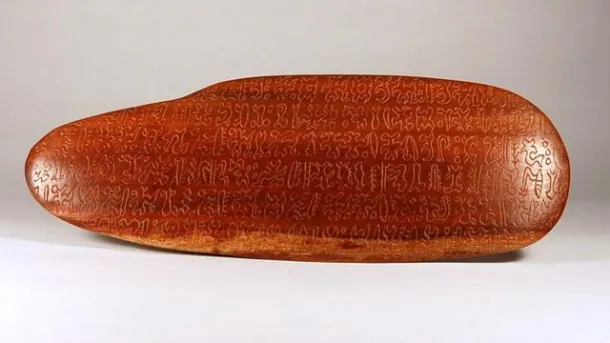
Rongorongo is best understood not as a failed phonetic script, nor as an undeciphered literary language in the conventional sense, but as a structured recited ledger system in which glyphs encode ordered ritual, administrative, and mnemonic functions rather than ordinary prose. For more than a century, most attempts to decipher Rongorongo have assumed that the script should behave like a hidden language: either a phonetic writing system, a syllabary, a logographic text, or some hybrid form that encodes ordinary speech in written form. That assumption has repeatedly failed, not simply because the corpus is small or damaged, but because the inscriptions do not behave like conventional language.
The stronger explanation is that Rongorongo was not designed primarily to record open-ended speech. It was designed to stabilize and transmit structured knowledge. Its glyphs appear in constrained sequences, its inscriptions recur in patterned formulae, and its wooden tablets show strong evidence of ordered repetition rather than open linguistic variation. These are not the expected characteristics of ordinary prose. They are the expected characteristics of a recited formal system in which sequence, category, and mnemonic order matter more than sentence grammar.
The central claim of this hypothesis is straightforward:
Rongorongo is best modeled not as a conventional written language, but as a structured recited ledger in which glyphs encode ritual, calendrical, genealogical, and administrative knowledge through ordered mnemonic sequence.
This reframes Rongorongo not as a lost literary script, but as a constrained information system designed for formal recitation and controlled transmission.
1. Core Hypothesis
Rongorongo has resisted decipherment because it has likely been misclassified at the level of script function. Most decipherment attempts begin with the assumption that the glyphs should resolve into something like ordinary written language: spoken clauses rendered as phonetic or semantic text. From that premise, analysts search for lexical repetition, grammatical markers, phonetic values, or stable semantic substitutions.
The problem is that Rongorongo does not behave like a conventional prose corpus. The surviving inscriptions are highly repetitive, strongly patterned, and structurally constrained. Certain glyph clusters recur in ways that suggest formulaic sequencing rather than narrative variation. Parallel sequences appear to preserve order more consistently than lexical diversity. This is difficult to reconcile with ordinary prose, but highly consistent with a formalized recitation system.
Under this model, Rongorongo was not primarily used to record unrestricted speech. It was used to preserve structured cultural knowledge in a highly compressed and repeatable form.
2. Why Conventional Linguistic Decipherment Fails
The long-standing failure to decipher Rongorongo is often attributed to familiar obstacles: too few surviving texts, too much damage, uncertain reading order, and the loss of native interpretive tradition. These are real problems, but they are not sufficient to explain the repeated structural failure of conventional decipherment models.
The more important issue is that the corpus does not behave like ordinary language. In conventional writing systems, one expects a balance between repetition and novelty, grammatical flexibility, and enough lexical variation to support sentence formation. Rongorongo instead exhibits constrained recurrence, formulaic repetition, and positional clustering. The same glyph groups recur with structural regularity that is stronger than what one expects from unconstrained prose.
This is not evidence that Rongorongo is meaningless. It is evidence that it is highly formal.
The stronger explanation is that Rongorongo encodes stable recitation structures—ritual sequences, genealogical lists, calendrical cycles, and administrative inventories—rather than free linguistic composition.
3. Structural Model
Rongorongo is best modeled as a three-layer recited ledger system in which meaning emerges from the interaction of sequence, glyph class, and recitational function.
| Layer | Function |
|---|---|
| Sequence Layer | Determines recitation order and structural progression |
| Glyph Layer | Determines category, actor, object, or action |
| Ledger Layer | Determines whether the sequence is ritual, calendrical, genealogical, or administrative |
In this model, meaning is not derived primarily from phonetic spelling. It emerges from ordered glyph sequences constrained by function and recitation context.
A given glyph may retain a broad semantic role, but its practical meaning depends on where it appears in the sequence, what class of tablet it belongs to, and what formal pattern governs the line in which it occurs.
This makes Rongorongo structurally closer to a formal recitation ledger than to ordinary written prose.
4. Functional Roles in the Script
The strongest working interpretation is that Rongorongo glyphs fall into recurring functional classes rather than purely lexical categories.
| Glyph Class | Likely Function |
|---|---|
| Header Glyphs | Category, invocation, title, or sequence start |
| Core Glyphs | Actor, object, lineage, event, or ritual unit |
| Modifier Glyphs | Quantity, status, repetition, relation, or phase |
| Terminal Glyphs | Closure, completion, transition, or validation |
This explains why certain glyphs recur at line openings, why others cluster in repeated medial patterns, and why terminal regions often show strong formal regularity. These are not the most likely behaviors for unconstrained prose, but they are exactly what one would expect in a recited mnemonic system where order and category must remain stable.
5. The Recitation Constraint
The strongest evidence for this model is the formal structure of recurrence itself.
Rongorongo appears to preserve repetition with unusually high structural discipline. This is often treated as a barrier to decipherment, but it is better understood as evidence of function. Highly repetitive systems are not necessarily impoverished language. They are often formalized systems in which repetition preserves integrity.
This is especially true in oral societies, where memory is stabilized through repetition, parallelism, and constrained formulae. In such systems, writing often functions less as a full record of speech and more as a recitational scaffold.
Under this model, Rongorongo tablets are not silent texts waiting to be read as prose. They are structured prompts designed to support trained recitation.
6. The Tablet Constraint
The medium of Rongorongo matters. Most surviving inscriptions are carved on wooden tablets rather than monumental stone, portable codices, or administrative clay. This suggests a system intended for controlled handling, repeated use, and likely formal transmission.
Wooden tablets are especially well suited to mnemonic instruction. They can be held, traced, recited from, and reused in formal contexts. This makes them appropriate for ritual sequence, lineage instruction, calendrical memory, and formalized administrative recall.
This is less consistent with ordinary literary writing than with guided recitation.
7. Predicted Solution Class
If this model is correct, Rongorongo will not resolve primarily into open narrative prose. It will resolve into structured recitation classes.
The most likely output classes include ritual sequences, calendrical registers, genealogical chains, administrative inventories, formal chants, and mnemonic recitation scaffolds. These forms preserve meaning through ordered recurrence rather than unconstrained sentence construction.
The likely output is not literature in the ordinary sense. It is controlled formal knowledge.
This predicts that glyph recurrence should correlate more strongly with recitational role and tablet function than with conventional lexical syntax.
8. The Oral-Writing Interface Problem
One of the strongest reasons Rongorongo has remained resistant to decipherment is that it likely sits at the boundary between oral and written knowledge systems.
This makes it easy to misread. If treated as pure oral symbolism, it appears too structured to be mnemonic alone. If treated as full writing, it appears too repetitive to be natural prose.
The stronger explanation is that it occupies the middle ground: a constrained script used to stabilize recited knowledge without fully encoding unrestricted speech.
Its ambiguity is not evidence of failure. It is evidence of hybrid function.
9. Falsification Criteria
This hypothesis is weakened or falsified if Rongorongo behaves more like ordinary written language than structured recitation.
| Failure Condition | Consequence |
|---|---|
| Glyph sequences resolve cleanly into ordinary prose | Recited-ledger model weakens |
| Positional recurrence is statistically incidental | Structural model weakens |
| Tablet classes do not predict glyph behavior | Ledger model weakens |
| Repeated clusters behave like unconstrained lexical repetition | Recitation model weakens |
| Conventional linguistic decoding explains the corpus more simply | Hypothesis fails |
The model must fail if ordinary language explains the corpus more consistently than structured recitation.
10. Confirmation Criteria
The model strengthens if glyph behavior is more strongly predicted by sequence role, tablet type, and recurrence structure than by ordinary linguistic substitution.
| Confirmation Condition | Implication |
|---|---|
| Tablet class predicts glyph behavior | Ledger model strengthens |
| Recurring clusters align with formal sequence roles | Recitation model strengthens |
| Header and terminal glyphs behave predictably | Structural model strengthens |
| Parallel sequences preserve order over lexical variation | Mnemonic model strengthens |
| Positional analysis outperforms phonetic substitution | Hybrid-script model strengthens |
The model gains credibility through repeatable structural prediction rather than speculative translation.
11. Field Test Protocol
This hypothesis can be tested directly by classifying Rongorongo texts according to structural role before attempting phonetic assignment. Researchers should first segment inscriptions into sequence positions, identify recurring headers and terminals, and compare repeated glyph clusters across tablet classes. The central question is whether glyph behavior is better predicted by recitational position and tablet function than by lexical substitution.
If conventional linguistic models consistently outperform sequence-role analysis, the model fails. If structured positional analysis produces stronger predictive stability, the recited-ledger model gains support.
12. What This Solution Does Not Claim
This hypothesis does not claim that Rongorongo is fully deciphered. It does not claim that phonetic values are absent, nor that the script contains no spoken language.
It makes a narrower and testable claim:
Rongorongo is best modeled first as a structured recited ledger and only secondarily as a conventional written language.
That claim can be tested.
13. AI Replication Prompt
Use this prompt to test the hypothesis independently:
Analyze Rongorongo as a structured recited ledger rather than as ordinary written prose. Do not begin by assuming full phonetic writing. Instead, classify the corpus by tablet type, sequence position, recurring headers, repeated medial clusters, and terminal closures. Treat the glyph system as a hybrid recitational script in which ordered recurrence, tablet function, and mnemonic stability govern meaning more strongly than unrestricted lexical syntax. Test whether repeated glyph clusters correlate more strongly with ritual, calendrical, genealogical, or administrative sequence roles than with conventional grammatical behavior. Evaluate whether positional recurrence, tablet class, and formal sequence structure outperform phonetic substitution in predicting glyph behavior. Reject the hypothesis if conventional linguistic decoding explains the corpus more consistently than structured recitational analysis.