
A Falsifiable Phase-Transition Hypothesis of Conscious Experience
This paper proposes Recursive Representational Energy Closure (RREC), a falsifiable physical hypothesis for the transition between nonconscious information processing and conscious experience. Contemporary consciousness research has identified recurrent processing, large-scale integration, perturbational complexity, and near-critical neural dynamics as important correlates of conscious states, but no consensus mechanism currently explains what distinguishes consciousness-specific criticality from ordinary recurrent or critical brain activity.
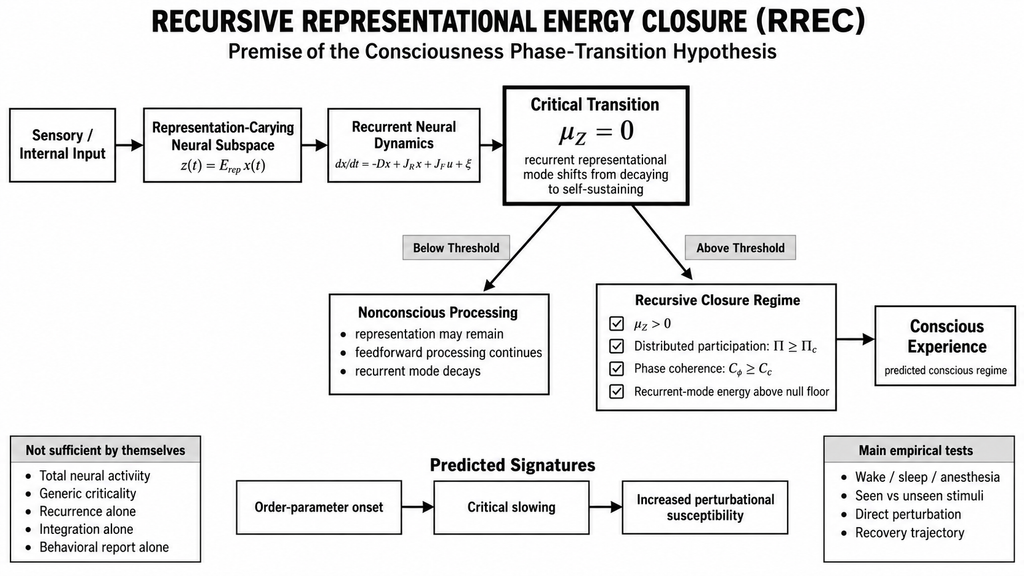
RREC proposes that conscious experience requires a specific conjunction of physical conditions. A validated neural representation must support a recurrent mode that becomes dynamically self-sustaining after local dissipation is accounted for, while also being sufficiently distributed and phase-consistent across the participating network. Feedforward processing, total neural activity, generic criticality, recurrence, integration, or behavioral report alone are therefore predicted to be insufficient.
The model is formulated using standard state-space dynamics, multivariate representation analysis, reduced-operator stability, and local bifurcation theory. An independently estimated representation map identifies a representation-carrying neural subspace. Recurrent dynamics are then restricted to that subspace, producing a reduced operator whose spectral abscissa, , serves as the principal control parameter. The critical transition occurs at
where the dominant recurrent representational mode changes from decaying to self-sustaining. Above threshold, the model predicts emergence of a nonzero recurrent-energy order parameter. Near the transition, it additionally predicts critical slowing and enhanced perturbational susceptibility.
Integration and coherence are treated as independent conditions rather than collapsed into a single fitted score. The proposed conscious regime therefore requires a positive recurrent growth rate together with sufficient mode participation, phase consistency, and recurrent-mode energy above a preregistered null floor.
A synthetic 80-node computational proof-of-concept demonstrates that the principal quantities can be recovered under controlled noise. The independently estimated representation subspace closely reproduces the hidden planted subspace, the reduced recurrent operator identifies the known bifurcation, the simulated order parameter follows the predicted onset, and recovery times exhibit the expected critical-slowing behavior. A separate control shows that the full network can become globally critical while the representation-conditioned subsystem remains subcritical, illustrating the proposed distinction between generic neural criticality and RREC closure. The simulation is a methodological demonstration, not empirical evidence for consciousness.
The paper specifies four prospective experimental tests: wake-sleep-anesthesia transitions, near-threshold conscious perception, causal perturbation of recurrent coupling, and recovery trajectories. It also defines comparator and ablation models based on total neural activity, generic criticality, recurrence, integration, and perturbational complexity.
H-RREC-1 is explicitly falsifiable. The hypothesis is rejected within the tested domain if conscious states reliably occur below the frozen recurrent threshold, unconscious states repeatedly satisfy the full closure criteria, predicted critical behavior is absent, targeted disruption of recurrent closure leaves experience intact, thresholds fail to generalize, or simpler models perform equally well after matching flexibility.
Confirmation would identify a measurable physical transition associated with conscious state. It would not, by itself, explain the qualitative character of experience or establish a complete theory of consciousness.
The paper’s conceptual provenance separates representation, recursion, integration, and coherence rather than defining awareness by any one of them, consistent with the earlier Calista and UIPO framework distinctions