
A Falsifiable Low-Energy Quantum-Gravity Hypothesis Linking Branch-Resolved Phase to Spacetime Tidal Geometry
Quantum Gravity–Classical Curvature Closure (QGCCC) presents a falsifiable low-energy quantum-gravity hypothesis testing whether the nonseparable phase generated across quantum gravitational branches closes quantitatively onto the same tidal-curvature structure that governs classical gravitational geometry.
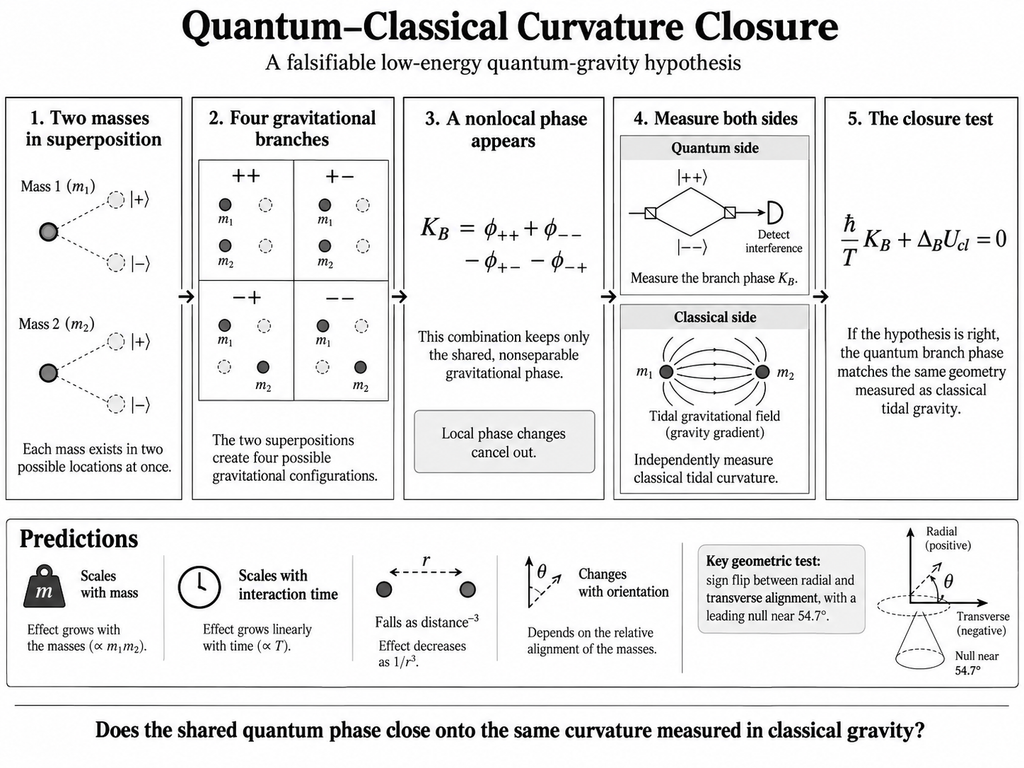
The paper considers two masses, each placed in a coherent spatial superposition. Their mutual gravitational interaction generates four branch-dependent phases. Because many phase contributions can be removed by local rephasing of either mass, they do not represent irreducibly relational two-body information. QGCCC therefore isolates the local-phase-invariant mixed finite difference
which vanishes for purely separable local phase contributions and directly captures the nonseparable component responsible for branch entanglement.
For the weak-field Newtonian interaction, the paper derives the exact closure relation
where Δ_B U_cl is the corresponding mixed finite difference of the classical gravitational interaction energy across the same four branch configurations.
In the small-superposition limit, the branch-space quantity reduces to a contraction of the classical tidal tensor,
This establishes the central proposed bridge: the quantum branch quantity and classical geodesic-deviation curvature are governed by the same second spatial derivative of the gravitational potential.
The hypothesis makes several parameter-free predictions within its stated regime. These include linear scaling with interaction time, dependence on both source masses and branch displacements, tidal distance scaling proportional to R^-3, and a fixed orientation dependence. For parallel branch displacements, the leading-order prediction includes a sign reversal between radial and transverse configurations and an angular suppression near
The manuscript also derives exact finite-branch corrections, allowing confirmatory tests to use the full source geometry rather than relying only on the leading tidal approximation.
QGCCC is explicitly framed as a model-discrimination hypothesis rather than as a claim that gravitationally generated entanglement alone proves gravity is quantized. The proposed experiment therefore uses two independently governed measurement channels: a classical curvature calibration and a quantum branch-phase measurement.
The primary falsification quantity is the closure residual
QGCCC is weakened or rejected within its declared domain if the residual remains nonzero beyond the preregistered uncertainty budget, if the predicted scaling, sign, or angular structure fails, or if competing classical, semiclassical, stochastic, or hybrid models explain held-out measurements better.
This deposit includes the manuscript and a reproducibility package containing calculation scripts, symbolic and numerical checks, rephasing-invariance tests, exact and approximate branch calculations, angular and distance scans, finite-size corrections, closure-grid verification, diagnostic outputs, environment specifications, and integrity records.
QGCCC is not proposed as a complete ultraviolet theory of quantum gravity. It is a finite, experimentally testable low-energy closure hypothesis asking whether quantum branch structure and classical spacetime tidal geometry can be connected through one measurable relation.