
A Theoretical State-Sufficiency Framework for Identity Persistence and Temporal Experience
This paper develops a theoretical and falsifiable model of identity persistence and temporal experience called the Present-Identity Invariance Hypothesis (PIIH). The motivating question is whether identity must be represented as something that travels through time, or whether persistence can instead be described by relations instantiated in each currently existing system state.
The formal model uses a current state x, a hypothetical transported identity carrier q, state-update rules, observables, and an identity map J. The central transport-eliminability theorem shows that q is scientifically unnecessary for a declared observable set whenever both the next-state dynamics and observables factor entirely through x. A complementary carrier-fiber obstruction states the opposite condition: if the same current state paired with different q values produces different next states or outputs, q cannot be eliminated at that representation. Additional theorems show how identity persistence can be represented as invariance across changing current states and how that invariance survives admissible clock reparameterization.
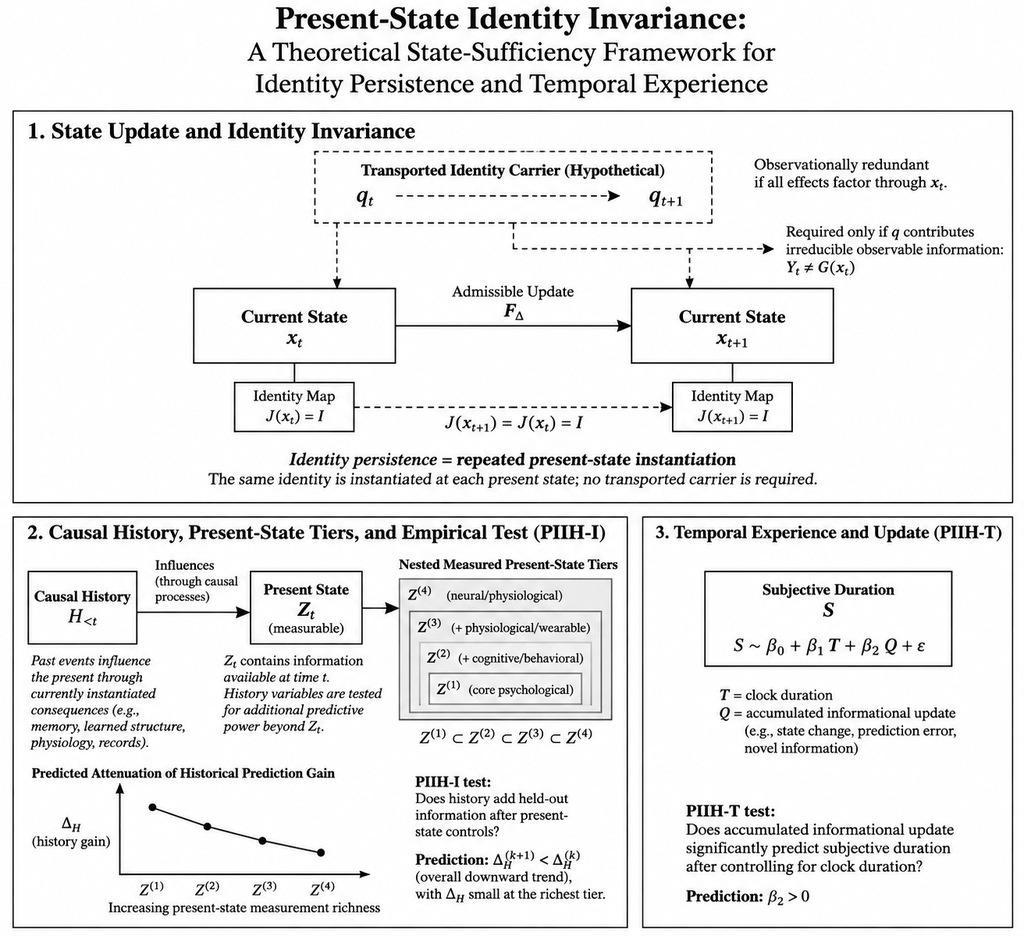
These results establish conditional mathematical non-necessity, not metaphysical nonexistence. The paper does not claim that human identity has been proven timeless, that only the present exists, that relativity is incorrect, or that time is a physical substance flowing through the body. Unified Informational Physics and Unified Informational Mathematics are treated as historical and compatibility frameworks, not as empirical premises.
Two separate empirical hypotheses make the theory vulnerable to failure. PIIH-I predicts that the additional held-out predictive value of chronological history should show an overall decline as preregistered present-state measurements become richer, with the richest primary tier falling below a practical residual-history threshold. PIIH-T predicts that subjective duration should depend on accumulated informational update in addition to clock duration. The two hypotheses can fail independently.
The proposed empirical program is prospective. It includes a low-burden longitudinal state-sufficiency design, a separate time-perception experiment, disjoint predictor and outcome channels, leakage controls, pilot-frozen attrition and missing-data rules, held-out participants and future sessions, outcome-independent calibration, finite effect thresholds, and independent replication. No human-subject results are reported in this version.
The strongest conventional alternatives are state-plus-history models, narrative-memory accounts, chronological-distance models, and ordinary clock-based explanations of subjective duration. PIIH-I is falsified at a declared measurement resolution if history retains a replicated, practically meaningful held-out advantage after the richest reliable present-state measurement, or if the preregistered aggregate attenuation signal fails. PIIH-T is falsified if a frozen informational-update estimator does not improve duration prediction beyond clock time, or reliably reverses direction.
The accompanying reproducibility package supplies the frozen manuscript, formal model, prospective protocol, decision-rule code, configuration files, schematic, mathematical closure record, validation packet, and checksums. The current contribution is therefore a preprint-ready theoretical framework with explicit proof boundaries and prospective empirical tests, not an empirical confirmation of the hypothesis.
Conceptually, the framework shifts the research question from “Where did the same identity travel?” to “What present organization preserves recognizability, and what additional information is actually required?” If supported, the model would offer a compact bridge between state-space dynamics, identity research, and temporal experience while leaving broader metaphysical questions open to independent investigation and criticism openly.