
An Ancient Architecture of Perception, Action, Feedback, and Stability Through Modern Systems Science and Informational Physics
For more than two thousand years, Buddhism has treated the Noble Eightfold Path as a practical architecture for changing the conditions that produce suffering.
Its eight factors are traditionally identified as:
- Right View
- Right Intention or Resolve
- Right Speech
- Right Action
- Right Livelihood
- Right Effort
- Right Mindfulness
- Right Concentration
Early Buddhist texts such as SN 45.8, Magga-vibhaṅga Sutta explicitly present these eight factors, while later explanatory traditions commonly organize them into three interdependent domains: wisdom, ethical conduct, and concentration. Importantly, the eight factors are not simply eight isolated steps completed one after another. They function as mutually supporting components of one path.
That architecture creates an unusual opportunity for translation into modern systems language.
The purpose of this article is not to claim that the Buddha knew control theory, Bayesian inference, information theory, nonlinear dynamics, or differential equations.
Ancient Indian civilization did not have electronic sensors, computers, dynamical-systems software, Shannon entropy, state-estimation algorithms, or modern neuroscience.
It did, however, have direct access to an extraordinarily complex experimental object:
human behavior.
People could observe that inaccurate perception creates bad decisions.
They could see that intention influences action.
They could see that speech changes relationships.
They could see that actions alter future conditions.
They could observe that one’s occupation continually feeds particular incentives and behaviors back into life.
They could recognize that changing habits requires sustained effort.
They could notice that self-observation changes behavior.
And they could discover that an unstable attention system processes reality differently from a concentrated one.
Ancient traditions described those relationships through ethical, contemplative, and philosophical language.
Modern systems science can describe related structural relationships mathematically.
The appropriate question is therefore not:
Did Buddhism secretly contain physics?
It is:
If we translate the functional architecture of the Noble Eightfold Path into modern systems language, what structural relationships remain recognizable?
That distinction is consistent with the scientific discipline built into Unified Informational Physics Ontology, which separates mathematical representation, empirical hypothesis, observation, protocol, and evidence rather than treating conceptual similarity as empirical proof. UIPO explicitly states that a model may organize a system coherently without thereby proving that the ontology represented by the model is physically fundamental.
The goal is structural translation.
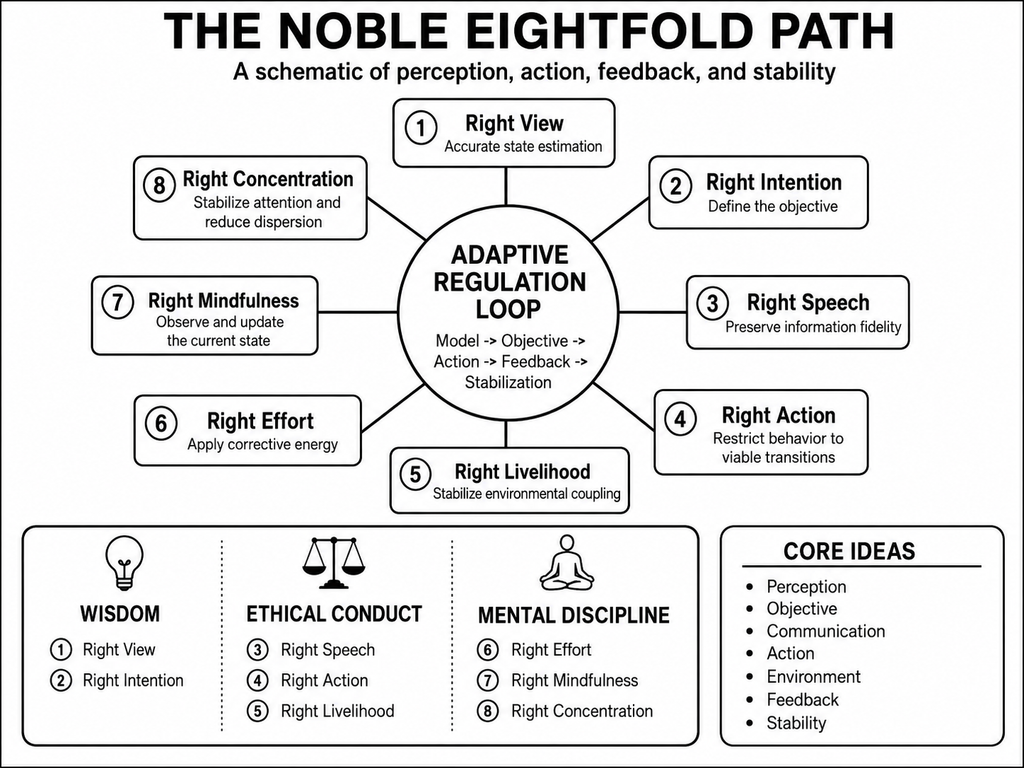
1. Right View — Build an Accurate Model of the System
The Eightfold Path begins with what is usually translated as Right View or Right Understanding.
In SN 45.8, Right View is connected specifically with understanding suffering, its origin, its cessation, and the path leading to its cessation.
Structurally, this means the intervention begins with a model of reality.
Modern science cannot operate without the same requirement.
Suppose a system has an underlying state
The observer does not necessarily perceive that state directly. Instead:
where
is observation,
is the observation process,
and is noise or error.
The agent then forms an estimate
of the true state.
The quality of action depends partly on how closely
If the internal model is badly wrong, even an internally logical decision can produce a bad outcome.
This is true in engineering.
A thermostat with an inaccurate temperature sensor regulates incorrectly.
A navigation system using the wrong position estimate chooses the wrong path.
A physician operating from an incorrect diagnosis can select the wrong treatment.
A person acting from a seriously distorted interpretation of a situation can do the same.
The physics translation of Right View is therefore:
Improve correspondence between internal representation and the state being acted upon.
This does not reduce Buddhist Right View merely to sensory accuracy. Traditional Right View contains ethical and soteriological commitments that extend beyond what a state-estimation equation can represent.
But the structural relationship is strong:
effective correction requires an adequate model of what is actually happening.
Informational Physics adds an important safeguard here. UIPO requires explicit separation between underlying state, observation, measurement model, and derived interpretation. A representation cannot simply be assumed to be the underlying reality.
In modern language:
Right View begins by reducing model error.
2. Right Intention — Define the Objective Function
Knowing the system state is not enough.
An agent also needs a direction.
The second path factor is commonly translated as Right Intention, Right Resolve, or Right Thought. The early formulation emphasizes resolve toward renunciation, absence of ill will, and harmlessness.
In control theory and optimization, this corresponds structurally to defining the objective before selecting the action.
Suppose the system has utility or cost function
The controller chooses an action
But the mathematics only tells us how to optimize the objective that was supplied.
It does not tell us whether the objective itself is wise.
An optimization system can be extremely efficient while optimizing the wrong thing.
For example:
A company maximizing quarterly output without including employee retention may burn out its workforce.
An algorithm maximizing engagement without accounting for misinformation may amplify outrage.
A person maximizing immediate gratification may undermine long-term stability.
This is one of the most important structural translations in the entire Eightfold Path.
Right View asks: What is happening?
Right Intention asks: What are we trying to produce?
The physics translation becomes:
Define an objective that does not destroy the system in the process of optimizing it.
We can make this explicit by using multiple terms:
The system does not optimize raw reward alone.
It also penalizes harmful or destabilizing trajectories.
Again, Buddhism makes a moral claim that physics itself cannot supply.
But systems mathematics demonstrates why objective definition matters:
A perfectly functioning optimizer with a corrupted objective can produce perfectly optimized failure.
3. Right Speech — Preserve Information Fidelity
Speech is information transfer.
The third factor, Right Speech, is traditionally associated with refraining from false, divisive, harsh, and otherwise unskillful speech.
Modern information theory gives this factor an unusually clean structural translation.
Let represent the source information and the message received by another agent.
Mutual information is
If communication faithfully preserves relevant information about the source, uncertainty about decreases after observing .
If communication is distorted, then
The receiver’s estimate becomes less reliable.
Signal quality can also be expressed using signal-to-noise ratio:
But harmful speech introduces something more dangerous than random noise.
False speech can inject structured error that the receiving system mistakes for signal.
Divisive speech can alter network relationships.
Harsh communication can modify the response state of the receiver.
Repeated low-value communication can consume limited attention bandwidth.
The physics translation is therefore:
Protect the fidelity and functional quality of the information channel.
This principle scales well beyond interpersonal ethics.
Scientific integrity depends on it.
Courts depend on it.
Markets depend on it.
Artificial intelligence systems depend on it.
Institutions depend on it.
A society with low information fidelity must spend increasing resources verifying everything it receives.
Truthful communication is therefore not merely a private virtue.
It reduces systemic uncertainty.
4. Right Action — Restrict the Admissible Action Space
A system can perceive accurately and hold a constructive objective yet still destabilize itself through the actions it permits.
Right Action addresses behavior.
Early formulations emphasize abstaining from killing, stealing, and sexual misconduct.
Modern control systems routinely distinguish between all mathematically imaginable actions and admissible actions.
Let the possible control set be
Constraints reduce it to
The system may then optimize only within that feasible region:
This is fundamental engineering.
An autonomous vehicle is not permitted to maximize travel speed through every mathematically possible trajectory.
A power plant is constrained by temperature, pressure, safety, and environmental limits.
A financial system restricts certain transfers.
A biological organism restricts molecular interactions through membranes and regulatory mechanisms.
Constraints are not necessarily obstacles to functioning.
They often make functioning possible.
The physics translation of Right Action is therefore:
Do not optimize through state transitions that violate the viability constraints of the larger system.
This is a deeper idea than “follow rules.”
The admissible-action boundary reduces destructive degrees of freedom.
In Informational Physics terms, a persistent system requires boundaries governing what transformations preserve its identity and viability.
Not every available operation should be executed merely because it can be.
5. Right Livelihood — Stabilize the Environment That Repeatedly Feeds the System
Right Livelihood may be the factor least obviously translatable into physics, but structurally it is extremely important.
Livelihood is not one isolated action.
It is the recurring environment through which a person acquires resources, performs behavior, encounters incentives, and reinforces patterns.
Systems science calls this persistent coupling.
Consider an agent state coupled to environment :
while the environment is also affected by the agent:
The relationship is bidirectional.
Over repeated interaction, environment changes agent and agent changes environment.
This is why occasional good behavior can be undermined by a continuously misaligned system.
A person working inside a structure that rewards deception receives different reinforcement from one that rewards accuracy.
An industry whose profit mechanism depends on externalizing damage creates a different long-run dynamic from one whose costs are internalized.
An algorithm repeatedly exposed to biased training data changes accordingly.
Right Livelihood can therefore be translated as:
Choose persistent system couplings whose normal operation does not continually regenerate the states you are trying to eliminate.
This is an environmental design principle.
If undesirable behavior is repeatedly produced by the incentive structure, continually correcting the individual without changing the environment may fail.
The network itself must be considered.
That is especially compatible with the broader systems principle that cause and trigger are different.
The triggering behavior may occur in the individual.
The causal reinforcement may reside in the system surrounding the individual.
6. Right Effort — Apply Corrective Energy in the Right Direction
Change requires effort.
But not every expenditure of energy moves a system toward a desired state.
Traditional explanations of Right Effort concern preventing unskillful states, abandoning those that have arisen, cultivating skillful states, and maintaining them.
Modern optimization has an obvious parallel.
Suppose a system has loss function
Gradient descent updates the system according to
where is the learning rate.
The important point is not merely that effort exists.
The effort must have direction.
If
is followed rather than
the system climbs the error surface instead of descending it.
Even correctly directed effort can fail when the update magnitude is badly chosen.
If
is too small, progress may be extremely slow.
If it is too large, the system may overshoot or oscillate.
This provides a useful structural translation of Right Effort:
Apply sufficient corrective energy, in the correct direction, at a magnitude compatible with system stability.
Effort is therefore not equivalent to force.
More effort is not automatically better.
This echoes the control-theoretic lesson already encountered in the Tao Te Ching translation: an intervention should match the dynamics.
Sustainable learning requires both correction and stabilization.
7. Right Mindfulness — Maintain an Observation Loop on the Current State
No adaptive system can correct itself if it stops observing itself.
Right Mindfulness is traditionally concerned with sustained, appropriate awareness of body, feeling, mind, and phenomena within Buddhist practice. It is also described as operating together with Right View and Right Effort rather than as an isolated technique.
Modern control theory calls the analogous requirement feedback.
A controller produces an action.
The system changes.
The new state is measured.
The next action is updated.
The loop can be represented:
Without updated measurement, the controller operates open-loop.
An open-loop plan assumes that the world continues behaving exactly as expected.
Real systems rarely cooperate.
Disturbances occur.
Models are incomplete.
Internal states drift.
Feedback is therefore essential.
A simple state-update rule might be
where the difference between observation and prediction generates a correction.
This resembles the logic of a Kalman-style estimator.
The physics translation of mindfulness is:
Continuously update the internal model using current observation rather than allowing yesterday’s estimate to masquerade as today’s state.
This is not a claim that Buddhist mindfulness is a Kalman filter.
Mindfulness includes experiential and ethical dimensions far beyond state estimation.
The correspondence is functional.
Adaptive intelligence requires:
observation,
error detection,
updating,
and return to the present system state.
8. Right Concentration — Reduce Competing State Dispersion
Right Concentration concerns the stabilization and unification of attention in Buddhist contemplative practice.
Physics and information theory provide several possible analogies, but the cleanest concerns dispersion.
Imagine attention distributed across competing targets with probabilities
Its entropy is
If attention is broadly dispersed, many competing states carry significant probability.
If it becomes concentrated around one target,
then
This does not mean low Shannon entropy is spiritually superior.
The equation simply illustrates concentration of a distribution.
Another representation uses variance:
as attentional state dispersion narrows.
Why does this matter structurally?
Because computation has finite resources.
A system trying to process too many competing signals simultaneously suffers interference, switching costs, and reduced depth.
In signal processing, coherent integration increases detectability.
In measurement, longer stable observation can improve signal resolution.
In cognition, sustained attention permits information to be integrated over longer windows.
The translation is therefore:
Reduce unnecessary competing state dispersion sufficiently for stable integration to occur.
Right Concentration does not stand alone.
It depends on the quality of the states being stabilized.
Concentrating perfectly on a corrupted model would merely stabilize error.
That is why the eight factors form a system.
The Eightfold Path as a Closed-Loop Control Architecture
The strongest modern translation does not emerge from any single factor.
It emerges when all eight are placed together.
They form a remarkably coherent systems loop:
Right View
→ estimate the state accurately.
Right Intention
→ define the objective.
Right Speech
→ preserve communication fidelity.
Right Action
→ restrict behavior to admissible transitions.
Right Livelihood
→ structure persistent environmental coupling.
Right Effort
→ apply corrective energy.
Right Mindfulness
→ observe the evolving state.
Right Concentration
→ stabilize processing sufficiently for integration.
We can compress the architecture mathematically.
Let
be the system state.
Observation generates
Right View builds the estimate
Right Intention defines an objective
Right Action restricts the feasible controls:
Right Effort applies the selected update:
Right Livelihood influences persistent environmental coupling:
The action changes the state:
Right Mindfulness observes the resulting state again.
Right Concentration reduces processing dispersion and stabilizes the observation/control cycle.
Then the loop repeats.
That is not merely a sequence.
It is a recursive control architecture.
This also fits the traditional understanding that the path factors reinforce one another rather than functioning strictly as eight sequential achievements.
The Traditional Threefold Division Through Systems Science
The Eightfold Path is commonly grouped into three areas:
Wisdom:
Right View + Right Intention
Ethical Conduct:
Right Speech + Right Action + Right Livelihood
Mental Discipline:
Right Effort + Right Mindfulness + Right Concentration.
That grouping also has an elegant modern translation.
Wisdom → Model + Objective
Conduct → Output + Action + Environment
Mental Discipline → Update + Observation + Stabilization
This creates a three-layer architecture:
Or more fully:
The path is therefore not merely a list of virtues.
Structurally, it resembles a complete adaptive system.
Informational Physics — The Path as Information Regulation
Informational Physics provides another useful layer.
UIPO treats concrete models as requiring explicit distinctions among state, observation, transformation, boundary, and information type. It also requires empirical claims to be linked to observation rather than validated merely by internal conceptual consistency.
Viewed through that framework, the Eightfold Path regulates information at several locations:
Right View regulates internal representation.
Right Intention regulates goal information.
Right Speech regulates outgoing information.
Right Action regulates state transformation.
Right Livelihood regulates boundary exchange and environmental coupling.
Right Effort regulates update magnitude and direction.
Right Mindfulness regulates observation and recursive feedback.
Right Concentration regulates processing stability.
This gives a compact informational description:
Errors at one layer propagate.
Bad observation can produce bad views.
Bad views can generate bad objectives.
Bad objectives produce bad actions.
Bad actions alter the environment.
That changed environment feeds new observations back into the system.
This can create reinforcing loops.
A stabilizing path therefore must correct not only one output but the entire informational cycle.
That may be the deepest systems insight contained in the Eightfold architecture.
The Ancient-to-Modern Bridge
An ancient Buddhist practitioner could recognize that mistaken perception creates suffering.
They could not write an observation model.
They could recognize that intention governs action.
They could not define an objective function.
They could see that harmful speech destabilizes relationships.
They could not calculate mutual information.
They could recognize that behavior must be constrained.
They could not define an admissible control set.
They could observe that livelihood continually shapes behavior.
They could not model persistent environmental coupling.
They could discover that change requires disciplined effort.
They could not calculate gradient descent.
They could observe their own changing mental state.
They could not implement recursive state estimation.
They could discover that concentrated attention differs from scattered attention.
They could not calculate entropy or variance.
The absence of equations does not imply the absence of structural observation.
It means those observations were encoded using another technological language.
View.
Intention.
Speech.
Action.
Livelihood.
Effort.
Mindfulness.
Concentration.
Modern systems science allows us to inspect the functional relationships among them at a different resolution.
Conclusion — An Ancient Theory of Adaptive Regulation
The most interesting physics-like feature of the Noble Eightfold Path is not any individual doctrine.
It is the architecture of the whole.
The path begins with representation.
It defines direction.
It regulates information.
It constrains action.
It considers environmental coupling.
It applies correction.
It observes the result.
And it stabilizes the cognitive system performing the process.
Modern systems science would recognize those functions immediately:
state estimation,
objective specification,
communication fidelity,
constrained control,
environmental coupling,
adaptive updating,
feedback,
and stabilization.
The Buddhist tradition describes them through a human and ethical vocabulary because its target is human suffering and liberation, not engineering.
Physics describes related structural operations mathematically because its target is measurable system behavior.
Informational Physics asks how information moves through the complete loop and what constraints allow the system to preserve or improve its organization.
The correspondence does not prove Buddhism through physics.
Nor does it reduce the Noble Eightfold Path to mathematics.
It reveals something more useful:
ancient people could identify functional architectures of human systems long before modern civilization developed equations capable of describing analogous structures.
Buddhism called it the Noble Eightfold Path.
Control theory might call it an adaptive closed-loop system.
Informational Physics asks how perception, intention, information, action, environment, feedback, and attention remain sufficiently aligned for the system to transform without losing its capacity to regulate itself.