
Human-originated signals, possible incoming patterns, and testable rules for 2026–2032
An invitation to an unknown intelligence should not confuse intent with evidence. Geometry offers a way to make proposed terms visible—separate participants, open boundaries, reversible approach, and a genuine opportunity not to respond. It does not give humanity a shared dictionary with a non-human recipient. The practical question is therefore twofold: what would humans deliberately display, and what would qualify as an independently verified reply?
This article presents ten individual figures: four from the original Geometric Invitation Symbols design and six subsequent additions. Separate Response Windows uses three unconnected fields to make two replies and an unanswered state visibly distinct. All ten symbols appear separately, without a full-page reproduction of the source poster. The dates refer to human publication, testing, and review—not predicted contact.
How to read the proposal
Eight figures belong to the human-originated vocabulary. The first four declare a peaceful posture; the next four define procedures with measurable choices, permission stages, and an eventual composite. Two additional figures are reserved here as possible incoming-pattern test families: countable order and reversible motion. They can also be used in human-issued challenges, but should not be labeled NHI-authored without source authentication.
The numbers in parentheses preserve source IDs, not priority: (1)–(4) are original poster designs, while (5)–(10) are later proposals. The groupings and first-use dates below govern the article.
Use-case map
| Use / role | Geometry (source ID) | First-use window |
| Human · declaration | Open-Gate Geometry (1) | 2026–27 |
| Human · declaration | Equal Identities (5) | 2026–27 |
| Human · declaration | Open Circle (6) | 2027–28 |
| Human · declaration | Unoccupied Center (7) | 2027–29 |
| Human · protocol | Balanced Exchange Paths (8) | 2028–30 |
| Human · protocol | Separate Response Windows (9) | 2029–31 |
| Human · protocol | Nested Open Boundaries (10) | 2029 pilot; 2030–32 main |
| Human · protocol | Combined Invitation (4) | 2031–32 |
| Possible incoming | Countable Sequence: 2–3–5 (2) | Monitor 2027–32 |
| Possible incoming | Reversible Motion with Pause (3) | Monitor 2028–32 |
I. Human-originated geometric invitations
These are statements and procedures that people may choose to transmit. A display can announce peaceful intent without creating an expectation of response. Every meaning below is therefore labeled as a *proposed human meaning*. No recipient’s interpretation has been independently recovered.
Standing declarations | 2026–2029
The early figures are deliberately restrained. They can be published and evaluated even if no outside party ever answers. Their immediate audience is human: researchers, observers, and the public can see what is being offered and what remains uncertain.
Open-Gate Geometry · First use 2026–2027 · original 1
A standing invitation, not a demand for contact.

Proposed meaning. Two distinguishable sides remain separate while a central opening permits an approach. The blank middle does not assert that contact has taken place, and it does not require the other side to cross.
Use scenario. Publish a dated, unchanging black-and-white display with a plain-language declaration that communication is welcome and optional. Compare human interpretations with a closed gate and a damaged-gate control. Record whether observers see welcome, confrontation, or an unfinished boundary.
Interpretive limit. The opening alone cannot convey a shared definition of consent; it is a human statement of intent.
Equal Identities · First use 2026–2027 · new 5
Parity without a hierarchy.

Proposed meaning. Two equally sized, nonoverlapping figures convey a proposed relationship of mutual standing. They do not assert that two intelligences possess equal knowledge or capability.
Use scenario. Display the equal pair beside deliberately unequal alternatives. In blinded human trials, test whether equality is inferred or whether participants see unrelated objects. If later exchange requires a measurable parity rule, use matched turns and matched opportunities to respond.
Interpretive limit. Equal circles are a human design convention, not a known preference of an unknown recipient.
Open Circle · First use 2027–2028 · new 6
An enduring boundary with an opening.

Proposed meaning. The gap suggests a boundary that is not sealed. The rest of the circle continues to define a distinct region.
Use scenario. Show closed, deliberately open, and irregularly broken circles under identical viewing conditions. Record whether the deliberate opening is interpreted as access, damage, warning, or no message at all.
Interpretive limit. A single opening has limited information capacity: it does not specify who may enter or what happens next.
Unoccupied Center · First use 2027–2029 · new 7
A place left deliberately unclaimed.

Proposed meaning. Four separated marks leave a central region empty. Humanity proposes that the center may be left unused or occupied only by a voluntary reply.
Use scenario. In a controlled exercise, allow participants to place a mark in the center, outside it, or nowhere. Compare with enclosed and target-like variants. Report interpretations that regard the center as an aiming point, not just favorable readings.
Interpretive limit. A response-shaped opening is not itself evidence that a response has occurred.
Interactive human tools | 2028–2032
The next designs begin to matter through their operating rules rather than through appearance alone. They represent reciprocal opportunity, legitimate refusal, staged permission, and a final composite. An exact procedure, not a glyph’s beauty, makes a claim testable.
Balanced Exchange Paths · First use 2028–2030 · new 8
A protocol for both parties to have a turn.
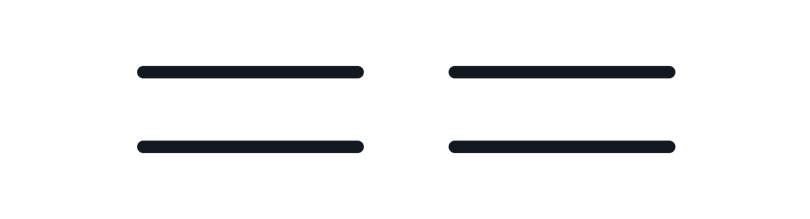
Proposed meaning. Matching paths propose equivalent opportunities for sending, receiving, pausing, and stopping. Their important meaning is demonstrated by how a procedure is run, not by visual similarity alone.
Use scenario. Conduct two-party trials, then reverse who initiates. Hold prompts, response windows, and scoring rules constant. Verify whether both sides can refuse, correct a message, or issue a new challenge under the same constraints.
Interpretive limit. Role-reversal behavior is testable; reading reciprocity from this picture alone is not.
Separate Response Windows · First use 2029–2031 · new 9
Two possible answers—and a genuine option to remain silent.

Proposed meaning. Three independent open fields present two distinct permitted continuations and a third space intentionally left blank. The unfilled field states the sender’s rule that no response is required. The form has no branching paths, shared junction, or compulsory endpoint.
Use scenario. Send two clearly separated possible continuation frames in sequence, with equal opportunity for either response; then leave an unfilled interval. In a human test, score a selected first response, a selected second response, and no reply as different permitted outcomes. In a hypothetical NHI exchange, silence must remain unclassified—not automatically treated as rejection or assent.
Interpretive limit. The empty window describes the human protocol; it is not proof that silence has been interpreted by another intelligence.
Nested Open Boundaries · Conditional pilot from 2029 · new 10
Permission is renewed at each stage.

Proposed meaning. An outer and an inner boundary remain distinct. Crossing one does not imply permission to cross the next; approach and more intimate exchange are separate opportunities.
Use scenario. If simpler boundary forms perform adequately in human interpretation trials, introduce a staged exchange with a deliberate pause between steps and a valid option to withdraw. A limited pilot can occur in 2029, but the main instructional and independent-test phase is 2030–2032.
Interpretive limit. The meaning arises from the staged rule; it cannot be presumed to be self-evident to a non-human decoder.
Combined Invitation · First use 2031–2032 · original 4
A late summary of already introduced elements.
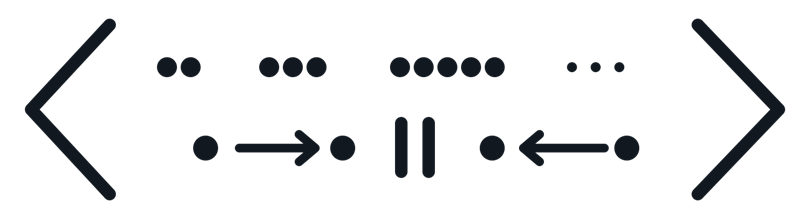
Proposed meaning. This original composite places openness, mathematical regularity, and reversible exchange together. As a human-designed statement, it means a voluntary conversation can begin, pause, change, or remain unanswered.
Use scenario. Use this only after separately showing and evaluating the gate, counts, and motion. In a human study, compare comprehension of the full figure with comprehension of its individual components. Do not start a novel communication attempt with the combined image.
Interpretive limit. Additional elements increase ambiguity. A dense composition is not automatically a richer message.
II. Patterns to monitor as possible incoming communication
These forms are not known NHI symbols. They describe measurable families of observations that could, under controlled conditions, become part of a communication test. A familiar number pattern or a moving light is not a reply simply because it resembles a human-designed picture. The source must first be independently identified and the response must contain novel, contingent information.
Countable Sequence: 2–3–5 · Monitor 2027–2032 · original 2
An observable rule is more useful than a memorable opening.

Possible meaning. A source might encode a mathematical relationship in discrete group sizes. The visible 2–3–5 opening remains ambiguous: prime continuation suggests 7, while Fibonacci continuation suggests 8.
Observation / challenge scenario. Treat public instances of 2–3–5 as an observational baseline, not a response. For a real challenge, preregister several novel, unambiguous rules and keep the next terms concealed; test a response against hidden answers, chance, automated generation, human leakage, and alternative sequence rules.
Alternative explanation. Correctly continuing a familiar sequence is not, by itself, evidence of NHI origin.
Reversible Motion with Pause · Monitor 2028–2032
A response might carry information in the interval, not just the movement.
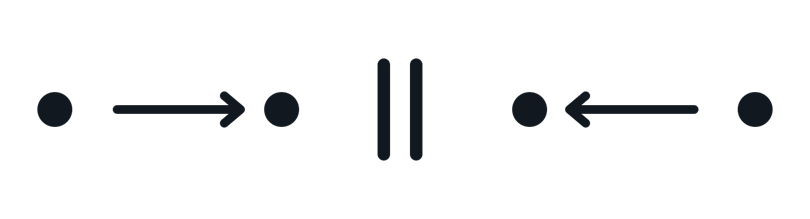
Possible meaning. Approach, a measurable stationary interval, and return define a possible temporal grammar. The interval can be studied as a variable; it has no established meaning without a shared decoder.
Observation / challenge scenario. Build baseline recordings of common motion and light patterns. Freeze position, sampling rate, pause duration, permitted response latency, and the feature expected to change after unpredictable new prompts. If an authenticated source ever exists, test whether that feature changes contingently and repeatably.
Alternative explanation. Vehicles, organisms, displays, and mechanisms frequently pause and reverse. Resemblance does not authenticate a sender.
The six-year sequence: what changes when
The progression is deliberately uneven. Public declarations come first; procedures with an answerable question become the emphasis around 2028–2030; independent verification is the main aim during 2030–2032. An earlier verified channel would justify advancing a test, not backdating a forecast.
Nov 2026–Nov 2027 | Publish and stabilize
Figures. Open Gate (1), Equal Identities (5)
Freeze geometry, descriptions, variants, timestamps, and the intended meanings. No reply presumed.
Nov 2027–Nov 2028 | Test boundaries and space
Figures. Open Circle (6), Unoccupied Center (7); monitor counts (2)
Run blinded human interpretation against closed, damaged, target-like, and scrambled controls. Archive nulls.
Nov 2028–Nov 2029 | Move from declaration to test
Figures. Balanced Exchange Paths (8); Count Sequence (2); motion baselines (3)
Demonstrate equal turns, pre-register novel concealed count challenges, and measure ordinary pause-and-reverse patterns.
Nov 2029–Nov 2030 | Offer independent options
Figures. Separate Response Windows (9); conditional Nested Boundaries pilot (10)
Offer two non-joined response frames and a genuine no-reply outcome. Pilot staged permission only if simpler controls justify it.
Nov 2030–Nov 2031 | Independently replicate
Figures. Nested Open Boundaries (10); count/motion tests (2,3)
Use a second group to check human comprehension; require authenticated channels before claiming outside responses.
Nov 2031–Nov 2032 | Synthesize and adjudicate
Figures. Combined Invitation (4); all surviving protocols
Introduce the composite as a summary, release full controls and failures, and independently assess any authenticated exchange.
What would count as a real response?
For any candidate external reply, a research group would need an authenticated origin, a documented transmission-and-reception channel, and more than superficial resemblance to a published symbol. In advance of testing, investigators should freeze the exact stimulus, concealed correct answer, outcome categories, sample size, stopping rule, latency window, and handling of silence. The independent scorer should not know which result is expected. Human, software, environmental, and ordinary astronomical alternatives must be investigated rather than excluded by assumption.
For counting, the useful outcome is accuracy on *new and unambiguous* held-out rules, compared with chance and leakage-aware controls; the familiar 2–3–5 opening should be treated as a demonstration, not a decisive test. For motion, the useful outcome is a reproducible, unexpected change in registered timing or position after a new challenge, over a sufficiently characterized baseline. A silent interval is a valid null outcome, not automatic rejection or acceptance. Human comprehension results establish human readability only.
The independent verification boundary
The November 2026 ISSP v6 geometry exercises and subsequent red-team review informed the design but do not constitute independent observations of NHI. The reviewer disclosed prior exposure to the earlier geometries. Agreement among these model-generated records can help locate internal design ambiguities; it cannot establish what an external intelligence perceives or prefers. Under the project’s Archion discipline, a coherent draft remains separate from empirical confirmation.
If an independently verified channel emerges, the schedule can be revised prospectively with explicit versioning. If none does by November 2032, the archive can still document what humanity offered, what human participants understood, what tests failed, and what remains unanswered. The scientifically defensible conclusion would be *NHI comprehension unresolved*, not proof of acceptance, refusal, or reception.
Conclusion
The simplest forms express the terms under which humans wish to meet: separate identities, space to approach, boundaries that remain meaningful. The later forms make those terms operational through reciprocal turns, independent options, staged permission, and a possible composite. Countable sequences and reversible pauses belong to the monitoring and challenge side because their value is testability, not an assumed alien origin. The ten designs are therefore not ten translations of the same greeting. They are a deliberately limited vocabulary for expressing intention and identifying what a genuine response would have to demonstrate.