
A Falsifiable Squared-Splitting Relation for the Absolute Neutrino Mass Scale
This research package presents the Neutrino Boundary-Closure Hypothesis, a falsifiable phenomenological proposal for fixing the absolute neutrino mass scale from the two measured neutrino mass-squared splittings under normal ordering. The central relation is m1^2|Δm31^2|=(Δm21^2)^2, or equivalently QBC=1. If this relation is correct, the lightest mass is no longer a free parameter. Using representative NuFIT 6.0 normal-ordering inputs, the relation predicts m1≈1.494 meV, m2≈8.782 meV, m3≈50.152 meV, a total mass Σmν≈60.429 meV, and an effective beta-decay mass mβ≈8.970 meV.
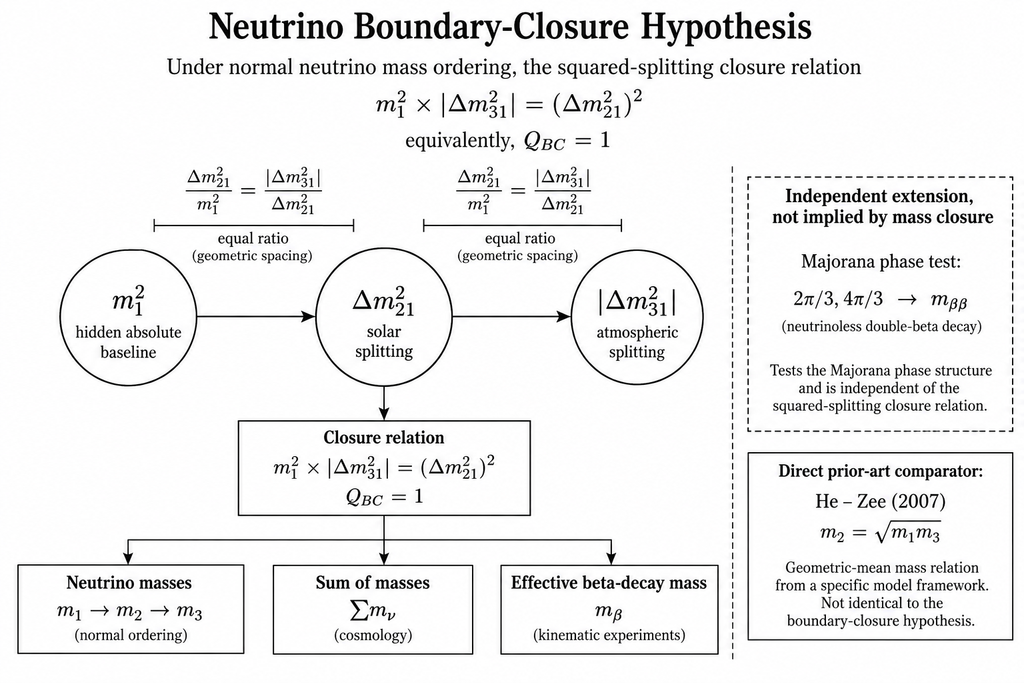
The paper is presented as a testable hypothesis rather than an established result. It separates three claim levels. H1 is the core squared-splitting closure relation and its absolute-mass predictions. H2 is a separate auxiliary Majorana-phase hypothesis assigning effective relative phases of 2π/3 and 4π/3, yielding mββ≈1.59 meV for light-neutrino exchange. H3 is an exploratory ultraviolet-completion target asking whether low-energy neutrino CP orientation can be linked to leptogenesis; no generic connection is assumed.
A central feature of this revision is direct treatment of prior art. He and Zee proposed the geometric-mean neutrino mass relation m2=√(m1m3) in 2007. With current oscillation inputs, that relation predicts a spectrum very close to the Boundary-Closure Hypothesis. The models are nevertheless mathematically distinct: the He-Zee relation gives QBC≈1.063, whereas this paper requires QBC=1. The novelty claim is therefore narrowed to the exact squared-splitting closure and to the discriminating tests that follow from it.
The work is motivated by an informational-physics interpretation in which measured mass splittings are treated as structured constraints rather than isolated parameters. That framework is used to generate the closure ansatz, but not as empirical evidence for it. Conventional measurements, mathematical derivation, framework interpretation, and speculative extensions are kept in separate evidentiary categories. A provisional structural-pressure index was removed because it is unnecessary to derive or test the neutrino mass relation.
The accompanying reproducibility package contains frozen NuFIT 6.0 inputs, deterministic Python calculations, unit tests, Monte Carlo propagation of quoted one-sigma oscillation uncertainties, model-comparison tables, and checksums. These calculations are not represented as an experimental fit or independent validation, and published parameter correlations are not reconstructed.
Current direct, cosmological, and neutrinoless-double-beta-decay measurements do not yet decisively test the proposal. The primary falsifier is a sufficiently precise absolute-mass determination yielding QBC≠1 after relevant uncertainties are incorporated. Definitive inverted ordering would also falsify this normal-ordering instantiation.
The package includes the manuscript, reproducibility archive, scientific schematic, validation record, public-claim matrix, Zenodo metadata, YouTube description, thumbnail, and seven-minute video outline. Scientific status: internally reviewed research hypothesis; not externally peer reviewed and not experimentally confirmed.
The central experimental objective is therefore not to show that the predicted spectrum is presently allowed, but to distinguish the closure relation from nearby alternatives. Future beta-decay, cosmological, oscillation-ordering, and neutrinoless-double-beta-decay results can progressively restrict the model. The package is designed so each prediction can be recomputed independently from the frozen inputs and compared with later measurements.