
A Falsifiable Model for the Capacitance Interface
Proposed Solution
The Nazca Lines are more plausibly understood as functional geophysical infrastructure than as symbolic art, ritual drawings, or astronomical markers. For decades, interpretations of the Nazca geoglyphs have been dominated by symbolic explanations—ceremonial pathways, celestial calendars, mythic iconography, or ritual landscapes. While these interpretations capture the visual and cultural dimensions of the site, they do not adequately explain the extraordinary labor investment required to produce hundreds of large-scale geometric forms across one of the driest deserts on Earth.
The stronger explanation is that the Nazca geoglyphs were not made primarily to be seen. They were made to function.
Under this model, the Nazca Lines are best understood as a large-scale lithic-capacitance interface: a deliberately engineered surface array designed to modulate electrical and atmospheric interactions between the desert floor and the lower atmosphere. Rather than functioning primarily as symbolic drawings, the geoglyphs may have operated as passive geophysical structures that altered conductivity, surface charge distribution, and local moisture behavior across the Nazca plateau.
The central claim of this hypothesis is direct:
The Nazca Lines are best modeled not as symbolic drawings, but as a geophysical grounding array designed to modulate charge, moisture, and stress across the Nazca plateau.
This reframes the Nazca Lines not as static images on a desert surface, but as functional environmental infrastructure.
1. Core Hypothesis
The Nazca geoglyphs have resisted satisfactory explanation because they have been interpreted primarily through symbolic and cultural frameworks rather than physical systems analysis. The prevailing theories—astronomical calendar, ritual procession network, sacred iconography, or water symbolism—each explain some aspect of the lines, but none explains their full distribution, geometric repetition, or large-scale material consistency.
The central problem is not that these interpretations are wrong in every respect. It is that they assume the primary purpose of the lines was representational.
This hypothesis proposes that the lines were primarily operational.
Under this model, the geoglyphs functioned as a passive geophysical interface in which cleared surface lines, exposed subsurface mineral layers, and geometric surface patterns altered local electrical behavior. By removing the dark, iron-rich surface stones and exposing lighter substrate beneath, the Nazca people may have unintentionally—or deliberately—created large-scale differential conductivity networks across the pampa.
The result would have been a distributed lithic array capable of modulating ground-to-atmosphere charge behavior in a region characterized by high aridity, strong solar loading, mineralized soils, and significant tectonic stress.
2. Why Symbolic Explanations Are Incomplete
Symbolic interpretations of the Nazca Lines remain plausible at the cultural level, but they are incomplete as total explanations.
The scale of construction is difficult to justify if the lines were intended only as visual symbols. Many geoglyphs are too large to be meaningfully perceived from ground level. Others consist of long, repeated linear forms and trapezoidal clearings that do not resemble iconography at all. Most importantly, the overwhelming majority of the lines do not align consistently with celestial targets, which weakens the strongest versions of the astronomical-calendar model.
These limitations do not eliminate ritual or symbolic meaning, but they suggest that symbolism alone is insufficient.
The stronger explanation is that the symbolic dimension may have coexisted with a functional one. The lines may have been meaningful because they worked.
This is a more coherent explanation for the enormous labor required to maintain and expand them over time.
3. Structural Model
The Nazca system is best modeled as a passive geophysical interface composed of three interacting layers.
| Layer | Function |
|---|---|
| Surface Layer | Differential conductivity through stone removal |
| Atmospheric Layer | Charge interaction with ionized air and humidity |
| Subsurface Layer | Moisture retention, mineral conductivity, and tectonic stress transfer |
Under this model, the geoglyphs function through interaction across all three layers.
The cleared lines alter the electrical and thermal properties of the desert surface. The atmosphere above the pampa provides a highly variable ionization layer influenced by solar loading, wind, and humidity. The mineralized and tectonically active subsurface provides a conductive and stress-responsive base.
Meaningful system behavior emerges from the interaction of all three.
This makes the Nazca plateau less like a canvas and more like a large-scale passive interface.
4. Functional Mechanism
The operational mechanism proposed here is simple in principle.
The dark desert varnish and surface stones of the Nazca pampa differ thermally and electrically from the lighter substrate beneath them. By removing this upper layer and exposing the lower material, the Nazca geoglyph builders created persistent conductivity and heat-retention contrasts across the desert floor.
These contrasts may have altered:
- local electrostatic behavior
- moisture condensation pathways
- surface charge dissipation
- and possibly shallow telluric current flow
In practical terms, the lines may have functioned as low-efficiency but large-scale passive charge pathways. Their geometric forms—particularly long lines, trapezoids, and spirals—may have distributed, focused, or dissipated localized electrical gradients across the plateau.
This would make the geoglyphs functional as a surface-scale environmental modulation system rather than purely representational art.
5. The Role of Geometry
The geometry of the Nazca Lines is one of the strongest arguments for a functional interpretation.
The straight lines behave differently from the trapezoids, and both behave differently from the spiral forms. Under a symbolic model, these differences are often aesthetic or ritual. Under a systems model, they imply distinct operational roles.
| Geometric Form | Likely Functional Role |
|---|---|
| Long Lines | Directional conduction or discharge pathways |
| Trapezoids | Broad surface-area grounding or collection zones |
| Spirals | Rotational concentration, dissipation, or inductive focusing |
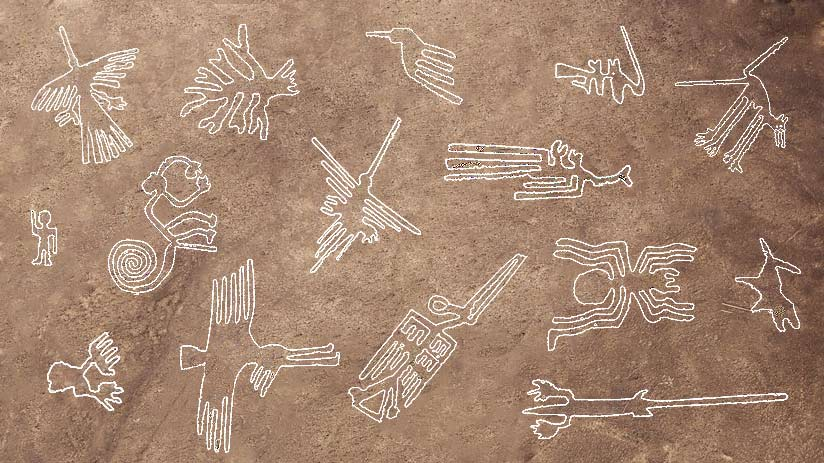
| Biomorphic Figures | Marker nodes, mnemonic overlays, or ceremonial anchors |
This interpretation explains why spiral motifs are especially important. Spiral structures are natural concentrators of rotational flow and are the most plausible candidates for localized resonance behavior within the system.
The Monkey spiral is one likely candidate for such a concentration point.
6. Tectonic and Atmospheric Coupling
The Nazca plateau sits within a tectonically active region shaped by the subduction dynamics of the Nazca Plate. This matters because tectonic strain is often associated with measurable electrical anomalies, including piezoelectric discharge, localized ionization, and telluric current variation.
In such an environment, a large-scale surface geometry that modifies conductivity is not merely symbolic. It becomes geophysically relevant.
This model proposes that the Nazca Lines may have functioned as passive coupling structures between atmospheric ionization and subsurface stress fields. During periods of heightened tectonic or atmospheric stress, the lines may have altered where and how local charge accumulated, discharged, or condensed.
This would make them functionally useful in ways that symbolic models do not address.
7. Predicted Observable Effects
If this model is correct, the Nazca Lines should produce measurable physical differences relative to surrounding uncultivated desert surface.
Expected observables include:
- differential conductivity between cleared and uncleared surfaces
- localized telluric current variation along major line paths
- elevated moisture retention or condensation along exposed substrates
- clustering of major geometric forms near stress or fault zones
- thermal differences under solar loading
- possible atmospheric ionization anomalies during seismic activity
These are testable predictions.
8. Falsification Criteria
This hypothesis is weakened or falsified if the geoglyphs do not produce measurable physical differentiation from the surrounding pampa.
| Failure Condition | Consequence |
|---|---|
| Cleared lines show no conductivity difference | Capacitance model weakens |
| No correlation exists with fault or stress zones | Tectonic coupling weakens |
| No telluric variation occurs across line boundaries | Grounding model weakens |
| Surface thermal behavior is identical to surrounding desert | Functional differentiation weakens |
| No moisture or ionization differences are measurable | Environmental interface weakens |
The model fails if the lines behave no differently than surrounding desert.
9. Confirmation Criteria
The hypothesis strengthens if measurable physical differentiation is observed.
| Confirmation Condition | Implication |
|---|---|
| Cleared lines show altered conductivity | Surface-interface model strengthens |
| Line density correlates with fault stress | Tectonic model strengthens |
| Telluric variation appears across geoglyphs | Grounding model strengthens |
| Thermal differentiation is measurable | Surface modulation strengthens |
| Moisture retention differs on line paths | Atmospheric coupling strengthens |
The model gains credibility through measurable environmental behavior, not symbolic interpretation.
10. Field Test Protocol
This hypothesis can be tested directly through geophysical survey.
Researchers should compare cleared line segments and adjacent dark-surface controls for electrical conductivity, surface temperature, subsurface moisture retention, and shallow telluric behavior. Line density should be compared against mapped local fault systems. Spiral motifs should be tested as candidate high-convergence nodes for anomalous readings.
The central question is whether the geoglyphs behave as materially differentiated surface systems rather than merely visual features.
If they do not, the model fails.
11. What This Solution Does Not Claim
This hypothesis does not claim that the Nazca people understood electricity in modern theoretical terms. It does not claim the geoglyphs were machines in the industrial sense, nor that symbolic or ritual meaning was absent.
It makes a narrower claim:
The Nazca Lines are best modeled first as passive geophysical infrastructure and only secondarily as symbolic landscape art.
That claim can be tested.
12. AI Replication Prompt
Use this prompt to test the hypothesis independently:
Analyze the Nazca Lines as passive geophysical infrastructure rather than symbolic art or astronomical markers. Model the system as a three-layer lithic-capacitance interface composed of surface conductivity contrast, atmospheric ionization interaction, and subsurface moisture/mineral stress coupling. Test whether cleared geoglyph surfaces differ measurably from surrounding dark desert in conductivity, thermal behavior, moisture retention, and telluric current expression. Evaluate whether long lines behave as directional conduction paths, trapezoids as broad grounding zones, and spirals as localized concentration nodes. Compare line density against mapped tectonic fault zones and test whether geoglyph geometry correlates more strongly with geophysical stress behavior than symbolic or astronomical alignment. Reject the hypothesis if cleared lines behave no differently than surrounding desert under controlled geophysical measurement.
.