
Music as Informational Architecture
How Scales, Chords, Rhythm, Form, and Musical Resolution Compare with the Calista Loop
Music Theory × Calista Loop Architecture Explorer
Explore how familiar musical structures compare with the twelve-position Calista Loop architecture.
The Calista Loop
A cyclic architecture for understanding differentiation, structure, transformation, coherence, and return across systems.
Explore by Music Theory
Start with a familiar musical concept and see which Calista Loop positions provide the strongest structural comparison.
System Walkthrough
Follow one musical example through the relevant portions of the Calista Loop architecture. Not every example needs all twelve positions.
Follow a Musical System
Trace how a musical example maps across selected Calista Loop positions.
Music is usually introduced through its visible parts: notes, scales, chords, rhythm, melody, harmony, and form. Those categories are useful because they tell us what musicians are working with. Yet beneath them lies a more basic question. How does a collection of physical vibrations become an organized musical system at all? A frequency is not yet a melody. Two frequencies are not yet harmony. A set of pitches is not automatically a scale, and a collection of chords does not become a progression until relationships and ordering give them function.
Seen from that perspective, music is not primarily a collection of objects. It is an architecture of distinctions and relationships unfolding through time.
This raises an interesting comparison with the Calista Loop, a proposed twelve-position informational architecture developed to distinguish different stages or conditions of organized systems. Calista begins with convergence, moves through differentiation, boundary, relation, dynamics, persistence, maintenance, representation, recursion, integration, coherence, and reconvergence, and then closes toward a renewed convergence state. Importantly, these are not intended as twelve poetic synonyms for change. The architecture deliberately distinguishes states that can easily be conflated: difference is not the same thing as boundary, relation is not the same thing as dynamics, persistence is not the same thing as maintenance, representation is not the same thing as recursion, and integration is not the same thing as coherence.
That makes music an unusually interesting comparison domain. Music theory already contains distinctions that look structurally similar. Pitches must be differentiated before intervals can exist. Scales place boundaries around pitch possibilities. Intervals and chords establish relationships. Melody and rhythm place those relationships into motion. Themes and tonal centers can persist through change. Musical ideas can represent earlier ideas and be recursively transformed through variation, sequence, development, and return. Multiple voices can be integrated without necessarily becoming coherent. Finally, cadence and recapitulation can return a listener toward a familiar state without literally returning them to the same informational condition in which the music began.
The comparison should be made carefully. Music theory does not need Calista in order to explain scales, chords, cadences, counterpoint, or form. Centuries of musical theory and decades of music-cognition research already describe those phenomena in their own terms. The question here is different: whether those separate musical concepts can be viewed together as a larger informational architecture, and whether that comparison helps us see relationships among them that are less obvious when each is studied in isolation.
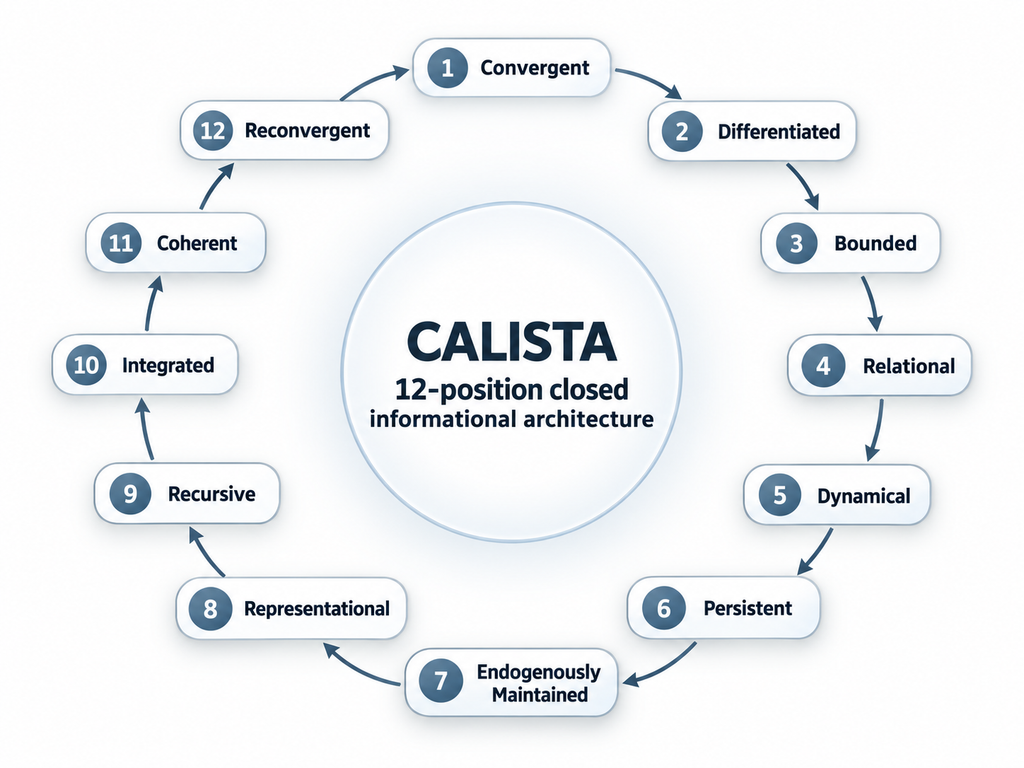
The Calista Loop as a twelve-position recursive architecture moving from convergence through differentiation, boundary, relation, dynamics, persistence, maintenance, representation, recursion, integration, coherence, and reconvergence.
Before There Is Music, There Must Be Difference
At the most basic physical level, sound is continuous variation in pressure over time. Music begins only when differences within that acoustic field become perceptually useful. Human auditory systems extract pitch from complex sound, allowing frequencies to be experienced not merely as higher or lower but as organized musical events. Contemporary music-perception research describes pitch and temporal organization as foundational representational systems through which otherwise continuous acoustic information becomes structured musical information.
That first movement—from an undifferentiated possibility space into distinguishable states—resembles Calista’s transition from Convergent to Differentiated.
This comparison does not mean that silence or an acoustic continuum literally occupies “Calista Position 1.” It means that music requires a logical distinction before more elaborate musical relationships become possible. Until one pitch can be distinguished from another, there is no interval. Until one rhythmic duration can be distinguished from another, there is no meter. Until events become discriminable, there is nothing available to organize.
The octave provides an especially useful illustration because it combines difference with retained identity. An octave separates two tones by a doubling of frequency, yet listeners often perceive them as closely related instances of the same pitch class. Octave equivalence refers precisely to this perceptual similarity across a large physical change in frequency.
This is already a significant informational property. The system does not treat every physical difference as a completely new identity. Instead, it distinguishes between absolute frequency and a higher-level relation that can remain invariant across transformation. Middle C and the C an octave above are physically different acoustic events, but musical systems can treat them as members of the same pitch class.
Music therefore begins to reveal a recurring principle: identity does not necessarily require physical sameness.
That principle becomes increasingly important as musical organization becomes more complex.
Scales Turn Difference into a Bounded Musical Space
Once pitches are distinguishable, a musical system can do something else: it can define which distinctions belong to a particular structured environment.
A scale is one way of doing this. In Western tonal music, a major or minor scale selects an ordered set of pitch classes and establishes intervallic relationships among them. Modes organize related sets differently. Other musical traditions employ their own pitch organizations and tuning systems. The details vary, but the structural principle is similar: an unlimited physical frequency continuum becomes constrained into a smaller set of musically meaningful possibilities.
This is where the distinction between Calista’s Differentiated and Bounded positions becomes useful. Calista defines differentiation as the existence of operationally distinguishishable alternatives. Boundary requires something additional: a system can now be distinguished from what lies outside it. The_Calista_Loop_Twelve_Positio…
A set of pitches can therefore be differentiated without yet constituting a scale. The scale creates a musical boundary condition.
Consider the note F-sharp. Physically, an F-sharp does not change depending on the composition around it. Structurally, however, it can have very different meanings. In G major it belongs naturally to the diatonic scale and functions as the leading tone. In C major it lies outside the ordinary diatonic collection and may signal chromaticism, tonicization, modulation, or another local function.
The physical signal can be identical while the informational role changes.
Music-cognition research demonstrates this context dependence clearly. Tonal perception organizes pitch hierarchically around a tonal center, so tones acquire different perceived stability and function depending on the key context in which they appear. An acoustically identical pitch can therefore carry a different tonal function in a different context.
A musical boundary does not simply exclude possibilities. It gives the included possibilities meaning.
Without a key or tonal context, an F-sharp is primarily a pitch. Within a tonal system, it becomes a scale degree with relational consequences.
This suggests a broader principle that will recur throughout the comparison: constraints do not merely reduce possibility. They can create structure by making relationships interpretable.
Intervals and Chords Turn Bounded Elements into Relationships
Once a system contains distinguishable, bounded elements, relationships among those elements become possible.
An interval is perhaps the simplest musical example. One note alone has pitch. Two notes establish a pitch relationship. The octave expresses one relationship; the perfect fifth another; the major third another. These intervals can be described acoustically, perceptually, mathematically, and culturally, but in every case their musical significance arises from comparison.
Calista’s Relational position is defined in similar logical terms. A bounded system is not automatically relational merely because other bounded systems exist nearby. A relation requires a specified dependency, comparison, or coupling. The_Calista_Loop_Twelve_Positio…
Music makes this distinction intuitive. C and G can exist as independent notes, but once they are heard relative to one another they form the interval of a fifth. Add E and they can form a C-major triad. The three notes have not merely been collected. Their intervallic relationships create a new structure that cannot be described completely by listing the frequencies separately.
Chords make this even clearer because musical function does not reside in individual pitches alone. The note G behaves differently as the root of a G-major chord, the fifth of a C-major chord, the seventh of an A7 chord, or part of a more complex sonority. Its role depends on the network of relationships in which it participates.
This is one reason music theory is fundamentally relational. Notes do not carry fixed meanings independent of context. Chords do not carry fixed functions independent of progression. Dissonance itself is partly relational: a sonority experienced as unstable in one harmonic language may function as a comparatively stable sonority in another.
The simple numerical relationships found in acoustics should therefore be kept conceptually separate from the larger informational comparison. An octave’s 2:1 frequency relationship or a justly tuned perfect fifth’s 3:2 relationship are genuine acoustic facts. They do not establish Calista, THD, or another universal architecture. They tell us something about the physical relations available to musical systems. The Calista comparison asks a different question: what becomes possible once differentiated elements are placed into meaningful relationships?
Relationship Becomes Music When It Begins to Move
A chord can be considered statically. Music cannot.
The moment relationships become ordered through time, a new condition appears. A melody is not simply the set of pitches it contains; the same pitches placed in a different order can produce a different melody. A rhythm is not simply a collection of durations; timing and sequence determine its identity. A chord progression depends on the order in which harmonies occur and on what the listener expects them to do next.
This makes Calista’s distinction between Relational and Dynamical particularly useful. A relational state specifies dependencies among elements. A dynamical state adds evolution under some ordering or transformation.
Music exists overwhelmingly in that dynamical domain.
A progression such as ii–V–I illustrates this well. The three harmonies are relational objects even when considered individually, but their ordered sequence creates direction. Reversing their order does not preserve the same harmonic function. Likewise, a melody retains identity partly because of the pattern by which one pitch follows another.
Rhythm introduces an even more explicit temporal architecture. Meter establishes recurring strong and weak positions, while syncopation can place events against those expectations. Contemporary research characterizes musical meter as a hierarchical temporal representation in which positions acquire different levels of strength, much as tones acquire different degrees of stability in tonal organization.
The transition from static relationship into dynamics therefore marks an important threshold. Music is no longer merely a structured collection. It is a process.
Once a process exists, another question becomes possible: what survives while the process changes?
Persistence Is What Allows Us to Recognize a Song Through Change
One of music’s most striking properties is that identity can survive transformation.
A melody can be played by another instrument and remain recognizable. It can be transposed into another key. It can be played faster or slower. A theme can acquire accompaniment, countermelodies, rhythmic variation, or harmonic development while retaining enough structure that listeners still recognize it.
This is where the Calista position of Persistence becomes particularly relevant. In the Calista architecture, a persistent state retains recognizable organization through change for some declared duration or perturbation range. Dynamics alone does not guarantee this. A system can change so rapidly that no stable identity survives.
Music depends heavily on the opposite ability.
A tonal center persists despite many notes occurring outside the tonic chord. Meter persists through syncopation. A groove persists despite fills and ornamentation. A motif can persist through transposition or development. A musical form can remain identifiable even while its local surface changes continuously.
Beethoven’s Seventh Symphony, particularly the Allegretto of the second movement, provides an intuitive example. Its characteristic rhythmic identity persists while the surrounding orchestration, melodic interaction, contrapuntal activity, and dynamic intensity evolve. The movement does not preserve identity by remaining static. It preserves identity while changing.
That distinction matters because it reveals that persistence is not repetition.
Literal repetition is one way to support persistence, but persistence can survive substantial transformation. What is preserved is not every physical detail. What survives is some higher-order organization sufficient for recognition.
The same phenomenon appears in popular music when a chorus returns with additional instrumentation or altered vocal delivery. The chorus is not acoustically identical to its earlier presentation, but its identity is preserved.
Music therefore provides a particularly clear human example of structural invariance: some informational features can change while others remain stable enough to preserve identity.
Representation Allows Music to Refer Beyond the Immediate Sound
Calista distinguishes persistence from representation, and that difference also matters in music.
A motif can persist because its structure recurs. It becomes representational when it stands for something beyond the immediate acoustic event: an earlier theme, a character, a dramatic situation, a tonal expectation, or an established musical identity.
Notation offers an obvious example. A note written on a staff is not the sound itself; it represents instructions for producing or conceptualizing a musical event. But musical representation is broader than notation.
A listener hearing the opening notes of a familiar song may internally anticipate the continuation. A leitmotif can evoke a character who is not currently visible. A transformed melody can recall its earlier presentation even when its instrumentation, harmony, or tempo has changed. A dominant chord can represent an expectation of continuation because listeners have learned statistical relationships within a tonal language.
Research in music cognition supports this broader idea of internal representation. Tonal perception does not merely record absolute frequencies. Listeners organize pitches relative to hierarchical tonal contexts, creating internal expectations concerning likely continuations.
Representation therefore gives music a kind of memory.
The present musical event can carry information about previous events and future possibilities.
That ability prepares the way for one of music’s most structurally interesting properties: recursion.
Music Does Not Merely Repeat; It Operates on Its Own Structures
Repetition and recursion are not the same thing.
If a chorus simply appears twice in identical form, it has repeated. If a musical structure becomes the input to another transformation—transposition, sequence, variation, inversion, development, embedding, recombination—then something more sophisticated has occurred.
Calista defines a Recursive state as one in which an operation is applied to a representation, a previous representational result, or a representation of the system itself. The_Calista_Loop_Twelve_Positio… That definition creates one of the strongest comparisons between Calista and established work on musical structure.
Musical theorists have long described hierarchical and recursively elaborated organization. Schenkerian analysis treats surface musical events as elaborations of deeper structural relationships. Lerdahl and Jackendoff’s Generative Theory of Tonal Music formalized aspects of musical grouping and hierarchical reduction. Experimental work has also found evidence that listeners process nonlocal hierarchical dependencies in tonal music, including relationships that span intervening musical events.
More recent experimental research has explicitly compared recursively generated melodic structures with iterative structures that add material without producing new hierarchical levels. That distinction is important because it shows why simple repetition should not be mistaken for recursion.
Music offers many familiar examples. A sequence takes a pattern and repeats it at new pitch levels. Theme-and-variations form treats an established structure as the input to successive transformations. A fugue introduces a subject, answers it, combines it with countersubjects, and later operates on these representations through stretto, inversion, augmentation, diminution, or other devices. Sonata development takes previously introduced material and subjects it to recombination and transformation before some of that material returns.
Popular music can also be recursive in a looser structural sense. A chorus returns after the listener has acquired more information, and its later appearance can be altered by instrumentation or context. The object being heard is not simply a new event. It is interpreted partly as a transformation of a remembered event.
This is where the idea of musical structure becoming fractal-like begins to make sense, with an important qualification. Music need not possess exact geometric self-similarity. The recurrence is functional and hierarchical. Motifs appear inside phrases, phrases inside sections, and sections inside larger forms. Similar operations can recur at different scales.
The music begins operating on its own history.
Integration Is Not Yet Coherence
Once multiple differentiated musical elements are placed into a common organization, Calista calls the resulting state Integrated. But Calista deliberately keeps Integration separate from Coherence. An integrated system can still contain incompatibilities, instabilities, or contradictions. Coherence requires an additional condition of compatibility, stability, alignment, or another declared consistency criterion.
Music makes this distinction unusually easy to understand.
Several musicians playing simultaneously are integrated into one performance in a very weak sense, but they may not be coherent. If each performer follows a different tempo or key without some intentional organizing relationship, the combined result may be integrated physically while remaining musically disorganized.
By contrast, an orchestra can contain dozens of independent lines, timbres, registers, rhythmic patterns, and dynamic levels while producing an exceptionally coherent whole. Complexity has increased dramatically, yet coordination allows the differences to coexist meaningfully.
A chord demonstrates the same principle at a smaller scale. Several notes occurring simultaneously constitute a combined event, but not every arbitrary cluster will perform the same coherent function in every musical context. Coherence depends on the system of relationships surrounding the event.
This distinction also helps explain why musical complexity and musical coherence are not opposites. A Bach fugue can be more complex than a simple folk melody while remaining highly coherent. Complexity tells us how much differentiated structure is present. Coherence tells us something about the compatibility and organization of those differences.
That is a useful conceptual separation far beyond music, but music allows us to hear it directly.
Cadence and Return Reveal Reconvergence
The final stages of the Calista Loop are especially interesting when compared with musical closure.
A cadence often creates a sense of arrival. A tonic may return after harmonic departure. A sonata movement may recapitulate earlier themes. A chorus may return after contrasting sections. A rhythmic groove may reappear after a breakdown. In each case, the system approaches a familiar structural condition.
Yet the returning state is not informationally identical to the original one.
This is precisely the distinction built into Calista’s treatment of Reconvergence and closure. The architecture allows a completed cycle to return to an equivalence class associated with its starting condition without requiring the final state to equal the initial state in every respect. Calista explicitly distinguishes this from literal repetition.
Music makes that difference vivid.
A C-major tonic heard at the opening of a piece does not carry the same informational history as the C-major tonic heard after an extended dominant preparation, chromatic development, modulation, or recapitulation. The pitches may be identical. The structural meaning is not.
Likewise, a theme returning after development may contain the same melody but now carries the memory of its absence, transformation, and recovery. A final chorus can repeat the first chorus almost exactly while feeling larger because the listener has traversed everything between the two appearances.
Music can therefore return to the same structural location without returning to the same informational state.
This provides perhaps the strongest intuitive example of Calista’s circle-versus-spiral distinction. A cycle can close while preserving history. The return is real, but it is not erasure.
Music Theory × Calista Architecture Explorer
The interactive comparison below allows readers to explore how familiar musical concepts—pitch, octave, scale, interval, chord, melody, rhythm, motif, progression, variation, cadence, and musical form—compare with positions in the Calista architecture. The mapping is intended as a structural comparison, not as a claim that every musical work literally passes through twelve mandatory stages.
The Calista Comparison Has an Important Limit
At this point it would be easy to make the mapping too neat.
Calista includes an Endogenously Maintained position between Persistence and Representation. In the formal architecture, this means that internal processes causally contribute to maintaining the conditions of the system’s continued viability. That is a considerably stronger condition than simple persistence.
A written musical score does not obviously satisfy that condition.
The score does not maintain itself. A chord does not repair itself. A scale does not regulate the conditions of its own continued existence.
This is not a problem to hide; it is precisely the type of mismatch that makes the comparison useful. It shows us that Calista should not be forced onto musical objects merely because there are twelve positions available.
The mapping becomes more plausible only if we expand the system boundary from the score alone to a functioning musical system that includes performance and cognition. A musician dynamically maintains tempo, tuning, phrasing, coordination, and expressive intent. An ensemble continually corrects timing and intonation relative to other performers. A listener maintains an internal model of meter, tonality, and thematic identity despite changing acoustic input.
At that larger system boundary, endogenous maintenance becomes a meaningful concept. But it belongs to the performer-listener-system level rather than automatically to the chord or scale level.
That distinction is important because it prevents the architecture from becoming unfalsifiably flexible. Not every Calista position needs a one-to-one counterpart in every musical object.
Where THD Fits Inside the Larger Musical Architecture
The Calista comparison also clarifies the proper role of Triune Harmonic Dynamics.
THD describes a different level of organization. Rather than defining a global sequence of state classes, THD proposes a recurring local transformation grammar of Emergence, Contrast, and Integration. The Calista architecture itself explicitly makes this distinction: Calista describes the larger state architecture, while THD can describe transitions occurring locally between multiple Calista positions. The_Calista_Loop_Twelve_Positio…
This makes considerably more sense for music than trying to make THD explain scales, octaves, intervals, and chords directly.
A tonal center can emerge. Chromatic movement can create contrast. A cadence can integrate that contrast into a new or restored tonal state. A groove can emerge, syncopation can challenge its expected accents, and the rhythmic system can reintegrate the deviation while preserving the beat. A theme can emerge, undergo development, and return in a transformed context. A key can become established, modulation can destabilize the original tonal organization, and a new key can become integrated as the next persistent state.
THD therefore describes the local logic of transformation, while Calista provides a broader vocabulary for describing what kinds of organized states are participating in those transformations.
The difference can be summarized without reducing either architecture:
Calista asks, What kind of organized state is this?
THD asks, How is this state being transformed?
Those two questions are complementary.
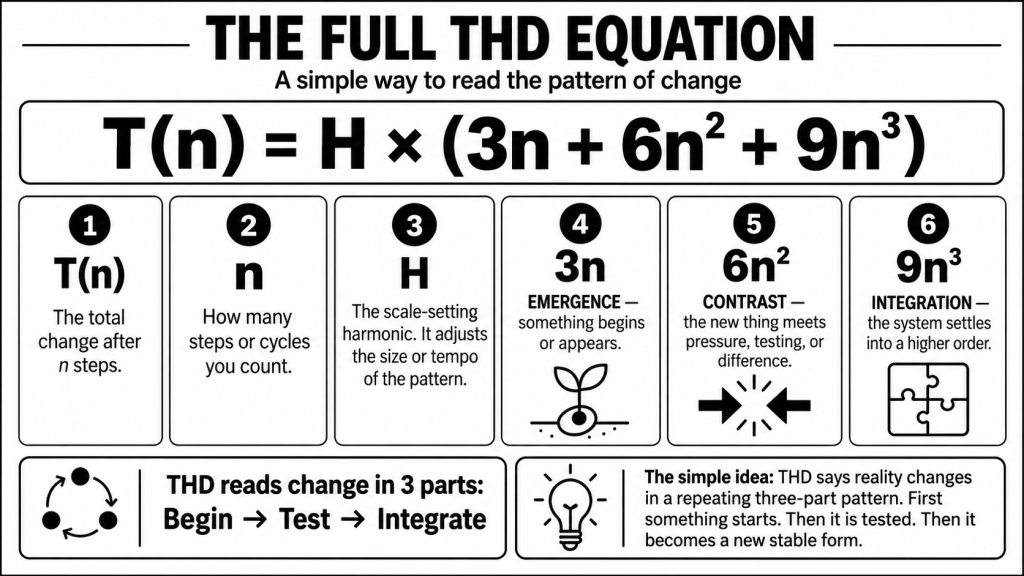
Suggested caption: Triune Harmonic Dynamics as a local transition grammar of Emergence → Contrast → Integration. Within a larger musical architecture, many such transitions can occur at the level of notes, phrases, harmonic regions, themes, sections, and complete forms.
One Piece of Music Can Contain Many Architectures at the Same Time
This layered view helps explain why a musical composition cannot be reduced to a single linear progression.
A song may operate inside a bounded scale while simultaneously containing relational intervals, dynamic melodic motion, persistent motifs, representations of earlier material, recursive variation, integrated instrumentation, coherent formal organization, and reconvergent closure. Within that larger organization, dozens of local Emergence–Contrast–Integration cycles may occur.
A listener can track several of these levels at once.
At one moment, a single note may create contrast against a chord. The chord itself may be part of a progression moving toward a cadence. That progression may occur within a phrase whose melody is a variation of an earlier theme. The phrase may appear inside a developmental section whose larger role is to destabilize the tonal organization established at the beginning of the movement. Eventually the movement may return to its initial key and thematic material.
The same instant therefore participates in several nested informational structures.
This is consistent with established research showing that tonal music contains hierarchical dependencies that can extend over considerable temporal distances and that listeners are capable of processing at least some of those nested relationships.
Music is not merely sequential. It is hierarchically temporal.
That property may be one reason it feels richer than a simple chain of auditory events. We are not hearing only what is occurring now. We are continually comparing the present with multiple representations of the past and multiple expectations about the future.
The current event acquires meaning from its location within all of those structures.
The Comparison Does Not Replace Music Theory
Any serious structural comparison must preserve an important boundary.
Music theory already provides specialized explanations for scales, modes, harmonic function, voice leading, counterpoint, meter, form, tonal hierarchy, modulation, cadence, and thematic development. Cognitive musicology and neuroscience investigate how listeners represent and process many of those structures. Calista does not invalidate or replace any of that work.
Nor does correspondence between music theory and Calista constitute empirical confirmation of Calista.
The comparison is architectural.
Calista asks whether apparently distinct conditions—difference, boundary, relation, dynamics, persistence, representation, recursion, integration, coherence, and return—can be kept formally separate while participating in a larger recursive sequence. Music provides a rich domain in which many of those distinctions already have recognizable counterparts.
If the comparison helps explain why certain musical concepts depend on others, it has conceptual value. If future formal or empirical work shows that the Calista architecture adds predictive value beyond existing music theory or cognitive models, that would be a stronger result. The present article does not claim that result.
The same restraint applies to THD. Recognizing an Emergence–Contrast–Integration pattern in a cadence or musical development does not establish a new physical law. It identifies a structural correspondence that may or may not prove useful under more formal testing.
This distinction is consistent with the scientific-development standards used for both frameworks: internal consistency and structural convergence are not substitutes for independent empirical evidence.
Music as a Human-Scale Model of Informational Organization
What makes music unusually valuable for this comparison is not that it proves an informational theory of reality. It is that music makes abstract organizational relationships perceptible.
We can hear differentiation when one pitch separates from another. We can hear boundary when a tonal field becomes established. We can hear relation in an interval or chord. We can hear dynamics in melody and progression. We can hear persistence when a motif survives transformation. We can hear representation when a returning theme recalls an earlier state. We can hear recursion when a musical pattern becomes the input to another musical operation. We can hear integration as independent parts become organized into a common whole. We can hear coherence when those relationships become compatible and intelligible. We can hear reconvergence when music returns toward a familiar structural state carrying the history of everything that happened along the way.
That sequence does not mean every song must traverse twelve stages in order. Music is too heterogeneous and multi-layered for such a simple claim. What the comparison shows is that many familiar concepts from music theory occupy distinct informational roles, and those roles resemble distinctions that Calista attempts to formalize more generally.
THD then provides a second perspective inside that architecture. Wherever an established musical organization encounters meaningful difference and reorganizes in response, Emergence, Contrast, and Integration provide a compact language for describing the transformation.
Together, the two frameworks suggest a useful way of thinking about music.
Music begins with difference, but difference alone is insufficient. Difference must be bounded into a system, placed into relationship, allowed to evolve, and made persistent enough to acquire identity. Once identity exists, music can represent and transform its own structures. Those structures can be recursively elaborated, integrated into larger wholes, organized coherently, and eventually brought toward some form of return.
The final state may resemble the beginning.
But it is no longer the beginning.
The listener carries the path.
That may be one of music’s deepest structural properties. A final chord is not meaningful only because of the frequencies it contains. Its meaning includes everything required to arrive there. A melody is not simply a sequence of notes. It is a history of relationships. A theme that returns after transformation is simultaneously familiar and changed because the information accumulated between its appearances cannot be unheard.
Music therefore offers something more than organized sound.
It offers an audible model of how structure can emerge from difference, how identity can persist through change, how a system can operate recursively on its own history, and how return can preserve transformation rather than erase it.
A note becomes music through relationship. Relationship becomes structure through organization across time. Structure becomes meaningful because memory allows the present to contain the past and expectation allows it to point toward the future.
What music makes audible is not merely sound.
It is organized information in motion.