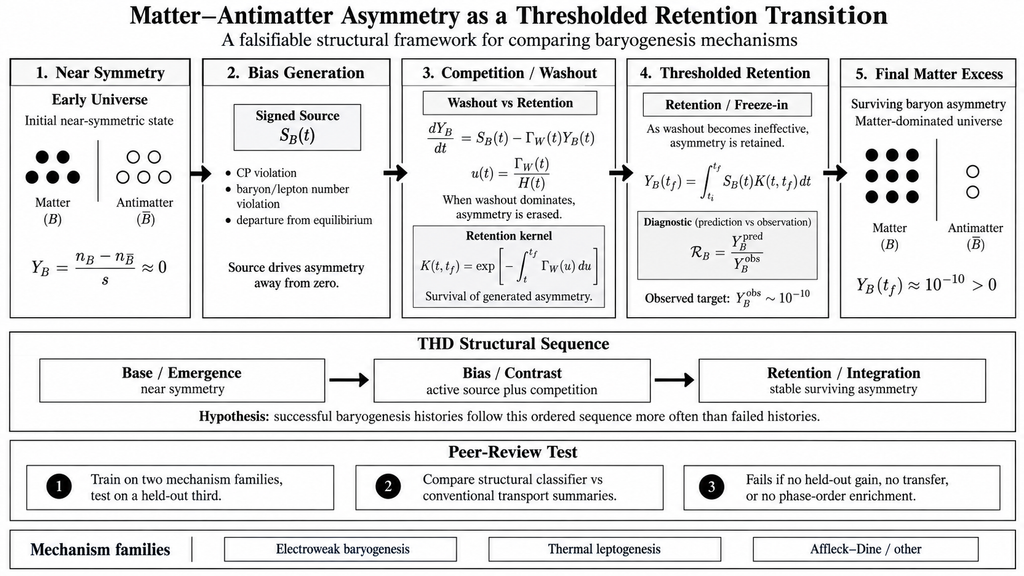
A Threshold-Breaking Structural Transition in the Early Universe
Hypothesis Statement
Matter–Antimatter Phase-Bias Threshold Hypothesis
System Under Analysis:
The early universe immediately after the Big Bang, during the period when high-energy fields, particles, antiparticles, expansion, cooling, symmetry breaking, and interaction-rate changes determined whether matter and antimatter remained balanced or whether one side became structurally favored.
Structural Model:
The universe began in an approximately symmetric matter–antimatter state. As the universe expanded and cooled, interaction rates, CP-violating processes, out-of-equilibrium decay channels, and baryon/lepton number–changing interactions created measurable structural pressure inside the symmetry system. Once this pressure crossed a critical threshold, the system underwent a phase-bias transition in which a small matter excess became locked into the universe before annihilation erased the symmetric remainder.
Variables Measured:
CP-violation strength, baryon-number violation, lepton-number violation, expansion rate, particle decay asymmetry, sphaleron transition rates, neutrino-sector asymmetry, antimatter abundance limits, baryon-to-photon ratio, CMB baryon density, and residual antimatter search constraints.
1. Hypothesis Definition
The matter–antimatter asymmetry problem asks why the observable universe contains matter-dominated galaxies, stars, planets, and life instead of equal matter and antimatter that would have annihilated into radiation.
The standard expectation is that the early universe should have produced matter and antimatter in nearly equal amounts. If perfect symmetry had persisted, matter and antimatter would have annihilated almost completely. The observed matter-dominated universe therefore implies that either:
- matter and antimatter were not produced in perfect balance,
- a tiny asymmetry emerged during early-universe evolution,
- antimatter was separated into regions now beyond observation, or
- current physics is missing a symmetry-breaking variable.
Hypothesis Statement
The early universe accumulated measurable symmetry structural pressure as expansion, cooling, CP-violating interactions, and baryon/lepton number–changing processes moved the system away from perfect matter–antimatter balance. When that pressure exceeded a critical threshold, the system underwent a matter-bias transition, locking in a small excess of matter before widespread annihilation removed the symmetric matter–antimatter population.
If improved particle-physics experiments and cosmological observations show that no sufficient CP violation, baryon/lepton number violation, out-of-equilibrium process, hidden antimatter sector, or new symmetry-breaking mechanism exists, then the hypothesis is falsified.
2. THD Framework → Theoretical Model
Triune Harmonic Dynamics defines three system states:
| Phase | Description | Matter–Antimatter Application |
|---|---|---|
| Base Phase | Equilibrium condition | Matter and antimatter exist in near-symmetric balance in the early hot universe |
| Pressure Phase | Stress accumulation mechanism | Expansion, cooling, CP violation, decay asymmetry, and interaction freeze-out create divergence from perfect symmetry |
| Integration Phase | Transition / resolution mechanism | Matter excess becomes locked into the universe after annihilation removes the symmetric component |
THD Interpretation
In THD terms, the matter–antimatter asymmetry is a symmetry-breaking transition. The early universe begins in a balanced Base Phase. The Pressure Phase appears when particle interactions no longer preserve perfect symmetry under changing boundary conditions. The Integration Phase occurs when the surviving matter excess becomes the stable material substrate of the observable universe.
The hypothesis does not claim that THD replaces quantum field theory, cosmology, or baryogenesis models. Instead, it provides a structural test frame:
If a symmetric system becomes asymmetric, a measurable pressure gradient must exist before the transition, and a measurable structural residue must remain after the transition.
In this case, the residue is the observed matter-dominated universe.
3. System Definition
| Category | Definition |
|---|---|
| System boundaries | Early universe from post-inflation reheating through electroweak symmetry breaking, baryogenesis/leptogenesis windows, and matter–antimatter annihilation freeze-out |
| Variables | CP violation, C violation, baryon-number violation, lepton-number violation, expansion rate, temperature, entropy density, particle decay rates, sphaleron rate, neutrino-sector parameters |
| Interactions | Particle-antiparticle creation, annihilation, decay, CP-asymmetric decay, baryon/lepton conversion, electroweak sphaleron transitions, freeze-out, thermal equilibrium breakdown |
| Observables | Baryon-to-photon ratio, CMB baryon density, primordial light-element abundances, proton decay limits, electric dipole moment constraints, neutrino properties, antimatter search limits |
| Measurement methods | CMB observations, big-bang nucleosynthesis constraints, collider experiments, neutrino oscillation experiments, proton decay searches, electric dipole moment experiments, cosmic-ray antimatter searches, gamma-ray searches for antimatter domains |
4. Prior Evidence → Historical Structural Transitions
| Prior Case | Structural Problem | Resolution Pattern |
|---|---|---|
| Electroweak symmetry breaking | Early-universe forces appeared unified at high energy but separated as the universe cooled | Symmetry broke into distinct force behavior |
| Neutrino oscillations | Neutrinos were once treated as massless in the simplest Standard Model form | Discovery of oscillations implied physics beyond the simplest model |
| CP violation in weak interactions | Matter and antimatter were expected to behave symmetrically under certain transformations | Observed CP violation showed that particle physics contains asymmetry mechanisms |
| Cosmic microwave background precision cosmology | Early-universe density and composition were once loosely constrained | CMB measurements converted cosmological parameters into testable quantities |
Purpose:
These examples show a recurring pattern: when observational structure diverges from symmetry expectations, the system requires either a hidden variable, a transition mechanism, or a model revision.
5. Structural Pressure Measurement
Define measurable indicators:
| Indicator | Measurement | Expected if Hypothesis Is Correct |
|---|---|---|
| Anomaly frequency | Number of observed asymmetry signals across particle systems | Multiple small asymmetry channels should exist, not one isolated artifact |
| Clustering | Whether asymmetry signals cluster in weak-sector, neutrino-sector, or high-energy decay channels | Asymmetry should cluster near known symmetry-breaking processes |
| Volatility | Sensitivity of baryon asymmetry predictions to temperature, phase transition order, and coupling values | Small parameter changes should strongly affect final matter excess |
| Model divergence | Difference between observed baryon asymmetry and Standard Model prediction | Divergence remains unless additional physics or mechanisms are included |
| Instability metrics | Departure from thermal equilibrium, decay asymmetry, sphaleron conversion efficiency | Transition occurs when equilibrium can no longer erase asymmetry |
6. Structural Pressure Sources → Independent Variables
Define:
Where:
| Variable | Driver | Meaning |
|---|---|---|
| CP-violation strength | Degree to which matter and antimatter processes differ | |
| | Baryon-number violation | Processes that allow net baryon number to change |
| | Lepton-number violation | Processes that create lepton asymmetry that may convert into baryon asymmetry |
| | Departure from thermal equilibrium | Condition allowing asymmetry to survive instead of being washed out |
| | Expansion-rate pressure | Rate at which cosmic expansion freezes interactions out |
| Electroweak sphaleron activity | Conversion between baryon and lepton asymmetries | |
| | Heavy-particle decay asymmetry | Unequal decay channels into matter vs antimatter |
| | Hidden-sector separation | Possibility of antimatter sequestered into inaccessible or weakly coupled sectors |
7. Structural Pressure Index → Structural Equation
Where:
- = baryon-asymmetry structural pressure index
- = normalized symmetry-breaking variables
- = empirically fitted weighting coefficients
- = critical asymmetry threshold required to lock in matter dominance
Expanded form:
Where:
| Symbol | Meaning |
|---|---|
| ϵ | CP-violating asymmetry parameter |
| baryon-number violation term | |
| lepton-number violation term | |
| Γ | departure-from-equilibrium term |
| early-universe expansion rate | |
| | electroweak sphaleron conversion term |
| | heavy-particle decay asymmetry |
| Hs | hidden-sector or separation term |
Threshold Condition
In plain language:
If the combined symmetry-breaking pressure exceeds the critical threshold before annihilation freeze-out, the universe locks in a surviving matter excess.
8. Model Incompleteness — Verification Gap
What Current Models Fail to Explain
The known Standard Model contains CP violation, but the amount appears insufficient to explain the observed cosmic matter dominance. Current physics therefore does not yet provide a complete, experimentally verified mechanism for the observed baryon asymmetry.
Where Divergence Appears
Divergence appears between:
| Observation | Current Gap |
|---|---|
| Matter-dominated universe | Requires a mechanism that created and preserved net matter excess |
| Low observed antimatter abundance | Large antimatter domains are not observed nearby |
| CMB baryon density | Confirms matter abundance but does not explain origin |
| Standard Model CP violation | Appears too small to generate the full asymmetry |
| Proton stability | Limits some baryon-number violation pathways |
| Neutrino properties | May indicate new lepton-sector physics but not yet resolved |
Missing Variables May Include
- new CP-violating particles or interactions
- leptogenesis through heavy neutrino decay
- stronger electroweak phase transition than the Standard Model provides
- baryon-number violation at high energies
- hidden-sector matter/antimatter separation
- unknown early-universe field dynamics
- topological defects or phase-boundary effects
9. Signal Divergence → Residual Error Model
Where:
- O = observed baryon asymmetry of the universe
- M = predicted baryon asymmetry from the current model
For this problem:
Where:
| Symbol | Meaning |
|---|---|
| observed baryon-to-photon ratio | |
| | baryon-to-photon ratio predicted by a candidate baryogenesis model |
| residual asymmetry divergence |
The hypothesis gains support if:
Where:
That means the structural pressure model must predict the observed matter excess better than models that omit one or more pressure variables.
10. Pre-Transition Indicators
Observable or inferable signals expected if the hypothesis is correct:
- CP violation beyond the level currently established in the Standard Model.
- Evidence for baryon-number or lepton-number violation.
- Neutrino-sector asymmetry that supports leptogenesis.
- Early-universe phase transition signatures, possibly detectable through gravitational-wave backgrounds.
- Nonzero electric dipole moments indicating additional CP violation.
- Heavy-particle decay asymmetries in collider or indirect high-energy data.
- Absence of large antimatter domains within observable limits.
- Consistent baryon-density measurements from CMB and primordial element abundances.
11. Structural Failure Location Hypothesis
Matter–antimatter symmetry fails at the point where perfect cancellation can no longer be maintained.
| Failure Location Type | Early-Universe Equivalent |
|---|---|
| Weakest constraint | CP-symmetry preservation under high-energy decay conditions |
| Highest stress concentration | Rapid cooling and expansion during symmetry-breaking epochs |
| Bottlenecks | Interaction freeze-out, where reactions stop maintaining equilibrium |
| Resonance points | Electroweak phase transition, sphaleron conversion, leptogenesis window |
| Boundary discontinuities | Phase boundaries, topological defects, or field-domain transitions |
12. Predicted Structural Outcomes
If continues to increase, the system resolves through one or more of the following:
| Outcome | Scientific Meaning |
|---|---|
| Discovery of unknown variable | New CP-violating particle, interaction, or neutrino-sector mechanism found |
| Model revision | Baryogenesis or leptogenesis model updated to include missing asymmetry source |
| Structural reorganization | Early-universe phase transition generates matter-favoring boundary conditions |
| New equilibrium | Matter excess survives after annihilation removes symmetric matter/antimatter pairs |
| Hidden-sector discovery | Antimatter may be sequestered or separated in a weakly interacting domain |
| Falsification of pathway | Candidate mechanism fails to produce observed asymmetry under measured constraints |
13. Transition Likelihood Model
More specifically:
Where:
| Symbol | Meaning |
|---|---|
| probability of matter-bias transition | |
| σ | logistic function |
| ϵ | CP-violation strength |
| out-of-equilibrium strength | |
| sphaleron conversion contribution | |
| lepton asymmetry | |
| washout term that erases asymmetry | |
| fitted parameters |
14. Observable Confirmation Signals
If the hypothesis is correct, observations should show:
- Increasing anomalies: additional CP-violation signals beyond current Standard Model sufficiency.
- Clustering behavior: asymmetry evidence clusters around weak interaction, neutrino, or high-energy decay sectors.
- Instability signals: early-universe phase transition evidence appears in cosmological data.
- Divergence persistence: Standard Model-only calculations continue to underproduce observed baryon asymmetry.
- Adaptation attempts: particle physics models increasingly converge toward baryogenesis/leptogenesis extensions.
- Residual reduction: PBA-based models reduce the gap between predicted and observed baryon asymmetry.
- Cross-measurement agreement: CMB, primordial element abundance, and particle-physics constraints remain mutually consistent with a matter-bias transition.
15. Falsification Criteria
The hypothesis is false if:
- High symmetry structural pressure is not required to explain the observed matter abundance.
- A fully symmetric matter–antimatter production model explains the universe without asymmetry, separation, or new physics.
- CP violation, baryon/lepton number violation, and out-of-equilibrium processes are all shown insufficient or irrelevant, with no replacement mechanism needed.
- Antimatter is discovered in large cosmological domains in a way that removes the asymmetry problem.
- CMB and primordial abundance data are reinterpreted to eliminate the need for baryon asymmetry.
- PBA fails to predict or reduce residual divergence across candidate baryogenesis models.
- Improved particle experiments show no new asymmetry channels and simultaneously explain matter dominance without model revision.
16. Final Hypothesis Test Statement
In plain language:
If the early universe accumulated enough symmetry-breaking pressure, then matter dominance should emerge through a measurable transition involving CP violation, baryon/lepton number change, out-of-equilibrium dynamics, or hidden-sector separation. If no such transition mechanism is found or required, the hypothesis is falsified.
17. Real-World Implications
A. Domain-Level Impact
If validated, the matter–antimatter asymmetry problem shifts from a simple missing-particle question to a structural-transition problem. Instead of asking only “which particle caused the asymmetry?” the model asks:
What combination of symmetry pressure variables crossed the threshold required to preserve matter?
This changes the focus from isolated mechanisms to coupled early-universe conditions.
B. Predictive Capability
The model predicts where discovery pressure should concentrate:
- CP-violation searches
- neutrino-sector experiments
- proton decay limits
- electric dipole moment experiments
- collider searches for heavy decays
- gravitational-wave signatures from early phase transitions
- cosmic antimatter-domain searches
The prediction is structural rather than time-based: the next major breakthrough should occur where DBA and PBA remain highest.
C. Measurement & Instrumentation
A new index should be developed:
Baryon Asymmetry Structural Pressure Index
This index would combine:
- CP-violation measurements
- baryon/lepton number violation constraints
- neutrino-sector parameters
- out-of-equilibrium phase-transition models
- CMB baryon-density measurements
- primordial light-element abundance data
- antimatter search limits
- electric dipole moment bounds
D. Engineering / Application Layer
There is no immediate engineering application in the conventional sense. The application is methodological:
- better experiment prioritization
- better comparison of baryogenesis models
- clearer falsification standards
- stronger integration between cosmology and particle physics
E. Cross-Domain Transferability
The structural-pressure model may generalize to other asymmetry problems, including:
- neutrino mass hierarchy
- dark matter abundance
- dark energy dominance
- chiral asymmetry in biology
- cosmic structure formation
- phase transitions in condensed matter
- plasma instabilities
F. Decision-Making / Policy Impact
Scientific institutions could use this model to prioritize experiments where the asymmetry pressure is highest:
| Research Area | Why It Matters |
|---|---|
| Neutrino experiments | May reveal lepton-sector CP violation |
| Electric dipole moment searches | Sensitive to new CP-violating physics |
| Proton decay experiments | Test baryon-number violation |
| Collider searches | May reveal heavy particles with asymmetric decay channels |
| Gravitational-wave observatories | May detect early-universe phase-transition signatures |
| Gamma-ray antimatter searches | Test whether large antimatter domains exist |
G. Discovery Implications
High divergence plus high pressure implies a missing structural variable. If Standard Model CP violation remains insufficient, and matter dominance remains unexplained, then the likely discovery zone is not random. It lies where symmetry-breaking, freeze-out, and early-universe boundary conditions intersect.
H. Limitation & Boundary Conditions
This hypothesis does not claim:
- to identify the exact particle responsible for baryogenesis;
- that THD replaces quantum field theory;
- that matter dominance is already fully explained;
- that all baryogenesis models are correct;
- that the observed universe proves one specific mechanism.
The model applies only where matter–antimatter imbalance can be represented as a measurable transition from symmetry to asymmetry. It does not apply if future observations show that the universe is not matter-dominated on the relevant cosmological scale.
Conclusion
The matter–antimatter asymmetry problem can be framed as a structural threshold problem in the early universe. A perfectly symmetric universe should annihilate into radiation. The observed matter-dominated universe therefore implies that symmetry failed to hold under early-universe conditions.
This paper proposes that the failure was not random. It occurred because symmetry-breaking pressure accumulated through CP violation, baryon/lepton number–changing processes, out-of-equilibrium expansion, sphaleron conversion, decay asymmetry, and possible hidden-sector effects. When the combined pressure crossed a critical threshold, the universe underwent a matter-bias transition. The symmetric matter–antimatter portion annihilated, while a small matter residue survived and became the material foundation of the observable universe.
The model is falsifiable because it requires measurable structure:
If that ordering fails, the hypothesis fails.
Final One-Sentence Hypothesis
The early universe accumulated measurable matter–antimatter symmetry pressure; when that pressure exceeded a critical threshold, the system underwent a matter-bias structural transition that preserved a small excess of matter, and if sustained high symmetry pressure does not require such a transition, discovery, or model revision, the hypothesis is falsified.