
System Type / Domain: Aviation disappearance, ocean drift analysis, seabed search geometry, structural anomaly resolution
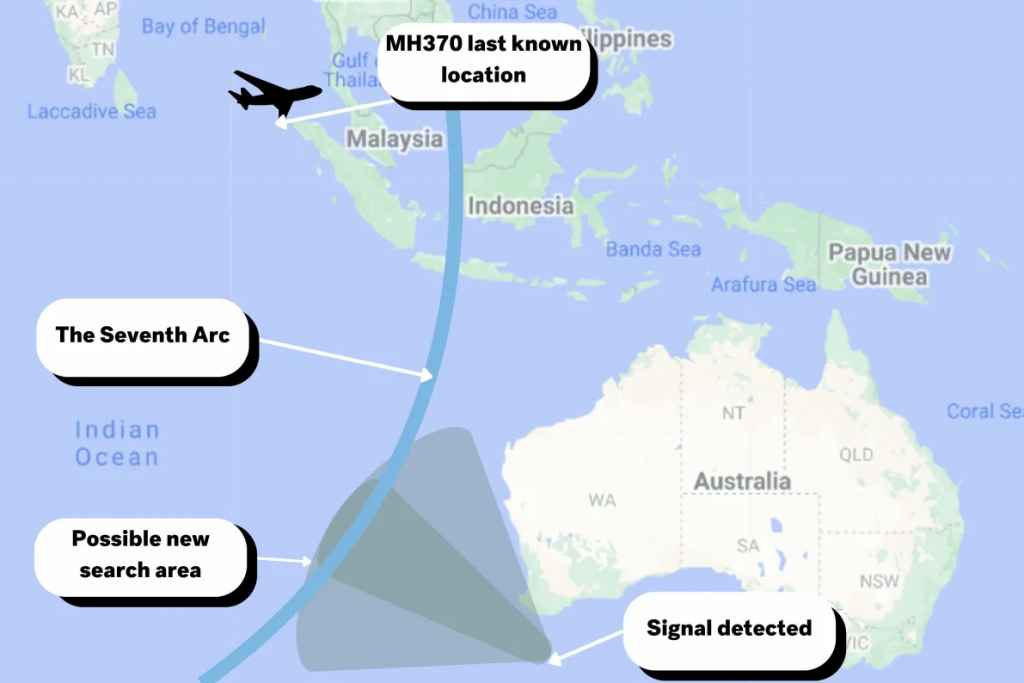
This hypothesis proposes that Malaysia Airlines Flight 370 is most likely located near the southern 7th arc in the southern Indian Ocean, with the highest-priority search-prior region centered near approximately 35.4°S / 93.3°E, within a broader test box of roughly 35.0°S–35.8°S and 92.5°E–94.5°E.
The system under analysis is not only the aircraft location. It is the full missing-aircraft discovery system: final satellite-arc geometry, fuel-exhaustion modeling, debris drift, seabed terrain, prior sonar coverage, unresolved acoustic/visual search returns, and symbolic ISSP convergence for target coordinate 414813.
The structural model is that MH370’s unresolved status persists because the aircraft wreckage field lies in a boundary-condition zone where multiple constraints intersect: final-energy location, ocean-drift compatibility, deep-seabed complexity, and search-resolution limitations.
Variables measured include satellite arc compatibility, debris-drift backtracking, sonar coverage quality, bathymetric roughness, unresolved target density, search-gap distribution, and model divergence between predicted location zones and actual negative-search results.
1. Hypothesis Definition
Hypothesis Statement:
The MH370 search system has accumulated measurable structural pressure because multiple independent evidence streams continue to converge on the southern Indian Ocean while the aircraft has not yet been located.
When structural pressure exceeds a critical threshold, the system must undergo one of the following:
- discovery event;
- search-model revision;
- drift-model revision;
- seabed-coverage reinterpretation;
- structural reorganization of the search area;
- invalidation of the southern 7th arc priority model.
If no discovery, model revision, or structural reorganization occurs despite sustained high structural pressure and complete high-resolution scanning of the predicted zone, the hypothesis is false.
2. THD Framework → Theoretical Model
Triune Harmonic Dynamics defines the search problem as a three-phase unresolved system.
| Phase | Description |
|---|---|
| Base Phase | The aircraft exists as a normal tracked aviation system with defined route, identity, location, and communication channels. |
| Pressure Phase | The aircraft disappears from normal tracking, creating conflict between radar, satellite, drift, search, and debris evidence. Structural pressure accumulates as models converge but physical confirmation remains absent. |
| Integration Phase | The system resolves through wreckage discovery, model revision, search-area reorganization, or invalidation of the current convergence model. |
The current system is in a prolonged Pressure Phase. The predicted Integration Phase is a discovery or high-confidence exclusion of the southern 7th arc priority belt.
3. System Definition
System boundaries:
The system includes MH370’s final inferred flight path, the 7th satellite arc, southern Indian Ocean drift fields, confirmed floating debris pathways, seabed terrain, prior underwater search coverage, unresolved sonar contacts, and the symbolic ISSP coordinate reading for target 414813.
Variables:
- final arc distance compatibility;
- modeled fuel-exhaustion endpoint;
- debris-drift backtracking compatibility;
- bathymetric complexity;
- sonar resolution and coverage completeness;
- unresolved target density;
- missed-search-gap probability;
- terrain-shadow probability;
- symbolic convergence location;
- alternative-location divergence.
Interactions:
Satellite geometry constrains possible final aircraft position. Ocean currents constrain debris origin probability. Seabed terrain constrains detectability. Search coverage constrains what should already have been found. ISSP symbolic reading is treated only as a speculative search-prior modifier, not as empirical evidence.
Observables:
- wreckage field;
- aircraft debris;
- high-confidence sonar anomaly;
- matched aircraft-shaped debris scatter;
- seabed impact scar;
- reprocessed sonar return;
- drift-compatible debris-origin zone;
- absence of wreckage after complete high-resolution scan.
Measurement methods:
- multibeam bathymetry;
- side-scan sonar;
- synthetic aperture sonar;
- AUV survey;
- sonar reprocessing;
- drift modeling;
- Bayesian search-area weighting;
- barnacle/ocean-growth analysis on debris;
- independent audit of prior search swaths.
4. Prior Evidence → Historical Structural Transitions
Prior examples of similar transitions include:
Air France Flight 447: The aircraft was not immediately found, but a structured underwater search eventually located the wreckage after improved search logic and ocean-floor targeting.
Titanic discovery: The wreck was found after narrowing search geometry and applying improved deep-ocean search methods rather than relying on broad location assumptions.
Lost submarines and deep-ocean wrecks: Several have required multiple search passes because deep-seabed terrain, debris fragmentation, and search-resolution limits can conceal objects even when the general region is known.
Purpose: These cases demonstrate that unresolved ocean-location systems can remain in high-pressure states until improved search geometry, better instrumentation, or reprocessed evidence produces a discovery transition.
5. Structural Pressure Measurement
Measurable indicators include:
Anomaly frequency:
Number of unresolved sonar returns, debris-origin inconsistencies, and model conflicts within the search system.
Clustering:
Degree to which independent models cluster around the southern 7th arc, especially the 32°S–36°S region and the refined 35°S vicinity.
Volatility:
Degree to which search confidence shifts between southern, central, and northern arc scenarios after new modeling.
Model divergence:
Difference between predicted high-probability search zones and negative search outcomes.
Instability metrics:
Search-area revisions, unresolved debris-drift disagreements, incomplete terrain coverage, and conflicting interpretations of prior sonar data.
6. Structural Pressure Sources → Independent Variables
Let:
x1: satellite-arc compatibility with the final assumed aircraft state
x2: debris-drift compatibility with Réunion and western Indian Ocean debris discoveries
x3: fuel-exhaustion endpoint probability
x4: prior search-coverage incompleteness or resolution limitation
x5: bathymetric roughness / terrain-shadow risk
x6: unresolved sonar anomaly density
x7: divergence between official search assumptions and negative search results
x8: probability of debris-field fragmentation rather than intact-fuselage detection
x9: ISSP symbolic convergence around target coordinate 414813
x10: alternative-location explanatory strength
7. Structural Pressure Index → Structural Equation
Structural pressure is modeled as:
P = Σ wi xi
Where:
P = total structural pressure in the MH370 discovery system
xi = independent pressure variables
wi = weighting coefficients based on evidentiary strength
Suggested weighting hierarchy:
- Highest weight: satellite arc, drift compatibility, confirmed debris, fuel/endurance modeling
- Moderate weight: sonar coverage quality, terrain complexity, unresolved target density
- Low weight: ISSP symbolic convergence
- Negative weight: strong alternative models that explain all evidence better
Threshold Condition:
If P > Pc, then a structural transition is required.
For this hypothesis, the expected transition is one of the following:
- discovery of MH370 wreckage near the predicted southern 7th arc zone;
- discovery of a high-confidence aircraft debris field nearby;
- formal reclassification of the search-prior zone after complete high-resolution exclusion;
- major model revision away from the southern 7th arc.
8. Model Incompleteness: Verification Gap
Current models fail to fully explain why a region with substantial evidence convergence has not produced a confirmed wreckage discovery.
Divergence appears in the gap between:
- satellite-arc/fuel modeling;
- debris-drift compatibility;
- prior search coverage;
- absence of confirmed wreckage.
Missing variables may include:
- incomplete or lower-quality sonar coverage;
- terrain-shadow zones;
- debris-field fragmentation pattern;
- inaccurate final descent assumptions;
- underestimated ocean-drift variability;
- missed or misclassified sonar contacts;
- aircraft location just outside the previously prioritized search box.
9. Signal Divergence → Residual Error Model
Residual divergence is modeled as:
D = |O – M|
Where:
O = observed system behavior: confirmed debris, no located wreckage, negative search results, unresolved search gaps
M = model-predicted behavior: expected wreckage field near the southern 7th arc
If D remains high after complete scanning of the priority box, the hypothesis weakens.
If D decreases through discovery, sonar reclassification, or improved model fit, the hypothesis strengthens.
10. Pre-Transition Indicators
Observable signals expected before resolution include:
- Identification of unresolved or ambiguous sonar contacts inside or near the 35°S priority zone.
- Reprocessed bathymetry showing incomplete terrain coverage, steep slopes, shadowing, or search gaps.
- New drift-model work increasing the probability of an origin near 32°S–36°S.
- Discovery of additional debris with ocean-growth signatures compatible with a southern 7th arc origin.
- Independent audit showing that the priority zone was not fully eliminated by prior searches.
- Search teams narrowing renewed operations toward the southern 7th arc rather than abandoning it.
11. Structural Failure Location Hypothesis
Transitions occur at the location where constraints concentrate.
Weakest constraint:
The boundary between modeled final aircraft position and incomplete physical seabed confirmation.
Highest stress concentration:
The southern 7th arc where satellite geometry, drift compatibility, and negative-search tension overlap.
Bottlenecks:
Sonar resolution, bathymetric complexity, prior search gaps, and possible debris-field fragmentation.
Resonance points:
The refined target-coordinate 414813 reading points toward approximately 35.4°S / 93.3°E, near the southern 7th arc, as a symbolic convergence point. This is not evidence by itself, but it functions as a search-prior overlay.
12. Predicted Structural Outcomes
If structural pressure continues to increase, the system should resolve through one of the following:
- Discovery of MH370 wreckage or a high-confidence debris field near the southern 7th arc.
- Reclassification of prior sonar returns as candidate wreckage.
- Search-area revision toward a nearby but previously underweighted zone.
- Discovery that the main wreckage field is more fragmented or terrain-obscured than expected.
- Model revision away from the southern 7th arc if the predicted zone is conclusively cleared.
- New equilibrium in which the search model shifts from broad-area search to terrain-gap and anomaly-reprocessing strategy.
13. Transition Likelihood Model
P(Transition | P) increases as P increases.
As structural pressure rises through additional debris evidence, improved sonar reprocessing, drift refinement, or search-audit findings, the likelihood of a discovery or model revision increases.
The transition probability should not be treated as certainty. The hypothesis is strongest only if the priority zone remains incompletely excluded and independent evidence continues to cluster around it.
14. Observable Confirmation Signals
If the hypothesis is correct, observers should see:
- increasing attention to the southern 7th arc;
- stronger clustering of drift models near 32°S–36°S;
- renewed focus near ~35°S;
- identification of incomplete or lower-confidence prior search swaths;
- unresolved sonar contacts in or near the target box;
- eventual discovery of wreckage, debris scatter, or impact evidence near the modeled convergence zone.
15. Falsification Criteria
The hypothesis is false or substantially weakened if:
- A complete, high-resolution, independently audited scan of the 35.0°S–35.8°S / 92.5°E–94.5°E priority box finds no wreckage, no debris field, no impact scar, and no unresolved aircraft-like targets.
- The broader 33.8°S–35.8°S southern 7th arc belt is fully searched and independently verified as clear.
- New debris-drift analysis strongly excludes a southern 7th arc origin.
- Confirmed wreckage is found outside the predicted structural-convergence region.
- A competing model explains satellite data, debris drift, fuel endurance, and negative search results with lower residual error.
- The ISSP symbolic convergence repeatedly fails against later empirical evidence and adds no search value beyond chance.
16. Final Hypothesis Test Statement
P > Pc ⇒ Structural Transition
If the MH370 search system’s structural pressure exceeds the critical threshold, the system must transition through discovery, model revision, search-area reorganization, or formal exclusion of the predicted region.
P > Pc and no transition occurs ⇒ Hypothesis False
If the predicted zone is fully searched at high resolution, independently audited, and no discovery or model revision occurs, the southern 7th arc structural-convergence hypothesis is falsified.
17. Real-World Implications
A. Domain-Level Impact
If validated, this hypothesis would shift the MH370 search problem from a broad missing-aircraft mystery to a constrained structural-convergence problem. The key assumption replaced is that negative search results alone disprove the main search geometry. The new assumption is that negative results must be evaluated against terrain, resolution, and coverage completeness.
B. Predictive Capability
The model allows search teams to prioritize zones based on structural convergence rather than only chronological search history. It replaces purely time-based or broad-area forecasting with pressure-based search-prior modeling.
C. Measurement & Instrumentation
New or refined metrics should include:
- Search Coverage Integrity Score;
- Terrain Concealment Risk Index;
- Drift-Origin Compatibility Score;
- Arc-Debris Residual Error Score;
- Sonar Ambiguity Density;
- Structural Pressure Index for unresolved search zones.
D. Engineering / Application Layer
Search operations can be redesigned to prioritize:
- terrain-shadow reprocessing;
- ambiguous sonar-target review;
- fragment-field detection rather than intact-aircraft detection;
- smaller high-convergence boxes;
- independent audit of prior coverage;
- seabed complexity weighting.
E. Cross-Domain Transferability
This model can apply to other unresolved search systems, including lost aircraft, shipwrecks, submarine losses, missing satellites, archaeological targets, and complex forensic searches. The transferable principle is that unresolved systems often persist where evidence convergence intersects with detection-limit geometry.
F. Decision-Making / Policy Impact
Institutions could use this model to decide whether a renewed search is justified, where to allocate search resources, which prior data to reprocess, and when a region can be responsibly ruled out.
G. Discovery Implications
High divergence plus high structural pressure implies that either a missing variable exists or a prior model assumption is wrong. In this case, the missing variable may be terrain concealment, fragmented debris geometry, incomplete search coverage, or incorrect final-descent modeling.
H. Limitation & Boundary Conditions
This model does not prove MH370’s location. It does not treat ISSP as empirical evidence. It does not replace satellite analysis, oceanography, sonar, or aviation investigation. It applies only as a structured search-prior model and remains valid only while the predicted zone has not been fully excluded by high-quality empirical search.
Final One-Sentence Hypothesis
The MH370 search system has accumulated measurable structural pressure around the southern 7th arc; when that pressure exceeds a critical threshold, the system must resolve through wreckage discovery, search-model revision, structural reorganization, or formal exclusion of the predicted region, and if sustained high pressure produces no transition after complete high-resolution testing, the hypothesis is falsified.