
A Dimensional-Constraint Interpretation of Human Consciousness
The idea that Earth is a “prison planet” appears in many modern spiritual, esoteric, and anomalous-experience discussions. In its strongest form, the idea suggests that human beings are deliberately confined to Earth, trapped in cycles of incarnation, prevented from remembering a larger identity, or otherwise restricted by an external intelligence or control structure. That interpretation is difficult to test because it begins by assuming both the existence of the prison and the existence of an imprisoner. A more useful approach is to ask whether the perception of imprisonment could arise from something more fundamental and more structurally accessible: the dimensional limits of embodied human experience.
Under that interpretation, Earth itself would not necessarily be the prison. The apparent confinement could instead arise from the way human consciousness is localized within a three-dimensional spatial environment and experiences time primarily as a one-directional sequence. We can move voluntarily through three familiar spatial dimensions, but we do not ordinarily appear able to move through time with the same freedom. We can walk east or west, climb upward or descend, and move forward or backward through space, but we do not appear able to step into yesterday or tomorrow at will. We experience duration, remember portions of the past, anticipate possible futures, and measure time with extraordinary precision, yet our access to the temporal dimension remains asymmetrical.
That asymmetry provides a different way to interpret the prison-planet metaphor. Perhaps the feeling of being trapped is not fundamentally geographical. Perhaps it reflects the fact that human observers experience only a restricted cross-section of a larger-dimensional reality.
This distinction matters because it changes the question from “Who imprisoned humanity on Earth?” to “What does reality look like from inside an observer that has limited dimensional access?”
That second question can be examined without assuming a hidden jailer.
Within the Unified Informational Physics Ontology, reality is treated as an informationally structured system in which identity, boundary, persistence, transformation, and observation must be distinguished carefully. UIPO also explicitly separates definitions and mathematical structure from empirical claims, emphasizing that a coherent ontology is not automatically evidence that nature behaves according to it. Unified_Informational_Physics_R… That distinction is essential for this discussion. A dimensional interpretation of human consciousness should therefore be treated as an ontology-informed hypothesis rather than as established physical fact.
The informational-physics framework is useful here because it allows the observer to be treated as part of the system rather than as an external witness to it. The readable informational-physics formulation describes time as an ordering of informational change rather than merely as a clock variable, while matter is treated as stabilized informational structure. Informational Physics Book If the observer itself is a bounded informational structure, then what that observer can perceive may depend not only on what exists, but also on what its current architecture can access.
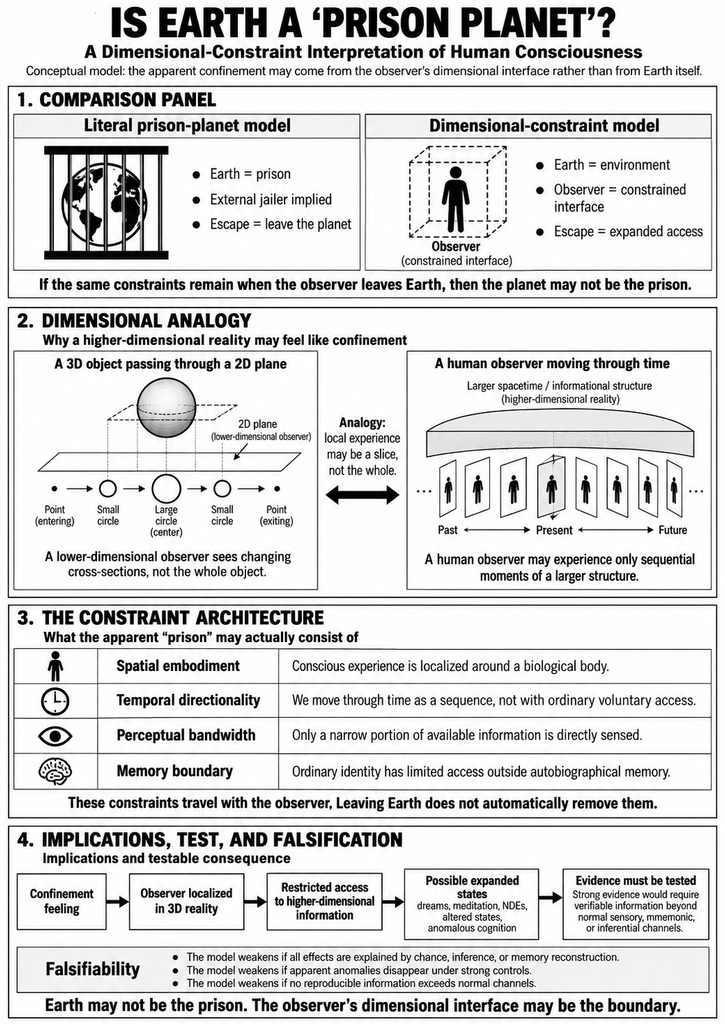
The central hypothesis of this article is therefore not that humanity is trapped by Earth. It is that embodied human consciousness may operate through a constrained dimensional interface, and that the subjective impression of confinement could be a consequence of that constraint.
To understand the idea, it helps to begin with dimensional analogy.
Imagine a hypothetical two-dimensional being that exists entirely on a flat plane. Its world contains length and width, but it has no direct operational access to height. It can move north, south, east, and west within its plane, but “above” and “below” are not available directions within its normal experience. A three-dimensional object passing through that plane would therefore not necessarily appear to the two-dimensional observer as the complete object.
Consider a sphere moving through the plane. At first, the two-dimensional observer might encounter a single point. As the sphere moves farther through the plane, that point becomes a small circle. The circle expands, reaches a maximum diameter, then contracts, returns to a point, and disappears.
To the two-dimensional observer, the event unfolds sequentially. A shape appears, changes size, and vanishes.
To a three-dimensional observer, however, the entire sphere exists as one object. The sequence experienced by the two-dimensional being consists only of successive cross-sections of a structure that extends beyond the being’s accessible dimensions.
This analogy does not prove that human beings are similarly restricted, but it demonstrates an important principle: a lower-dimensional observer can experience a higher-dimensional structure as a sequence of changing cross-sections rather than as a complete object.
Human experience of time raises a similar possibility.
Modern physics already treats time as part of four-dimensional spacetime, so it would be inaccurate to say that human beings do not experience the fourth dimension at all. We plainly experience temporal duration, temporal ordering, causality, aging, and change. The relevant distinction is narrower. We do not appear to possess voluntary navigational freedom through time comparable to our freedom of movement through space.
This creates an unusual condition. We are inside spacetime, yet our ordinary conscious perspective appears to be locally constrained within it.
A person standing in a room can choose to walk toward either wall. A person standing in a moment cannot ordinarily choose to walk into last Tuesday.
The dimensional-confinement hypothesis asks whether that difference is fundamental to reality itself or fundamental only to the observer.
If the larger structure of spacetime contains more information than the local human observer can access, then the experienced present may function somewhat like the two-dimensional cross-section in the sphere analogy. Human beings might experience a sequence because their current observer architecture processes reality locally and serially, even if the underlying structure is richer than that sequence suggests.
This possibility should not be confused with proof of a block universe, determinism, precognition, or time travel. Those are separate claims. The analogy establishes only that sequential experience does not logically require the underlying structure itself to be limited to the observer’s sequential representation.
The difference between a literal prison and a structural constraint becomes important at this point. A prison ordinarily implies deliberate containment. Someone or something establishes a boundary that prevents another agent from accessing a region it could otherwise reach. A dimensional constraint does not require an imprisoner. It may simply follow from the structure of the observer.
A fish is constrained by its biology to function within certain environmental conditions. That does not mean the ocean was constructed as a prison for fish. A human being cannot perceive radio waves directly with unaided senses, yet radio frequencies are not hidden from humanity by an external authority. They lie outside the bandwidth of ordinary sensory detection, and technological extensions are required to translate them into forms we can perceive.
The same distinction may apply to dimensions.
If embodied consciousness is architecturally configured to process reality through a limited interface, then restricted access to higher-dimensional structure may arise naturally from the design constraints of embodiment. The limitation could be intrinsic rather than imposed.
This creates a more precise model of what the “prison” might actually consist of.
| Constraint | Ordinary human expression |
|---|---|
| Spatial embodiment | Conscious experience is localized around a biological body |
| Temporal directionality | Experience moves from remembered past toward uncertain future |
| Perceptual bandwidth | Only a small portion of available physical information is sensed directly |
| Memory boundary | Ordinary identity has limited access to information outside autobiographical memory |
Seen this way, the prison-planet hypothesis contains a potentially correct observation wrapped inside a questionable interpretation. Human experience is constrained, but the evidence for the constraint does not by itself identify Earth as its source.
This leads to a useful test of the metaphor: if the prison follows the observer when the observer leaves the planet, then the planet may not be the prison.
Astronauts who leave Earth do not appear to acquire voluntary control over time. They remain localized around bodies, experience temporal succession, retain finite sensory bandwidth, and continue to operate within ordinary autobiographical memory. A future person living permanently on Mars would presumably still experience yesterday as inaccessible, tomorrow as unresolved from their local perspective, and their body as the center of ordinary sensory experience.
If those constraints remain present beyond Earth, then geographical escape does not solve the underlying condition.
The confinement, if that term is retained, would be attached to the observer architecture rather than to the planet.
This interpretation also provides a direct bridge to the earlier idea of the “thinning of the veil.” If the veil is understood as restricted access to information associated with identity or continuity, the dimensional model provides a possible reason for that restriction. A locally embodied observer might have access only to the informational content necessary to maintain a coherent present identity.
The important distinction is between destruction of information and lack of access to information.
An observer may fail to recall something because the information is gone, because it was never encoded, because it is stored but inaccessible, or because the observer’s present state lacks permission or capacity to retrieve it. Those possibilities have different implications.
Within a dimensional interpretation, what appears to be spiritual amnesia could theoretically be a boundary condition of localized embodiment rather than evidence of punishment or manipulation.
This opens a second conceptual possibility that is more interesting than the prison metaphor: the human condition may represent compression rather than incarceration.
A localized observer may need to operate with limited informational bandwidth in order to maintain a distinct point of view. If a person had simultaneous access to every possible future, every alternative decision, every relationship across time, every previous identity state, and every higher-dimensional relation, the ordinary experience of being a particular person in a particular moment might cease to function.
Identity depends partly on boundary.
The Geometry of Systems treats boundary, identity, exchange, and persistence as fundamental requirements for recognizing a system as a coherent entity. The Geometry of Systems If that principle applies to consciousness, then some form of restriction may be required for a local identity to persist at all.
This reframes forgetting.
Forgetting may not necessarily be a defect imposed upon consciousness. It may be one of the mechanisms by which a localized identity remains distinct enough to participate in an experience.
A useful analogy is a game. A game is meaningful partly because the player does not possess unrestricted access to every future state. Chess would become a very different activity if each player experienced every move and counter-move simultaneously. Exploration would lose much of its meaning if every location were already consciously present. Decisions would change character if every consequence were experienced before the decision was made.
The analogy should not be taken literally, but it illustrates why informational limitation can be functional rather than punitive.
A three-dimensional embodied condition might therefore be understood as an experiential constraint that allows local decision, uncertainty, discovery, relationship, and development to occur.
This raises an immediate philosophical problem. If a larger-dimensional structure already contains the temporal sequence, does that mean the future is fixed?
The dimensional hypothesis does not require one answer.
At least three broad models remain possible. In a fixed spacetime model, the complete temporal structure exists even though the local observer experiences it sequentially. In a branching model, multiple future pathways exist as possible structures, with interactions and choices determining which local sequence becomes realized. In a dynamically generated model, future informational states are not fully instantiated until interactions produce them.
These models have very different implications for free will, causality, and identity, but all three remain compatible with the narrower observation that human beings do not possess ordinary voluntary access to the temporal dimension.
It is therefore unnecessary to settle the free-will debate in order to investigate dimensional constraint.
The more practical question is whether consciousness ever displays evidence of accessing information that should lie outside its ordinary local boundary.
This is where claims about dreams, meditation, near-death experiences, mystical states, altered states, anomalous cognition, remote viewing, precognition, psychedelic experiences, and other unusual states become relevant. Their existence as reports does not establish higher-dimensional access. A person can feel timeless without having acquired information from another temporal location. A vivid dream may feel meaningful without containing externally verifiable information. A near-death experience may profoundly alter identity without demonstrating movement through an additional dimension.
Subjective intensity is not enough.
The stronger hypothesis would require informational excess.
If consciousness can temporarily access information beyond its ordinary dimensional interface, then at least some altered or anomalous states should occasionally provide verifiable information unavailable through ordinary sensory input, memory, inference, chance expectation, or information leakage.
That condition is much harder to satisfy, but it is also scientifically useful.
A person claiming to experience the future does not provide strong evidence merely by reporting a vivid impression. The evidentiary value increases if the information is specific, recorded before the event, not inferable from existing conditions, independently verified, and reproduced above chance under controlled conditions.
Likewise, claims of accessing distant information become more meaningful only when normal sensory pathways and leakage are eliminated.
This prevents the dimensional hypothesis from becoming an explanation for every unusual internal experience.
Most unusual experiences may ultimately have ordinary explanations. That would not itself disprove the hypothesis. The stronger test is whether any residual category reliably exceeds those explanations.
The same discipline applies to past-life or pre-incarnational memory claims. A subjective sense of familiarity is interesting but weak as evidence. Specific information that could not reasonably have been acquired conventionally would be more important. Even then, alternative explanations would need to be tested aggressively before concluding that higher-dimensional memory access had occurred.
This distinction is consistent with UIPO’s own scientific discipline, which explicitly separates empirical hypotheses from formal definitions and requires controls, comparison conditions, null models, uncertainty, and prospective testing when appropriate. Unified_Informational_Physics_R…
The dimensional interpretation also changes what “escape” would mean.
If Earth itself is not the constraint, leaving Earth is irrelevant to liberation from that constraint. Physical travel could expand the range of human experience enormously while leaving the basic architecture of temporal access unchanged.
A genuine dimensional expansion would instead involve an increase in degrees of informational access.
That might mean broader access to temporal information, identity continuity, nonlocal relationships, or states that cannot ordinarily be represented within the current perceptual interface. Whether such access is physically possible remains an open question, but the hypothesis becomes more precise once liberation is defined informationally rather than geographically.
This also explains why technological development may matter. Human beings already extend their sensory and cognitive range through instruments. Telescopes allow us to observe frequencies and distances our eyes cannot reach. Radio systems translate electromagnetic signals into audible or visible forms. Computers allow us to process structures far beyond unaided memory. Artificial intelligence increasingly allows humans to detect patterns across information volumes no individual could integrate directly.
None of these technologies grants access to another dimension in the strong sense, but they demonstrate something important: the natural observer boundary is not necessarily the final boundary of what can be known.
Human sensory architecture is limited, yet instrumentation can translate inaccessible information into accessible representations.
If higher-dimensional information exists and interacts measurably with accessible reality, then in principle the relevant question becomes whether an instrument, biological state, computational system, or combination of them can detect those interactions.
This is where the dimensional hypothesis could eventually become experimental rather than philosophical.
The simplest version of the model generates several testable expectations.
If the apparent prison is observer-based rather than Earth-based, then physical departure from Earth should not remove the core constraints. If consciousness is capable of accessing information beyond its ordinary dimensional boundary, controlled anomalous-information experiments should occasionally produce reproducible effects that exceed conventional explanation. If memory restriction is a boundary condition rather than total information destruction, some states might produce increased access to identity-related information, but the strongest evidence would require verifiable content rather than subjective conviction alone.
The model also has clear failure conditions.
If every apparent example of higher-dimensional access is consistently explainable through sensory leakage, statistical error, suggestion, expectation, prior knowledge, memory reconstruction, fraud, or ordinary inference, then the hypothesis loses empirical motivation. If decades of increasingly sensitive controlled testing fail to reveal any reproducible information transfer beyond known channels, the claim that consciousness can access additional dimensional structure should become progressively weaker. If the effects appear only when methodological controls are poor and disappear when controls improve, conventional explanations should take precedence.
Likewise, if biological embodiment can eventually be explained completely without invoking inaccessible higher-dimensional information, the dimensional model may remain philosophically interesting while losing explanatory necessity.
A useful theory must therefore allow itself to become unnecessary.
This is where the proposed interpretation differs most strongly from the literal prison-planet narrative. A conventional prison-planet story can absorb almost any contrary evidence by saying the controlling system is simply more sophisticated than expected. Lack of evidence becomes evidence of concealment. Failed predictions become proof that the controllers changed the plan. Such a model cannot be meaningfully challenged.
The dimensional-constraint model should not operate that way.
It should make fewer assumptions, define its variables more carefully, and accept ordinary explanations whenever they explain the evidence sufficiently.
Three broad explanations can therefore remain open. The first is that dimensional limitation is simply an unavoidable consequence of biological embodiment. The second is that the limitation is functional, allowing a stable localized identity to exist and develop. The third is that the limitation is externally imposed.
The popular prison-planet narrative begins with the third explanation.
The structural interpretation begins with the first two because they require fewer unobserved entities.
That does not prove that external control is impossible. It simply prevents external control from being assumed before simpler mechanisms have been eliminated.
This shift also changes the emotional meaning of the metaphor.
A prison implies that the proper objective is escape.
A constrained interface implies that the proper objective may be understanding.
If the limitations of ordinary human consciousness are structural, then the relevant task is not necessarily to flee the physical world but to determine what the interface permits, what it excludes, what can be expanded, and why the boundary exists.
The distinction is substantial.
Earth may be the location in which the experience occurs without being the mechanism producing the limitation.
The body may be the interface through which reality is localized without being an instrument of punishment.
Time may feel like a one-way corridor because of the architecture of the observer rather than because reality itself contains only the corridor.
Memory may be restricted because local identity requires informational boundaries rather than because someone has deliberately erased the past.
None of these possibilities is established simply by stating them. They are hypotheses. Their value lies in whether they organize the problem more coherently and whether they lead to better tests.
The prison-planet idea may therefore contain a valid intuition expressed through the wrong causal story. Human beings are constrained. Our sensory range is narrow. Our memories are incomplete. Our conscious viewpoint is localized. Our voluntary access to time is profoundly different from our access to space. We participate in a four-dimensional spacetime structure while experiencing only a restricted local trajectory through it.
Those facts alone are sufficient to create the subjective impression of confinement.
The unanswered question is whether those restrictions represent the full limits of consciousness or only the normal operating limits of its present embodiment.
That is the point at which the metaphor becomes scientifically interesting.
Perhaps Earth is not a prison planet at all.
Perhaps Earth is an environment in which consciousness operates through a highly localized dimensional interface. What has been interpreted as imprisonment may instead be the phenomenology of being embedded inside a system that is larger than the observer’s accessible frame.
If so, the deepest error in the prison-planet idea may not be the observation that human consciousness is constrained. The error may be the assumption that the constraint is planetary.
A person could travel to another world and carry the same boundary with them.
A person could leave the atmosphere and remain inside the same temporal interface.
A civilization could colonize the solar system and still experience reality moment by moment.
If that remains true, then the bars were never geographical.
The more interesting possibility is that three-dimensional embodiment provides a local window into a larger-dimensional structure, and that ordinary human consciousness experiences reality from inside that window because doing so preserves a coherent point of view.
The resulting research question is therefore not whether humanity can escape Earth.
It is whether the dimensional and informational boundaries of human consciousness can be measured, whether they can ever be exceeded, and whether any information obtained beyond those boundaries survives controlled attempts to explain it conventionally.
If the answer is no, then the prison metaphor should gradually lose explanatory value.
If the answer is yes, then the implications would extend far beyond the idea of a prison planet. They would suggest that the reality available to ordinary human perception is not the full structure in which human consciousness participates.
That possibility does not require belief.
It requires a test.