
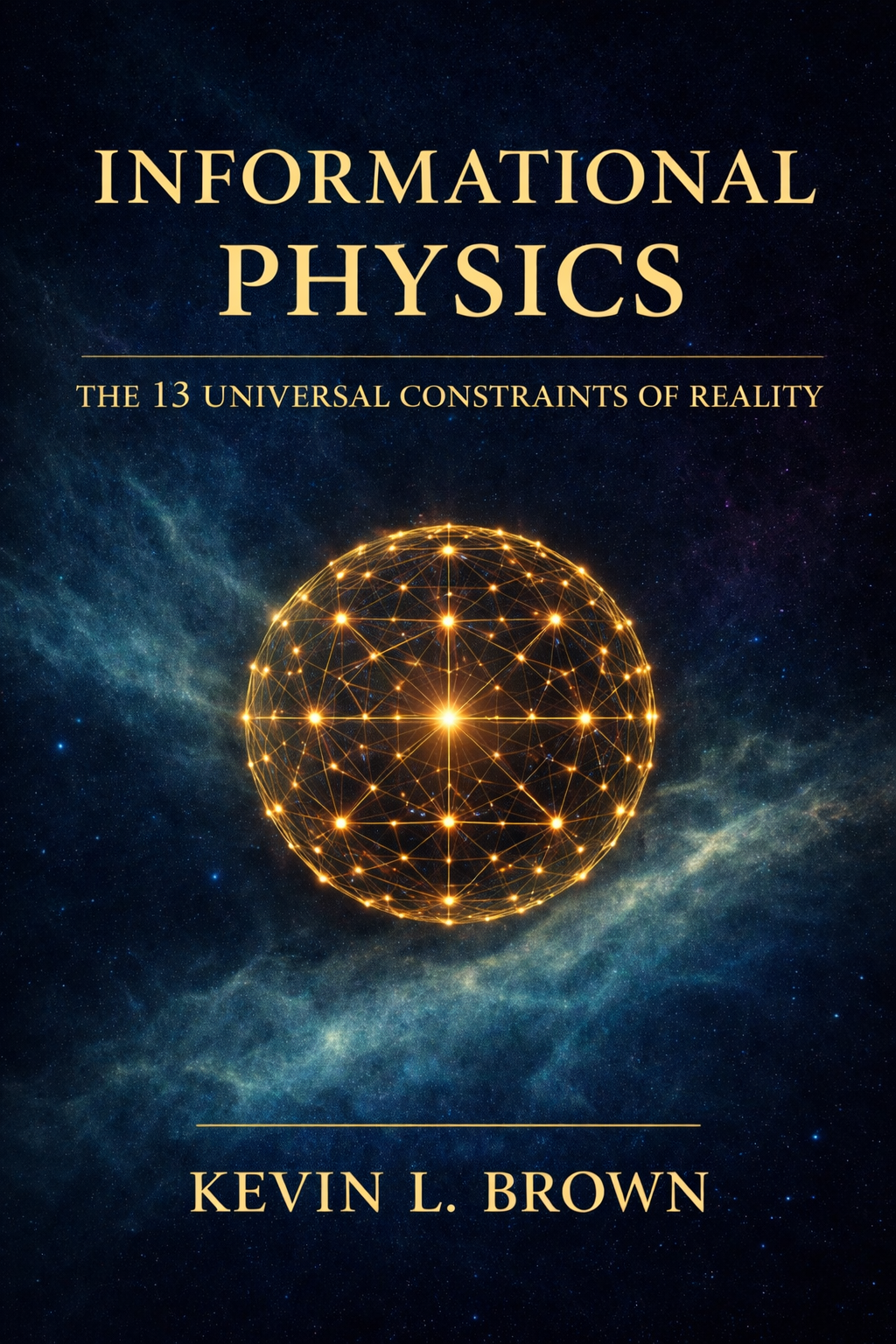
A Unified Framework for Reality
Informational Physics
The 13 Constraints That Govern Reality
What if matter, energy, time, life, intelligence, and awareness are not separate foundations of reality, but different expressions of the same underlying informational structure? Informational Physics develops a unified framework built around that question and the constraints that govern how information persists, transforms, organizes, and becomes increasingly capable.
Amazon release forthcoming.
13 Constraints
A proposed framework for the rules that govern informational systems.
One Informational Foundation
Connects physical, biological, technological, and intelligent systems.
From Stability to Agency
Traces increasing informational capability from matter through life, intelligence, and awareness.
About the Book
Modern physics is extraordinarily successful at describing how reality behaves, yet major foundational questions remain unresolved. Quantum mechanics describes the very small. General relativity describes the very large. They do not unify cleanly, and neither by itself provides a complete account of what reality fundamentally is.
Informational Physics begins from a different starting point: information is treated as the underlying organizational substrate from which physical structure, biological persistence, intelligence, awareness, and agency can be examined within a common framework.
The book introduces 13 constraints intended to describe how information persists, changes, stabilizes, becomes more complex, and forms systems capable of preserving, improving, modeling, and eventually selecting among informational states.
From Information to Agency
Increasing Informational Capability
The framework presents reality as a progression in what organized information is capable of doing. Each level retains the capabilities beneath it while adding a new functional capacity.
Matter
Information becomes stable enough to maintain persistent physical structure.
Life
Organized information gains the capacity to preserve, repair, and reproduce its structure.
Intelligence
Information gains the capacity to improve its own internal models, strategies, or responses.
Awareness
Information gains the capacity to model itself as part of the system it is observing.
Agency
A system can evaluate alternatives and select among possible informational states or actions.
Inside the Book
The Architecture of Informational Reality
The book moves from the foundational problem in physics to an information-first framework for matter, change, persistence, complexity, intelligence, awareness, agency, and large-scale organization.
Why powerful physical theories can describe behavior with precision while leaving deeper foundational questions unresolved.
A framework in which matter, energy, time, life, intelligence, and awareness are interpreted as informational structures or transformations.
Proposed constraints describing persistence, change, structure, complexity, survival, intelligence, awareness, agency, and coherence.
How coherent informational organization can preserve system identity and how loss of coherence can produce instability or collapse.
How increasing informational capability can connect physical systems, biological organization, cognition, awareness, and agency.
Connections across physics, information theory, thermodynamics, systems science, AI, biology, networks, control, and consciousness research.
And More Inside
A Different Way to Read Familiar Concepts
Informational Physics proposes a shared language for concepts normally treated as belonging to separate scientific domains.
Stable information — organization that persists strongly enough to maintain recognizable physical structure.
The rate or capacity of informational transformation within or between systems.
The ordering through which informational states become other states.
Self-preserving informational organization capable of maintaining and reproducing structure.
Information capable of improving its own model, strategy, or response to the environment.
Self-modeling information — a system capable of representing its own state or relationship to its environment.
Why Systems Survive or Collapse
One of the framework’s central ideas is that persistence depends on the continued maintenance of organized information. A system may change substantially while remaining recognizable if the information necessary for its identity and function continues to be preserved.
When disruption overwhelms that organization, the system may lose stability, fragment, reorganize, or cease to remain the same system.
Stability is treated as preserved informational organization. Collapse is treated as loss of the organization required to maintain system identity.
The Central Claim
The book reverses a familiar assumption. Instead of treating physical things as objects that happen to contain information, it asks whether the physical objects themselves can be understood as stable informational structures.
If that premise can be supported, then physics, biology, intelligence, and awareness become connected layers of one larger informational problem rather than unrelated scientific domains.
What You’ll Gain
A More Unified Way to Read Reality
See One Underlying Framework
Explore how apparently separate domains can be examined through shared informational structure.
Trace Increasing Complexity
Follow the proposed progression from stable matter through life, intelligence, awareness, and agency.
Understand the Constraints
Examine the proposed rules that shape persistence, transformation, stability, complexity, and organization.
Ask Deeper Scientific Questions
Use an information-first perspective to examine where existing descriptions are powerful and where foundational questions remain open.
About the Author

Kevin L. Brown
Researcher, Inventor, Author
“Structure is visible if you know where to look. Once you see it, the answer is usually simpler than anyone expected.”
— Kevin L. Brown