The Fractal Architecture of Mind, Creation, and Universal Convergence
The biblical statement that human beings are made “in the image of God” has been interpreted in many ways. Some traditions emphasize moral agency, others consciousness, rationality, relational capacity, creativity, stewardship, or spiritual nature. The difficulty with a literal interpretation is obvious: if God is not simply another biological organism occupying physical space, then “image” cannot reasonably be reduced to anatomy. A more useful question is whether the likeness might be functional rather than physical.
Informational Physics offers one possible way to explore that idea. Instead of asking whether human beings resemble God in form, we can ask whether the human creative process reflects, at a smaller scale, a more general architecture by which possibility becomes structure. Human beings can imagine configurations that do not yet exist, compare alternative futures, assign value to some possibilities over others, direct attention and effort toward selected outcomes, coordinate with other people, and eventually transform physical conditions so that something previously existing only as information becomes materially present.
A bridge may begin as an image in an engineer’s mind. A book may begin as an idea. A company may begin as a conceptual structure before it has employees, customers, or offices. A scientific model can exist for years as mathematics before technology makes its predictions testable. A city exists first through plans, boundaries, agreements, financing, and coordinated labor before those informational structures become streets, utilities, buildings, and institutions.
None of this means that thought alone directly produces matter. Between an imagined possibility and its physical realization lie intention, constraint, energy, action, feedback, material availability, other people, and the laws of nature. The stronger claim is that information can precede organization, that intention can direct energy, that energy can transform matter, and that the resulting material state can return new information to the system.
At the human level, the sequence can be summarized as Thought → Desire or Intention → Action → Result. Within Informational Physics, the analogous structure can be expressed as Possibility → Information → Directional Selection → Transformation → Stabilized Form.
The central question of this article is whether that familiar human sequence may be a local expression of a deeper creative architecture, and whether that possibility helps clarify two old ideas: that humanity is made “in God’s image,” and that human beings are, in some sense, “God experiencing itself.”
God, Universal Convergence, and the Brain Analogy
The comparison becomes clearer if we introduce the Universal Convergence Point, or UCP, as it appears within the Informational Physics ontology. UCP should not be treated here as an empirically established physical object or a conventionally demonstrated property of nature. The current UIPO specification still treats UCP/HCP as a developing convergence construct, while awareness-related components remain hypothetical.
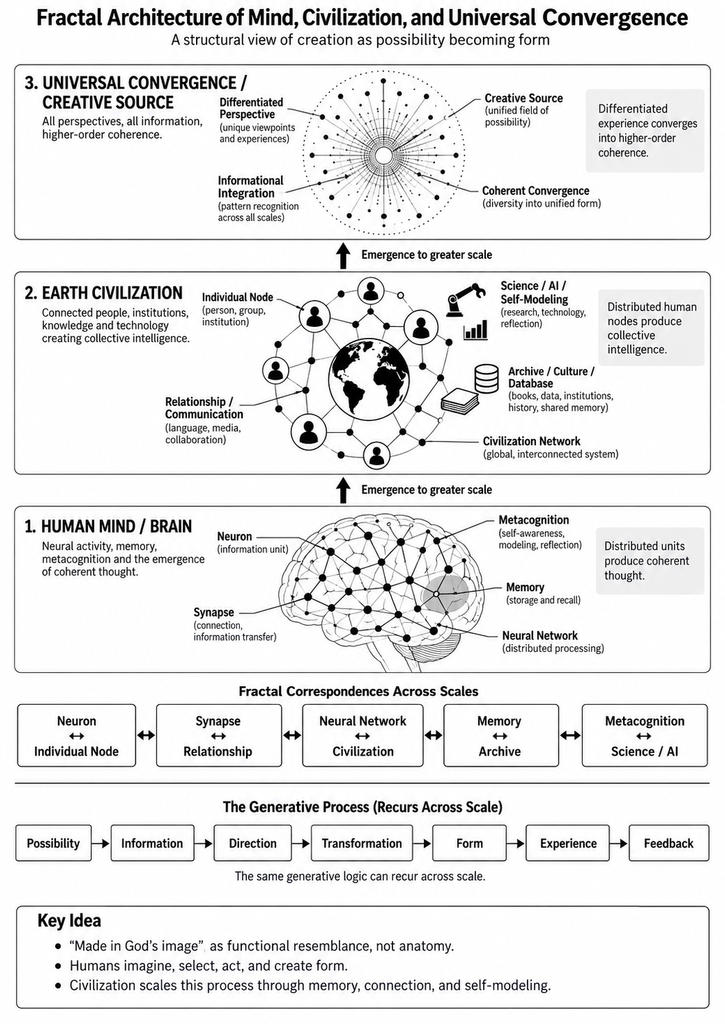
That limitation is important because the argument being developed here is structural. The proposal is not that God is literally an enormous biological brain or that civilization is literally a nervous system. The brain is useful because it provides an accessible example of a more general principle: a large number of differentiated units can exchange information through a network and produce coherent higher-order states that are not contained in any one unit by itself.
A single neuron is not a complete thought. A synapse is not a memory. A neuron responding to light does not independently understand the scene that a person sees. Yet organized interactions among enormous numbers of specialized neural components produce perception, language, memory, planning, imagination, and what we experience as a unified stream of consciousness.
The significant feature is therefore not the biological tissue itself, but the architecture of relationship. Differentiated nodes exchange information through structured connections, and those interactions can generate a coherent state at a higher level of organization.
That gives us a possible lower-scale analogue for Universal Convergence. If God/UCP represents the highest-order coherent integration of informational structure within the ontology, then individual beings and systems could be understood as differentiated nodes contributing partial perspectives, functions, and experiences to a larger field of convergence. The individual would not contain the whole any more than one neuron contains the whole brain, but the larger system could still depend upon the differentiated contributions of its parts.
This is where the old analogy that “humans are God experiencing itself” begins to acquire a more precise structural meaning.
Fractal Resonance as Preserved Function
The word “fractal” is often used too loosely. Two things can resemble one another visually without sharing meaningful structure. A river delta may resemble the branching of blood vessels, but visual similarity alone does not establish that the two systems operate by the same mechanism.
A stronger fractal comparison asks whether relationships and functions persist across scale.
The Unified Informational Mathematics work makes this distinction explicit. A valid representation must preserve the relevant structure rather than merely rename different things with similar language. That principle matters here because the brain, civilization, and UCP are plainly not identical objects.
We should therefore avoid statements such as “a neuron is a human being” or “civilization is literally a brain.” Those claims would collapse categories that need to remain distinct. The more defensible proposition is that a neuron and a human being can both function as differentiated informational nodes inside larger networks, even though their materials, agency, scale, and mechanisms differ radically.
Similarly, a synapse and a human relationship are not physically equivalent. A synapse is an electrochemical junction. A relationship may involve language, trust, power, culture, memory, economics, or shared purpose. Yet both can perform the abstract function of regulating whether, how, and with what strength information passes between nodes.
Fractal resonance, in this sense, means preserved relational geometry rather than literal identity.
The Brain as a Local Convergence System
The human brain is one of the strongest available examples of distributed informational integration. Different neural systems process vision, sound, movement, language, memory, emotion, bodily signals, and future planning. These functions remain specialized, but their outputs are continuously integrated.
Subjective experience normally does not feel like millions of independent processes competing for attention. It feels unified.
This illustrates a critical systems principle: higher-order coherence can arise through differentiation rather than despite it.
A brain does not function because every neuron does the same thing. It functions because many specialized units participate in a coordinated architecture. Some signals are amplified, others inhibited, some preserved in memory, and others ignored. The system filters because unlimited information without regulation would produce noise rather than intelligence.
The synapse becomes particularly important in this architecture because a capable neuron that cannot communicate with anything else contributes little to cognition. Intelligence therefore depends not only on the properties of individual nodes, but also on the quality, timing, topology, and regulation of the connections among them.
That provides a natural bridge toward civilization.
Earth Civilization as a Distributed Informational Network
Human civilization increasingly behaves like a distributed information-processing system, although that statement does not imply that civilization possesses a single subjective consciousness.
Individuals perform specialized functions. Organizations coordinate specialized groups. Universities generate and preserve knowledge. Governments coordinate collective decisions. Markets transmit certain kinds of resource information. Libraries preserve cultural memory. Scientific institutions test models against observation. Digital networks distribute information globally. Artificial intelligence increasingly compares and synthesizes material across domains that previously remained separated by the limits of individual attention.
No single person contains civilization, yet civilization possesses information no individual could hold.
This becomes especially obvious when we examine memory. Human biological memory disappears when a person dies unless some portion of it has been transferred. Civilization solved that limitation through external storage. Writing allowed information to survive its author. Libraries enlarged the archive. Printing increased replication. Digital storage dramatically expanded density. Networked computing reduced retrieval time. Artificial intelligence now adds the ability to query, compare, summarize, and reorganize portions of that distributed archive dynamically.
Civilization has therefore developed something functionally analogous to memory outside the biological brain.
The same logic applies to communication. Language, trade, education, telecommunications, scientific publication, diplomacy, finance, transportation, and digital networks all connect otherwise separated nodes. None is literally a synapse, but each participates in the general problem of moving information or resources across boundaries.
The strongest ISSP-selected fractal resonance points for Earth civilization can be summarized as follows:
| Biological or Cognitive Scale | Earth-Civilization Scale | Preserved Function |
|---|---|---|
| Neuron | Individual person or specialized organization | Local processing and specialized contribution |
| Synapse | Relationship, language, trade, digital communication | Transfer and regulation of information |
| Neural network | Civilization | Distributed processing across many nodes |
| Memory | Books, archives, databases, culture | Persistence of information through time |
| Metacognition | Science, philosophy, statistics, AI | System observing and revising its own models |
These five correspondences are more useful than a long list of visual analogies because each preserves a meaningful function.
Metacognition as the Strongest Present-Day Resonance
The most important current resonance point may not be global connectivity itself. It may be civilization’s growing capacity for self-observation.
A sophisticated human mind does not merely perceive the external world. It can also examine its own thinking. It can notice contradictions, revisit assumptions, compare memories, evaluate decisions, and model future behavior. That ability is usually described as metacognition.
Civilization increasingly possesses analogous mechanisms.
History allows society to inspect earlier states. Science compares collective beliefs with observation. Statistics reveals population-level patterns that no individual could perceive directly. Satellites allow humanity to observe Earth globally. Economics, sociology, psychology, and systems science attempt to model collective behavior. Computers make simulation possible, while artificial intelligence now permits comparison and synthesis across bodies of information too large for one person to process directly.
This does not establish a planetary consciousness, but it does show that civilization has developed increasingly sophisticated tools for building models of itself.
That is a genuine architectural transition.
A civilization that can inspect and revise its own models occupies a different informational state from one limited to local reaction. From an ISSP targeting perspective, this may be one of the strongest current Earth-level resonances with a convergence architecture because it is observable, measurable, and not dependent upon purely metaphysical claims.
“Made in God’s Image” as Generative Architecture
With that foundation established, Genesis can be revisited from a different angle.
One possible interpretation of being made “in God’s image” is that humans share a generative capacity with the larger creative source. The resemblance would lie not in anatomy but in the ability to move from possibility toward form.
Consider an architect standing before an empty field. The future building does not yet exist physically, but some version of it may already exist informationally. The architect can imagine alternatives, compare them, revise proportions, encode the structure in drawings, test it through engineering, communicate it to other minds, estimate cost, organize labor, and eventually participate in constructing it.
The building therefore passes through several states. It begins as possibility, becomes internal information, becomes representation, becomes coordinated intention, becomes action, and finally becomes a material structure that can be occupied and evaluated.
That is a more disciplined understanding of manifestation.
Manifestation is not thought bypassing causation. It is information successfully guiding transformation.
Thought, Desire, Action, and the Mechanics of Manifestation
Popular discussions of manifestation often stop at thought or desire, as though sufficiently strong belief should directly produce a physical outcome. Informational Physics suggests a more rigorous sequence.
Thought generates or recognizes a possible configuration. Desire gives that configuration value relative to alternatives. Intention stabilizes attention and direction. Action couples the internal informational state to the external environment. Energy is expended, materials and other nodes respond, feedback returns information about the difference between intention and outcome, and the internal model is revised.
This process may repeat many times before a stable result emerges.
The sequence can be represented more completely as:
| Human Experience | Functional Role |
|---|---|
| Imagination | Generate possible states |
| Thought | Organize a possible pattern |
| Desire | Assign value or preference |
| Intention | Select and stabilize direction |
| Action | Transfer energy into the environment |
| Feedback | Measure mismatch and revise |
| Physical result | Stabilize a pattern in matter |
The sequence can therefore be compressed as Thought → Desire → Action → Feedback → Form.
At the ontology level, the corresponding sequence becomes Information → Direction → Transformation → Matter → New Information.
The important point is that reality provides resistance. A person may imagine a bridge that violates material tolerances, but the bridge will not stand because the imagination was vivid. Physical constraints participate in the selection process.
That brings us to another important principle: creation requires constraint.
Constraint Is Part of Creation
Unlimited possibility does not create stable structure by itself. Creation requires boundaries.
A building must obey geometry, gravity, material strength, zoning, financing, sequencing, and labor availability. A book requires language. A company requires roles. A scientific theory requires internal consistency and observational testing. A civilization requires rules capable of regulating conflict and exchange.
Constraint therefore should not be treated as the opposite of creativity. Constraint is one of the mechanisms that converts possibility into architecture.
This corrects a weakness in simplistic manifestation language. Imagination may generate a vast possibility space, but physical realization remains selective because only certain configurations can satisfy the relevant boundary conditions.
Stable creation therefore requires a balance between openness and constraint. There must be enough freedom for novelty, enough structure for persistence, enough energy for transformation, enough feedback for correction, and enough time for the resulting pattern to stabilize.
That balance appears at many scales.
Information, Energy, and Matter
The human creative process can now be compared with the proposed Information–Energy–Matter relationship within Informational Physics.
The current UIPO specification is careful to distinguish its informational substrate as a modeling and representational architecture from the stronger claim that information is ontologically fundamental. The latter remains a separate hypothesis rather than an established result.
Within the ontology, however, the structural relationship is clear enough to use conceptually.
Information specifies possible organization. Energy enables transformation. Matter carries persistent physical expression.
A blueprint contains organization but cannot construct itself. Building requires energy, labor, machinery, and material. The physical building becomes matter arranged according to informational constraints.
The relationship between the human and ontology levels therefore looks like this:
| Human Scale | Informational-Physics Scale |
|---|---|
| Imagination | Possibility space |
| Thought | Informational configuration |
| Desire | Directional weighting |
| Intention | State selection |
| Action | Energy transfer |
| Construction or behavior | Transformation |
| Physical result | Stabilized material expression |
| Experience of result | New information and feedback |
This is a stronger formulation than the statement that “thoughts create reality.” Thought alone does not create the outcome. Instead, information can shape the way energy is applied, and energy can reorganize matter within physical constraints.
Scaling the Process Toward God and Universal Convergence
Only after the human-scale process is grounded does it make sense to extend the analogy upward.
If Universal Convergence represents the highest-order integration of coherent informational possibilities within the ontology, then creation at the God/UCP level should not be imagined as a giant human mind thinking verbal sentences.
The analogy should preserve function rather than appearance.
At that scale, the process might be described as possibility becoming differentiated information, information producing directional structure, directional structure governing transformation, and transformation producing stable expression.
The human process would then be a local biological expression of the same general architecture.
The resemblance is therefore generative rather than anatomical.
Humans imagine and create locally. The proposed UCP architecture differentiates and integrates possibility at a larger scale. The phrase “in God’s image” could, under this interpretation, mean that human consciousness participates in a localized version of the same movement from possibility toward organized form.
Unlimited Imagination and Bounded Physical Power
This distinction also clarifies what is meant by human potential.
Human beings do not possess unlimited physical power. Our bodies are finite, our knowledge incomplete, our actions constrained by physical law, resources, time, institutions, other people, and uncertainty.
Imagination behaves differently.
Human cognition can represent configurations that do not currently exist. We can imagine new machines, possible societies, mathematical objects, fictional worlds, technologies beyond current engineering capability, and alternative futures that may never occur.
Most of those possibilities will never become physical, but the informational search space is far broader than the set of presently realized states.
This may be one of the strongest possible interpretations of divine resemblance. Human physical capacity is bounded, but the capacity to generate and explore possibility extends far beyond immediate material conditions.
“Humans Are God Experiencing Itself”
The old philosophical and mystical intuition that “humans are God experiencing itself” can now be interpreted more carefully.
Taken literally at the level of individual ego, the claim becomes difficult to defend. No individual possesses universal knowledge or complete perspective. Human beings misunderstand reality, disagree with one another, experience only narrow portions of history, and make errors continuously.
The statement becomes more coherent when interpreted through distributed information.
A neuron participates in the activity of the brain without containing the entire cognitive state of the brain. Its local activity contributes to a larger state it does not independently represent.
A human being could occupy a similar relationship to Universal Convergence.
Each person experiences reality from a unique informational position shaped by body, history, relationships, culture, environment, ability, limitation, choice, and temporal location. No other person occupies exactly the same position.
If those differentiated experiences can be communicated, preserved, compared, and integrated through culture, memory, institutions, and collective learning, then the larger system gains access to perspectives that would not exist in an undifferentiated state.
The phrase can therefore be reformulated more carefully:
The whole experiences itself through differentiated local perspectives.
This interpretation does not require each individual to be the totality of God. Instead, the individual becomes one bounded perspective through which the whole gains additional informational resolution.
Individuality therefore does not necessarily contradict unity. It may be one of the mechanisms through which richer unity becomes possible.
Why Differentiated Human Functions Matter
If civilization is a distributed information-processing system, specialization is not a flaw. It is one source of capability.
A brain consisting of identical units performing identical functions would be severely limited. Civilization likewise benefits from differentiated human functions.
The Personal Energetic Profile currently formalizes thirteen archetypal orientations—Visionary, Builder, Explorer, Sage, Nurturer, Rebel, Leader, Artist, Alchemist, Guardian, Seeker, Healer, and Mystic—as one possible way of describing recurring functional differentiation.
The broader argument does not require that taxonomy to be final. The relevant point is that collective intelligence often depends upon different nodes performing different functions.
Builders stabilize structures. Visionaries detect emerging possibilities. Explorers gather information from outside familiar boundaries. Sages preserve context. Nurturers maintain capacity. Rebels challenge obsolete constraints. Leaders coordinate direction. Artists translate experience. Alchemists specialize in transformation. Guardians protect continuity. Seekers pursue missing information. Healers restore function. Mystics attempt to integrate across layers.
A civilization containing many different functional nodes may be better able to explore possibility space than one composed of highly uniform thinkers.
Higher-order coherence may therefore require differentiation rather than sameness.
Collective Thought Structures
If civilization behaves as a larger informational network, then we can ask what might count as a “thought” at the civilizational scale.
It would probably not resemble a sentence simultaneously appearing in billions of human minds. A more useful definition would be a sufficiently coherent distributed informational pattern capable of coordinating behavior across many independent nodes.
Languages fit part of this definition because they organize shared representation. Currencies coordinate exchange. Scientific paradigms coordinate research. Legal systems coordinate expectations. Constitutions organize political authority. Technical standards coordinate machines and industries. Religions and philosophical systems organize meaning and conduct across populations.
These structures can outlive the individuals who created them. They can influence millions of people. They can be revised, challenged, strengthened, fragmented, or replaced.
They are therefore not merely ideas inside one biological brain. They are persistent informational structures instantiated across many minds, institutions, technologies, and records.
Within the God/UCP analogy, these kinds of coherent distributed structures may represent intermediate levels between individual cognition and larger convergence.
Civilization Begins to Observe Itself
The strongest Earth-civilization resonance emerges when the network develops the ability to examine its own state.
Science is one mechanism for doing this. History is another. Statistics, economics, sociology, psychology, systems science, global monitoring, simulation, and increasingly artificial intelligence all contribute to civilization’s ability to construct models of itself.
The collective informational architecture can therefore be summarized as nodes → connectivity → memory → distributed processing → self-observation → model revision.
This sequence resembles increasing cognitive sophistication without requiring the conclusion that civilization has become a single conscious organism.
What matters is that the system has gained recursive capability. It can process information about its own processing.
That makes contemporary civilization particularly relevant to the UCP analogy because convergence is no longer only about communication. It increasingly includes self-modeling.
Universal Convergence Does Not Require Uniformity
A common mistake is to assume that convergence means difference disappears.
From a systems perspective, that would often reduce capability rather than increase it.
A brain becomes coherent because specialized components remain differentiated while functioning together. An orchestra remains coherent because instruments retain distinct roles. An ecosystem depends on functional diversity. A healthy body requires many different cell types.
Civilizational coherence may likewise require greater integration without eliminating local identity.
The useful principle is that coherence is compatible differentiation rather than sameness.
This gives a systems interpretation to the ancient problem of the One and the many. The whole does not need to erase the parts. The whole can exist through the relationships among them.
This also makes the phrase “humans are God experiencing itself” more precise. If the larger whole gains informational richness from differentiation, then each local perspective contributes something unavailable from an undifferentiated state.
Unity gives rise to diversity, diversity generates experience, experience produces information, and information can return to the larger system through integration.
That is a recursive loop rather than a dissolution of individuality.
Creation as a Learning Loop
The manifestation process does not end when a physical result appears. The result becomes new information.
A scientist forms a hypothesis, performs an experiment, observes the outcome, and changes the next hypothesis. An engineer creates a prototype, tests it, discovers weaknesses, and revises the design. An artist produces a work, experiences its effect, and changes future expression. A society invents technology, experiences the consequences, and develops new laws and norms.
Creation is therefore recursive.
At the human scale, the process can be expressed as Possibility → Selection → Action → Form → Experience → Feedback → Updated Possibility.
At the speculative God/UCP scale, the analogous process would be possibility differentiating into structure, structure generating experience, experience returning information, and integration expanding the possibilities available to the next state.
This gives a systems interpretation to the idea that creation may be ongoing rather than completed in a single event.
The universe, under this hypothesis, would not simply have been created once. Creation would be the continuing process through which possibility becomes experience and experience becomes additional information.
Where the Analogy Must Stop
A useful model also needs explicit boundaries.
There is currently no empirical demonstration that Earth civilization possesses a unified subjective consciousness comparable to an individual human mind. Humans possess agency and subjective experience in ways no individual neuron appears to possess. Synapses are electrochemical structures, while human relationships involve language, culture, trust, economics, power, interpretation, and autonomy.
Civilizational memory is external and distributed rather than biological. Artificial intelligence can increase synthesis without implying civilization-level consciousness.
Likewise, UCP remains an ontology-level construct and should not be represented as a scientifically established mind of God.
The analogy is therefore functional and structural.
It does not establish literal identity.
Verification and Falsification
Several parts of this framework can nevertheless be tested.
If civilization increasingly behaves like a distributed information-processing network, then higher-quality connectivity should improve the speed and range of useful information exchange until noise, overload, misinformation, or excessive coupling begin degrading performance.
If external memory increases civilizational persistence, societies with stronger archival and educational systems should preserve useful information more effectively across generations.
If specialization contributes to collective intelligence, heterogeneous groups should outperform homogeneous groups on at least some complex tasks when coordination remains effective.
If AI functions as a synthesis layer, cross-domain information integration should become measurably faster when AI-assisted analysis is introduced.
If the fractal analogy is meaningful, the proposed mappings should preserve function under changes of scale.
The framework should be weakened where the correspondences depend only on visual resemblance, where the functions do not survive translation across scale, where the analogy produces no useful predictions, or where simpler network models explain the same behavior without requiring UCP-specific assumptions.
The key falsification question remains straightforward:
Does the mapping preserve real function across scale, or are we simply using similar language for fundamentally unrelated systems?
That question must remain open if the hypothesis is to remain intellectually useful.
A Contemporary Translation of the Idea
The entire argument can be expressed without specialized terminology.
A human being can imagine something that does not yet exist, decide that the possibility matters, organize effort around it, and alter the environment until some portion of that imagined state becomes real. Civilization performs the same process collectively. Ideas move among people, some become shared goals, institutions organize around them, resources are allocated, and technologies, laws, cities, art, and knowledge emerge.
At the same time, civilization is developing increasingly sophisticated ways to remember itself, observe itself, model itself, and revise itself.
Informational Physics asks whether that familiar process may be a smaller-scale expression of a deeper architecture of reality.
Under that interpretation, “made in God’s image” does not mean that humanity physically resembles God. It means that humans may participate in the same basic creative pattern: possibility becoming information, information becoming directed transformation, and transformation becoming form.
Conclusion: The Image May Be the Process
The biblical idea that humanity is made in the image of God, the philosophical intuition that humans are God experiencing itself, the distributed architecture of the brain, the increasing informational integration of civilization, and the human ability to turn imagined possibilities into physical structures can all be brought into one coherent systems hypothesis.
None of those ideas proves the others, but together they suggest a possible way of interpreting the relationship between local consciousness and a larger creative order.
The most important resemblance between humanity and the creative source may not be appearance. It may be the capacity to move from possibility toward form while learning from the consequences of that transformation.
At the human scale, imagination opens possibility space. Thought organizes a candidate pattern. Desire and intention give direction. Action transfers energy into the environment. Physical constraints determine what can survive. Feedback returns information about the result, and the internal model changes.
Civilization amplifies the same process. Billions of differentiated human nodes exchange information, preserve memory outside themselves, specialize in different functions, create institutions, build technologies, establish shared informational structures, and increasingly construct models of the collective system in which they participate.
If Universal Convergence describes increasing integration among differentiated informational structures, then civilization can be interpreted as one intermediate layer in that process.
The old statement that “humans are God experiencing itself” can then be understood without making the individual ego equivalent to God. A person becomes one local perspective through which the larger system encounters a portion of reality that no other node encounters in exactly the same way. The whole gains informational richness not by eliminating individuality, but by integrating differentiated experience.
In that model, unity and individuality are not enemies. Individuality is one of the mechanisms through which unity can become more informationally complete.
The creative loop therefore continues at multiple scales. Possibility becomes structured information. Information directs transformation. Transformation reorganizes matter. Material form produces experience. Experience generates new information. New information changes the next possibility space.
If this architecture truly recurs across scale, then being made “in God’s image” may describe something much deeper than resemblance of form. It may describe participation in a shared generative process through which possibility becomes reality and reality becomes new information.
The image, in other words, may not be a picture.
It may be the architecture of creation itself.