
Why Humanity Has Become a Recursive Civilization—and What Must Come Next
Human civilization has reached a peculiar point in its development. For most of recorded history, societies were forced to concentrate primarily on immediate problems of survival and organization: food production, territorial security, disease, transportation, communication, energy, governance, and the preservation of knowledge. Those problems have not disappeared, but humanity has developed systems capable of managing them at scales that earlier civilizations could scarcely have imagined.
We can observe the planet from orbit, communicate almost instantaneously across continents, reconstruct historical events from enormous archives, model complex economies, track disease outbreaks, map ecological change, monitor military activity, forecast weather, measure human behavior, and simulate possible futures. Governments maintain statistical representations of their populations and economies. Corporations continuously model markets and consumer behavior. Scientists construct increasingly sophisticated representations of nature. Digital networks collect immense quantities of information about human activity. Artificial intelligence is now beginning to analyze the accumulated representations created by civilization itself.
Humanity has become extraordinarily capable of observing humanity.
Yet this unprecedented capacity for self-observation exists alongside an equally striking inability to coordinate what we know. We understand that economic systems interact with energy systems, that energy systems affect ecological systems, that ecological systems shape food and water security, that health influences economic stability, that information systems influence politics, and that technology changes security, employment, education, and governance. Nearly every major civilizational system is now deeply connected to every other major system.
Nevertheless, civilization still manages most of these domains as if they were structurally separate.
Governments optimize national interests. Businesses optimize organizational interests. Markets optimize transactions and returns. Political parties optimize electoral advantage. Media platforms optimize attention and engagement. Institutions optimize according to their mandates. Scientific disciplines optimize within increasingly specialized domains. Individuals optimize according to personal incentives, identities, and constraints.
The parts have become intelligent. The whole remains incompletely coordinated.
This contradiction provides a useful way to locate modern civilization within the Calista Loop, Kevin L. Brown’s proposed twelve-step recursive architecture for describing how complex informational systems differentiate, stabilize, maintain themselves, develop representation and recursion, integrate, become coherent, and eventually return toward a renewed convergence state.
The Calista Loop is not intended as a simple historical ladder in which societies advance permanently from primitive to advanced. It proposes something more structural. Systems may progress, stall, fragment, regress, reorganize, recover, and begin new cycles. Higher-order capabilities depend upon lower-order structural conditions, which means that development can move in both directions.
When the Calista architecture is applied to human civilization, a specific hypothesis emerges. Humanity appears to reside primarily at Stage 9: Recursive, while pressing increasingly against the transition into Stage 10: Integrated.
Human civilization can represent itself, analyze itself, model itself, criticize itself, forecast its own behavior, and modify its institutions in response to those representations. What it has not yet learned to do reliably is coordinate its major differentiated systems as parts of a larger whole.
The central civilizational problem of the present era may therefore no longer be a shortage of intelligence. It may be that recursive intelligence has developed faster than integrative capacity.
The Calista Loop: Kevin L. Brown’s Twelve-Step Architecture
The Calista Loop proposes twelve structurally distinct state classes through which complex informational systems may develop. Each stage represents a capability or organizational condition that is not automatically contained in the previous stage. The sequence is:
| Stage | Calista State | Core Structural Meaning |
|---|---|---|
| 1 | Convergent Unity | A relatively unified condition in which operational differentiation is limited |
| 2 | Differentiated | Distinguishable states, components, or identities emerge |
| 3 | Bounded | Differentiated components acquire meaningful boundaries |
| 4 | Relational | Bounded entities enter defined relationships or couplings |
| 5 | Dynamical | Relationships produce ongoing change through time |
| 6 | Persistent | Structures endure rather than disappearing immediately |
| 7 | Endogenously Maintained | Internal processes actively preserve viability |
| 8 | Representational | The system encodes information about itself or its environment |
| 9 | Recursive | Representations become inputs to further modeling, correction, and self-modification |
| 10 | Integrated | Differentiated subsystems become mutually constrained parts of a larger functioning whole |
| 11 | Coherent | The integrated whole reduces destructive contradiction and maintains stable alignment |
| 12 | Reconvergent | Differentiation approaches renewed unity while retaining accumulated information |
The sequence closes by returning toward a renewed version of Convergent Unity. This return is not literal repetition. The system does not simply erase everything that occurred and return to its original beginning. Instead, it returns to the same structural class while carrying forward history, information, and complexity accumulated during the previous cycle.
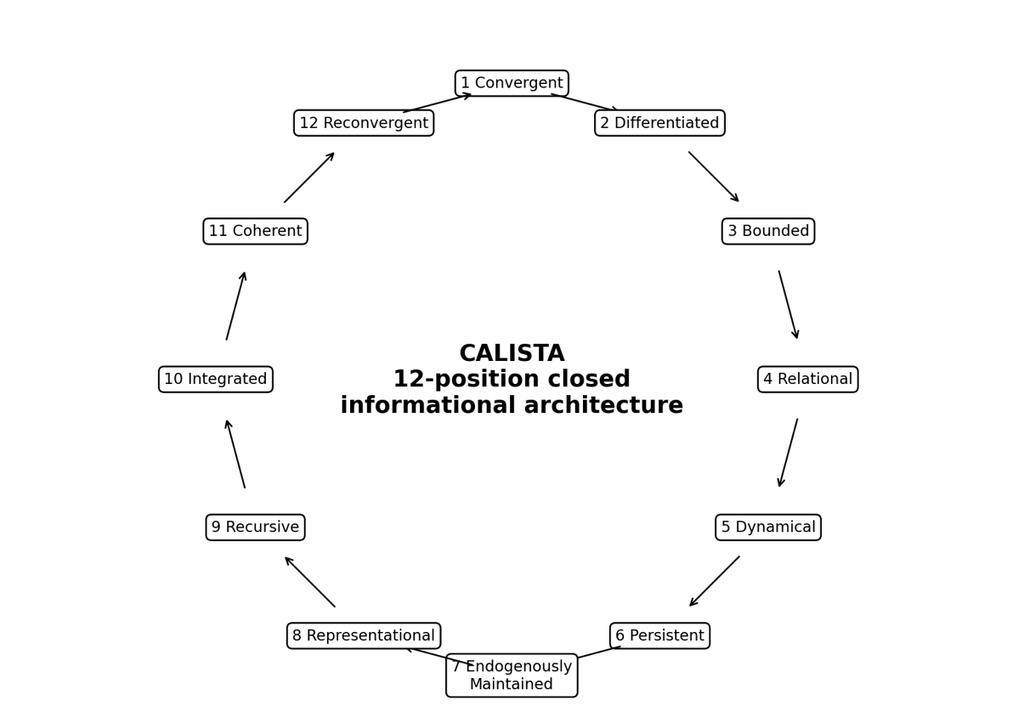
For that reason, the Calista Loop is better imagined as a spiral than as a circle. A spiral can return to the same angular position while occupying a different location along another dimension. Similarly, a system can return to convergence without returning to its original state.
Stage 1, Convergent Unity, represents a relatively unified condition. Unity does not mean absolute simplicity or featureless nothingness. A convergent state may contain latent structure. What matters is that those distinctions have not yet become operationally dominant enough to establish strongly independent identities. A seed contains enormous biological information before its tissues and organs differentiate. A social order may possess cultural structure before specialized institutions emerge. Convergence is therefore best understood as a condition in which the system remains sufficiently unified that differentiation has not yet become the defining feature.
Stage 2 begins when meaningful differences emerge. One becomes many. A previously unified condition differentiates into alternative states, functions, identities, regions, roles, or components. In human systems this can appear as occupational specialization, social classes, political factions, professions, technologies, institutions, cultures, or territorial distinctions. Yet differentiation alone does not produce independent organization. Differences must acquire boundaries.
That produces Stage 3, Bounded. A boundary distinguishes system from environment or one subsystem from another. Tribes distinguish members from outsiders. States establish territories. Corporations distinguish themselves from competitors. Institutions define their jurisdictions. Academic disciplines establish domains. Legal systems specify authority. Boundaries allow differentiated entities to function as identifiable systems rather than merely as variations within an undivided whole.
Stage 4, Relational, emerges when bounded systems begin interacting meaningfully. They exchange resources, communicate, trade, compete, cooperate, form alliances, create dependencies, or enter conflict. The system is no longer merely a collection of separate parts. It becomes a network of relationships.
At Stage 5, Dynamical, those relationships produce ongoing change. States evolve through time. Resources move. Institutions adapt. Populations migrate. Technologies diffuse. Markets fluctuate. Governments reorganize. Conflicts alter relationships and boundaries. A civilization becomes not merely a structure but a process.
Dynamics alone, however, can be temporary. For recognizable systems to develop, some patterns must endure. Stage 6, Persistent, describes this stabilization. Cities survive beyond their founders. Institutions survive individual leaders. Languages persist across generations. Laws endure beyond the governments that enacted them. Infrastructure remains usable. Cultural memory accumulates. Persistence converts transient activity into durable organization.
Yet persistence is not the same as self-maintenance. A ruin can persist. A mountain can persist. A civilization must actively reproduce the conditions required for its continuation. Stage 7, Endogenously Maintained, appears when the system develops internal processes that preserve its own viability. Civilization produces food, repairs roads, trains workers, educates children, generates energy, treats disease, enforces laws, transfers knowledge, maintains institutions, and replaces failed components. The system no longer merely survives; it actively sustains itself.
Stage 8, Representational, marks another qualitative change. The system begins encoding information about itself and its environment. Writing, mathematics, maps, statistics, science, accounting, legal codes, databases, media, archives, models, and measurement systems allow civilization to externalize memory and construct increasingly precise representations of reality. These representations expand coordination across distance and time because knowledge no longer depends solely upon individual memory.
But there remains a distinction between representing reality and using those representations recursively. A census represents a population. A Stage-9 system takes that census, analyzes it, changes policy because of what it learns, measures the consequences, and then feeds those consequences back into subsequent decisions.
That is recursion.
At Stage 9, the system begins modeling itself and using those models to modify itself. Economists analyze economies. Governments analyze governments. Scientists study scientific institutions. Companies measure organizational performance and redesign themselves. Social scientists study society. Media analyzes media. Financial markets react to forecasts about financial markets. Algorithms analyze user behavior and alter the information users see, producing new behavior that generates new data. Artificial intelligence now extends this process by processing enormous bodies of human-generated representation and feeding new analyses back into civilization.
Stage 10, Integrated, requires something stronger than recursion. An integrated system does not simply possess many intelligent subsystems that observe themselves independently. Those differentiated subsystems become mutually constrained components of a larger functioning whole. Integration is stronger than connection. The contemporary world is highly connected, but connection alone does not ensure that the effects of one subsystem are incorporated into the decision logic of another.
Stage 11, Coherent, goes further still. Integrated systems can remain deeply conflicted. A government may contain many integrated agencies but still produce contradictory policy. A corporation may connect all of its departments while rewarding incentives that undermine the enterprise. An organism can contain every major organ yet remain systemically ill. Coherence means that the integrated components maintain sufficiently low destructive contradiction that the whole becomes stable and mutually reinforcing.
Finally, Stage 12, Reconvergent, describes a system that approaches renewed unity while retaining the information generated through differentiation. Diversity does not disappear. Fragmentation decreases. The system preserves specialization while reducing destructive separation. Reconvergence completes the cycle and provides the starting condition for a new round of differentiation.
Why the Calista Loop Is a Loop Rather Than a Ladder
The most important feature of the Calista architecture is that it does not assume permanent upward progress. Systems can move forward, backward, or remain trapped at a threshold.
That makes the loop potentially useful for analyzing civilizations because historical societies do not simply become increasingly advanced forever. They can lose institutional capabilities. Complex networks can fragment. Knowledge can survive while coordination deteriorates. Governments can remain in name after losing operating capacity. Infrastructure can persist after maintenance systems fail.
The Calista Loop treats these as different structural losses rather than collapsing them all into the vague category of decline.
Suppose an integrated Stage-10 civilization loses the ability to coordinate its major subsystems but retains sophisticated self-modeling, science, information systems, and institutional analysis. That civilization would not necessarily regress immediately to a primitive condition. It would more plausibly fall toward Stage 9. Recursion survives; integration does not.
If recursive self-correction then deteriorates but vast archives, databases, maps, scientific knowledge, and communication systems remain, the system could regress toward Stage 8. Representation survives, but it is no longer being used effectively to modify the system.
If representational institutions become unreliable while agriculture, infrastructure, healthcare, energy, security, and governance continue functioning, civilization may fall primarily toward Stage 7. The system still maintains itself even though its higher-order informational capacities have weakened.
If endogenous maintenance breaks down, persistent physical and institutional structures may remain for some time. Roads, buildings, dams, archives, and legal forms can survive after the processes required to maintain them deteriorate. That would resemble Stage 6.
This gives regression a directional logic.
A civilization does not necessarily lose every capability simultaneously. Higher-order capabilities can disappear while lower-order ones remain.
The same logic applies in the forward direction. Stage 10 cannot be created simply by declaring global unity. Integration requires strong lower-stage capabilities. The components must already be differentiated, bounded, relational, dynamical, persistent, self-maintaining, representational, and recursive before they can become effectively integrated.
This means a civilization cannot reliably sustain a higher Calista state after losing the structural conditions that support it.
That principle offers a potentially predictive framework. If the defining capability of a stage fails, the system’s likely regression path becomes narrower. A Stage-9 civilization whose recursive institutions fail should first lose effective recursion, not immediately lose all persistence or maintenance. Conversely, a Stage-9 civilization successfully developing cross-system coordination should begin displaying measurable Stage-10 behaviors before genuine Stage-11 coherence becomes possible.
Civilizational rise and decline can therefore be understood not merely as changes in wealth or military power, but as changes in structural capability.
Humanity Has Already Crossed the Early Calista Thresholds
Human civilization clearly exhibits the earlier stages of the Calista Loop.
It is massively differentiated. Humanity contains thousands of cultures, languages, professions, industries, technologies, religions, political systems, communities, institutions, and social structures. Economic specialization alone has produced roles that would have been incomprehensible to earlier societies.
Civilization is also strongly bounded. Political borders remain powerful. Corporations have legal identities. Institutions define membership and authority. Property systems determine ownership. Religions define communities. Digital networks determine access. Academic disciplines establish domains of expertise. Boundaries are everywhere.
Those bounded systems are intensely relational. Global trade connects producers and consumers across continents. Finance moves capital across borders. Diplomacy connects governments. Telecommunications connect billions of individuals. Supply chains bind factories, ports, mines, farms, data centers, transport systems, banks, and retailers into enormous networks of dependency.
Civilization is also highly dynamical. Technology changes rapidly. Populations move. Markets fluctuate. Governments rise and fall. Political coalitions reorganize. New industries emerge. Old industries disappear. Cultural norms evolve. Information travels almost instantaneously.
These systems have also become persistent. Cities, laws, universities, religious institutions, corporations, archives, languages, governments, and technologies survive beyond individual lifetimes. Civilization stores accumulated structure and carries it forward.
More importantly, civilization is endogenously maintained. It reproduces itself through agriculture, energy systems, healthcare, transportation, logistics, education, manufacturing, governance, security, finance, family systems, institutional succession, and knowledge transfer. The continued existence of modern civilization depends upon countless maintenance processes operating continuously.
Human civilization is also deeply representational. We measure and model almost every domain we can observe. We track atmospheric chemistry, purchasing behavior, ocean temperature, employment, disease prevalence, genetic sequences, traffic flow, financial transactions, energy consumption, crop production, migration, political opinion, satellite movement, military deployment, educational outcomes, and social networks.
The world has become saturated with representations of itself.
That representational infrastructure creates the conditions for Stage 9.
Humanity at Stage 9: The Recursive Civilization
The defining feature of a recursive civilization is not simply that it knows things. It is that it uses information about itself to change itself.
Governments conduct censuses and redesign services. Central banks analyze economic data and alter monetary policy. Companies study customers and redesign products. Transportation systems measure traffic and alter routing. Hospitals monitor outcomes and modify procedures. Universities measure educational performance and redesign curricula. Political campaigns analyze voter behavior and change strategy. Markets respond to forecasts about markets. Media organizations analyze the influence of media. Scientists examine the reliability of scientific methods.
This is recursion at institutional scale.
The recursive character of civilization has accelerated sharply because digital technologies have connected observation, computation, decision, and feedback. Modern systems can often measure their own behavior almost continuously.
Artificial intelligence extends this further. AI systems are trained on representations created by civilization and then generate new representations, classifications, predictions, analyses, and strategies that are fed back into human institutions.
Civilization has begun recursively processing its own informational output.
That makes the present era qualitatively different from earlier historical periods. Human societies have always reflected upon themselves to some degree, but never before has a civilization possessed a planetary network of satellites, sensors, databases, scientific institutions, digital communications, computer models, and artificial intelligence capable of building such extensive representations of its own behavior.
Humanity has developed something approaching a planetary self-model.
But a planetary self-model is not the same thing as a planetary integrated system.
This is the central distinction.
Civilization increasingly has something analogous to sensory and cognitive capacity at planetary scale. It can see economic instability developing. It can observe environmental change. It can monitor emerging diseases. It can identify supply-chain vulnerabilities. It can model military escalation. It can map social polarization. It can measure inequality, educational performance, infrastructure deterioration, and demographic change.
Yet the institutions that possess these representations frequently cannot coordinate their responses.
Our sensory capacity has outgrown our integrative capacity.
That is why Stage 9 provides such a strong description of the present civilizational condition.
Why Humanity Remains at Stage 9
Humanity has not yet crossed decisively into Stage 10 because its major subsystems remain better at optimizing themselves than at optimizing the larger civilization to which they belong.
This problem appears almost everywhere.
National governments prioritize national interests even when major problems cross borders. Corporations generally optimize organizational outcomes. Political parties optimize electoral advantage. Media organizations and platforms optimize audience attention. Markets optimize transactions and returns. Institutions optimize according to their mandates. Each behavior can be rational locally while creating poor results systemically.
The contemporary world is therefore highly connected without being fully integrated.
Institutional siloing reinforces the problem. Energy policy is often managed separately from water policy, although water treatment and distribution require energy and energy production often requires water. Land use is managed separately from transportation despite their obvious relationship. Housing policy may be separated from economic development. Economic development may be separated from ecological constraints. Health policy can be separated from education, food systems, infrastructure, or housing even though all affect health outcomes.
Civilization’s causal structure is integrated whether or not its institutions acknowledge that fact.
Its governance structure frequently is not.
Temporal mismatch creates another barrier. Different civilizational systems operate on very different timescales. Financial markets may react in milliseconds. Companies can change strategy within months. Election cycles operate over years. Infrastructure can last many decades. Ecological changes may unfold across centuries. Cultural changes can take generations.
Institutions often optimize around their own clocks rather than the timescales of the systems they influence.
A government may know that infrastructure requires fifty-year planning but still operate primarily around a four-year election cycle. A company may understand environmental consequences that unfold over decades while being judged quarterly. The system can perceive long-term risk without possessing incentive structures that consistently act on it.
Information fragmentation is another Stage-9 limitation. Humanity produces more information than any previous civilization, but information abundance has not produced a unified informational environment. Individuals and institutions increasingly inhabit different factual and interpretive worlds. Algorithmic platforms personalize information. Political identities shape interpretation. Technical expertise is dispersed across increasingly specialized fields. False claims can spread rapidly while correction is slow and less emotionally compelling.
The result is a civilization that has extraordinary representational capacity but weak shared interpretation.
Incentives also remain poorly aligned. Actions that benefit one subsystem can impose costs upon others. A company can increase profits while shifting environmental costs outward. A nation can improve strategic advantage while increasing global instability. A political movement can increase support by deepening polarization. A media platform can increase engagement through outrage. Consumers can receive cheaper products through supply chains that increase systemic fragility.
The logic is recurring: what is rational for the subsystem may be irrational for the whole.
Civilizational feedback is also incomplete. Humanity frequently identifies problems correctly. Reports are produced. Investigations occur. Recommendations are written. Failures are documented. Data is collected.
But the same structural conditions often reproduce the same outcomes.
The system observes itself without reliably correcting itself.
That is almost a textbook Stage-9 condition.
A recursive civilization can identify error.
An integrated civilization must coordinate correction.
Identity creates another barrier. People tend to identify primarily with families, communities, nations, religions, political movements, professions, cultures, and ideologies. These identities are not inherently incompatible with integration. In fact, healthy integration depends upon differentiation.
The problem occurs when subsystem identity systematically makes the viability of the larger civilization secondary.
A genuinely integrated civilization would allow local identities to remain strong while adding a higher-order identity: membership in a shared human civilization.
Security remains similarly fragmented. Humanity spends enormous resources protecting subsets of civilization from other subsets of civilization. Military deterrence may be rational under current conditions, but from a systems perspective it remains evidence of incomplete integration.
Scientific specialization creates another barrier. The deeper knowledge becomes, the narrower expertise often must become. This has produced enormous progress, but it also makes synthesis more difficult. Climate interacts with energy. Energy interacts with economics. Economics interacts with politics. Politics interacts with information. Information interacts with cognition. Technology interacts with security. Health interacts with logistics.
Major civilizational problems are cross-domain precisely when institutions and disciplines are becoming increasingly specialized.
The deeper problem is that humanity does not yet possess a routinely functioning integrated model of civilization.
We have economic models, climate models, epidemiological models, demographic models, military models, transportation models, energy models, and countless specialized simulations. What we do not yet possess at sufficient scale is an institutional architecture that routinely integrates those models into coordinated whole-system decisions.
That is why humanity remains at Stage 9.
Civilization can increasingly identify its contradictions faster than it can resolve them.
The Twelve Civilizational Systems That Must Integrate
If humanity is to cross into Stage 10, integration cannot remain an abstract ideal. It has to become visible across the major systems upon which civilization depends.
A useful decomposition contains twelve civilizational systems.
Governance and Institutional Coordination
Human governance remains dominated by states, municipalities, agencies, courts, treaties, regulatory bodies, and international organizations with overlapping but limited authority. This architecture protects autonomy and diversity, but it performs poorly when the causal scale of a problem exceeds the jurisdiction of the institution responsible for managing it.
A Stage-10 civilization would not necessarily require a single world government. Integration would instead mean better matching the scale of governance to the scale of the problem. Local issues could remain local, regional problems could be coordinated regionally, and genuinely global risks could activate reliable global response mechanisms.
The defining improvement would be interoperability between levels of governance rather than simple centralization.
Economic and Financial Systems
The modern economy is already global in connectivity but not fully integrated in consequence accounting. Capital crosses borders instantly. Supply chains span continents. Currency, credit, trade, and investment bind societies together.
Yet many long-term effects remain poorly reflected in immediate economic decisions. Environmental damage, infrastructure vulnerability, resource depletion, social instability, and systemic risk can remain external to transactions.
A Stage-10 economy would become better aligned with whole-system viability. Markets could remain competitive, but the information carried by prices, regulation, risk models, and investment criteria would increasingly reflect long-term resilience and system-level consequences.
Energy Systems
Energy is one of civilization’s foundational maintenance systems. Nearly every advanced civilizational capability depends upon reliable energy.
Yet energy remains fragmented across national policies, technologies, grids, markets, resource bases, corporate ownership, and geopolitical interests.
Stage-10 integration would require coordinated treatment of generation, transmission, storage, resilience, affordability, environmental impact, technological transition, and national security. Energy systems would increasingly be planned as part of a broader civilizational infrastructure rather than isolated national assets.
Food and Water Systems
Food and water are inseparable from land, energy, climate, settlement, health, and ecology, yet they are often managed independently.
Agriculture consumes water. Water treatment requires energy. Energy production can consume water. Urban development alters watersheds. Climate affects food production. Trade redistributes agricultural output across continents. Groundwater depletion affects long-term settlement and economic growth.
Stage-10 civilization would treat these dependencies as one coupled planning problem. The objective would not be centralized control of food and water, but systemic resilience: maintaining human needs without degrading the natural and infrastructural systems that make those needs achievable.
Infrastructure and Transportation
Civilization depends upon roads, ports, railways, airports, electrical grids, telecommunications, pipelines, water systems, logistics networks, housing, and digital infrastructure.
These systems are deeply interconnected but frequently planned separately.
A Stage-10 infrastructure model would explicitly map dependencies. Housing planning would incorporate transportation. Transportation would incorporate energy. Energy would incorporate land use and water. Telecommunications would integrate emergency response and security. Ports would be modeled as components of larger supply systems.
Infrastructure would increasingly be planned as a network rather than a collection of assets.
Health and Biological Security
Disease crosses borders easily. So do biological supply chains, biotechnology, pharmaceutical manufacturing, genetic research, and biological risk.
A Stage-10 civilization would develop stronger interoperability between public-health systems, research institutions, medical supply chains, surveillance networks, and emergency response organizations. The objective would not be a single uniform healthcare system, but coordinated biological resilience.
Education and Knowledge Transmission
Civilization now produces knowledge faster than most educational institutions can absorb it. Entire technological fields can transform in the time required for a student to complete formal schooling.
An integrated civilization would therefore treat learning as continuous infrastructure rather than a phase confined mainly to youth.
Education would increasingly emphasize systems thinking, scientific literacy, information evaluation, reasoning, adaptability, and technological competence. Specialized knowledge would remain essential, but education would also become better at connecting specialization to whole-system understanding.
A civilization cannot integrate what its population cannot interpret.
Science and Technology
Science may be humanity’s most powerful recursive institution. It observes reality, constructs models, tests those models, identifies error, and revises knowledge.
Technology converts those representations into capability.
But science remains fragmented by specialization, institutional incentives, proprietary interests, and national competition. Technology can also advance faster than governance can understand its consequences.
Stage-10 civilization would build stronger mechanisms for cross-domain synthesis and anticipatory governance. Scientific discoveries would move more efficiently into public decision-making, and technological development would increasingly be evaluated across economics, security, culture, labor, ecology, health, and governance simultaneously.
Information, Media, and Communication
The modern information environment demonstrates the difference between connectivity and integration more clearly than almost any other domain.
Humanity has near-global communications. Yet informational coherence remains weak.
Platforms compete for attention. False claims can travel faster than correction. People increasingly receive personalized information. Political communities may operate from incompatible factual assumptions.
Stage 10 would not require a single official truth system. Such centralization could itself become dangerous.
Instead, information systems would improve provenance, transparency, verification, correction, and interoperability. Disagreement would continue, but disagreement could increasingly occur over interpretation, policy, and values rather than completely incompatible descriptions of basic reality.
Law, Security, and Conflict Management
Legal systems remain primarily jurisdictional while economic, technological, cyber, and informational systems operate globally.
Cyberattacks can cross borders instantly. Financial crimes operate through transnational networks. AI creates new legal questions. Autonomous weapons create new security risks. Resource competition can generate interstate conflict.
Stage-10 integration would require stronger mechanisms for managing transnational harms and disputes without requiring political uniformity. Security would increasingly include prevention, verification, resilience, de-escalation, and shared risk reduction.
Culture, Identity, and Social Cohesion
Civilization cannot integrate institutionally if human identity remains organized primarily through mutually exclusive categories.
Stage 10 does not require cultural homogenization. Healthy integration depends upon preserved differentiation.
The required change is layered identity.
A person can be a member of a family, a city, a nation, a religion, a profession, a cultural tradition, and humanity simultaneously. These identities need not cancel one another.
Civilizational integration would become more plausible when membership in humanity is understood as an additional layer rather than a competitor to every local identity.
Planetary and Ecological Systems
Human civilization does not sit outside the planetary system.
Atmosphere, oceans, freshwater, soils, climate, ecosystems, biodiversity, and material cycles are part of the physical infrastructure supporting civilization.
Stage-9 institutions often treat these systems as external environmental concerns. Stage-10 civilization would increasingly treat them as operating conditions.
Environmental governance would therefore become less about protecting an external thing called nature and more about maintaining the planetary systems that make civilization possible.
Integration Does Not Mean Centralization
The concept of an integrated civilization can easily be misunderstood as a call for political uniformity or global centralization.
That is not what the Calista architecture implies.
Biology provides a better analogy.
A human body is highly integrated precisely because its organs remain different. The heart does not become the brain. The lungs do not become the liver. The nervous system does not absorb the skeletal system.
Specialization remains.
Integration connects specialized components through feedback, communication, resource flows, common constraints, and shared viability.
Civilizational integration should operate similarly.
Nations can remain nations. Cultures can remain distinct. Markets can remain competitive. Religions can remain diverse. Local communities can retain autonomy.
The critical change is that their interactions become increasingly compatible with the viability of the larger system.
Integration therefore means differentiation plus interoperability, feedback, and mutual constraint, not sameness.
What Stage 10 Human Civilization Might Look Like
If humanity successfully crossed into Stage 10, the transition would probably be less dramatic than popular visions of planetary transformation suggest.
There may be no single historical moment when humanity declares itself integrated. The change would emerge gradually through institutions and system behavior.
Policies would increasingly be evaluated across multiple domains rather than one. Energy decisions would include water effects. Transportation decisions would include housing, health, and ecological consequences. Economic decisions would include resilience and long-term systemic costs. Public-health systems would coordinate internationally before crises rather than primarily after them. Infrastructure planning would become more anticipatory.
AI models could integrate information across previously separate institutional domains. Governments and businesses could model how changes in energy, demographics, infrastructure, water, economics, and health interact before major decisions are implemented.
Global risks would increasingly trigger preventive coordination.
Scientific findings would move more rapidly into governance.
Critical supply-chain dependencies would become visible.
Long-term resilience would acquire greater institutional weight.
International organizations would become better at coordinating genuinely transnational problems while leaving local issues under local control.
The most important transformation would be structural rather than political.
Subsystems would increasingly incorporate their effects on the larger civilization into their own decision-making.
Humanity would begin behaving less like thousands of powerful systems sharing the same planet and more like specialized components participating in one larger system.
Stage-10 civilization would still contain competition, disagreement, experimentation, political conflict, and institutional failure. Integration does not eliminate contrast.
It changes the system’s ability to process contrast without destroying the larger whole.
What Stage 11 Human Civilization Might Look Like
Stage 11 would represent a deeper transformation.
Integration alone is not enough because highly integrated systems can still contain destructive contradictions.
Stage 11 requires coherence.
A coherent civilization would increasingly organize its major systems so that their success reinforces rather than undermines one another.
Economic prosperity would become more compatible with ecological stability. Information systems would reward accuracy and correction more strongly than distortion. Technological development would increasingly occur alongside governance capable of understanding consequences. Healthcare, education, housing, infrastructure, food, and economic systems would become mutually supportive foundations rather than isolated policy categories.
Conflict would not disappear. Complex systems require mechanisms for managing disagreement and competing interests.
But conflict would increasingly occur within boundaries that preserve the viability of the whole.
War between major powers could become structurally less likely because the economic, technological, ecological, and institutional interdependence of the integrated civilization would make catastrophic conflict irrational at a much deeper level than simple deterrence.
Stage 11 would also require stronger corrective feedback. Institutions would become better at learning from failure. Policies that consistently produce poor results would become easier to revise. Transparency would improve where it improves system function. Trust would become more conditional upon demonstrated reliability rather than ideological loyalty.
A particularly important indicator would be the declining prevalence of systems that benefit by degrading the conditions upon which the larger civilization depends.
A coherent civilization could tolerate mistakes, competition, inefficiency, and disagreement.
It could not indefinitely tolerate self-destruction as an operating model.
What Stage 12 Human Civilization Might Look Like
Stage 12, Reconvergent, is necessarily more speculative because humanity has not demonstrated anything resembling a complete planetary version of this state.
Reconvergence would not mean cultural sameness or political uniformity.
It would mean that differentiation remains available while destructive separation decreases.
Human beings could retain national, religious, regional, cultural, professional, and philosophical identities while also possessing a stronger species-level identity.
The phrase “human civilization” would increasingly describe an experienced reality rather than merely an analytical category.
Knowledge could become more integrated as boundaries between disciplines become increasingly permeable. Economics, biology, physics, psychology, technology, information science, ecology, and governance might be understood through deeper shared structural principles.
Civilizational institutions could become capable of planning across centuries rather than primarily operating around election cycles, budget periods, market cycles, or individual lifetimes.
Planetary stewardship could become ordinary infrastructure management rather than an ideological dispute.
Artificial intelligence might increasingly function as an extension of distributed civilizational cognition rather than primarily as a commercial product or strategic asset.
Humanity could eventually develop much stronger integration between biological intelligence, artificial intelligence, and distributed knowledge systems without requiring those forms of intelligence to become identical.
The distinction between a national problem and a human problem could weaken for genuinely planetary issues.
Stage-12 civilization would therefore approach unity without sacrificing differentiation.
That is the essence of reconvergence.
Why Stage 12 Returns to Stage 1
Reconvergence does not end the Calista Loop.
It creates the conditions for renewed convergence.
But the renewed Stage 1 is not identical to the original Stage 1.
It retains history.
The best analogy is a spiral staircase. Viewed from above, successive turns can occupy the same angular position. Yet each turn exists at a different height.
A completed civilizational cycle could function similarly.
A sufficiently integrated and coherent planetary civilization could become the starting condition for an entirely new differentiation cycle.
An interplanetary civilization might differentiate into Earth-based, lunar, Martian, orbital, or distant communities.
Human intelligence could differentiate into biological, artificial, augmented, or hybrid forms.
New scientific categories could emerge.
New political structures could become necessary.
New cultural identities could appear.
The completion of one cycle would therefore generate the initial conditions of the next.
Calista does not describe a final destination.
It describes recurrence with retained information.
What Regression Would Look Like If Humanity Fails the Stage 9 to Stage 10 Transition
The same architecture that describes progression must also account for failure.
Humanity is not guaranteed to reach Stage 10.
In fact, Stage 9 may be unusually unstable because recursive capability can strengthen both integration and fragmentation.
Artificial intelligence can improve reasoning, but it can also increase misinformation, surveillance, cyber conflict, financial manipulation, political persuasion, and military competition.
Global communication can coordinate humanity, but it can also amplify polarization.
Economic interdependence can discourage conflict, but it can also propagate systemic shocks.
Scientific discovery can solve problems, but it can also create capabilities institutions are not prepared to manage.
A failed Stage 9 → Stage 10 transition would therefore not necessarily begin with technological collapse.
It could begin with recursive dysfunction.
Civilization might retain advanced technology, scientific knowledge, databases, networks, and artificial intelligence while losing trust, interoperability, and effective corrective feedback.
The information would remain.
The ability to use that information collectively would weaken.
That would represent regression toward Stage 8.
Further regression could occur if representational institutions themselves fragmented. Scientific systems could become heavily politicized or nationalized. Shared databases could lose accessibility or reliability. Historical records could persist without functioning institutions capable of translating knowledge into coordinated action.
A further decline toward Stage 7 could leave societies capable of maintaining food, energy, security, healthcare, and basic infrastructure while losing much of their higher-order recursive sophistication.
If maintenance capacity then weakened, persistent infrastructure could remain without reliable upkeep. Roads would still exist but deteriorate. Buildings would remain but become unusable. Power systems would become unreliable. Institutions could survive symbolically after losing actual operating capacity.
Civilizational regression therefore does not necessarily mean forgetting technology.
It can mean losing the relationships required to maintain technological civilization.
This is particularly important because modern technology is relationally dense.
A semiconductor fabrication plant depends upon electricity, ultrapure water, software, specialized equipment, global logistics, finance, stable governance, technical education, and enormous networks of suppliers.
The physical factory is only one component.
The real technology is the system.
Civilizational decline can therefore occur while enormous amounts of knowledge remain stored.
The higher-order organization needed to enact that knowledge disappears first.
That is one of the most important implications of applying the Calista Loop to civilization.
Collapse is not simply destruction.
It is the loss of structural capability.
AI as the Great Stage-9 Amplifier
Artificial intelligence may be the defining technology of the current Calista transition because it magnifies recursion directly.
For thousands of years, humanity has accumulated representations of reality in books, legal systems, maps, scientific papers, software, archives, images, engineering documents, medical literature, financial records, databases, and cultural artifacts.
AI systems can now process enormous portions of that representational archive.
Civilization has therefore created machines capable of recursively operating upon the informational output of civilization itself.
But recursion does not guarantee integration.
If AI is deployed primarily inside fragmented institutions, it may simply make those institutions more effective at pursuing local goals.
Corporations become more efficient competitors. Governments become more capable strategic actors. Militaries become more sophisticated. Political organizations become more persuasive. Markets become faster. Advertising becomes more targeted. Information systems become increasingly personalized.
Civilization could become dramatically more intelligent while remaining structurally Stage 9.
AI could even deepen Stage-9 instability if improved subsystem optimization increases whole-system conflict.
But another path exists.
AI could help civilization understand relationships too complex for individual institutions to model effectively. Energy, water, transportation, public health, food, climate, demographics, economics, migration, security, infrastructure, and technology could be analyzed as coupled systems.
AI could identify hidden dependencies before they become crises.
It could expose unintended consequences before policies are implemented.
It could translate between specialized scientific disciplines.
It could improve scenario planning and long-term forecasting.
Under those conditions, AI could become an integration technology.
The key distinction is therefore not whether civilization has powerful AI.
It is what kind of system the AI serves.
AI operating inside fragmented incentives can strengthen Stage 9.
AI operating inside genuinely integrated institutions could accelerate Stage 10.
AI embedded in an integrated and internally aligned civilization could eventually contribute to Stage 11 coherence.
The most significant historical role of artificial intelligence may therefore not be labor replacement or even machine intelligence in isolation.
It may be helping civilization understand enough of its own complexity to integrate itself.
How Would We Know Humanity Had Reached Stage 10?
If the Calista Loop is to function as more than a metaphor, the Stage 9 → Stage 10 transition must produce observable changes.
Humanity should not be classified as integrated simply because international institutions exist or because people speak about global citizenship.
The transition would have to appear in the behavior of major systems.
Cross-system decision-making would become routine. Large infrastructure projects would be evaluated simultaneously for effects on energy, water, housing, transportation, ecology, economics, and health.
Scientific information would move into governance more quickly.
Global risks would trigger coordinated preventive responses rather than primarily emergency reactions.
Institutions would share interoperable data standards where interoperability creates system value.
Critical supply-chain and infrastructure dependencies would be mapped.
Economic incentives would increasingly internalize costs that were previously shifted outward.
AI and simulation tools would increasingly be used for whole-system planning rather than only isolated optimization.
International institutions would demonstrate the ability to coordinate genuinely transnational problems while respecting legitimate local autonomy.
Institutional failures would produce measurable redesign rather than repeated documentation without structural correction.
Long-term resilience would become a normal decision criterion.
Most importantly, local optimization would increasingly be constrained by whole-system consequences.
That is the real threshold.
Stage 10 begins when civilization’s major differentiated systems stop operating primarily as independent optimizing networks and begin behaving as mutually constrained components of a larger civilizational system.
Humanity’s Present Choice
The modern world often appears paradoxical because civilization is extraordinarily capable and extraordinarily fragmented at the same time.
Within the Calista framework, those conditions are not contradictory.
They are precisely what a late Stage-9 civilization might look like.
Recursive capability exposes contradiction.
Civilization measures inequality, environmental degradation, institutional failure, political polarization, infrastructure decay, public-health weakness, financial instability, educational performance, misinformation, warfare, demographic pressure, and technological risk.
Humanity knows more about its own dysfunction than any civilization in history.
But knowledge of dysfunction is not the same as integration.
This may explain why the present era can feel simultaneously sophisticated and irrational.
Civilization can see more than it can coordinate.
Recursive capability therefore creates pressure toward the next transition. Once a system repeatedly observes the consequences of fragmentation, integration becomes increasingly attractive.
But it does not become inevitable.
The same recursive capacity can be used to defend fragmentation.
Political groups can produce more sophisticated narratives. States can improve propaganda. Companies can optimize extraction. Algorithms can reinforce identity divisions. Militaries can model conflict more effectively. Institutions can become better at rationalizing their own incentives.
Recursive intelligence can therefore either expose the necessity of integration or make fragmentation more powerful.
That makes the Stage 9 → Stage 10 transition potentially one of the most unstable points in the loop.
The system has become intelligent enough to transform itself but has not yet become integrated enough to coordinate that transformation.
That description fits modern humanity remarkably well.
Civilization’s Next Frontier
Human progress is commonly narrated through invention.
Fire. Agriculture. Writing. Cities. Printing. Steam power. Electricity. Telecommunications. Computers. The internet. Artificial intelligence.
Those innovations changed civilization profoundly.
But technologies alone do not determine civilizational structure.
A civilization can possess extraordinary technology while remaining poorly integrated.
The next major civilizational transition may therefore be less visible than previous technological revolutions.
It may not arrive as a single machine or discovery.
It may arrive as a new relationship between systems.
Energy planning begins incorporating water. Economic decisions begin incorporating planetary constraints. Scientific disciplines become more interoperable. Governance becomes more adaptive. Information systems improve correction and provenance. AI becomes a tool for integration rather than merely optimization. National institutions become better at cooperating without eliminating autonomy. Human identity becomes increasingly layered rather than mutually exclusive. Long-term consequences acquire greater institutional weight.
Civilization begins learning how to coordinate what civilization already knows.
If that occurs, humanity will cross a qualitatively different threshold.
Stage 9 asks whether civilization can understand itself.
Humanity increasingly can.
Stage 10 asks whether civilization can coordinate itself.
That appears to be the present test.
Stage 11 asks whether an integrated civilization can reduce destructive internal contradiction enough to become coherent.
Stage 12 asks whether differentiated civilization can ultimately return toward unity without erasing what differentiation created.
The Calista Loop therefore proposes more than a theory of technological progress. It offers a structural map of differentiation, identity, relationship, change, persistence, maintenance, representation, recursion, integration, coherence, regression, and renewal.
Human civilization appears to have moved remarkably far around that loop.
It has learned how to preserve knowledge, build durable institutions, model nature, maintain complex infrastructure, observe itself, and create machines capable of analyzing the accumulated representations of civilization itself.
Yet humanity still behaves in many respects as a collection of highly capable subsystems competing inside a shared environment rather than as one integrated civilizational system.
That may be the defining contradiction of our age.
If the Calista architecture proves useful at civilizational scale, it also suggests what the next transition must involve.
The next civilizational leap may not be becoming more intelligent.
It may be learning how to become a system.