
Why Only Coherence Survives
The issue was structural, not just stylistic. The earlier version kept reverting to “claim → short sentence → short sentence → conclusion.” This version is rebuilt so each section develops through sustained argument, example, comparison, and transition rather than compressed rhetorical beats.
Human beings have spent thousands of years asking why the universe exists, but the question is usually approached from one of two directions. Science asks how the universe works, while philosophy and religion ask what it means. Those approaches have produced enormous insight, yet they often leave an important question sitting between them: what does the universe actually do, repeatedly and across scale, that might tell us something about its larger function? Instead of beginning with cosmological speculation, it may be more useful to begin with a pattern that can be observed almost everywhere we look. Structures form, they encounter disturbance, and they either maintain enough internal and external compatibility to continue, reorganize into something different, or cease to exist in their previous form. A star, a cell, a human body, a family, a scientific theory, an institution, and a civilization operate through radically different mechanisms, yet all of them face some version of the same structural challenge. Each must remain coherent enough to survive the conditions acting upon it.
A thing continues to exist as that thing only so long as the relationships that define it remain coherent enough for its identity or function to persist.
That observation leads to a deceptively simple proposition: only coherence survives. The statement does not mean that coherent structures are permanent, because nothing we observe appears permanent in that absolute sense. It also does not mean that everything that survives is perfectly orderly, morally good, or free from internal conflict. Rather, it means that persistence requires some sufficient degree of relational integrity. A thing continues to exist as that thing only so long as the relationships that define it remain coherent enough for its identity or function to persist. Once those defining relationships fail beyond recovery, the system changes into something else. A bridge becomes debris. A living organism becomes nonliving matter. A government becomes a historical institution. A star becomes a remnant. The material may remain, but the prior coherent organization is gone.
A river offers a useful metaphor because its identity clearly does not depend on retaining the same material. The water is constantly changing, sediment moves, the banks erode, rainfall varies, tributaries swell and shrink, and yet the river remains recognizable because a larger pattern persists through those changes. A living body is similar. The molecules composing it are exchanged with the environment, cells are replaced, memories accumulate, and behavior changes, yet enough organizational continuity remains for the person to continue being recognized as the same person. The identity of the system is therefore not reducible to the persistence of particular particles. It depends on the continuity of relationships.
Once persistence is viewed in those terms, the possibility of a much broader pattern becomes visible. Perhaps coherence is not simply a useful property found in some systems. Perhaps it is the general condition under which any persistent organization can exist at all. If so, the universe can be examined not merely as an expanse of matter and energy, but as an ongoing process in which relationships are continually formed, tested, destabilized, reorganized, retained, and sometimes expanded into larger forms of organization. The mechanisms vary enormously, but the structural question remains remarkably similar: what can remain coherent through change?
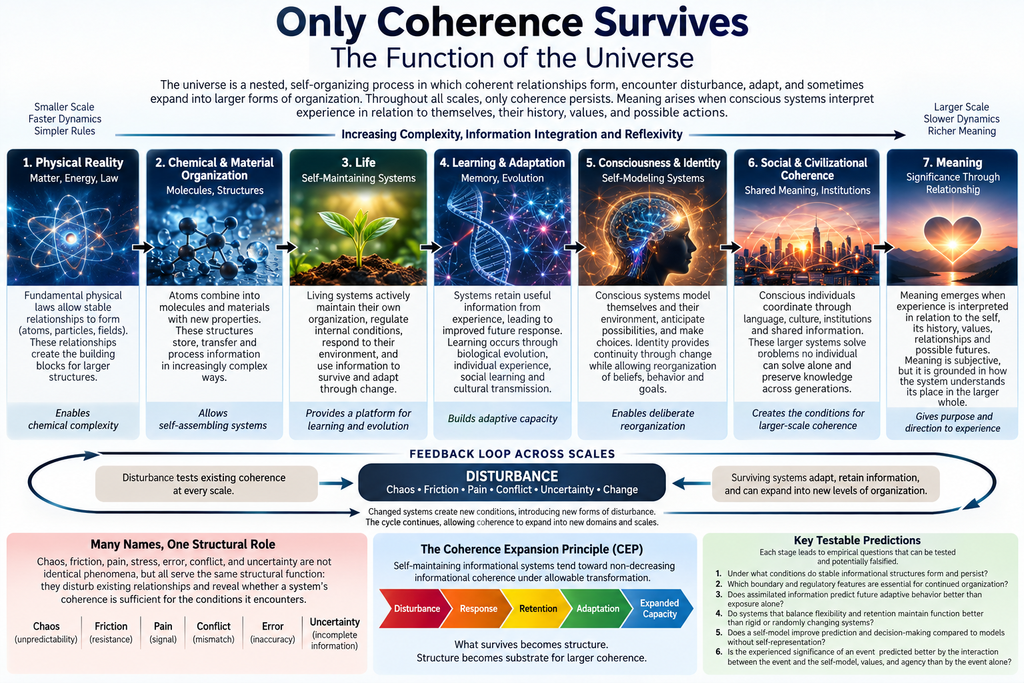
Coherence Is Not the Same as Order
Any serious discussion of coherence has to begin by separating it from the ordinary idea of order. The two concepts overlap, but they are not identical. Order usually refers to regularity, arrangement, repetition, or predictability. A crystal is highly ordered because its atoms occupy a repeating lattice. A row of identical objects is orderly because its arrangement is obvious. A machine operating under tightly controlled conditions can also appear orderly because each component behaves within a narrow range. Coherence is broader. It concerns whether the relationships among the parts remain sufficiently compatible for the whole to persist and function.
This distinction becomes clear when a living organism is compared with an ordered but passive structure. A crystal may possess remarkable geometric regularity, yet if it fractures, it does not actively redirect resources to repair itself. A human body is far less orderly in the visual or static sense. Trillions of cells are metabolizing, communicating, dividing, dying, repairing, and competing for resources. Hormone concentrations change. Electrical signals move through nervous tissue. Blood chemistry is continually adjusted. Microorganisms inhabit the digestive system. Proteins are built and dismantled. The system is never still. Yet this apparent messiness is compatible with a deeper coherence because the organism continuously regulates itself in ways that preserve a viable whole.
A tree bending in heavy wind makes the same point. A rigid structure may appear more orderly until the load becomes strong enough to break it. The flexible tree changes shape dramatically, but that flexibility may be exactly what allows it to survive. In other words, coherence is not the preservation of form at all costs. It is the preservation of functional relationship through changing conditions. A coherent system can bend, adjust, reroute, compensate, or temporarily move away from equilibrium without losing the larger organization that defines it.
This is also why coherence should not be confused with a simplistic opposition between order and thermodynamic entropy. The second law of thermodynamics does not forbid local organization. Stars form, crystals grow, living organisms develop, and weather systems generate temporary structure while total entropy can still increase. The universe does not need to reverse thermodynamics in order for coherent structures to exist. What matters for the present argument is that local and nested systems can maintain organized relationships for finite periods within an entropic environment.
A city is an instructive analogy. A functioning city is not orderly because everyone performs the same action. Millions of people pursue different goals, traffic moves in multiple directions, businesses open and close, buildings are repaired or demolished, electrical demand rises and falls, information circulates, and weather interrupts routine. Yet the city remains coherent because enough relationships continue to function. Roads connect destinations, water is distributed, electrical systems balance supply and demand, laws provide common boundaries, financial systems allow exchange, and communication permits coordination among people who may never meet one another. The complexity is not removed. It is organized well enough to remain viable.
Coherence should therefore be understood as the ability of a system to preserve enough relational compatibility to remain itself despite change. That definition is more useful than static order because it applies to dynamic systems, and nearly everything of interest in the universe is dynamic.
Chaos, Friction, Pain, and the Many Faces of Disturbance
The word “chaos” creates a different problem because it carries several meanings. In mathematics, chaos can refer to deterministic systems whose future states are highly sensitive to initial conditions. In everyday language, chaos may simply mean unpredictability, confusion, or disorder. In biology, similar pressures may be described as stress. In engineering, they may appear as load, vibration, noise, heat, or mechanical strain. In psychology, disturbance may be experienced as anxiety, grief, confusion, contradiction, or pain. In relationships, it often appears as friction or conflict. In economics, it may be experienced as volatility. At the scale of civilization, disturbance can take the form of resource scarcity, institutional failure, technological disruption, war, environmental change, or breakdowns in shared information.
These phenomena are obviously not identical in a literal physical sense. Emotional pain is not thermodynamic entropy, economic volatility is not molecular turbulence, and relational conflict is not mechanical friction. Yet each can occupy the same structural role within its own domain. Each places pressure on an existing organization and reveals whether the system’s present coherence is sufficient for the conditions it is encountering.
For that reason, the broader concept of disturbance is useful. Disturbance can be defined as any event or condition that challenges the existing relationships through which a system maintains its identity or function. Chaos can then be understood as disturbance experienced as unpredictability, friction as disturbance experienced as resistance between interacting systems, pain as disturbance translated into the signaling language of a living or conscious organism, and conflict as disturbance emerging from incompatible relationships, goals, expectations, or models.
Seen this way, a bridge under load, a muscle under resistance, a body experiencing injury, a mind encountering contradiction, a marriage experiencing conflict, and a scientific theory confronting anomalous evidence share an important structural similarity. In every case, existing organization is being tested against something it did not fully absorb in its previous state. The specific material and mechanism differ, but the question is the same: can the system integrate this disturbance without losing the coherence required for continuation?
This is why disturbance is often more revealing than stability. A bridge standing on a calm day tells us less about its engineering than the same bridge under heavy load. A belief that has never been challenged tells us less about its reliability than one repeatedly confronted with contradictory evidence. A relationship that has never experienced disagreement has not yet demonstrated whether it can remain intact when two different internal worlds come into tension. A society that has never encountered scarcity or external pressure has not revealed the full resilience of its institutions.
The same reasoning explains why chaos can function as a kind of teacher without requiring us to imagine that chaos itself possesses intention. Disturbance exposes weakness that stable conditions can hide. It reveals which relationships remain viable under pressure and which do not. When a system survives the disturbance and retains useful information from the encounter, the system may become more capable of responding to similar conditions in the future. In that restricted but important sense, disturbance can become instruction.
Pain is perhaps the clearest example because it makes the structural signal conscious. Physical pain warns that tissue integrity may be threatened. Emotional pain may reveal loss, rejection, violated expectation, loneliness, or threatened identity. Cognitive discomfort may expose conflict between beliefs. Relational friction may reveal incompatible assumptions that had previously remained implicit. The experience is often unpleasant precisely because the system needs the disturbance to attract attention.
A smoke alarm is irritating because an alarm that is easy to ignore would not perform its function very well. Silencing the alarm can remove the noise while leaving the fire untouched. The same principle applies more broadly. Numbing pain while continuing to injure the body can worsen the underlying damage. Suppressing disagreement may create temporary peace while unresolved conflict deepens. Rejecting contradictory evidence can make a belief feel coherent while reducing its relationship to reality.
The more useful question is therefore not always, “How do we eliminate the disturbance?” Sometimes the more important question is, “What incoherence is this disturbance revealing?” That change in perspective becomes central to understanding why challenge persists at every level of complexity.
The Universe as a Continuous Test of Coherence
Once disturbance is understood structurally, the universe begins to look less like a collection of finished things and more like a continuous process of formation, testing, persistence, transformation, and dissolution. Structures form because conditions permit certain relationships to stabilize. Those structures then encounter new conditions. Some remain viable. Others change. Still others fragment or disappear.
No cosmic examiner needs to be assumed for this process to occur. The testing emerges naturally from changing conditions. A molecular arrangement that is unstable does not remain intact indefinitely. A star persists while its internal physical relationships remain viable, then transforms when those relationships change. An ecosystem survives while enough of its interdependencies continue functioning. A species persists while its inherited traits remain sufficiently compatible with the environment. An institution survives while its rules, incentives, and information flows continue to solve the problems for which the institution exists.
What matters is not whether every system follows the same mechanism. They clearly do not. What matters is that changing conditions continually filter structures according to whether their organization remains workable.
This is easier to understand if survival is separated from the idea of absolute strength. The strongest organism in one environment may be poorly suited to another. A cactus thrives in conditions that would kill many plants adapted to wet forests, while the same cactus may fail where those forest plants thrive. Fitness is therefore relational. It describes compatibility between a system and the environment through which that system must continue.
The same principle applies beyond biology. A business model that is highly successful under one technological regime may collapse when the environment changes. A political institution designed for one historical context may struggle in another. A scientific model may remain useful within one range of conditions and fail outside that range. A person may develop psychological strategies that are adaptive in childhood but dysfunctional in adulthood.
The persistence question is always relational. Does the present organization remain compatible with present conditions?
This is where the idea of sufficient coherence becomes important. A system does not need perfect internal agreement or perfect stability. A human body contains imperfections. A family contains disagreement. A scientific theory can contain unresolved questions. A civilization can contain political conflict. A galaxy can contain violent processes. The relevant threshold is whether those disturbances exceed the system’s ability to preserve or restore the relationships required for continuation.
That threshold is also scale-dependent. A cancer cell can be remarkably effective at preserving itself while reducing coherence at the level of the organism. A criminal network can maintain internal coordination while damaging the larger society. A corporation can optimize short-term extraction while undermining the environmental or social conditions on which it ultimately depends. A person can maintain a highly consistent worldview by excluding every piece of contradictory information.
These examples show why local coherence is not sufficient to define successful coherence at larger scales. A system can be internally organized and still be destructive to the wider structures that make its existence possible. Long-term persistence therefore increasingly depends on relational coherence: the ability to maintain oneself while remaining sufficiently compatible with the larger systems in which one is embedded.
From Hydrogen to the Cosmic Web
At the physical level, the story of coherence begins with relationship. Hydrogen is useful as an intuitive starting point because it is simple. A hydrogen atom is not merely a proton and an electron existing somewhere near each other. It is a specific relational configuration governed by physical constraints. The components matter, but the organization of those components is what makes the atom recognizable as the system we call hydrogen.
From there, atoms can participate in molecules, molecules can participate in larger chemical structures, and complex chemistry can generate forms that were impossible at simpler levels. At astronomical scales, gravity becomes one of the major organizing mechanisms through which matter develops large-scale structure. Stars form, planetary systems emerge, galaxies develop, galaxies gather into larger groups and clusters, and matter traces the enormous filaments of the cosmic web.
The significance of this progression is not that the universe follows a simple linear ladder from small to large. It is that stable organization at one level creates possibilities at another. Once some relationships become sufficiently persistent, they can serve as components in new relationships.
Language provides a useful comparison. Letters form words, words form sentences, sentences form paragraphs, and paragraphs form books. Every level depends on the one below it, but no higher level can be explained by merely listing its ingredients. A dictionary may contain nearly every word used in a novel, yet the dictionary is not the novel because meaning depends on arrangement.
The same is true of matter and life. Knowing every chemical element present in a cell does not explain the organization of the cell. Knowing every neuron in a brain does not by itself explain the architecture of a thought. Knowing every citizen in a nation does not explain its institutions. Relationship creates new levels of structure.
This is why the movement from hydrogen to the cosmic web should be understood as nested coherence rather than simple accumulation. Stable lower-level relationships become available for participation in larger systems. Atoms permit chemistry. Chemistry permits more complex molecular structures. Some molecular structures permit self-maintaining biological systems. Biological systems create evolutionary possibilities. Nervous systems permit increasingly sophisticated modeling. Symbolic language allows information to pass between minds. Writing allows information to persist across generations. Institutions allow knowledge and coordination to exceed the capacity of any single person.
Each level inherits something from those below it while introducing something genuinely new. Coherence is therefore cumulative without being mechanically deterministic.
Coherence Builds on Coherence
The recurring pattern becomes clearer when we examine what happens after a coherent structure persists. It does not merely remain where it is. It can become substrate for another level of organization.
An atom can become part of a molecule. A molecule can become part of a cell. A cell can become part of an organism. An organism can become part of a family, ecosystem, or society. A person can become part of an institution or civilization. In each case, the lower-level structure retains some identity while participating in a larger relational whole.
This does not mean that every lower-level structure inevitably progresses upward. Most atoms never become part of living cells, and most organisms do not participate in human-style civilizations. The point is more modest: higher-order coherence requires lower-order structures that are stable enough to participate in it.
A house illustrates the relationship. A wall depends on bricks that retain their integrity. If the bricks dissolve immediately, no wall can exist. Yet once the wall exists, the relationship changes. The wall constrains the position of each brick, and the architecture of the house constrains the wall. Higher-level organization feeds back into lower-level components.
Biology makes this even more obvious. A body depends on its cells, but the body also regulates the environment in which those cells exist. Blood flow, hormones, immune signaling, and nervous regulation influence cellular behavior. The larger whole does not merely emerge from the parts and then become irrelevant. It changes the conditions experienced by those parts.
The same process appears socially. Individuals create families, institutions, and cultures, yet those structures then influence the individuals who participate in them. Language shapes thought. Laws constrain behavior. Economic systems alter incentives. Schools transmit particular forms of knowledge. Cultural expectations influence relationships and identity.
Coherence is therefore bidirectional. Lower levels enable higher levels, while higher levels constrain and sometimes stabilize lower levels. This is why the statement that a community cannot become orderly if households are not orderly captures only half of the relationship. Stable households can strengthen a community, but stable communities can also strengthen households. A school can help stabilize a child from an unstable home. A healthy institution can compensate for local weaknesses. A strong body can sometimes support damaged tissue until repair is possible.
Reality is therefore not best pictured as a staircase where each level simply hands structure upward. It is better pictured as a nested network in which coherence moves in both directions. Weakness at one scale can propagate to others, and stability at one scale can help restore others.
That recursive architecture becomes increasingly important once life appears.
Life Changes the Character of Coherence
Nonliving structures can persist, but life introduces a fundamentally different relationship to persistence because living systems actively participate in their own continuation. A rock can remain intact for millions of years, but if it fractures it does not redirect resources toward repair. A living organism does.
When body temperature rises, regulatory mechanisms respond. When tissue is damaged, healing begins. When energy reserves fall, hunger alters behavior. When pathogens enter, immune systems mobilize. When water becomes scarce, thirst changes priorities. The system expends energy in order to preserve the relationships that make continued life possible.
A useful metaphor is the difference between a log and a boat moving downstream. The log is carried by the river. The boat is also constrained by the river, but if it has steering, it can respond to currents. It cannot ignore the environment, yet it can alter its trajectory relative to that environment.
Life begins to steer.
Even simple organisms show this distinction. Bacteria can move toward favorable chemical conditions and away from harmful ones. Plants alter growth in response to light. Animals seek food, shelter, mates, safety, and favorable temperature. Biological systems continually register differences in the environment according to whether those differences support or threaten continuation.
Seen from this perspective, survival instincts are not arbitrary additions to life. They are expressions of self-maintaining coherence. Hunger preserves energy availability. Pain signals threatened tissue integrity. Fear mobilizes response to danger. Attachment supports relationships that may be essential in social species. Curiosity can improve a system’s model of uncertain surroundings.
The particular mechanisms vary dramatically across species, but the structural function is similar: living systems expend energy and process information in ways that help maintain viable organization through change.
Life therefore represents a transition from passive persistence to active coherence maintenance. The universe now contains systems that do not merely remain intact when circumstances happen to permit it. Some systems actively sense conditions, compare those conditions with internal needs, and alter behavior accordingly.
The next transition occurs when those encounters can be retained.
When Disturbance Becomes Information
Once life can respond to disturbance, the disturbance can begin to shape future response. This is where persistence becomes adaptation.
A nonliving structure can certainly be altered by what happens to it. Metal can bend, stone can crack, and landscapes can erode. Yet living and learning systems can sometimes retain information about an encounter in a way that changes future behavior.
The immune system is a familiar example. A pathogen disrupts the organism, but the encounter can modify later immune response. What threatened the system becomes part of the system’s future preparedness. The disturbance has been converted into information that changes future coherence.
Learning follows the same basic pattern. A child touches something hot, experiences pain, and later avoids repeating the action. An animal changes hunting strategy after repeated failure. A person makes a financial mistake and, if the experience is integrated, changes later behavior. A scientific community discovers evidence that contradicts a prevailing model and modifies the theory.
The important transition is that the system no longer simply returns to its prior condition. Its history becomes part of its future organization.
A path through tall grass is a useful metaphor. The first passage is difficult because no route has been established. Repeated passage alters the terrain, and what was once difficult becomes easier because the history of earlier movement has become embedded in the environment.
Memory performs a comparable function. Previous encounters change future probability.
This is where the idea that chaos “teaches” becomes more precise. Disturbance is not inherently beneficial. Many disturbances overwhelm the systems they affect. Severe trauma can reduce capacity rather than increase it. A species can be driven extinct. A body can be damaged beyond repair. A civilization can collapse without preserving the knowledge necessary to rebuild.
The constructive effect appears only when the system survives and something useful from the encounter is retained. Under those conditions, disturbance can expand adaptive capacity. The system becomes capable of responding differently the next time.
This creates a fundamental recursive cycle. Disturbance produces response. Response produces retention. Retention changes future response. If the modification improves viability, the system can remain coherent across a broader range of circumstances.
The system has not merely survived.
It has learned.
Consciousness Makes Coherence Reflexive
Life can respond to disturbance, but consciousness adds another layer because a conscious system can become aware of its own organization and attempt to change it deliberately.
A person can notice that a belief is contradictory, that a habit is damaging health, that a relationship keeps producing the same conflict, or that a financial pattern is unsustainable. A scientist can recognize that a preferred hypothesis no longer fits the evidence. A leader can see that an institution is becoming mismatched with its environment.
At this level, the system is not merely reacting to conditions. It is constructing models of itself and the world, comparing those models with experience, and imagining alternatives.
Coherence becomes reflexive.
A thermostat changes behavior when temperature moves outside a target range. A person can question whether the target itself is appropriate. That difference may appear small, but it creates an enormous expansion of possibility.
Consciousness allows some forms of disturbance to be processed before they produce complete failure. An engineer can identify a structural weakness before a bridge collapses. A physician can detect disease before symptoms become catastrophic. A person can recognize a destructive relationship pattern before the relationship ends. A society can identify environmental risk before damage becomes irreversible.
Prediction turns coherence from a purely reactive process into an anticipatory one.
The relationship between mental and physical coherence also becomes important at this stage. Chronic psychological stress can influence sleep, behavior, hormonal regulation, relationships, and physical health. Physical illness can alter mood, cognition, and perception. A dysfunctional household can destabilize individuals, while stable relationships can support emotional regulation.
The statement that a body cannot be placed in order if the mind is not in order captures part of this relationship, but the deeper principle is bidirectional. A mind can become clearer while the body remains ill, and a body can heal while the mind remains distressed. What matters is that each level alters the conditions under which the other must maintain coherence.
Consciousness therefore does not simply add more complexity to life. It creates a system capable of inspecting its own coherence and participating deliberately in its reorganization.
Matter persists through viable physical relationship. Life actively maintains itself. Consciousness can anticipate, interpret, and choose among possible reorganizations.
That shift eventually extends beyond the individual.
From Individuals to Civilizations
Once conscious organisms begin coordinating at scale, coherence becomes a social problem. A collection of intelligent individuals does not automatically produce an intelligent collective. Higher-order organization depends upon relationships among the members, not merely the capacities of the members themselves.
An orchestra provides a straightforward illustration. Every musician may be individually brilliant, but if each performs a different composition at a different tempo, the result is noise. The larger system becomes coherent only when distinct individuals coordinate around shared relationships while preserving their differences.
Civilization operates in a similar way. Large societies require coordination among millions or billions of people who do not know one another personally and often disagree about values, priorities, and interpretations. Nevertheless, food must move, water must be distributed, electricity must remain available, infrastructure must be maintained, knowledge must be transmitted, disputes must be resolved, and information must travel across enormous networks.
Language creates shared symbols. Laws create boundaries. Markets coordinate exchange. Scientific institutions provide methods for evaluating claims. Schools transmit knowledge. Money provides a common abstraction for value. Governments coordinate selected collective functions. Communication systems allow information to move across geographic and social distance.
None of these systems eliminates disagreement, nor should they. Difference itself is not incoherence. A body is coherent precisely because different organs perform different functions. The heart does not need to become the liver, and the nervous system does not need to become bone.
Higher-order coherence requires compatibility, not sameness.
The same is true socially. A coherent civilization can contain competing ideas, cultures, interests, and institutions so long as those differences remain within relationships that prevent the larger system from disintegrating.
This is why surface peace can be deceptive. A society in which disagreement is suppressed may appear orderly while deeper contradictions accumulate. A family that never discusses conflict may appear calm while emotional distance increases. An organization that punishes criticism may look unified until it suddenly fails because important information has been filtered out.
Coherence is therefore not the absence of disagreement. It is the capacity to process difference without losing the relationships required for the larger whole to continue.
As scale increases, that problem becomes more difficult because the number of relationships increases. Greater complexity creates greater capability, but it also creates more possible points of failure. A technological civilization can coordinate across the planet, yet the very systems that make such coordination possible can also produce new kinds of misinformation, cyber-risk, social fragmentation, and systemic dependence.
Every expansion of coherence creates a larger field in which incoherence can emerge.
The Meaning of Life Remains Subjective
A general function does not automatically produce a universal personal meaning. If life can be described structurally as preserving, adapting, and extending coherence through change, that does not tell each individual what their life must mean. Function describes what a system does within a larger process, while meaning concerns the significance an observer gives to experience.
The same event can carry completely different meaning for different observers. Rain may mean relief to a farmer during drought while representing danger to a family facing a flood. A career loss may be interpreted as catastrophe by one person and liberation by another. A difficult relationship may be understood as failure, instruction, grief, transformation, or some combination of them. Those interpretations are shaped by history, values, expectations, available choices, and imagined futures.
Meaning is therefore not mechanically assigned by the universe. It is created through interpretation and choice. Some interpretations may ultimately prove more coherent with evidence and experience than others, but the meaning of a life remains inseparable from the perspective of the person living it.
The function of life may be general.
Its meaning remains personal.
Why Disturbance Never Disappears
If coherence is fundamental to persistence, it is reasonable to ask why chaos, friction, pain, and conflict continue to exist. If systems become more coherent, should disturbance not eventually disappear?
The opposite may be true. Greater coherence can create the capacity for greater complexity, and greater complexity creates new forms of disturbance that could not previously exist.
A bacterium cannot experience an identity crisis because it does not possess the cognitive architecture required for one. A technologically advanced civilization can experience global cybersecurity risk because it has developed the networks necessary for such a problem to exist. A small village cannot suffer worldwide financial contagion because the required economic connectivity does not exist. A civilization with planetary-scale communication can.
This means that solving one class of coherence problem often creates the conditions for a new class of problem.
A child learns to stand and then confronts the problem of walking. Walking creates the possibility of running. Scientific advances solve old questions and reveal deeper ones. New technologies overcome previous limitations while creating vulnerabilities that would have been impossible before those technologies existed.
The internet illustrates this recursive structure especially well. It dramatically increased the speed and scale of human communication, allowing information to move across the planet almost instantly. That expansion increased collective capacity, but it also created misinformation at unprecedented scale, information overload, algorithmic manipulation, cybersecurity threats, and forms of polarization that exploit the same networks designed to connect people.
The coherence problem did not disappear.
It moved into a larger state space.
For this reason, disturbance may not be an accidental imperfection that the universe is slowly eliminating. It may be inseparable from the continued expansion of possibility. Every new relationship creates another relationship that can become unstable. Every increase in freedom creates additional ways for systems to diverge. Every increase in complexity creates new possibilities for mismatch.
This does not mean that suffering should be romanticized. Disturbance can exceed adaptive capacity. Too much load breaks the bone instead of strengthening it. Too much stress can fragment a person rather than make the person stronger. A society can be destroyed rather than improved by crisis.
The constructive effect depends on the relationship between disturbance and capacity. When a disturbance is survivable and useful information is retained, the system can become more capable than it was before. When the disturbance exceeds the system’s ability to integrate it, coherence may collapse.
Growth therefore does not come from pain by itself. It comes from successfully integrating what the pain reveals.
A system expands when it becomes capable of remaining coherent under conditions that previously would have destabilized it.
The disturbance does not necessarily become smaller.
The system becomes larger than the disturbance.
The Coherence Expansion Principle
This broader pattern aligns directly with what I describe in the Universal Informational Physics Ontology as the Coherence Expansion Principle, or CEP. At its core, CEP proposes that self-maintaining informational systems tend toward non-decreasing informational coherence under allowable transformation.
“Only Coherence Survives” can be understood as the plain-language persistence condition behind that proposition.
A system encounters disturbance. If it cannot maintain enough coherence, its previous organization dissolves, fragments, or transforms. If it survives, information from the disturbance may be retained. That retained information can alter future response. Improved response can allow the system to remain viable across a wider range of conditions. Once that expanded capacity becomes stable, it can become the basis for a more complex level of organization.
The process is cumulative without requiring monotonic progress in every local system.
Organisms die. Species become extinct. Civilizations collapse. Knowledge is lost. Individuals regress. Entire structures can disappear.
CEP does not require that every object become progressively more ordered. Its stronger and more interesting implication is that successfully stabilized coherence can become substrate for broader coherence. Once a capacity exists and is preserved, it can support a larger range of relationships.
A child first learns balance, then uses balance to walk. Walking becomes the basis for running. Language allows private experience to become shared. Writing allows knowledge to outlive the individual. Scientific institutions allow knowledge to be tested collectively. Digital networks allow information to move at planetary scale.
Each stable capacity enlarges the range within which coherent organization can operate.
Yet each enlargement also creates new possibilities for disturbance. Walking creates the possibility of falling while running. Writing creates the possibility of preserving error as well as truth. Scientific institutions create the possibility of institutional bias. Digital communication creates both unprecedented coordination and unprecedented information disorder.
Coherence expansion is therefore not a march toward a frictionless universe.
It is an expanding capacity to remain integrated across increasingly complex conditions.
The larger cycle can be understood as disturbance revealing the boundary of current coherence, adaptation expanding that boundary, and expanded capacity producing new forms of complexity that generate new boundaries.
In that sense, the universe may not be moving away from challenge.
It may be continually creating systems capable of meeting more complex forms of challenge.
From the Smallest to the Largest
The most intriguing aspect of this framework is its apparent scale invariance. The mechanisms change dramatically from one level to another, yet the structural logic remains recognizable.
At atomic scales, viable relationships create persistent structures. At molecular scales, compatible interactions create larger configurations. At biological scales, organisms actively maintain homeostasis and adapt to changing environments. At cognitive scales, minds integrate perception, memory, prediction, and choice. At social scales, groups coordinate individuals. At civilizational scales, institutions coordinate groups and preserve knowledge beyond individual lifetimes. At cosmic scales, gravitational relationships contribute to the formation of stars, galaxies, clusters, and the large-scale structure of matter.
No single mechanism is being claimed across all of these domains. Gravity does not regulate families. Psychological insight does not bind atoms. Natural selection does not operate identically to galactic dynamics.
The scale invariance lies in the architecture rather than the mechanism.
Parts enter into relationships. Some relationships remain viable. Viable relationships produce wholes. Those wholes become parts of larger systems. The larger systems then feed constraints back into the components.
This is why the smallest and largest scales can be structurally connected without pretending that the physics is the same.
A body cannot exist without coherent cellular organization, yet the body regulates the cells. A community cannot exist without people, yet the community influences the people. A galaxy depends on its constituent matter, yet the collective gravitational structure influences the movement of matter within the galaxy.
Reality is nested, and coherence operates within those nested relationships.
This also explains why disorder at one scale can propagate outward. A damaged cell can sometimes threaten an organism. A dysfunctional household can contribute to social instability. A failing institution can damage the systems that depend upon it.
The reverse is equally important. Higher-level coherence can help restore lower-level instability. A healthy organism can repair tissue. A functioning community can support struggling families. A stable institution can preserve knowledge through individual turnover.
Coherence is therefore neither purely bottom-up nor purely top-down.
It is relational across scale.
Coherence Is Not Automatically Good
Because coherence supports persistence, there is a temptation to treat it as morally good. That would be a mistake. Coherence is a structural property, not an ethical judgment.
A criminal organization can be coherent. A harmful ideology can be internally consistent. A parasite can be highly adapted. A cancer can develop effective mechanisms for protecting its growth. An authoritarian system can preserve internal stability for long periods.
Persistence does not establish moral value.
The distinction becomes especially clear when systems are nested. A cancer can increase its local coherence while destroying the coherence of the organism. An institution can become highly effective at preserving itself while failing the larger society it was created to serve. A company can become extremely efficient at extracting resources while undermining the environmental or social systems upon which its long-term survival depends.
Even an individual belief system can become internally coherent in a pathological way if every contradictory fact is excluded.
That is rigid coherence rather than adaptive coherence.
It maintains internal consistency by severing relationship with corrective information.
Long-term resilience therefore requires more than internal organization. It requires compatibility with reality and with the larger systems upon which the smaller system depends.
An organism depends on an environment. A person depends on a body and social relationships. Communities depend on ecosystems and infrastructure. Civilizations depend on planetary conditions.
At sufficiently large scales, local optimization that destroys the surrounding system becomes self-defeating.
The more robust form of coherence is therefore relational coherence: the ability to preserve oneself while remaining compatible with the larger structures that make one’s existence possible.
That distinction is especially important if the Coherence Expansion Principle is applied to civilization, because the most coherent future is not necessarily the one in which every subsystem maximizes itself. It is the one in which local systems remain viable without destroying the larger network of relationships that sustains them.
Is This What “Return to Source” Means?
At this point the framework reaches the boundary between structural analysis and metaphysical interpretation.
Many spiritual traditions describe existence as a movement from unity into differentiation followed by some form of return, reunion, integration, enlightenment, or return to Source. Informational Physics does not, by itself, prove that such a metaphysical Source exists, nor does the emergence of coherent structures demonstrate that the universe possesses a predetermined spiritual destination.
Those are stronger claims.
Yet the structural correspondence is interesting.
If Source is understood as maximal unity, integration, or relational coherence, then the Coherence Expansion Principle provides a possible informational interpretation of what “return to Source” might mean.
The important point is that unity does not require the destruction of individuality.
A cell does not cease to be a cell because it participates in a body. A musician does not cease to be an individual because the orchestra produces a symphony. A person does not cease to be distinct because they participate in a loving relationship or community.
The larger whole does not necessarily erase the parts.
It changes their relationship.
This distinction may offer a more useful interpretation of spiritual unity. Unity is not sameness. It is differentiated parts becoming sufficiently coherent to participate in a larger whole without losing all distinction.
Seen that way, “return to Source” need not describe a reversal in which differentiation disappears and reality collapses back into an undivided state. It could describe a developmental process in which differentiated systems become increasingly capable of participating in larger forms of coherent relationship.
The movement would not be many becoming one because the many are erased.
It would be many learning how to become one while remaining many.
Whether that correspondence represents metaphysical truth, symbolic language, or a hypothesis beyond present testing remains open. The structural analogy should not be confused with empirical proof.
But if reality repeatedly produces larger wholes from coherent relationships among differentiated parts, then the metaphor of return to Source gains a precise informational meaning: increasing integration without requiring the elimination of identity.
The Function of the Universe
What, then, can reasonably be said about the function of the universe?
Purpose and function should be distinguished carefully. Purpose usually implies intention, and asserting that the universe was deliberately created to accomplish a specific end requires assumptions beyond what structural observation alone can establish. Function can be approached more cautiously by asking what the universe repeatedly does.
It forms relationships.
Some relationships are unstable and disappear. Others persist.
Persistent structures interact with other structures, and some become components of larger structures.
Eventually, systems appear that actively preserve themselves. Some of those systems retain information from disturbance. Some develop memory. Some adapt. Some build internal models of their environments. Some become conscious enough to examine their own models and change behavior intentionally. Some form societies capable of preserving information beyond individual lifetimes.
At every level, disturbance continues.
Every new structure encounters conditions capable of destabilizing it. Every increase in complexity creates new ways for relationships to fail. Every larger whole contains more interactions that must remain sufficiently compatible for the whole to continue.
The mechanisms vary enormously. Gravity participates in large-scale physical organization. Chemical bonding structures matter at molecular scales. Homeostasis preserves biological viability. Natural selection filters inherited traits. Memory changes future behavior. Consciousness allows prediction and choice. Language and institutions coordinate groups. Feedback operates through countless forms.
No single mechanism explains coherence in every domain.
What appears to persist is the structural requirement itself.
Systems continue only while they maintain sufficient coherence through changing conditions.
From this perspective, chaos is not simply the enemy of the process. It is one of the conditions through which the process becomes visible.
Friction reveals incompatible relationships. Pain signals threatened integrity. Error reveals mismatch between model and outcome. Conflict reveals structures that cannot presently coexist. Uncertainty exposes the limits of prediction. Each disturbance identifies the boundary of existing coherence.
Sometimes the system breaks.
Sometimes it restores its previous organization.
Sometimes it transforms.
Sometimes it retains enough information from the disturbance to become capable of surviving conditions that previously would have overwhelmed it.
That retained capacity can then become part of a larger structure.
What survives becomes structure, and structure becomes substrate for what can emerge next.
The universe may therefore be better understood not as a machine moving toward a final condition of static order, but as a recursive process through which coherence is repeatedly formed, tested, retained, reorganized, and expanded.
Its achievement is not the elimination of entropy, because coherent structure can exist within an entropic universe. Its achievement is not the elimination of friction, because new relationships create new forms of resistance. Its achievement is not the elimination of pain, because conscious systems use pain as information about threatened integrity.
The deeper pattern is the increasing capacity of systems to remain coherent through change.
That pattern appears in the stability of an atom, in a star maintaining its structure, in a wound healing, in an immune system remembering, in a mind correcting a mistaken belief, in a family resolving conflict, in a scientific theory surviving stronger tests, in a civilization reorganizing after crisis, and in the emergence of ever-larger structures from relationships among smaller ones.
The language changes because the domain changes. The mechanism changes because the scale changes. The form of disturbance changes because complexity changes. Yet the structural problem remains recognizably the same.
Something forms. Something challenges it. Either its defining relationships remain viable, they reorganize into a new viable form, or the structure ceases to exist as it was.
Seen across enough scales, that repetition suggests a remarkably simple answer to an extraordinarily large question.
The universe does not appear to preserve everything.
It preserves what can remain coherent long enough to become part of what comes next.
And that may be the clearest statement of its observable function:
Only coherence survives.
This version keeps the cadence intentionally continuous all the way through the conclusion rather than shifting back into slogan-like fragments.