
An Ancient Architecture of Diagnosis, Causation, Reachability, and System Correction Through Modern Physics and Informational Physics
For more than two thousand years, Buddhism has organized its central diagnosis of human suffering around four propositions known as the Four Noble Truths:
- There is suffering, stress, or unsatisfactoriness.
- Suffering has an origin.
- Suffering can cease.
- There is a path that leads toward that cessation.
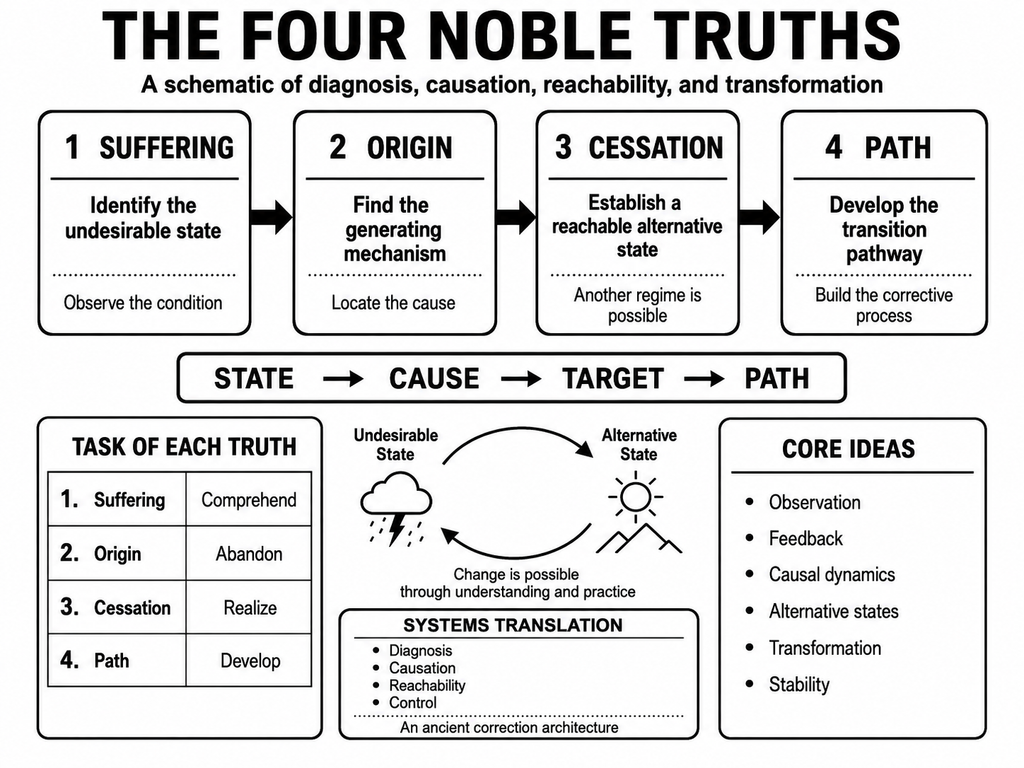
In the Dhammacakkappavattana Sutta—traditionally regarded as the Buddha’s first discourse—the four truths are presented not merely as things to believe, but as conditions carrying different tasks: suffering is to be comprehended, its origin abandoned, cessation realized, and the path developed.
That structure is striking.
It does not begin with faith in a conclusion.
It begins with a problem.
Then it identifies a generating mechanism.
Then it asks whether a different state is possible.
Finally, it specifies an intervention capable of moving the system toward that state.
Modern science uses remarkably similar architecture.
In medicine:
symptom → cause → recoverable condition → treatment
In engineering:
failure state → failure mechanism → target state → corrective control
In optimization:
loss → generating parameters → minimum → update rule
In systems science:
observed instability → causal dynamics → viable region → transition pathway
This does not mean that the Buddha secretly possessed control theory, differential equations, or information theory.
Ancient India did not have modern sensors, statistical inference, nonlinear-dynamics software, state estimators, computers, or mathematical control systems.
But ancient observers did have access to human experience.
They could observe recurring patterns of desire, frustration, attachment, change, reaction, relief, discipline, and behavioral transformation.
The absence of modern mathematics did not prevent observation.
It constrained how those observations could be expressed.
Ancient traditions therefore encoded complex structural relationships in another language:
suffering,
craving,
cessation,
practice.
Modern civilization can additionally express comparable system relationships using equations.
The question here is therefore not:
Does physics prove Buddhism?
It is:
When the Four Noble Truths are translated into the language of modern systems science, what functional architecture remains?
The answer is unusually clean.
The Four Noble Truths can be read as an ancient four-stage framework for system diagnosis and correction.
1. The First Noble Truth — Identify the System State
The First Noble Truth concerns dukkha, a term translated variously as suffering, stress, dissatisfaction, or unsatisfactoriness.
The early formulation includes birth, aging, death, sorrow, separation from what is loved, association with what is disliked, and not obtaining what is desired; it then summarizes the problem in terms of clinging to the five aggregates.
Physics cannot determine whether an experience constitutes Buddhist dukkha.
But systems science can illuminate the structure of the first move:
Before correcting a system, identify its actual state.
Let the underlying state be
An observer receives measurements
where describes how the state becomes observable and represents measurement noise.
The first scientific question is not:
“What should this system be?”
It is:
Suppose a desired operating region is
A system can then be described as displaced from that region when
Alternatively, define some deviation or loss function
where
represents a defined target or acceptable state and larger values indicate increasing deviation.
This is structurally analogous to the first truth.
Before treatment:
measure the condition.
Before optimization:
calculate the loss.
Before control:
estimate the state.
Before correcting suffering:
comprehend suffering.
The Buddha’s formulation is particularly interesting because the associated duty is not immediately “eliminate suffering.”
It is comprehend it.
That is good systems methodology.
If a system reacts to an error signal before understanding its source, it may amplify the problem.
An organization sees falling productivity and increases pressure.
But if the actual cause is overload, pressure worsens productivity.
A person feels distress and immediately suppresses it.
But if the distress carries information about a persistent condition, suppression may conceal rather than correct the mechanism.
A machine overheats and its operator ignores the temperature warning.
The warning disappears only when the sensor fails—not when the problem is solved.
The first structural principle is therefore:
Do not confuse an undesirable signal with the mechanism generating it. First characterize the state.
In Informational Physics terms, this distinction matters because a system state, its observation, and an interpretation of that observation are not identical objects. UIPO V2.0 explicitly requires empirical quantities to be tied to an observation model and separates representation from claims about underlying physical reality.
The First Noble Truth can therefore be translated as:
Identify and accurately represent the undesirable system state before attempting correction.
2. The Second Noble Truth — Find the Generating Mechanism
The Second Noble Truth moves from condition to causation.
In the early formulation, the origin of suffering is identified with craving—particularly craving associated with sensuality, becoming, and non-becoming.
This is not merely the statement:
“Suffering exists.”
It says:
The observed state is generated by a process.
That is the central transition from description to science.
A general dynamical system can be written
where
is the state,
represents internal parameters,
represents action or control,
and represents environmental influence.
If an undesirable state persists, the relevant question becomes:
Suppose loss changes according to
Substituting the system dynamics gives
Now the system can distinguish between variables that merely accompany the problem and variables that actually drive its persistence.
This difference is fundamental.
Correlation is not mechanism.
Symptom is not cause.
Trigger is not cause.
The Second Noble Truth is therefore structurally analogous to causal identification.
Consider a simple positive feedback loop:
If
deviation may amplify rather than dissipate.
The current state alone does not explain why instability persists.
The feedback coefficient does.
The Buddhist concept of craving can be explored similarly—not as a literal physical force, but as a recurrent internal operation whose output becomes new input.
A simplified feedback representation might be
where
is experience,
is reaction,
is resulting action,
and is the new experiential state.
If the response reinforces the same generating condition,
the cycle becomes recursive.
This is the language of feedback.
The early Buddhist framing likewise focuses heavily on cause and effect rather than treating suffering as an inexplicable condition. One traditional explanation emphasizes that the Four Noble Truths organize experience according to causation: suffering, its origination, its cessation, and the causal path leading to cessation.
The physics translation becomes:
Persistent undesirable states are often maintained by recurrent dynamics, not by the visible state alone.
This distinction can completely change intervention.
If a floor keeps flooding because a pipe is leaking, repeatedly drying the floor treats state without mechanism.
If an organization repeatedly experiences bottlenecks because every decision requires one executive, hiring harder-working employees may not alter the causal structure.
If a feedback controller creates oscillation because its gain is too high, increasing gain makes the system worse.
The Second Noble Truth therefore adds:
Find the process generating the state.
3. The Third Noble Truth — Determine Whether Another State Is Reachable
The Third Noble Truth is cessation.
The early discourse describes cessation in relation to relinquishing and releasing the craving identified by the second truth.
Structurally, this introduces a remarkably important question:
Is the undesirable state inevitable?
If suffering has a cause, and that cause can cease, then another state becomes possible.
Control theory calls this a reachability problem.
Consider
Given an initial state
we ask whether there exists some admissible control trajectory such that
for some finite .
If yes, the target region is reachable.
For a linear system
controllability can be investigated through the matrix
If
the system is controllable in the standard linear sense.
The Buddhist claim is obviously not a claim about linear controllability.
The structural analogy concerns the logical role of the third truth.
The system is not merely diagnosed.
It is asserted to possess a reachable alternative.
That is crucial.
Without the Third Noble Truth, the first two truths would produce only diagnosis:
There is suffering.
Here is why.
End of model.
Instead:
There is suffering.
It has a generating process.
That process can stop.
Therefore:
such that the system can occupy another regime.
In dynamical-systems language, we can imagine two regions:
for the undesired regime and
for cessation or the desired regime.
The meaningful scientific question becomes whether there exists a trajectory
such that
and
The Third Noble Truth asserts the conceptual possibility of that transition.
This is why it plays such a powerful structural role.
A problem becomes fundamentally different once the target state is shown to be reachable.
In medicine, a condition that can remit is approached differently from an irreversible condition.
In engineering, an unstable system that can be stabilized invites controller design.
In optimization, the existence of a feasible minimum changes the problem from description to search.
In behavioral change, identifying a mechanism that can be interrupted creates agency.
The Third Noble Truth can therefore be translated as:
Establish that an alternative stable state exists and that the system is not permanently confined to the undesirable regime.
4. The Fourth Noble Truth — Construct the Path Through State Space
The Fourth Noble Truth identifies the way leading to cessation: the Noble Eightfold Path.
The same early discourse specifies its eight factors—Right View, Right Resolve, Right Speech, Right Action, Right Livelihood, Right Effort, Right Mindfulness, and Right Concentration.
The important structural point is this:
A destination is not a trajectory.
Knowing
does not tell us how to get there.
The system requires a policy.
Let
be a control policy assigning an admissible action to each relevant state.
Then
and
The path becomes a sequence:
This is the cleanest physics translation of the Fourth Noble Truth.
A reachable target still requires a workable transition rule.
The distinction matters everywhere.
“Become healthy” is not a treatment protocol.
“Reduce emissions” is not an energy transition plan.
“Improve the company” is not an operating system.
“Stop suffering” is not yet a path.
The Fourth Noble Truth supplies the missing architecture:
what has to be developed to move the system?
This is why early Buddhist teaching treats the duties of the truths differently. The path is specifically something to be developed, not merely acknowledged.
In optimization language, one might write:
Knowing that a minimum exists does not place the system at the minimum.
Repeated updates do.
Likewise, a controller continually measures, acts, observes error, and corrects again.
The path is therefore naturally understood as iterative transformation.
The Four Truths as a Complete Scientific Problem-Solving Architecture
Placed together, the structure becomes unusually clear.
Truth 1 — Suffering
Identify the undesirable state.
Truth 2 — Origin
Identify the generating mechanism.
Truth 3 — Cessation
Establish a reachable alternative state.
Truth 4 — Path
Construct an admissible trajectory from one to the other.
The entire system can be compressed into four questions:
This pattern occurs throughout scientific reasoning.
Medicine
Symptoms
→ pathology
→ healthy condition
→ treatment
Engineering
Failure
→ failure mechanism
→ stable operating region
→ corrective design
Machine learning
Loss
→ parameter/error structure
→ lower-loss solution
→ optimization algorithm
Organizational diagnostics
Visible dysfunction
→ structural constraint
→ viable configuration
→ intervention
Informational Physics
Observed state
→ generative structure
→ coherent alternative
→ admissible transformation
This is why the Four Noble Truths are structurally different from a simple list of beliefs.
They constitute a problem-solving sequence.
The Duties Make the Architecture Even More Precise
The early formulation adds another layer that is easy to overlook.
Each truth has a different operation associated with it:
Suffering → comprehend
Origin → abandon
Cessation → realize
Path → develop.
Those are not interchangeable instructions.
Modern systems language would say the same.
You do not “eliminate” a measurement.
You interpret it.
You do not merely “understand” a destabilizing feedback mechanism.
You alter or remove it.
You do not “develop” the target state conceptually.
You reach it.
You do not merely “believe” in the controller.
You implement it.
The corresponding operations might be written:
This transforms the Four Noble Truths from four static propositions into a four-operator architecture.
Each type of information requires the correct response.
That is a sophisticated systems principle.
A common failure in problem solving is applying the wrong operation to the right information.
People argue with symptoms.
They tolerate causes.
They idealize targets.
They neglect pathways.
The Four Truths assign each one a different task.
Feedback, Craving, and Reinforcing Loops
The Second Noble Truth becomes especially interesting when examined through feedback.
Suppose an external or internal event produces a state deviation:
The system reacts:
That reaction changes subsequent conditions:
If the response reduces the deviation,
the feedback is stabilizing.
But if the response amplifies or repeatedly regenerates the condition,
the process becomes destabilizing.
Craving can be explored structurally as a reinforcement operation:
Again, this does not equate Buddhist craving with an engineering gain coefficient.
It identifies a shared structural principle:
A system can perpetuate an undesirable state through the way it responds to that state.
This insight appears across psychology, addiction, economics, conflict systems, and machine learning.
The response becomes part of the cause.
That is why simply removing external disturbance does not always solve an internally reinforced process.
The Middle Way as Bounded Optimization
The discourse introducing the Four Noble Truths also introduces the Middle Way, rejecting both sensual indulgence and self-affliction and identifying the Noble Eightfold Path as the alternative.
This can be translated carefully into constrained optimization.
Suppose performance depends on an intervention variable .
Too little regulation creates one failure regime.
Too much creates another.
Then a cost function might take the form
The optimum is not necessarily at either extreme:
The Middle Way is not therefore mathematically equivalent to “take the average.”
And Buddhist sources do not define it as simple moderation between all extremes.
The stronger structural translation is:
Avoid operating regimes whose extremes destabilize the objective; search for the viable control region instead.
Engineering does this constantly.
Too little damping produces oscillation.
Too much damping can make response excessively slow.
Too little redundancy creates fragility.
Too much can create cost and complexity.
Too little physiological stress produces deconditioning.
Too much produces injury.
The viable operating zone depends on the system.
This is not compromise.
It is constraint-aware optimization.
Informational Physics — From Observation to Causal Transformation
The Four Noble Truths also map naturally onto an informational architecture.
UIPO distinguishes state spaces, fields or state variables, admissible operators, observation models, and empirical hypotheses. It also insists that conceptual unity is not itself empirical validation.
Using that vocabulary:
First Truth — Observation
What is the system state?
Second Truth — Generative Dynamics
What produces and maintains that state?
Third Truth — Viability / Alternative State
Is another regime available?
Fourth Truth — Admissible Transformation
What operator moves the system?
subject to
This allows the entire Four Truth structure to be represented as:
That is a recognizable scientific architecture.
Informational Physics adds one further question:
What information has to change for the system’s dynamics to change?
A causal loop can persist because the system keeps reusing the same internal representation, objective, response, or boundary rule.
Changing external conditions without changing that informational structure may leave the recursive pattern intact.
The Four Noble Truths can therefore be interpreted as moving progressively deeper:
visible experience,
generative condition,
possible reorganization,
and transformation protocol.
The Ancient-to-Modern Bridge
An ancient Buddhist practitioner could recognize suffering.
They could not construct a numerical state estimator.
They could observe that craving repeatedly generated distress.
They could not write a nonlinear feedback equation.
They could discover that cessation was possible.
They could not formalize controllability or reachability.
They could develop a path of practice.
They could not express it as a control policy over state space.
The absence of equations does not imply the absence of structural observation.
It means the observation had to be encoded through another language.
Ancient language:
Suffering.
Modern systems language:
Undesirable state.
Ancient language:
Origin.
Modern systems language:
Generating mechanism.
Ancient language:
Cessation.
Modern systems language:
Reachable alternative state.
Ancient language:
Path.
Modern systems language:
Transition policy.
The underlying architecture survives translation surprisingly well.
Conclusion — An Ancient Theory of System Correction
The Four Noble Truths are often summarized as a religious doctrine about suffering.
Structurally, they are more interesting than that description suggests.
They form a complete correction architecture.
First:
identify the problem.
Second:
locate its cause.
Third:
determine whether another state is possible.
Fourth:
develop the pathway that reaches it.
Modern science repeatedly uses the same general architecture:
The details are radically different across medicine, physics, engineering, psychology, and Buddhism.
The structure is recognizable.
The Four Noble Truths do not become laws of physics because equations can be placed beside them.
Nor does modern mathematics capture the full experiential or philosophical meaning of Buddhist liberation.
What the translation reveals is narrower and more defensible:
ancient observers developed a disciplined causal architecture for changing an undesirable human state long before modern civilization possessed the mathematical machinery to formalize analogous system problems.
Buddhism calls the stages:
suffering,
origin,
cessation,
and path.
Systems science might call them:
state identification,
causal diagnosis,
target reachability,
and corrective control.
Informational Physics asks what observations, causal relationships, boundaries, and admissible transformations make movement from one state to another possible.
Ancient language describes the problem.
Modern mathematics describes the dynamics.
The structural question underneath both is the same:
If a system is generating an undesirable state, what must change for a different state to become possible?