
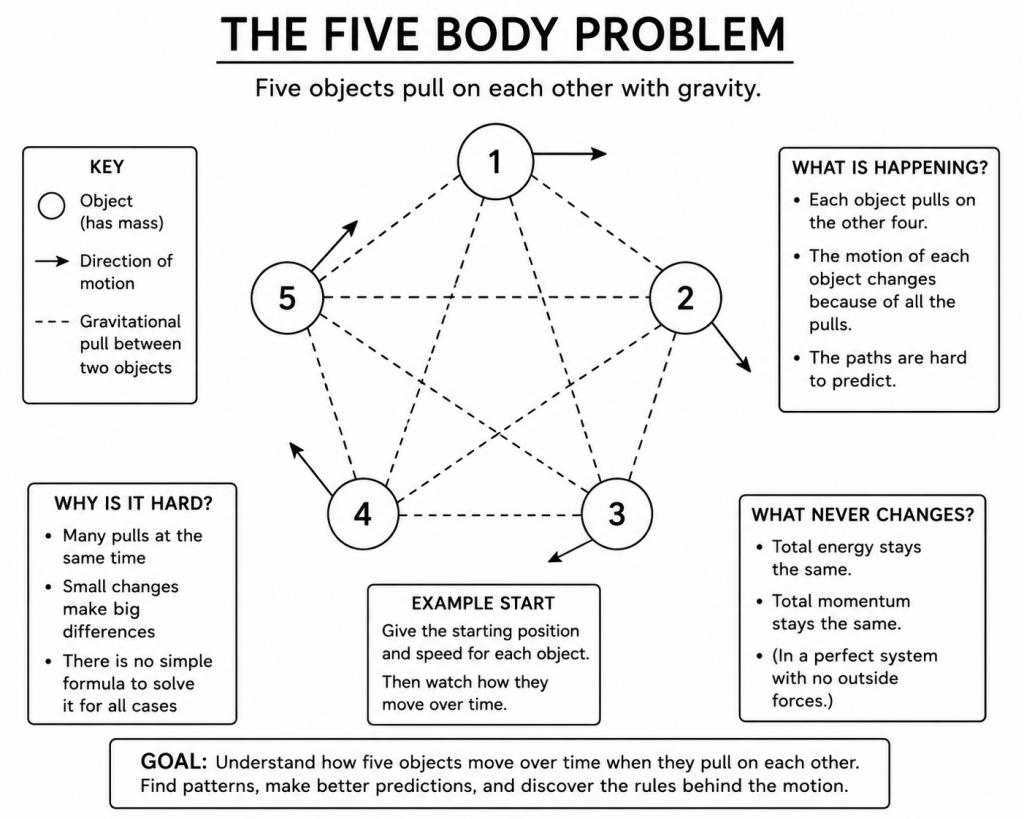
This hypothesis analyzes a five-body gravitational system as a structurally pressured dynamical system. The structural model treats instability, resonance overlap, trajectory divergence, and residual prediction error as measurable pressure variables that may indicate where existing modeling approaches require transition, revision, or higher-order classification.
1. Hypothesis Definition
The five-body problem accumulates measurable structural pressure as five mutually interacting gravitational bodies generate nonlinear coupling, resonance instability, and sensitivity to initial conditions. When this pressure exceeds a critical threshold, the system must undergo a structural transition in the form of model revision, discovery of hidden constraints, emergence of attractor families, probabilistic stability classification, or computational reorganization.
If no transition occurs despite sustained high structural pressure, and if no predictive improvement emerges from revised modeling, the hypothesis is false.
2. THD Framework → Theoretical Model
| Phase | Description |
|---|---|
| Base Phase | The system behaves within the known gravitational framework, using mass, position, velocity, force exchange, and energy conservation as the primary explanatory structure. |
| Pressure Phase | Structural pressure accumulates through resonance overlap, exponential trajectory divergence, close-approach instability, and growing disagreement between predicted and observed or simulated behavior. |
| Integration Phase | The system resolves through a new explanatory structure, such as hidden invariants, attractor basins, reduced-order classification, coordinate transformation, or a revised computational model. |
3. System Definition
The system boundary is a closed or semi-closed configuration of five mutually interacting gravitational bodies. The variables include mass, position, velocity, acceleration, angular momentum, total energy, resonance relationships, phase-space geometry, and Lyapunov divergence. The interactions are gravitational exchanges among all five bodies, including direct attraction, multi-body coupling, resonance amplification, and energy redistribution.
The observables are orbital divergence, recurring quasi-stable motifs, clustering in phase space, long-term instability, prediction error, and attractor persistence. These can be measured through numerical integration, perturbation testing, Lyapunov exponent analysis, resonance mapping, phase-space reconstruction, and comparison between predicted and simulated trajectories.
4. Prior Evidence → Historical Structural Transitions
Prior scientific transitions show that persistent divergence often marks a boundary where the explanatory structure must change. The three-body problem helped shift expectations away from universal closed-form solutions and toward chaos theory. General relativity replaced Newtonian assumptions in regimes where gravitational behavior diverged from prior predictions. Quantum mechanics emerged when classical models failed to explain observed behavior at small scales. Turbulence theory also shows that complex systems may require statistical, topological, or attractor-based descriptions rather than exact deterministic prediction.
The purpose of these examples is not to prove the five-body hypothesis, but to show a recurring structural pattern: when a model repeatedly fails under measurable pressure, either the system must be reclassified, the model must be revised, or the limits of prediction must be formally defined.
5. Structural Pressure Measurement
Structural pressure can be measured through anomaly frequency, clustering, volatility, model divergence, and instability metrics. In this context, anomaly frequency means the rate at which trajectories deviate from expected behavior under small perturbations. Clustering refers to repeated formation of similar phase-space patterns or quasi-stable orbital geometries. Volatility measures how rapidly orbital states change under small differences in initial conditions. Model divergence measures the growth of residual error between predicted and simulated behavior. Instability metrics include Lyapunov exponents, resonance overlap density, close-approach frequency, and energy redistribution irregularity.
6. Structural Pressure Sources → Independent Variables
The independent variables are:
where is resonance overlap density, is Lyapunov divergence rate, is close-approach frequency, x4 is energy-transfer instability, is angular momentum redistribution, is phase-space curvature complexity, and is residual prediction error.
Together, these variables define the measurable stress profile of the five-body system.
7. Structural Pressure Index → Structural Equation
In this equation, is structural pressure, are the stress variables, and are weighting coefficients assigned according to each variable’s contribution to instability and model divergence.
The threshold condition is:
This does not mean the physical system must become orderly. It means the explanatory framework must transition if the pressure index remains high and the current model fails to compress, classify, or predict the system’s behavior beyond brute-force simulation.
8. Model Incompleteness — Verification Gap
Current N-body models can simulate five-body systems numerically, but they do not provide a general closed-form analytic solution for arbitrary five-body configurations. The main divergence appears in long-term prediction, especially where small initial differences produce large trajectory separation. The potentially missing variables are not necessarily new forces; they may be hidden geometric constraints, attractor classifications, resonance topology, stability-basin structure, or better coordinate systems for describing the system.
9. Signal Divergence → Residual Error Model
Here, is observed or simulated system behavior, and is predicted model behavior. If residual error increases without forming reproducible structure, the hypothesis weakens. If residual error increases while also clustering into repeatable patterns, quasi-stable geometries, or attractor families, the hypothesis gains support because divergence would indicate hidden structure rather than mere unpredictability.
10. Pre-Transition Indicators
Pre-transition indicators include persistent growth in residual error, repeated resonance clustering, recurring quasi-stable orbital motifs, rapid Lyapunov escalation, repeated close-approach instability, and emergence of phase-space regions where trajectories organize into recognizable families. A strong confirmation signal would be that these indicators appear across independent simulations and remain stable under changes in numerical method.
11. Structural Failure Location Hypothesis
The transition is most likely to occur at the weakest constraints in the five-body system. These include close-approach zones where gravitational influence changes rapidly, high resonance-overlap regions where multiple orbital periods interfere, energy redistribution bottlenecks where momentum and angular momentum shift abruptly, and phase-space boundaries where small changes in initial conditions separate stable from unstable outcomes.
12. Predicted Structural Outcomes
If P continues to increase, the system should resolve through one of several outcomes. It may reveal a previously unknown variable or hidden invariant. It may require model revision through topology, probability, or coordinate transformation. It may reorganize into attractor families or stability basins. It may show system failure through ejection, collision, or irreversible instability. It may also settle into a new equilibrium or quasi-equilibrium that can be classified even if it cannot be exactly predicted.
13. Transition Likelihood Model
This means the likelihood of model transition, discovery, or structural reclassification increases as structural pressure increases. The claim is not that every chaotic five-body configuration becomes solvable in the classical sense, but that rising pressure should make the need for a new classification or explanatory structure increasingly measurable.
14. Observable Confirmation Signals
If the hypothesis is correct, researchers should observe increasing anomalies, clustering behavior, instability signals, divergence persistence, and adaptation attempts in the modeling framework. More specifically, they should find that high-pressure configurations repeatedly generate identifiable resonance structures, stability boundaries, attractor basins, or predictive compression opportunities that outperform unstructured brute-force numerical simulation.
15. Falsification Criteria
The hypothesis is false if high structural pressure persists without transition, if anomalies resolve without structural change, if the system stabilizes without reorganization, if divergence resolves without discovery or model revision, or if the pressure index fails across comparable systems. It is also false if apparent attractor families fail replication, if clustering disappears under independent numerical methods, or if revised models do not improve prediction, classification, or compression beyond existing approaches.
16. Final Hypothesis Test Statement
For the five-body problem, the test statement is: if the structural pressure index exceeds a defined critical threshold, then the system must produce either structural transition, discovery, model revision, reorganization, or formally measurable instability classification. If high pressure persists and no such transition occurs, the hypothesis is falsified.
17. Real-World Implications
A. Domain-Level Impact
If validated, this hypothesis changes the five-body problem from a search for universal exact prediction into a search for structural classification. It replaces the assumption that solution must mean closed-form trajectory prediction with the possibility that solution can mean identifying stable basins, instability boundaries, attractor families, and reproducible coherence structures.
B. Predictive Capability
The new predictive capability would be classification-based forecasting. Instead of predicting exact long-term positions, the model would predict which structural regime a five-body system is entering: stable, quasi-stable, resonant, collision-prone, ejection-prone, or transition-sensitive.
C. Measurement & Instrumentation
The model would require development of a structural pressure index for N-body systems, along with resonance-overlap maps, attractor persistence metrics, phase-space clustering measures, and residual-divergence tracking. In practice, structural pressure would be tracked by running ensembles of simulations and measuring whether divergence remains random or organizes into repeatable patterns.
D. Engineering / Application Layer
This framework could improve orbital design, satellite swarm planning, asteroid-defense modeling, and long-duration mission stability analysis. The preventable failures would include unstable orbital placements, resonance-driven drift, collision pathways, and mission designs that appear stable in short windows but fail under long-term structural pressure.
E. Cross-Domain Transferability
The same model may transfer to turbulence, plasma systems, ecological instability, market volatility, neural synchronization, and distributed AI systems. It generalizes most strongly where many interacting agents produce nonlinear divergence, yet also show recurring patterns, attractors, or stability basins.
F. Decision-Making / Policy Impact
Space agencies and orbital-governance institutions could use this model to classify risk before exact prediction fails. What becomes more predictable is not every future position of every body, but the structural likelihood of instability, transition, collision, ejection, or long-term orbital degradation.
G. Discovery Implications
High divergence plus high structural pressure would imply that the system may contain hidden geometry, missing classification variables, or underdeveloped stability-basin structure. This would guide discovery by directing attention toward where prediction error clusters rather than treating all divergence as equal.
H. Limitation & Boundary Conditions
The model does not apply where divergence is purely numerical artifact, where observed clustering is produced by the integration method rather than the physical system, or where no reproducible structure appears across independent simulations. It also does not claim to produce a universal closed-form solution for arbitrary five-body configurations. Its boundary is structural solvability, not absolute deterministic prediction.
Final One-Sentence Hypothesis
The five-body problem accumulates measurable structural pressure through nonlinear gravitational interaction, and when that pressure exceeds a critical threshold, the system must undergo structural transition, discovery, model revision, or reorganization; if sustained high structural pressure does not produce transition or predictive improvement, the hypothesis is falsified.