
Progressive Constraint, Regulation, Sensory Filtering, Attention, and State Stabilization Through Modern Systems Science and Informational Physics
Modern popular culture often reduces yoga to physical posture. Classical Yoga presents a much larger architecture.
In Patañjali’s Yoga Sūtras, the practical system is organized into eight limbs:
- Yama — ethical restraints
- Niyama — personal observances
- Āsana — posture
- Prāṇāyāma — regulation of breath
- Pratyāhāra — withdrawal or regulation of sensory engagement
- Dhāraṇā — concentration
- Dhyāna — meditation
- Samādhi — absorption
The eightfold system appears in Yoga Sūtra II.29. Classical Yoga places these practices inside a much broader philosophical project concerned with disciplining mental activity and ultimately attaining liberation; āsana is only one limb rather than the totality of Yoga.
From the perspective of modern systems science, something structurally interesting appears.
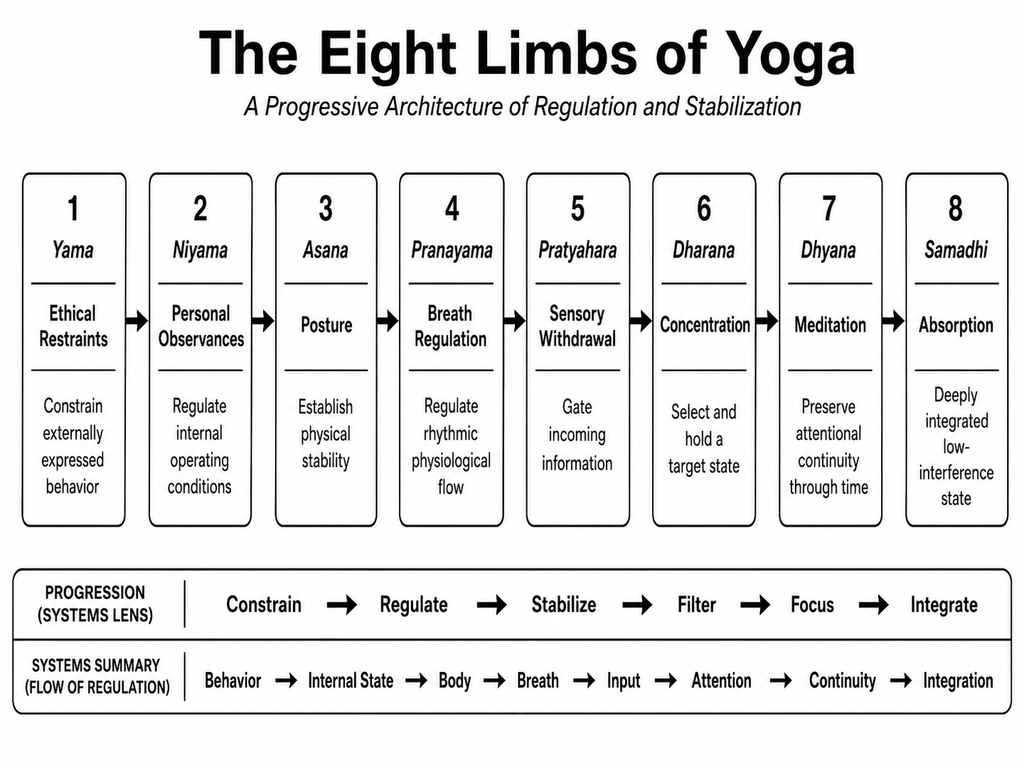
The sequence begins by constraining behavior. It then regulates internal conditions, stabilizes the body, regulates a major physiological rhythm, filters incoming sensory information, narrows attention, maintains that narrowed state through time, and finally describes a condition of extremely deep integration or absorption.
That architecture resembles a progressive reduction of uncontrolled degrees of freedom.
Ancient practitioners did not possess control theory, signal processing, information theory, biomechanics, dynamical-systems software, or modern neuroscience. They could nevertheless observe that human behavior, physiology, sensory input, attention, and mental stability interact.
They encoded those observations through a practical sequence.
Modern civilization can additionally ask:
What does the Eight Limbs architecture look like when translated into the mathematical language of regulation, constraint, information, and state stabilization?
The purpose of that question is not to claim that Patañjali secretly knew modern physics. It is to determine whether a recognizable systems architecture remains after the ancient terminology is translated into modern structural language.
The result is unusually coherent.
The Eight Limbs as a Progressive Regulatory Architecture
The broad translation can be summarized before examining each limb individually.
| Yoga limb | Classical function | Systems-science translation |
|---|---|---|
| Yama | restraints | constrain externally expressed behavior |
| Niyama | observances | regulate internal operating conditions |
| Āsana | posture | establish physical stability |
| Prāṇāyāma | breath regulation | regulate a rhythmic physiological flow |
| Pratyāhāra | sensory withdrawal | gate incoming information |
| Dhāraṇā | concentration | select and hold a target state |
| Dhyāna | meditation | preserve attentional continuity through time |
| Samādhi | absorption | deeply integrated, low-interference state |
The important point is that the sequence does not begin with concentration.
It first reduces disturbances arising from behavior, habit, bodily instability, uncontrolled physiological rhythm, and sensory capture. Only then does it move into sustained attention.
Structurally, this resembles an engineering principle:
Before demanding precision from a system, reduce the disturbances that continually drive it away from precision.
1. Yama — Constrain the Admissible Action Space
The first limb, yama, consists of behavioral restraints. Classical formulations include non-harming, truthfulness, non-stealing, sexual restraint, and non-possessiveness. The restraints are treated as foundational rather than optional accessories to meditation.
Modern systems science provides a direct analogue through constrained control.
Suppose a system can choose actions from a set
Without restrictions, every action in is technically available.
A constraint function
reduces that set to
The controller then operates only inside the admissible region:
This principle is everywhere in engineering.
An autonomous vehicle is not allowed to optimize travel time through every mathematically possible trajectory. Safety constraints remove dangerous trajectories from the action space.
A power system cannot optimize output while ignoring temperature limits.
A financial system does not permit every conceivable transfer.
The restrictions are not failures of the optimization system. They define what successful operation means.
The structural translation of yama is therefore:
Remove classes of behavior whose consequences destabilize either the agent or the larger system in which the agent operates.
This provides an important distinction between freedom and unbounded state space.
A system with more available actions is not automatically more functional.
Sometimes stability increases when destructive possibilities are deliberately removed.
2. Niyama — Regulate the Internal Operating State
Where yama primarily constrains outward behavior, niyama turns toward internal discipline. Classical Yoga lists observances including cleanliness, contentment, disciplined practice, study, and devotion to Īśvara.
The modern systems translation is internal regulation.
Consider an internal state vector
The system functions best within some operating region
Disturbance pushes the state away from that region:
A regulatory process attempts to reduce the deviation:
where represents corrective gain.
The analogy is not that cleanliness or contentment literally constitute feedback coefficients. Rather, niyama functions structurally as a set of practices intended to maintain the internal conditions under which later stages become possible.
This distinction matters.
A system can obey external constraints while remaining internally unstable.
An organization may comply with every external regulation while possessing dysfunctional internal processes.
A machine may operate inside safety limits but perform poorly because it has not been calibrated.
A person may avoid destructive behaviors yet remain unable to sustain attention because internal habits continually generate disturbance.
Yama therefore restricts the external action space.
Niyama regulates the internal operating state.
Together they form the boundary conditions for everything that follows.
3. Āsana — Establish Mechanical Stability
Modern yoga culture often makes āsana the center of Yoga. Classical Patañjali gives posture a narrower role. The Internet Encyclopedia of Philosophy notes that the text devotes relatively little space to āsana and emphasizes a posture stable and comfortable enough to support meditation.
That gives āsana a clean physical interpretation:
Stabilize the mechanical platform before asking it to support higher-resolution processing.
A mechanical system near equilibrium can be represented as
where
- represents inertia,
- damping,
- restoring stiffness,
- external forcing.
Stable posture does not mean zero movement. Biological systems constantly make small corrections.
The more useful condition is bounded deviation:
where is a reference posture.
The structural importance becomes obvious.
If posture is continuously unstable, attention is repeatedly recruited to correct it.
If pain or strain dominates the body, higher-order concentration must compete with those signals.
In control terminology, physical instability becomes a persistent disturbance input.
Āsana therefore functions as platform stabilization.
A telescope must be mechanically stable before producing a high-resolution image.
A measurement instrument must be isolated from excessive vibration.
A meditation system similarly benefits from reducing unnecessary physical disturbance before attempting sustained attentional control.
4. Prāṇāyāma — Regulate a Rhythmic Physiological Flow
The fourth limb, prāṇāyāma, involves regulation of breathing. Classical explanations emphasize the controlled movements and timing of inhalation, exhalation, and retention rather than merely “taking deep breaths.”
Breathing is particularly interesting from a systems perspective because it is simultaneously:
- rhythmic,
- physiological,
- partly automatic,
- partly voluntarily controllable,
- coupled to other biological processes.
A simple oscillatory approximation can be written
where
- is respiratory amplitude,
- respiratory frequency,
- phase.
Voluntary regulation modifies these parameters:
A more general controlled physiological model is
where the breath-control input modifies the dynamics of a larger physiological state .
The article should not overstate what follows from this. Classical prāṇāyāma concepts such as prāṇa are not reducible to one established physical variable.
The systems correspondence is narrower:
A naturally oscillating process becomes an intentional control channel.
This is unusual because respiration lies at an interface between automatic and voluntary regulation.
The practitioner does not manufacture respiration from nothing.
The system is already oscillating.
Practice modifies its timing.
In engineering language, this is not creating the plant.
It is modulating an existing oscillator.
5. Pratyāhāra — Gate Incoming Information
The fifth limb, pratyāhāra, is commonly described as withdrawal of the senses from their objects.
The clearest modern translation is sensory gating.
Any observer receives information through channels.
Let the raw sensory vector be
Not every channel needs equal processing weight.
Introduce a gating matrix
with
The processed signal becomes
When
that channel’s influence on downstream processing is reduced.
This does not mean the sensory organ stops functioning. The distinction is between signal availability and signal allocation.
Modern systems must constantly solve this problem.
A radio filters frequencies.
An AI system selects relevant context.
A network firewall blocks unwanted traffic.
A brain receives far more sensory information than conscious attention can process simultaneously.
Pratyāhāra therefore represents an important transition.
The earlier limbs primarily regulate action, internal habits, body, and breathing.
Pratyāhāra begins regulating what enters the active processing loop.
That creates a clean systems principle:
A limited-capacity processor becomes more stable when irrelevant input no longer competes equally for its resources.
6. Dhāraṇā — Select and Hold a Target State
The sixth limb, dhāraṇā, involves fixing attention on a chosen object or location. Classical treatments describe it as concentration: holding the mind to one place.
Modern information theory offers a useful limited analogy.
Suppose attention is distributed across competing targets:
The entropy of this distribution is
If attention is broadly distributed, entropy is relatively high.
If one target dominates,
then
This does not mean meditation is literally Shannon entropy reduction in the brain.
The equation illustrates the structural relationship:
the number of actively competing possibilities decreases.
Dhāraṇā therefore functions like target acquisition.
The system identifies one state, object, or representation as the active reference and suppresses competing transitions sufficiently to maintain it.
That can also be represented as
The challenge is not initially to preserve this state indefinitely.
It is to establish it reliably.
That distinction becomes important in the next limb.
7. Dhyāna — Preserve Continuity Through Time
Classical sources describe dhyāna as continuous meditation on the chosen object, without the interruptions that characterize earlier concentration. The IEP describes dhāraṇā, dhyāna, and samādhi as a progressively deepening continuum rather than entirely unrelated practices.
The systems difference between dhāraṇā and dhyāna can therefore be expressed as:
Dhāraṇā selects the state.
Dhyāna maintains the state through time.
Suppose the target representation is .
A simple temporal coherence measure is autocorrelation:
If attention changes rapidly and unpredictably, correlation decays quickly.
If the state persists,
remains high over longer intervals.
Another formulation measures cumulative deviation:
Sustained meditation corresponds structurally to keeping this deviation small over an extended interval.
The distinction is critical in many systems.
Momentary stability is easy.
Persistent stability is harder.
A bridge must remain stable through repeated loading.
A communication channel must preserve signal across time.
A spacecraft controller cannot find the correct orientation once and then stop correcting.
Dhyāna therefore adds temporal continuity to attentional selection.
8. Samādhi — Deep Integration and Reduced Internal Interference
The eighth limb, samādhi, is the most difficult to translate without oversimplifying it.
Classical Yoga describes a progressively deepening absorptive state in which the distinction between the practitioner as reflective observer, the act of meditation, and the meditation object becomes radically reduced. The tradition treats samādhi as central to Yoga’s ultimate philosophical and liberative project.
Physics cannot verify that philosophical interpretation simply by providing a dynamical analogy.
The appropriate structural translation is therefore modest:
Samādhi represents an extremely integrated state in which competing internal transitions no longer continually disrupt the selected configuration.
Consider a dynamical system with an attractor :
with
A Lyapunov function may satisfy
so trajectories approach the stable set.
One might also describe declining state dispersion:
or increased concentration around a low-dimensional manifold
None of these equations is samādhi.
They provide a modern language for one functional feature of the description:
the system ceases to wander among competing configurations and becomes deeply stabilized around one integrated regime.
This is where the progressive structure of the eight limbs becomes most apparent.
The Eight Limbs as Nested Constraint
The complete sequence can be represented as progressively restricting the system’s uncontrolled state space.
Let the initial space of possible states and actions be
Each regulatory layer removes additional uncontrolled degrees of freedom:
The reduction can be interpreted functionally:
removes destructive actions.
reduces internal instability.
stabilizes physical configuration.
regulates physiological rhythm.
reduces competing input.
selects an attentional target.
stabilizes that target over time.
approaches deeply integrated absorption.
The key word is constraint, but not constraint in the sense of arbitrary restriction.
This is structured reduction of unnecessary variability.
Modern engineering routinely does the same thing when trying to produce precision.
A measurement instrument is isolated.
Noise is filtered.
Mechanical vibration is reduced.
Input channels are gated.
A reference signal is selected.
Feedback maintains alignment.
The system becomes increasingly capable of sustaining a narrowly defined state.
The Eight-Limb Architecture as a Control Stack
Another way to understand the structure is to treat the limbs as layers in a control architecture.
| Layer | Yoga function | Systems function |
|---|---|---|
| 1 | Yama | external behavioral constraints |
| 2 | Niyama | internal calibration |
| 3 | Āsana | mechanical stabilization |
| 4 | Prāṇāyāma | rhythmic physiological regulation |
| 5 | Pratyāhāra | input filtering |
| 6 | Dhāraṇā | reference selection |
| 7 | Dhyāna | temporal reference maintenance |
| 8 | Samādhi | integrated stable regime |
This arrangement reveals why the sequence has structural coherence.
Imagine asking a high-precision control system to maintain a stable reference while:
- its external actions continually create disturbances,
- its internal parameters drift,
- its platform vibrates,
- its main oscillator is irregular,
- every sensory channel competes for processing,
- no reference target is selected.
The system would struggle.
The Yoga architecture handles those disturbances progressively rather than asking concentration to overcome all of them simultaneously.
That is a strong systems principle:
Reduce upstream disturbance before increasing downstream precision.
Informational Physics — Regulating the Full Information Pathway
Informational Physics adds another useful interpretation because every limb affects a different part of the system’s information architecture.
Yama regulates which outputs are permitted.
Niyama regulates the system’s internal state.
Āsana stabilizes the system’s physical platform.
Prāṇāyāma regulates an important periodic flow.
Pratyāhāra gates incoming information.
Dhāraṇā selects the active reference.
Dhyāna preserves that reference through time.
Samādhi represents deep integration of the resulting state.
The architecture can therefore be represented:
That is not merely a list.
It is a dependency chain.
If early layers remain unstable, they generate disturbance for later layers.
A noisy input channel makes concentration harder.
An unstable body makes sensory withdrawal harder.
An uncontrolled behavioral environment continually introduces new disturbances.
This is why the eight limbs can be read as an architecture of progressive coherence through regulation without claiming that the metaphysical conclusions of Yoga have thereby been physically demonstrated.
The structural model is testable separately from the philosophical interpretation.
The Ancient-to-Modern Bridge
Ancient practitioners could recognize that destructive behavior disturbed the mind. They could not define an admissible control set.
They could recognize that disciplined personal habits improved stability. They could not write homeostatic feedback equations.
They could discover that physical posture affected sustained meditation. They could not calculate mechanical perturbation.
They could regulate breathing. They could not model oscillator phase or feedback control.
They could deliberately withdraw attention from sensory objects. They could not construct a gating matrix.
They could concentrate on one object. They could not calculate attentional entropy.
They could distinguish brief concentration from sustained meditation. They could not calculate autocorrelation functions.
They could experience states of profound absorption. They could not draw nonlinear attractors or low-dimensional state manifolds.
The absence of equations does not imply the absence of structural observation.
It means those observations were encoded using the conceptual language available to the civilization.
Ancient Yoga described:
restraint,
observance,
posture,
breath,
sensory withdrawal,
concentration,
meditation,
absorption.
Modern systems science can describe analogous functions as:
constraint,
calibration,
stabilization,
oscillatory control,
signal filtering,
state selection,
temporal persistence,
integration.
The two languages are not identical.
But the functional architecture survives translation remarkably well.
Conclusion — Eight Layers of Progressive Stabilization
The Eight Limbs of Yoga are often presented today as a collection of spiritual practices, with physical posture receiving disproportionate attention.
Viewed structurally, the architecture is more integrated.
The sequence progressively regulates:
behavior,
internal condition,
physical configuration,
physiological rhythm,
sensory input,
attention,
temporal continuity,
and finally deep integration.
That produces a recognizable systems progression:
Modern control engineering would recognize the logic.
A high-precision system functions better when unnecessary disturbances are removed before the final state is demanded.
Signal processing recognizes the value of filtering.
Dynamical systems recognize stabilization.
Information theory recognizes concentration of probability distributions.
Biomechanics recognizes platform stability.
Control theory recognizes constrained action and feedback.
Informational Physics asks how these layers interact to preserve identity while progressively reducing uncontrolled state variation.
None of those parallels proves the metaphysical claims of Yoga.
But they reveal something significant.
Ancient Indian practitioners developed a layered architecture for regulating human behavior, physiology, sensory input, and attention long before modern civilization acquired the mathematical tools needed to model analogous control problems.
Classical Yoga calls the stages:
Yama. Niyama. Āsana. Prāṇāyāma. Pratyāhāra. Dhāraṇā. Dhyāna. Samādhi.
Modern systems science might describe them as:
constraint, internal regulation, platform stabilization, rhythmic control, sensory gating, state selection, temporal continuity, and integration.
The structural question beneath both languages is the same:
How does a complex system progressively remove disturbances until it can sustain a highly stable and integrated state?