
The Triune Formation of Predation Hypothesis
1. Hypothesis Definition
The human cognitive threat-recognition system accumulates measurable structural pressure through repeated exposure to overlapping predator classes. This pressure emerges from the need to rapidly identify, classify, and respond to multiple forms of predatory threat that historically occupied distinct but overlapping ecological domains, including terrestrial ambush predators, aerial strike predators, and mammalian pursuit predators.
When structural pressure exceeds a critical threshold, the system must undergo structural transition.
In cognitive terms, that transition appears as symbolic compression: the consolidation of multiple predator classes into stable abstract archetypes that reduce cognitive load while preserving threat salience.
These archetypes are not arbitrary cultural inventions. They are adaptive compression structures generated when the cost of maintaining multiple independent predator models exceeds the efficiency threshold of symbolic abstraction.
If sustained high structural pressure does not produce stable composite threat archetypes, symbolic compression, or structural reorganization in cognitive threat representation, the hypothesis is false.
2. THD Framework → Theoretical Model
Triune Harmonic Dynamics defines three system states governing the formation of composite threat archetypes.
| Phase | Description |
|---|---|
| Base Phase | The threat-recognition system responds to isolated predator classes independently through direct sensory and reflexive processing. |
| Pressure Phase | Repeated co-exposure to multiple predator classes increases classification complexity, forcing the system to process overlapping threat profiles under higher cognitive load. |
| Integration Phase | The system resolves accumulated pressure through symbolic compression, generating stable archetypal forms that unify multiple threat classes into single high-salience symbolic objects. |
3. System Definition
The system under analysis includes the perceptual and cognitive architecture involved in biological threat recognition, especially the visual cortex, amygdala, temporal pattern-recognition systems, and higher-order abstraction networks responsible for symbolic consolidation. System boundaries include the full adaptive pathway from sensory predator recognition to long-term symbolic encoding and cross-generational transmission. Variables include predator overlap density, response intensity to hybrid threat imagery, symbolic recurrence across isolated cultures, and persistence of composite predator motifs across generations. Interactions include the integration of morphology, movement, salience, and environmental threat signals into increasingly generalized cognitive threat constructs. Observables include the recurrence of composite predator archetypes in geographically isolated cultures, persistent emotional salience attached to non-existent hybrid predators, and consistent symbolic compression of multiple predator traits into stable cross-generational forms.
4. Prior Evidence → Historical Structural Transitions
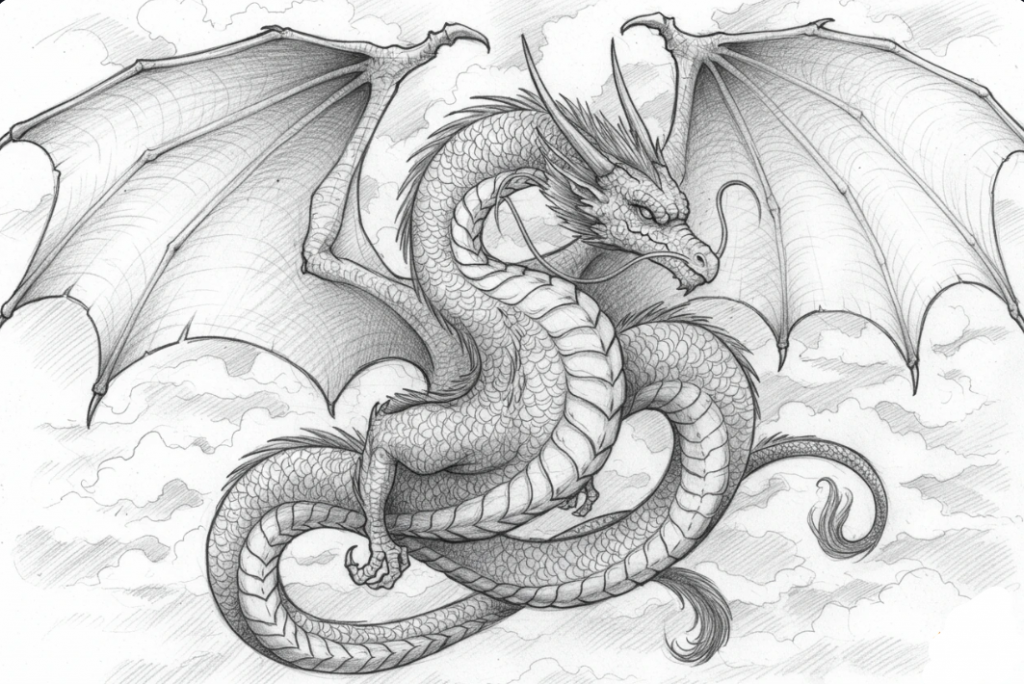
Historical and comparative evidence suggests that symbolic threat compression is not unique to a single mythic form, but recurs as a stable cognitive output across independent cultures. The dragon is the clearest surviving triune composite, combining serpentine locomotion, avian elevation, claws, dentition, and territorial aggression into a single generalized apex threat. Its persistence across Europe, Asia, and Mesoamerica suggests convergent symbolic emergence rather than simple cultural diffusion. The stronger test of the model, however, is not whether dragons recur. It is whether structurally similar archetypes emerge independently under the same cognitive pressures.
That broader archetype class is both observable and repeatable.
5. Structural Pressure Measurement
Structural pressure is measured through the recurrence, stability, and cognitive salience of composite predator forms. Anomaly frequency is reflected in the repeated appearance of hybrid predator archetypes in cultures separated by geography and chronology. Clustering appears in the repeated emergence of composite predator forms in regions historically characterized by overlapping predator ecologies. Volatility appears in heightened cognitive and emotional responses to hybrid predator forms that do not correspond to real animals but remain intuitively legible as threats. Model divergence appears where isolated predator-response models fail to explain persistent fear salience associated with symbolic hybrids. Instability metrics include the degree to which composite predators evoke stronger and more durable emotional responses than their isolated biological components.
6. Structural Pressure Sources → Independent Variables
The independent variables driving structural pressure are:
- x₁: terrestrial predator exposure, including reptiles, constrictors, and venom-bearing ambush threats
- x₂: aerial predator exposure, including raptors and high-velocity strike threats
- x₃: mammalian carnivore exposure, including felines and pursuit predators
- x₄: predator overlap density, defined as the frequency of simultaneous multi-domain threat environments
- x₅: symbolic retention pressure, defined as the cognitive demand to preserve and transmit threat models across generations
7. Structural Pressure Index → Structural Equation
P=i=1∑nwixi
Where:
- (P) is structural pressure
- (x_i) are threat-load variables
- (w_i) are weighting coefficients for adaptive salience
Threshold Condition:
P>Pc⇒Structural Transition Required
When cumulative predator-processing pressure exceeds the threshold for efficient independent classification, symbolic compression becomes the expected adaptive transition.
8. Model Incompleteness (Verification Gap)
Current evolutionary and cognitive models explain isolated predator fear well, but they do not adequately explain why human symbolic systems repeatedly generate emotionally salient hybrid predators that exceed any natural animal in structural complexity and psychological persistence.
The strongest divergence appears where the mind preserves intense, intuitive threat salience toward composite predators that do not exist in nature, yet remain cognitively immediate and cross-culturally stable.
The missing variable is not mythology. It is compression.
9. Signal Divergence → Residual Error Model
D = |O – M|
Where:
- (O) is observed symbolic threat salience
- (M) is predicted salience under isolated predator models
The divergence between observed and predicted salience increases as symbolic predators become more structurally composite and ecologically impossible.
10. Pre-Transition Indicators
Observable pre-transition signals include increasing symbolic hybridization of predator traits, elevated mnemonic persistence of composite threats, and the repeated emergence of stable multi-domain predator forms in oral and visual symbolic systems.
11. Structural Failure Location Hypothesis
The transition into symbolic archetype occurs at the point where direct biological threat classification becomes cognitively inefficient. The weakest constraint is the system’s ability to maintain multiple independent predator models without symbolic compression. The highest stress concentration occurs where overlapping predator features produce classification conflict. The primary bottleneck is the cost of preserving separate threat responses under multi-domain exposure. The strongest resonance points appear where overlapping predator ecologies produce repeated multi-domain threat load.
12. Predicted Structural Outcomes
If structural pressure continues to increase, the system resolves through stable symbolic predator compression. This produces repeatable archetypes that combine multiple predator domains into coherent abstract threat forms. The dragon is one such output, but it is not the only one. If the model is correct, other cultures should independently produce structurally similar predator composites that preserve the same compression logic while varying in symbolic detail.
Example 1: The Griffin
The griffin is one of the clearest examples of dual-domain predator compression. It combines the head, beak, and wings of a raptor with the muscular body and claws of a lion. This is not a random hybrid. It fuses the dominant aerial predator and dominant terrestrial predator into a single threat architecture. The griffin appears across the ancient Near East, Mediterranean, and Central Asian symbolic systems, often in guardian or territorial roles. Its persistence is significant because it consistently preserves the same structural logic: the integration of sky-threat and ground-threat into a unified apex form. Under this model, the griffin functions as a compressed two-domain threat archetype. It is the clearest predicted precursor to full triune compression. Its cognitive role is not simply symbolic guardianship. It is the stabilization of dual predator classes into a single high-salience threat construct.
Example 2: The Chimera
The chimera is structurally more important than its later mythological interpretation suggests. In its classical form, it combines lion, serpent, and goat elements into a single unstable composite. While the goat appears non-predatory at first glance, its inclusion is not arbitrary. It introduces morphological distortion and anomaly into the threat model. This matters because the chimera is not simply a stronger predator. It is a cognitively unstable predator. It forces the recognition system to process category violation in addition to threat. The result is not merely fear of attack, but fear of malformed unpredictability. Under the triune model, the chimera represents a higher-order threat synthesis in which the mind is no longer compressing predator classes alone, but predator classes plus anomaly load. It is a threat archetype built not only from danger, but from classification instability. That makes the chimera an especially strong test case for cognitive overload and symbolic compression.
Example 3: Thunderbird
The thunderbird is one of the clearest examples of amplified aerial predation transformed into archetypal scale. It appears across multiple Indigenous North American traditions as a dominant sky-force entity associated with storms, lightning, altitude, and atmospheric control. Its structural significance lies in its exaggeration of avian predation into environmental agency. The thunderbird is not simply a large bird. It is an aerial predator abstracted to the scale of weather and sky dominance. Under this model, the thunderbird represents the expansion of aerial threat into environmental totalization. It preserves the avian threat core, but scales it into atmospheric authority. This is exactly what the model predicts when one predator class becomes cognitively amplified beyond ordinary biological constraints. The thunderbird is therefore not merely mythic weather symbolism. It is an apex sky-threat abstraction.
Example 4: Nāga and Serpent Deity Systems
The Nāga complex, along with related serpent-deity systems across South and Southeast Asia, provides a crucial non-Western validation case. These figures often combine serpentine morphology with territorial intelligence, environmental control, and quasi-human cognition. This matters because the Nāga does not simply preserve serpent threat. It preserves serpent threat elevated into environmental and cognitive agency. It represents the continuation of the serpentine threat system beyond simple predation into abstract territorial dominance. Under the model, this is exactly what should occur when one high-salience predator class becomes recursively integrated into symbolic cognition. The result is not just fear of snakes. It is the emergence of the serpent as a persistent abstract control form. The Nāga therefore functions as a culturally elaborated but structurally consistent continuation of the same compression logic.
13. Transition Likelihood Model
P(Transition∣P)↑ as P↑
As overlapping predator-processing pressure increases, the probability of symbolic compression into composite threat archetypes increases accordingly.
14. Observable Confirmation Signals
If the hypothesis is correct, independent cultures should repeatedly produce composite predator forms, stable cross-generational recurrence, exaggerated threat integration, and symbolic compression that exceeds any single natural predator. These examples are not interchangeable myths. They are repeated outputs of the same structural process. The dragon alone can be dismissed as diffusion. A class of structurally similar predator composites emerging across isolated environments is much harder to dismiss. That is the falsifiable strength of the expanded model.
15. Falsification Criteria
The hypothesis is false if composite predator archetypes do not preserve recurring structural logic, if hybrid threat forms emerge randomly without stable predator-class compression, if isolated cultures fail to produce convergent composite apex-threat forms, or if neurological responses to these forms are indistinguishable from neutral symbolic hybrids. It is not enough that hybrid creatures exist. They must preserve consistent predator compression logic across cultures and time.
16. Final Hypothesis Test Statement
P>Pc⇒Structural Transition
P>Pc and no symbolic compression occurs⇒Hypothesis False
If overlapping predator exposure generates sustained high structural pressure, the cognitive system must transition into stable symbolic compression. If no such transition occurs, the hypothesis is falsified.
17. Real-World Implications
If validated, this model reframes mythic predator archetypes as measurable outputs of adaptive cognition rather than arbitrary cultural inventions. It enables predictive modeling of symbolic threat formation, improves understanding of phobia persistence and inherited salience bias, and provides a transferable framework for studying how cognition compresses recurrent environmental pressures into durable symbolic forms across domains.
Final One-Sentence Hypothesis
The human threat-recognition system accumulates measurable structural pressure through overlapping exposure to terrestrial, aerial, and mammalian predators; when this pressure exceeds a critical threshold, cognition resolves that load through symbolic compression into stable composite archetypes such as dragons, griffins, chimeras, thunderbirds, and serpent deities, and if sustained high pressure does not produce such convergent symbolic forms, the hypothesis is falsified.