
A Falsifiable Origin Hypothesis
Cosmogenesis from Informational Scale Dynamics develops a hypothesis in which cosmic expansion represents the evolution of retained informational structure, rather than a transition imposed at a finite initial moment. Grounded in the Unified Informational Physics Ontology (UIPO), the study asks whether a specified informational geometry can jointly determine an expansion law and a physical clock while producing quantitative restrictions that can be contradicted.
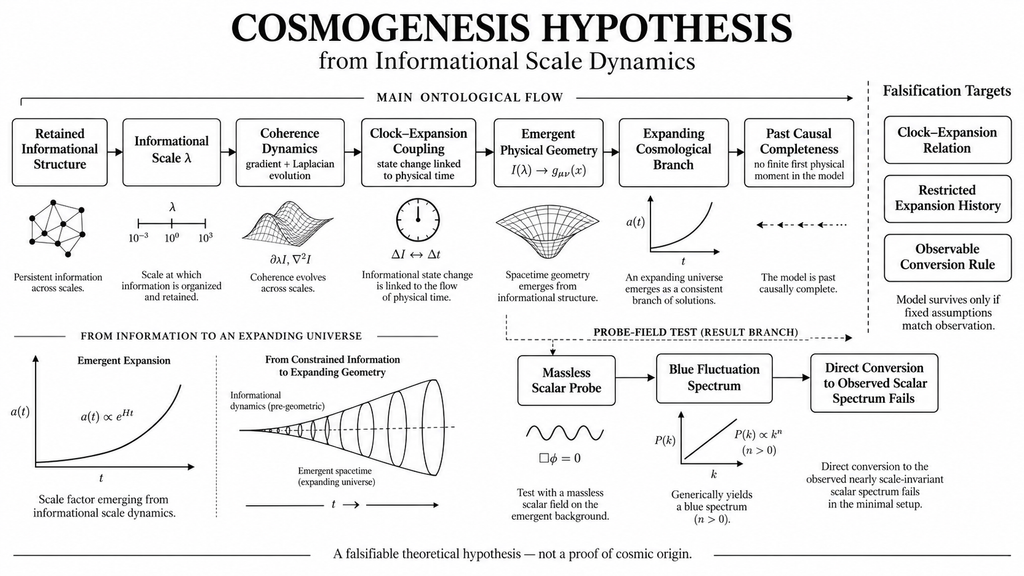
The model combines UIPO’s gradient–Laplacian coherence functional with two distinct evolution schemas: metric-gradient motion and state evolution containing a clock-rate factor. Requiring both schemas to hold simultaneously on a scale coordinate with a dilation-invariant configuration metric fixes the clock relationship and constrains expansion. A separately declared observation map connects informational scale to a spatially flat physical geometry. Coherence remains a defined informational score, not an assumed energy density or gravitational field.
The principal mathematical result establishes a general logarithmic scale asymptotic for smooth entropy profiles whose Laplacian has a regular, nonempty zero set and satisfies the stated nonvanishing-gradient condition. Under the specified geometry, alignment, and observation assumptions, the resulting expanding branch is past timelike and null geodesically complete. Both massive-particle proper times and light-ray affine lengths extend indefinitely into the past. Scalar polynomial curvature invariants vanish asymptotically, although boosted curvature components can diverge. Causal completeness therefore does not establish universally bounded tidal curvature or a complete resolution of quantum singularities.
An exact sinusoidal entropy profile supplies a global homogeneous example. Its expansion approaches a finite limiting scale in the future, while its Hubble rate first increases and subsequently decreases. These are predictions of the declared profile in reference units, not fitted measurements or a demonstrated future history of our universe. Variations in configuration geometry, clock alignment, and the observation map identify explicit conditions under which past completeness fails.
A separately specified free, massless, minimally coupled scalar probe provides a conditional fluctuation prediction. Analytic asymptotics and numerical mode integrations yield a blue dimensionless spectrum with logarithmic slope approaching one. This is not an observed scalar spectral index near one. A scale-independent conversion into the dominant adiabatic perturbation would instead predict an index approaching two, incompatible with the published Planck benchmark when the applicable bands are identified. That simple conversion extension is excluded; the background theorem does not require it.
Falsification targets include the joint clock–expansion relation, the restricted expansion-history family, and any explicitly specified conversion into observables. Profiles, reference constants, estimators, and observation maps must be fixed independently of validation outcomes. Retrospective reconstruction of arbitrary hidden functions does not constitute prediction. The paper also excludes realization of the early branch through minimally coupled canonical scalar fields with positive kinetic terms in flat Einstein cosmology.
Numerical checks address quadrature, asymptotic coefficients, coordinate consistency, integration refinement, and probe normalization. No astronomical likelihood fit or new observational dataset is reported. The proposal does not supply a covariant gravitational action, matter-production mechanism, or observed thermal history. Its primary contribution is a conditional expanding-origin mechanism with mathematical proofs, calculable probe behavior, and explicit restrictions that a complete physical realization must ultimately satisfy together.