
Most calendars tell us when something happens. A harmonic calendar asks a different question: does the structure of time itself correspond with the kinds of changes that become more visible during particular periods?
The THD Harmonic Calendar was developed from Triune Harmonic Dynamics, a framework that describes transformation through three recurring phases: Emergence, Contrast, and Integration. Emergence describes formation—the appearance of something new or the opening of a new possibility. Contrast describes testing—the point at which an emerging or established structure encounters pressure, resistance, contradiction, limits, competition, or correction. Integration describes stabilization—the stage in which prior pressure is resolved, reorganized, completed, or incorporated into a more usable structure.
The public Harmonic Calendar currently applies those phases recursively across Daily, Weekly, Monthly, and Yearly timing layers. Its collective calendar begins on March 20, uses a 364-day harmonic year, assigns days 1–9 of each 28-day cycle to Emergence, days 10–18 to Contrast, and days 19–28 to Integration. Weekly phase is determined from the dominant Daily phase across a seven-day window. Twenty-eight-day blocks themselves recursively rotate through Emergence, Contrast, and Integration, while the position within the 364-day year is divided into larger Emergence, Contrast, and Integration sectors.
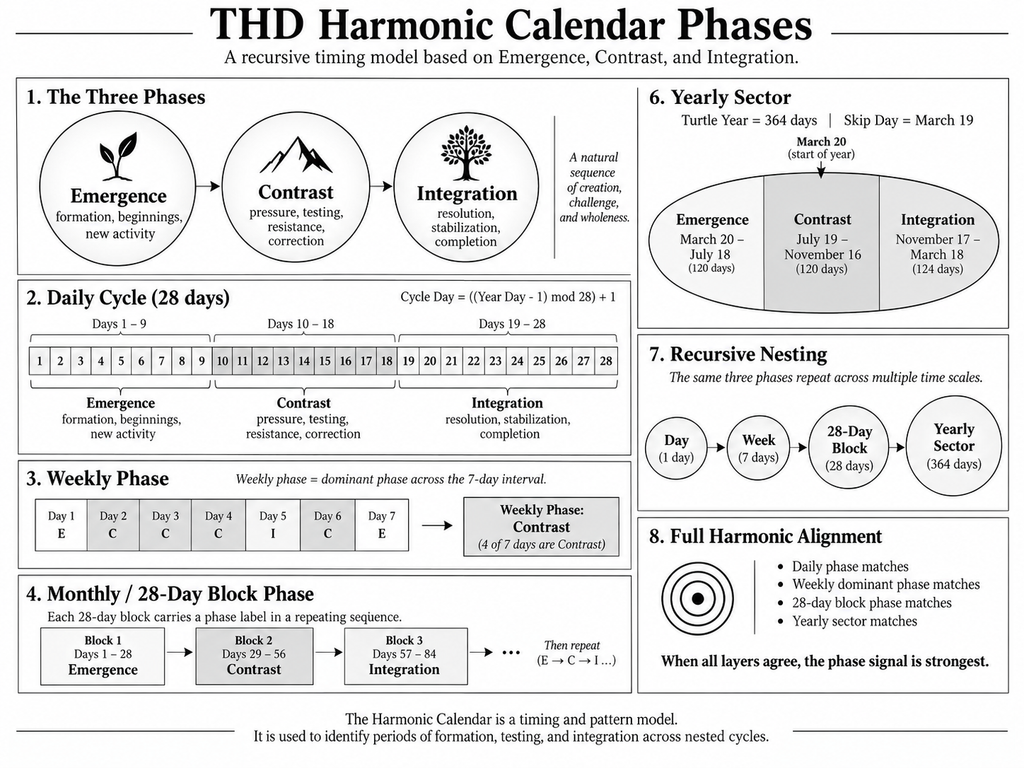
Under the proposed alignment used for this forecast, 2026 is treated as an Emergence year, 2027 as a Contrast year, and 2028 as an Integration year.
That distinction matters because 2027 creates an unusually useful experimental opportunity.
If 2027 is an overall Contrast year, and the Harmonic Calendar correctly identifies periods in which multiple nested timing layers simultaneously occupy Contrast, then the strongest overlaps should correspond with a measurable increase in Contrast-like behavior in the surrounding informational environment.
Two windows stand out:
July 19–24, 2027
and
October 11–16, 2027.
During these periods, the proposed Annual Phase, the existing Yearly sector, the Monthly 28-day block, the Weekly dominant phase, and the Daily phase all converge on Contrast.
This creates a prospective test of a simple proposition:
If nested harmonic timing has predictive value, major news coverage during the strongest Contrast-alignment windows should contain a greater-than-normal concentration of conflict, resistance, pressure, disruption, correction, reversal, exposure, volatility, institutional challenge, and unresolved testing.
The purpose of the forecast is not to predict one earthquake, one political crisis, one stock-market decline, or one war. It is to make a more fundamental and potentially more useful prediction about the structural character of events.
If the calendar is meaningful, Contrast should become statistically more visible when Contrast is simultaneously reinforced across multiple scales.
Triune Harmonic Dynamics itself remains a research hypothesis rather than an externally established cross-domain law. The current UIPO research specification explicitly separates mathematical definition from empirical applicability and requires THD claims to be subjected to frozen mappings, held-out evaluation, alternative models, and falsification rather than treating recurring patterns as proof by themselves. That makes a prospective test such as this particularly important.
What a Contrast Window Actually Means
A common misunderstanding would be to interpret Contrast as simply meaning that “bad things happen.”
That is too crude.
Contrast is not synonymous with catastrophe, violence, collapse, or negativity. It describes a structural relationship in which a system encounters opposition or a constraint that tests its current configuration.
A government proposing a law and encountering a court injunction is Contrast.
A company launching a product and discovering a major defect is Contrast.
Workers challenging management through a strike are expressing Contrast.
Scientists publishing a result that another research team subsequently disputes is Contrast.
A technology platform encountering a regulatory restriction is Contrast.
Markets repricing assets abruptly after an unexpected economic report are expressing Contrast.
Two nations entering difficult negotiations after escalating tensions are expressing Contrast even if no military conflict occurs.
In every example, the underlying geometry is similar. Some condition exists. An opposing pressure appears. The system must respond.
That definition follows the calendar’s own public characterization of Contrast as “pressure, resistance, correction, or testing,” with practical emphasis on review, repair, refinement, slowing down, and resolving weak points.
The forecast therefore concerns the density of this structural pattern, not simply the emotional tone of the news.
This is important because negative sentiment and Contrast are not the same thing. A retrospective article about a disaster that occurred years earlier might be emotionally negative without representing a new Contrast event. Conversely, a headline such as “Regulators Challenge Proposed Merger” may be relatively neutral in tone while being structurally very strong Contrast.
The classification must therefore focus on what the system in the headline is doing.
Why These Two Windows Matter
The Harmonic Calendar is recursive. The Daily cycle operates inside a Weekly context. Daily and Weekly phases occur inside larger 28-day blocks. Those blocks occur inside larger sectors of the 364-day Turtle year.
The current tool is explicitly Daily-first: the Daily phase identifies the immediate date while Weekly, Monthly, and Yearly layers provide supporting or background context.
Under the proposed Annual extension, one additional scale sits above those layers.
For most dates, these levels will not agree. A Contrast day may occur during an Emergence month. An Integration week might occur during a Contrast sector. That mixed condition is expected in a recursive system.
The interesting dates are those where several scales converge.
For July 19, 2027, the Turtle Calendar reaches harmonic year day 122. That corresponds to cycle day 10, the first Daily Contrast position. It also begins the fifth 28-day block of the Turtle year, which is a Contrast block under the repeating Emergence–Contrast–Integration block sequence. It enters the larger Contrast sector of the 364-day year, and the following seven-day Daily distribution is dominated by Contrast. With 2027 provisionally assigned the overall Annual Contrast phase, all five layers point in the same direction.
The same geometry reappears beginning October 11, 2027. That date corresponds to harmonic year day 206 and again cycle day 10. It begins another Contrast-positioned 28-day block while remaining inside the larger annual Contrast sector. Its Weekly and Daily structures also align with Contrast.
The strongest overlaps are therefore:
| Timing layer | July 19–24 | October 11–16 |
|---|---|---|
| Proposed Annual Phase | Contrast | Contrast |
| Turtle Year Sector | Contrast | Contrast |
| 28-Day Block | Contrast | Contrast |
| Weekly Dominant Phase | Contrast | Contrast |
| Daily Phase | Contrast | Contrast |
| Alignment | 5 of 5 | 5 of 5 |
These are not merely dates chosen because something dramatic happened on them. They are being identified in September 2026, roughly ten months before the first window and more than a year before the second.
That prospective separation is essential.
The 2027 Headline Forecast
The primary forecast is straightforward.
During both July 19–24 and October 11–16, 2027, major U.S. and international news should contain an unusually high proportion of structurally Contrast-like headlines relative to ordinary periods.
The expected signature is broad. Political and institutional reporting should disproportionately concern opposition, investigations, legislative battles, legal challenges, governmental standoffs, leadership pressure, disputed decisions, or failed negotiations.
Geopolitical news should be more likely to emphasize confrontation, sanctions, diplomatic deterioration, territorial disputes, military pressure, stalled negotiations, or escalating rhetoric.
Economic and financial reporting should be more likely to feature volatility, unexpected deterioration, repricing, credit pressure, layoffs, earnings disappointments, funding difficulties, sharp disagreement over economic policy, or market reactions to adverse information.
Corporate reporting should more frequently contain restructuring, leadership changes, legal disputes, failed transactions, labor conflict, bankruptcy pressure, operational disruption, product problems, or regulatory opposition.
Technology and infrastructure reporting may contain outages, cyber incidents, platform disruptions, safety failures, contested deployments, regulatory restrictions, technological setbacks, or problems revealed under load.
Social reporting may emphasize protest, strikes, backlash, public resistance, polarization, or organized opposition.
Scientific reporting may include disputes over results, replication failures, contradictory findings, regulatory concerns, revisions of prior conclusions, or evidence that places pressure on an existing model.
Legal and regulatory reporting should be especially compatible with Contrast because courts, regulators, plaintiffs, defendants, agencies, corporations, and governments frequently occupy explicitly opposing structural positions.
Environmental and natural events may also produce Contrast signatures when they place infrastructure, governments, communities, or emergency systems under acute pressure. The prediction is not that earthquakes, hurricanes, wildfires, or heat waves are themselves caused by the calendar. It is that events producing system-level pressure may contribute to the overall Contrast density during these windows.
Finally, exposure and revelation should be watched carefully. Investigations, leaks, audits, scandals, hidden liabilities, undisclosed vulnerabilities, and previously unseen problems are archetypal Contrast events because they introduce information that forces an existing system to confront a weakness.
July and October May Express Contrast Differently
Although both periods reach the same five-layer alignment, their positions inside the broader Contrast sector suggest a secondary prediction.
The July 19–24 window occurs at the beginning of the larger Yearly Contrast sector. The most natural signature is therefore the activation of opposition.
This period should be especially compatible with headlines describing confrontation, challenge, testing, reversal, pushback, or the first visible manifestation of pressure.
Typical structural forms might resemble:
“Court Blocks Major…”
“Talks Collapse After…”
“Workers Strike Over…”
“Government Faces Pressure From…”
“Markets Drop Following Unexpected…”
“Regulators Challenge…”
“Tensions Escalate Between…”
“Investigation Opens Into…”
These are examples of structure, not predictions of literal wording.
The October 11–16 window occurs much deeper into the broader Contrast season. If the recursive interpretation is useful, this period may be more likely to show accumulated consequences.
Rather than simply “opposition appears,” the later window may emphasize pressure that has persisted long enough to force difficult choices, restructuring, escalation, or visible failure.
Representative structural forms could include:
“Crisis Deepens As…”
“Negotiations Fail Again…”
“Company Restructures After…”
“Government Faces Deadline Amid…”
“Leadership Under Growing Pressure…”
“Regulators Take Action Following…”
“System Failure Exposes…”
“Markets Reprice Risk As…”
This provides a secondary falsifiable claim. July should lean relatively more toward challenge and activation, while October should lean relatively more toward consequence and accumulated pressure.
That distinction should be evaluated after the fact rather than assumed to have succeeded.
What Would Count as Evidence?
One dramatic headline during either period proves almost nothing.
There are conflicts, lawsuits, market declines, accidents, political disputes, and corporate failures every day somewhere in the world. A sufficiently motivated researcher could select examples from almost any six-day period and construct a convincing narrative.
That is precisely what this demonstration must avoid.
The correct object of measurement is therefore not whether Contrast headlines exist. It is whether their relative concentration increases.
The principal measure will be Contrast Density:
Suppose 100 independently sampled headlines are examined during a target period and 58 are classified as Contrast. The Contrast Density is 58 percent.
That value has little meaning by itself. It must be compared with a baseline.
If ordinary six-day periods average 35 percent Contrast, then 58 percent during a preregistered window would be interesting.
If ordinary periods already average 55 percent Contrast, the same result would provide little support for the calendar.
This is why comparison periods are essential.
The Control Periods
Each target window should be compared against at least three kinds of controls.
The first should be the immediately preceding six-day period.
The second should be the immediately following six-day period.
The third should consist of multiple six-day windows distributed elsewhere throughout 2027 and chosen independently of their news content.
For July 19–24, for example, an initial adjacent comparison can use July 13–18 and July 25–30. October 11–16 can similarly be compared with October 5–10 and October 17–22.
But adjacent controls alone are insufficient because news events often persist across boundaries. A war, financial crisis, hurricane, election, or government shutdown may dominate several consecutive weeks.
The stronger comparison therefore uses multiple distributed control windows from outside the predicted five-layer Contrast periods. Ideally these dates would be selected in advance or by a reproducible random procedure.
An annual baseline should also be calculated if sufficient headline data are available.
The question then becomes much harder to manipulate:
Were the two dates identified in advance actually unusual relative to the broader informational environment of 2027?
Measuring Breadth, Not Just Volume
Contrast Density is only the first metric.
The second should be Contrast Breadth.
Imagine that a geopolitical crisis occurs during July and produces 60 nearly identical stories about the same conflict. Contrast Density could become very high simply because one event dominated the news cycle.
That is weaker evidence for a generalized harmonic environment.
The more interesting result would be simultaneous Contrast across independent domains.
For example, suppose the same six-day period contains heightened confrontation in international affairs, a major court ruling in domestic politics, increased financial volatility, a labor strike, regulatory action against a technology company, and an unexpected scientific dispute.
Those events are causally unrelated but structurally similar.
That is precisely the type of cross-domain recurrence THD proposes should be worth examining.
A Breadth Score can therefore count how many independent news domains show elevated Contrast relative to their own normal rates.
Suggested domains include politics and government, geopolitics, economics and markets, business and labor, law and regulation, technology and infrastructure, science, social conflict, and environment or emergency systems.
A result involving seven domains is stronger than one involving only one.
The UIPO research specification is particularly relevant here because it cautions that fitted 3–6–9 mappings should be tested on held-out data and against alternatives rather than treating the mapping itself as validation. The same principle applies here: the forecast must create a risky expectation that could fail.
A Frozen Headline Classification Rubric
To prevent interpretation from changing after the dates have passed, the following rubric is proposed now.
| Phase | Structural definition | Typical signals |
|---|---|---|
| Emergence | A new state, entity, direction, capability, opening, or possibility is forming. | launch, discovery, creation, announcement, breakthrough, expansion, opening, new initiative |
| Contrast | An existing or emerging state encounters pressure, opposition, contradiction, limits, disruption, failure, or correction. | conflict, challenge, resistance, lawsuit, strike, protest, sanctions, failure, volatility, reversal, investigation, outage, escalation |
| Integration | Previous pressure moves toward resolution, stabilization, agreement, completion, restoration, or consolidation. | settlement, agreement, recovery, completion, normalization, stabilization, restoration, implementation, consolidation |
| Unclear | The headline does not contain enough structural information for reliable classification. | informational headline without identifiable transformation state |
Only one primary phase should be assigned to each headline.
The classification should be based primarily on the headline itself. When a headline is genuinely ambiguous, the linked article may be consulted for context, but the system should record that additional context was required.
An AI system should also give a classification-confidence score. A headline that clearly states “Workers Begin Strike After Contract Talks Fail” might receive Contrast with 98 percent classification confidence. A headline such as “President Addresses Nation Tuesday” might be Unclear.
Unclear headlines should not be forced into one of the three phases merely to increase sample size.
Preregistered Success Criteria
The demonstration should not rely on a vague declaration that the dates “felt Contrast-heavy.”
Before the events occur, we can define progressively stronger levels of support.
A failed result occurs if Contrast Density during the target windows is approximately equal to or below the relevant control baseline.
A weak result occurs if Contrast Density is higher than baseline but only slightly, inconsistently, or primarily because of one dominant story.
A moderate result occurs if both target windows exceed their control-period Contrast Density and Contrast is the largest of the three THD headline classes.
A strong result occurs if both target windows materially exceed their adjacent and distributed controls, Contrast is clearly the dominant class, and increased Contrast occurs across several independent domains.
A very strong result would additionally show that the July period contains more activation/challenge language while the October period contains more consequence/escalation language, as prospectively predicted here.
For operational scoring, a useful provisional threshold would be:
Target Contrast Density must exceed the relevant control mean by at least 10 percentage points to qualify as a meaningful elevation.
A second condition should require Contrast to represent the largest THD class in both windows.
A third should require elevated Contrast in at least four independent news domains.
These thresholds are intentionally demanding enough that an ordinary noisy variation should not automatically qualify as confirmation.
They may eventually be improved statistically, but they should not be loosened after seeing the results.
What Would Falsify the Forecast?
The forecast can fail.
That fact is central to the demonstration.
If July 19–24 and October 11–16, 2027 do not exhibit elevated Contrast Density relative to appropriately selected controls, the headline-density hypothesis is not supported.
If only one window shows the effect, the forecast receives a mixed result.
If the apparent increase disappears after duplicate stories about the same event are removed, the evidence weakens substantially.
If Contrast is elevated but similar or stronger elevations routinely occur during randomly selected non-aligned windows, the calendar has not demonstrated useful discrimination.
If the classification outcome depends strongly on which AI system performs the grading, inter-rater reliability becomes a problem and the result should be treated cautiously.
If Emergence or Integration consistently dominates the predicted Contrast windows, that directly contradicts the forecast.
These are not inconveniences to be explained away later. They are part of the test.
Broader Uses of the Harmonic Calendar
Headline analysis is only one possible application.
If the recursive timing hypothesis survives testing, the same architecture can be applied to other systems in which transitions can be classified objectively.
In financial markets, Contrast windows could be tested against volatility, dispersion, unusually large price movement, revisions of expectations, failed breakouts, liquidity stress, or disagreement between market sectors. This does not imply that Contrast must cause prices to decline. A sharply rising market can also express Contrast if expectations are being rapidly repriced.
In organizational systems, a Harmonic Calendar could be tested against conflict reports, project rework, unexpected obstacles, leadership challenges, failed milestones, defect rates, or decision reversals. Businesses might eventually use Contrast windows for review, stress testing, auditing, negotiation, or risk identification rather than automatically scheduling launches during those periods.
In political systems, the method could examine legislative blockage, legal disputes, protest activity, leadership challenges, diplomatic confrontation, contested votes, investigations, or regulatory conflict.
In technology, researchers could measure outages, vulnerability disclosures, failed deployments, product recalls, security incidents, regulatory resistance, or unexpectedly poor performance.
In science, one could track corrections, retractions, failed replications, contradictory findings, paradigm disputes, or newly discovered limits of existing models.
Emergence windows could be tested separately for launches, discoveries, new organizations, first demonstrations, announcements, technological introductions, business formations, or novel scientific results.
Integration windows could be tested against settlements, completed mergers, enacted agreements, recovery, stabilization, finalized standards, successful implementation, or institutional consolidation.
The important shift is that the calendar becomes more than a personal planning interface.
It becomes a generator of prospective temporal hypotheses.
Public AI Validation Prompt
After either target period has passed, anyone should be able to reproduce the test without using Creation Unified’s interpretation of the headlines.
The following prompt is intentionally designed to work with any AI system capable of internet research.
COPY-PASTE AI PROMPT
====================================================================
THD Harmonic Calendar Independent Headline Validation Test
Conduct an independent retrospective measurement of publicly available news headlines for a prospectively specified THD Harmonic Calendar forecast.
Do not assume the forecast is correct. Your job is to attempt to determine objectively whether the predicted Contrast effect occurred.
The two preregistered target windows are:
July 19–24, 2027
October 11–16, 2027
Compare them with:
- the immediately preceding six days for each target window;
- the immediately following six days for each target window;
- at least six additional six-day control windows distributed elsewhere in 2027 and outside the two target periods;
- an overall 2027 baseline if sufficient data are available.
Use a consistent set of major publicly accessible news sources across every period. Prefer broad general-news sources such as Reuters, Associated Press, BBC, major national newspapers, or similarly established outlets. Do not change source selection based on whether headlines appear to support the forecast.
Deduplicate substantially identical stories. If numerous outlets report the same underlying event, do not allow that single event to dominate the analysis simply because it generated many duplicated headlines.
Gather as close as reasonably possible to the same number of headlines from every evaluated period.
Classify every usable headline into exactly one primary THD category using this frozen rubric:
EMERGENCE: A new state, entity, direction, capability, opening, or possibility is forming. Typical signals include launch, discovery, creation, announcement, breakthrough, expansion, opening, introduction, formation, or new initiative.
CONTRAST: An existing or emerging state encounters pressure, opposition, contradiction, limits, disruption, failure, or correction. Typical signals include conflict, challenge, resistance, lawsuit, strike, protest, sanctions, failure, volatility, reversal, investigation, outage, escalation, rejection, breakdown, dispute, exposure, or crisis.
INTEGRATION: Previous pressure moves toward resolution, stabilization, agreement, completion, restoration, or consolidation. Typical signals include settlement, agreement, recovery, completion, normalization, stabilization, restoration, implementation, reconciliation, consolidation, or resolution.
UNCLEAR: Insufficient information exists to classify the headline reliably. Do not force ambiguous headlines into a THD phase.
For every headline record:
- date;
- source;
- headline;
- primary category;
- classification confidence from 0–100%;
- one-sentence reason;
- news domain;
- whether the story duplicates another underlying event.
Use these domains where applicable:
Politics/Government
Geopolitics
Economics/Markets
Business/Labor
Law/Regulation
Technology/Infrastructure
Science
Social Conflict
Environment/Emergency
Other
For every evaluated six-day period calculate:
Emergence Density = Emergence headlines / all classifiable headlines
Contrast Density = Contrast headlines / all classifiable headlines
Integration Density = Integration headlines / all classifiable headlines
Do not include Unclear headlines in the denominator.
Also calculate a Contrast Breadth Score equal to the number of independent news domains in which Contrast is the dominant or materially elevated phase.
For the July target window, separately measure whether Contrast headlines disproportionately describe activation of opposition: challenge, confrontation, resistance, blocking, rejection, dispute, investigation, first escalation, or testing.
For the October target window, separately measure whether Contrast headlines disproportionately describe accumulated consequences: crisis deepening, repeated failure, restructuring, deadlines, leadership pressure, enforcement, system breakdown, persistent escalation, or forced correction.
Grade the forecast using the following frozen rubric:
FAIL: Target Contrast Density is not elevated relative to controls, or another THD phase consistently dominates.
WEAK SUPPORT: Contrast is somewhat elevated but the difference is less than 10 percentage points above the relevant control mean, occurs in only one target window, or is mostly attributable to one underlying story/domain.
MODERATE SUPPORT: Both target windows have higher Contrast Density than their adjacent/control means and Contrast is the largest THD class in both windows.
STRONG SUPPORT: Both target windows exceed their relevant control mean by at least 10 percentage points, Contrast is the dominant class in both, and elevated Contrast appears across at least four independent news domains.
VERY STRONG SUPPORT: All Strong Support conditions are satisfied and the prospectively predicted difference between July and October is also observed: July is more activation/challenge-oriented while October is more consequence/escalation-oriented.
Do not improve the grade because individual dramatic events appear impressive. Evaluate the aggregate dataset.
Report:
- sources used;
- headline sample sizes;
- deduplication method;
- classification results;
- phase-density table for every target and control period;
- Contrast Breadth Scores;
- July activation score;
- October consequence score;
- comparison with controls;
- final forecast grade;
- strongest evidence supporting the forecast;
- strongest evidence against it;
- sensitivity or ambiguity in classification;
- whether another reasonable interpretation explains the results;
- a clear conclusion stating whether the forecast was supported, mixed, or falsified.
Do not assume THD or the Harmonic Calendar is scientifically validated. This analysis is an independent test of a specific prospectively registered prediction.