
Functional Retention and First-Passage Transition Compression in Recursive Adaptive Systems
Compression in Recursive Adaptive Systems proposes a bounded timing hypothesis for recursively adaptive systems. The central claim, CAH-T, is that task-relevant retained functional organization can reduce the time required for a system to reach a later viable integration state when external resources and starting conditions are matched. The hypothesis is conditional: retained structure must remain relevant to the new transition demand, and previously useful structure may become neutral or harmful when that demand changes.
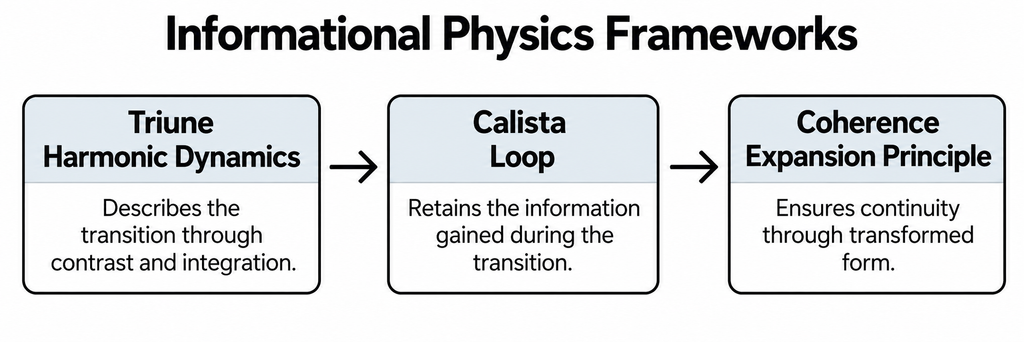
The hypothesis was conceptually derived from three earlier framework ideas: the Coherence Expansion Principle, the Calista Loop, and Triune Harmonic Dynamics. In this manuscript, however, those works are treated only as intellectual provenance. CAH-T is restated in conventional state-space and intervention language so that it can be tested independently of the parent frameworks.
Transition time is defined as a prospectively specified first-passage time into a viable or integrated region of state space, with a required dwell interval. This avoids relying on a universal scalar pressure coordinate or assuming that shorter timing automatically proves greater coherence. The paper also separates CAH-T from a stronger, unverified claim that net new coherence itself accelerates over successive cycles.
The primary computational proof-of-concept uses an eight-dimensional stochastic adaptive-identification system. Every intervention begins from the same parameter estimate and receives the same input stream, noise stream, learning rate, update budget, and held-out probe set. Relevant, scrambled, and task-irrelevant anisotropic update matrices share the same trace and eigenvalue spectrum; only their orientation relative to the next transition demand differs. Across 200 independent held-out systems, relevant retained geometry reached the frozen integration criterion in a mean 5.07 updates, compared with 14.35 for isotropic reset, 22.92 for scrambled orientation, and 24.77 for coherent but task-irrelevant orientation. Adding structural alignment to matched-start predictors increased grouped-cross-validated R² for log first-passage time from 0.011 to 0.611.
A prospective regime-switch test provides the key boundary condition. When the dominant transition direction changed, previously useful retained geometry became slower than reset before gradually relearning the new direction. This demonstrates that CAH-T does not equate memory with progress: retained organization helps only while it remains functionally aligned.
The mechanism used in the benchmark—anisotropic matrix preconditioning—is established in adaptive estimation and optimization. The manuscript does not claim a new optimizer. Its proposed contribution is a higher-level, falsifiable complex-systems regularity linking relevant retained organization to later first-passage timing. A secondary neural diagnostic is retained as a negative control because conventional transfer and proximity variables explain most of its timing effect.
The manuscript includes explicit falsification conditions. CAH-T must be narrowed or rejected if relevant retention does not shift first passage earlier than resource-matched controls, if scrambled or task-irrelevant structure performs equally well, or if a deliberate relevance switch fails to neutralize or reverse the advantage. The associated archive preserves code, frozen settings, raw replicate-level results, statistical outputs, software-environment information, and cryptographic hashes. The present evidence is limited to computational adaptive systems; physical, biological, ecological, and field validation remain open tests.